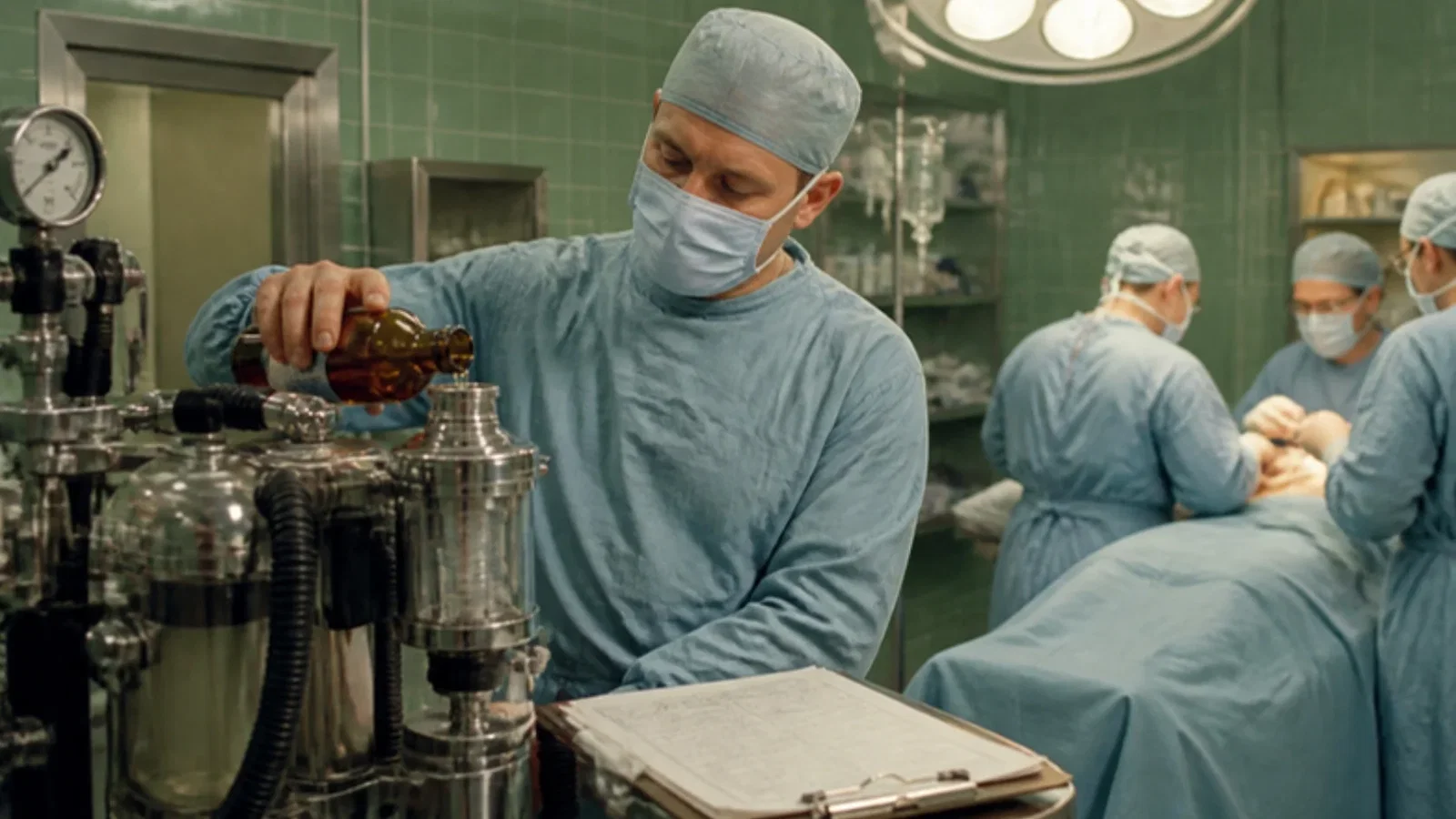
The Cleveland Clinic Quarterly of July 1960 printed 'Methoxyflurane — A New Anesthetic Agent: A Clinical Evaluation Based on 206 Cases' by Carl E. Wasmuth and six colleagues. Methoxyflurane, sold as Penthrane, had been the most satisfactory of a series of fluorinated compounds studied by Artusio and Van Poznak: non-explosive, profoundly analgesic and relaxing, with apparently low toxicity. In 206 patients the authors found induction slow and somewhat irritating, like ether; deep levels lowered blood pressure; recovery was so long that the vapour had to be stopped half an hour to an hour before the end, and early patients developed atelectasis; patients came out with a 'chalky whiteness' and some shivered. Blood sugar rose during anaesthesia; the effect on the liver could not yet be judged. As a primary agent it had 'little to commend it'; as a supplement, chiefly in long abdominal surgery, it had a definite but limited place, and 'time alone can determine its place'.
Reading Library · Anesthesia Epochs · 中文版
Watch the education video (for clinicians)
1960: Methoxyflurane — Analgesia and Arousal · Anesthesia Epochs Education Series
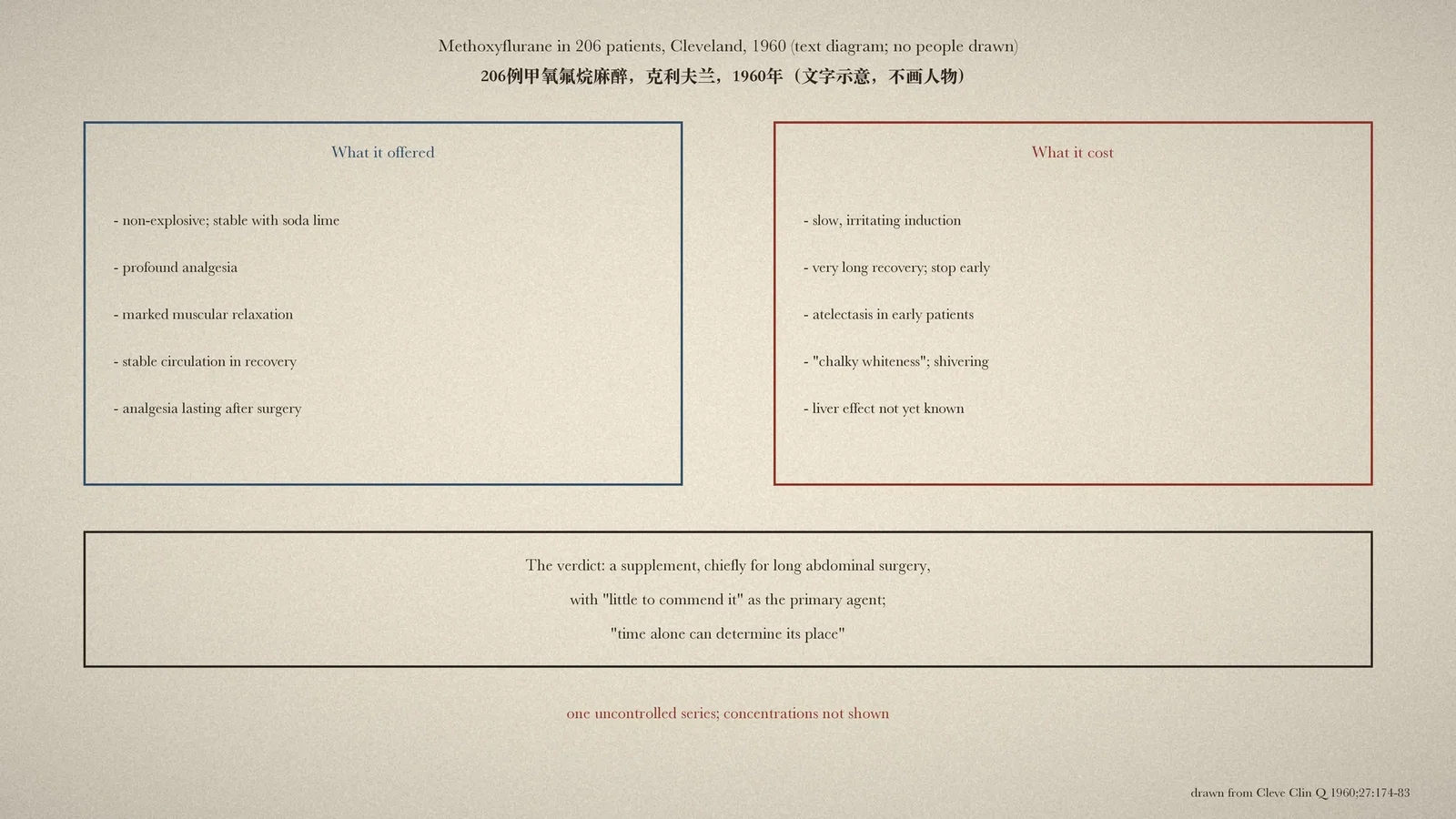
By 1960 a new inhaled anaesthetic had to meet a long list of demands: it had to be safe near electrical equipment, work with the other drugs patients now received, and compete with intravenous techniques. Methoxyflurane met the demand of being non-explosive. A clinical report from Cleveland that July shows what else it brought, and why its authors stopped short of calling it the answer. [1, p. 174][1, p. 181][1, p. 182]
A new agent
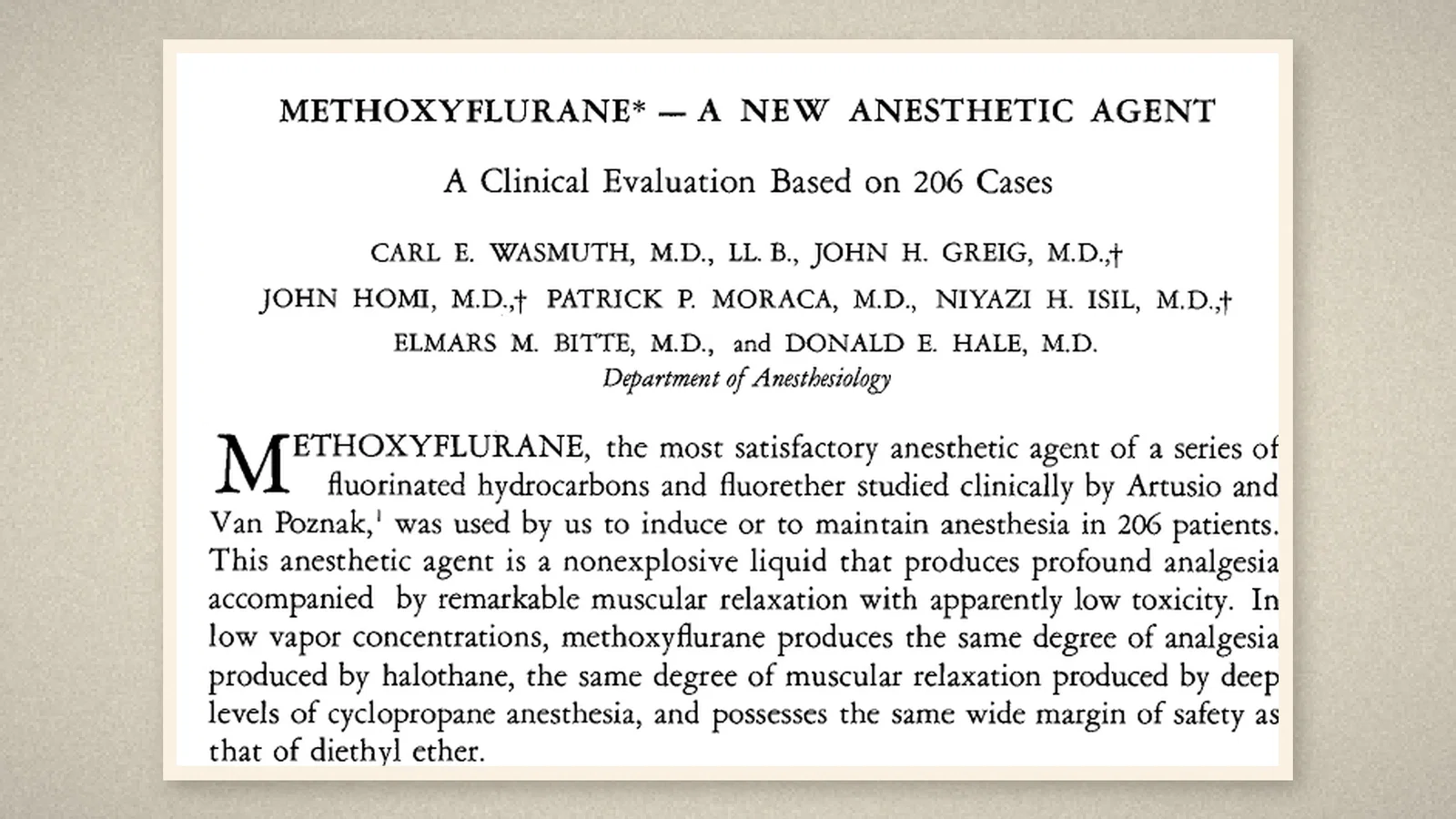
"Methoxyflurane — A New Anesthetic Agent: A Clinical Evaluation Based on 206 Cases" was written by Carl E. Wasmuth, John H. Greig, John Homi, Patrick P. Moraca, Niyazi H. Isil, Elmars M. Bitte and Donald E. Hale of the Department of Anesthesiology. Methoxyflurane had been the most satisfactory of a series of fluorinated compounds studied by Artusio and Van Poznak, and the Cleveland group "used [it] to induce or to maintain anesthesia in 206 patients". It was "a nonexplosive liquid that produces profound analgesia", with "remarkable muscular relaxation with apparently low toxicity". It was sold as Penthrane by Abbott Laboratories. [1, p. 174]
The liver question
The authors explained why they tested liver function: "Since the publication of reports of fatal hepatic damage following chloroform", every new agent had to be checked for damage to the organs. The clearest effect was a rise in blood sugar during anaesthesia, which did not persist. On the liver, too few patients had been followed for "final conclusions", although the early impression was of effects comparable to ether. [1, p. 176][1, p. 177][1, p. 178]
Slow in, slow out
In practice the drug relaxed muscles strongly. "One is immediately impressed with the great amount of muscular relaxation", often enough for the whole operation. Induction with it was another matter: the vapour "was somewhat irritating", patients coughed, and induction "was fairly long, similar to induction of diethyl ether". At deep levels blood pressure often fell, and lightening the anaesthetic brought it back. [1, p. 178][1, p. 179]
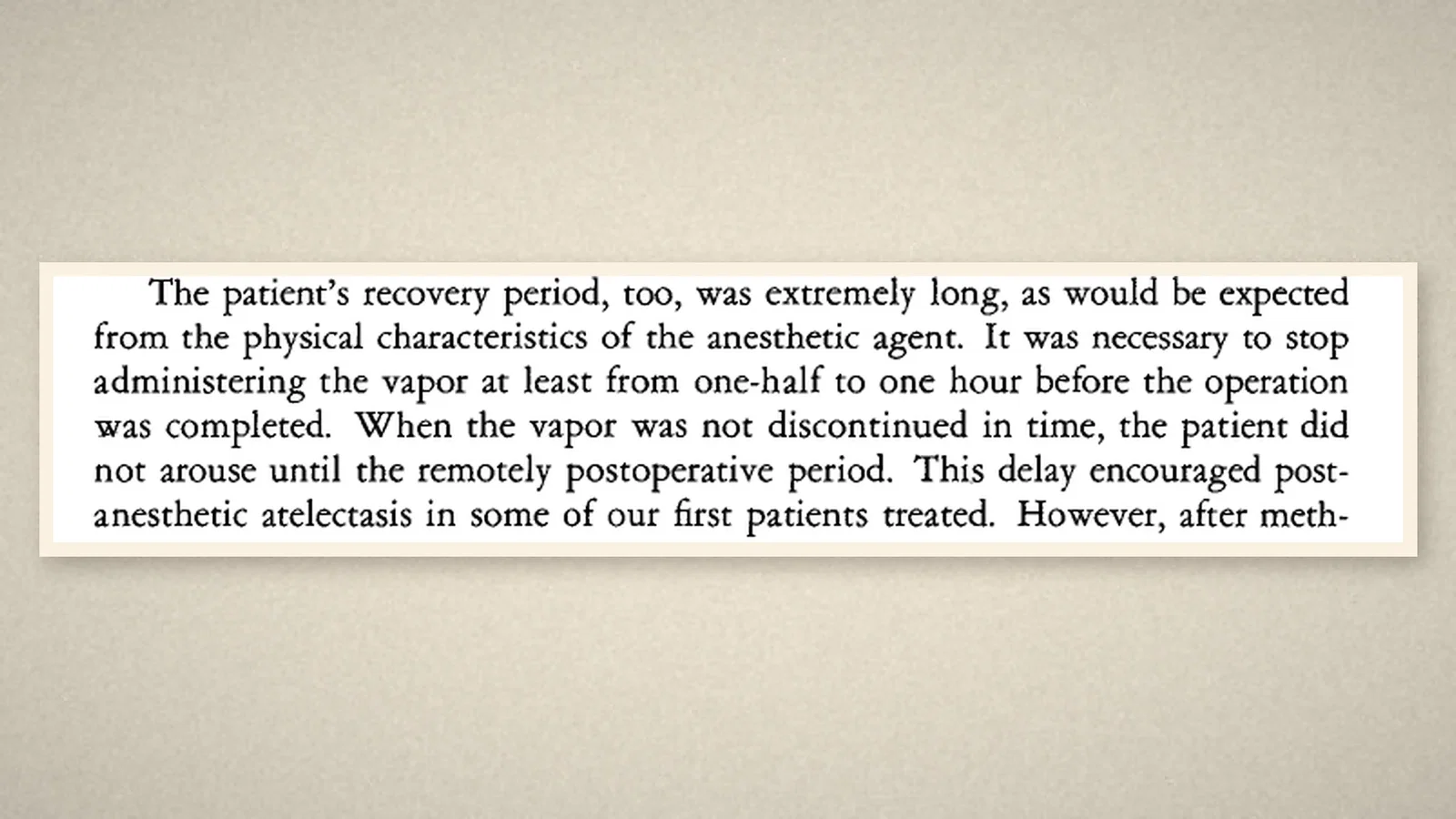
Recovery was the main problem. "The patient's recovery period, too, was extremely long." The vapour had to be stopped half an hour to an hour before the end of the operation, or the patient did not wake until well afterwards, and in the early cases that delay encouraged atelectasis in the lungs. In 35 patients watched closely, full arousal took one to two hours on average. They came back to the ward with a "chalky whiteness" of the skin, and seven had bouts of shivering. On the other hand their circulation was stable, and pain relief lasted so long that only seven needed an analgesic. [1, p. 179][1, p. 180][1, p. 181]
A limited place
The discussion placed the drug against its competition. Since balanced anaesthesia and the new intravenous drugs, few inhaled agents could compete; any new agent also had to be non-explosive, because of the "multiplicity of electric equipment" in operating rooms. Of the many compounds tried in the previous ten years, "only one, halothane, has qualified for use". [1, p. 181][1, p. 182]
Methoxyflurane, they concluded, was "suitable as a supplementary agent", mainly in long abdominal operations and with nitrous oxide, and safe where cyclopropane or trichlorethylene would be dangerous. As the main anaesthetic, "methoxyflurane has little to commend it": the long sleepiness outweighed the long analgesia. [1, p. 182]
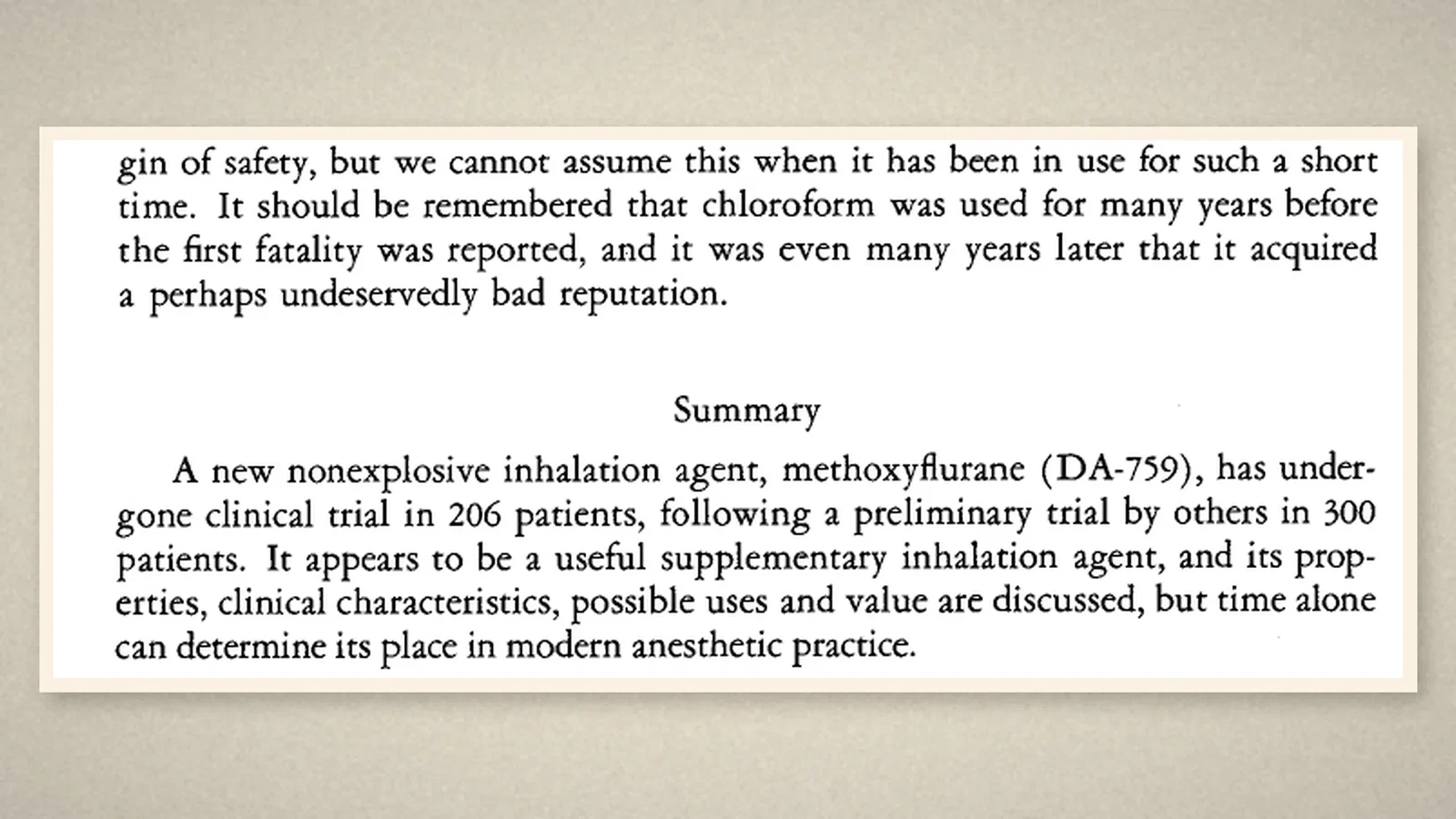
They ended with a caution. The drug probably had a wide margin of safety, but that could not be assumed so soon: chloroform "was used for many years before the first fatality was reported". The summary repeated it: "time alone can determine its place in modern anesthetic practice". [1, p. 183]
What the record shows
An honest early report. The authors listed what the drug offered and what it cost, gave it a narrow role, and declined to call it safe before time had tested it. Their caution about the liver, and their reminder of chloroform, show that they knew a drug's harms might appear only later. What those harms turned out to be is not in these pages.
Sources and reading limits
Read: Carl E. Wasmuth and colleagues, "Methoxyflurane — A New Anesthetic Agent: A Clinical Evaluation Based on 206 Cases", Cleveland Clinic Quarterly July 1960;27:174-183, in full (publisher's open PDF from the journal’s website; text extracted and page images checked; tables of physical data skimmed).
Not covered: the clinical papers of Artusio and Van Poznak, cited here only as a personal communication; the manufacturer's pharmacology; later reports on methoxyflurane's toxicity and on its use as an analgesic.
Limits: this article reads one uncontrolled clinical series, and its judgements are the authors'. The paper gives the experimental code as DA-739 in a footnote and DA-759 in the text; the text's form is used. Concentrations, vapour data, doses and laboratory values are not repeated, and the page crops leave them out. Patients are not identified, and the paper's case details are not repeated. The first names of Artusio and Van Poznak were not printed. The remark about chloroform's first fatality is the authors'.
Three illustrations are crops of the Cleveland Clinic Quarterly of July 1960 (pp. 174, 179 and 183); one is a text diagram drawn from the paper, with no people drawn and no concentrations shown.
- Wasmuth CE, Greig JH, Homi J, Moraca PP, Isil NH, Bitte EM, Hale DE. Methoxyflurane—a new anesthetic agent: a clinical evaluation based on 206 cases. Cleve Clin Q. 1960;27:174-83. Cleveland Clinic Journal of Medicine
Continue exploring
Related reading connects shared questions and contexts; it does not by itself establish historical influence.
- 1951: Suckling Designs Halothane at ICI
- 1930: Leake and Chen Reason Their Way to Divinyl Ether
- 1923: Luckhardt and Carter Breathe Ethylene and Oxygen Themselves
Anesthesia Epochs · The Source Room · About & Editorial Method
Published November 3, 2026. Sources and reading limits are stated above. Illustrations are labelled as original source images or AI-made. Historical accounts are educational; they are not current treatment instructions.