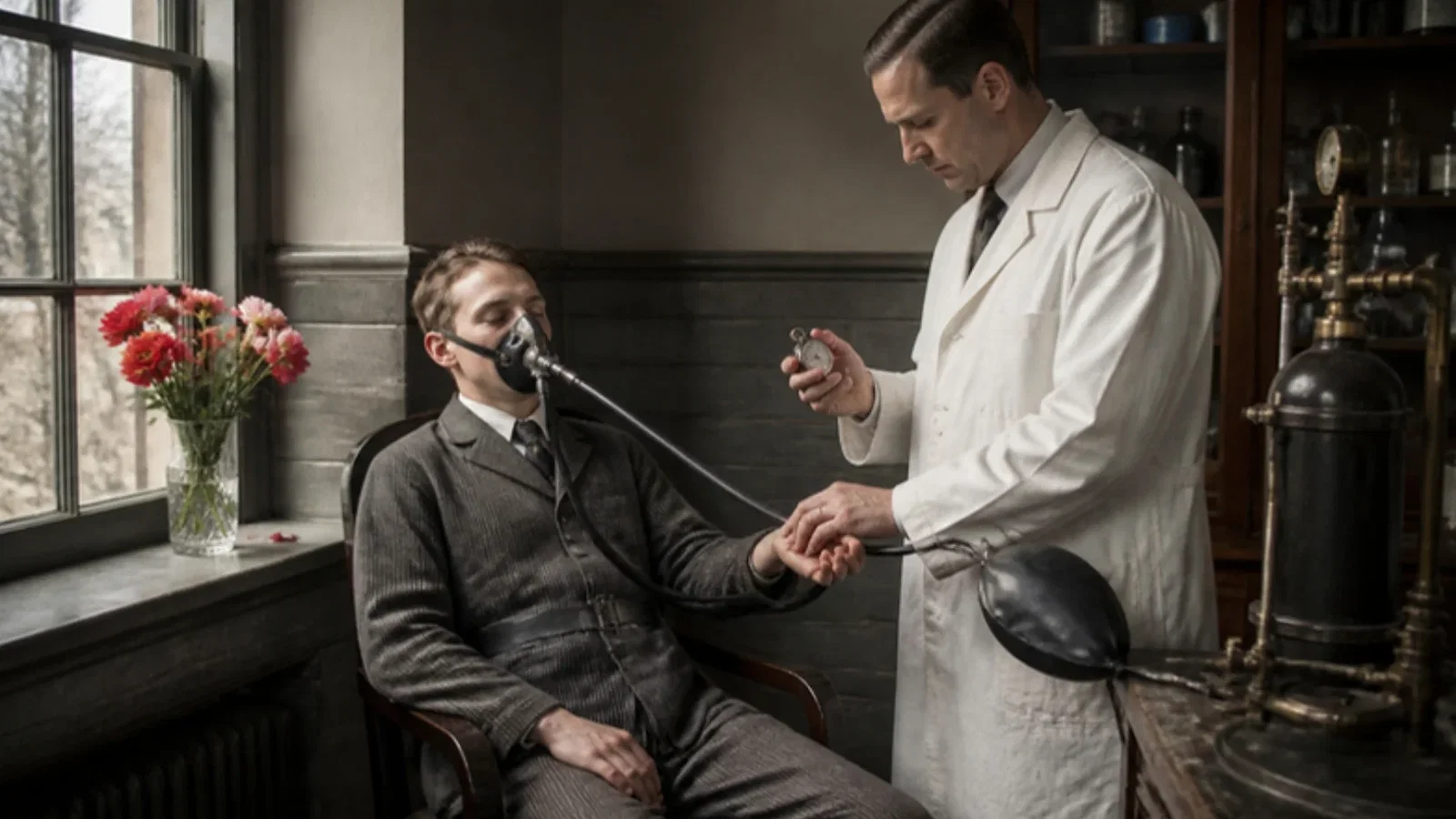
On 17 March 1923 JAMA printed 'The Physiologic Effects of Ethylene: A New Gas Anesthetic' by A. B. Luckhardt and J. B. Carter of the Hull Physiological Laboratory, University of Chicago. The lead came from carnations that 'went to sleep' in Chicago greenhouses in 1908, traced to the ethylene in illuminating gas. The authors compared ethylene with nitrogen, hydrogen and nitrous oxide in frogs, mice, rats, guinea-pigs, rabbits, kittens and dogs, then from 21 January 1923 breathed ethylene with oxygen themselves and anaesthetised colleagues, twelve people in all. On 19 May a second report described 106 operations at the Presbyterian Hospital, Chicago, from 14 March to 26 April, given mostly by Isabella Herb and Mary Lyons; it admitted two failures and warned that ethylene is inflammable and must not be used near a spark, cautery or flame.
Reading Library · Anesthesia Epochs · 中文版
Watch the education video (for clinicians)
1923: Ethylene — Efficacy and Fire Risk · Anesthesia Epochs Education Series
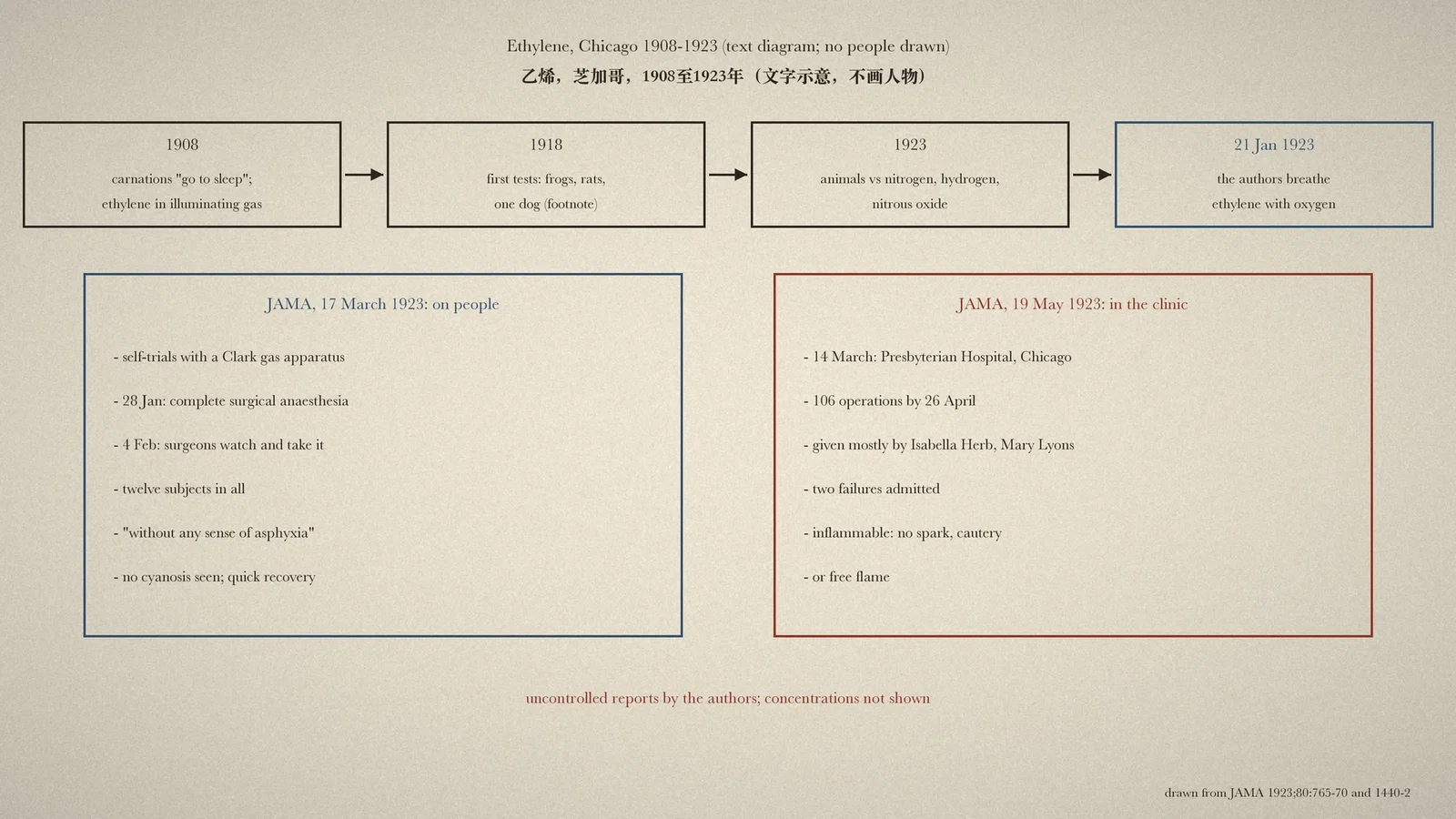
Some anaesthetics came out of chemistry, others out of the clinic. Ethylene came out of a greenhouse. Two papers in JAMA in the spring of 1923 trace its whole route in a few months, from flowers that would not open, to two physiologists breathing the gas themselves, to more than a hundred operations in a Chicago hospital, and they end with a warning that the gas can explode. [1, p. 765][1, p. 768][2, p. 1440][2, p. 1442]
Flowers that "go to sleep"
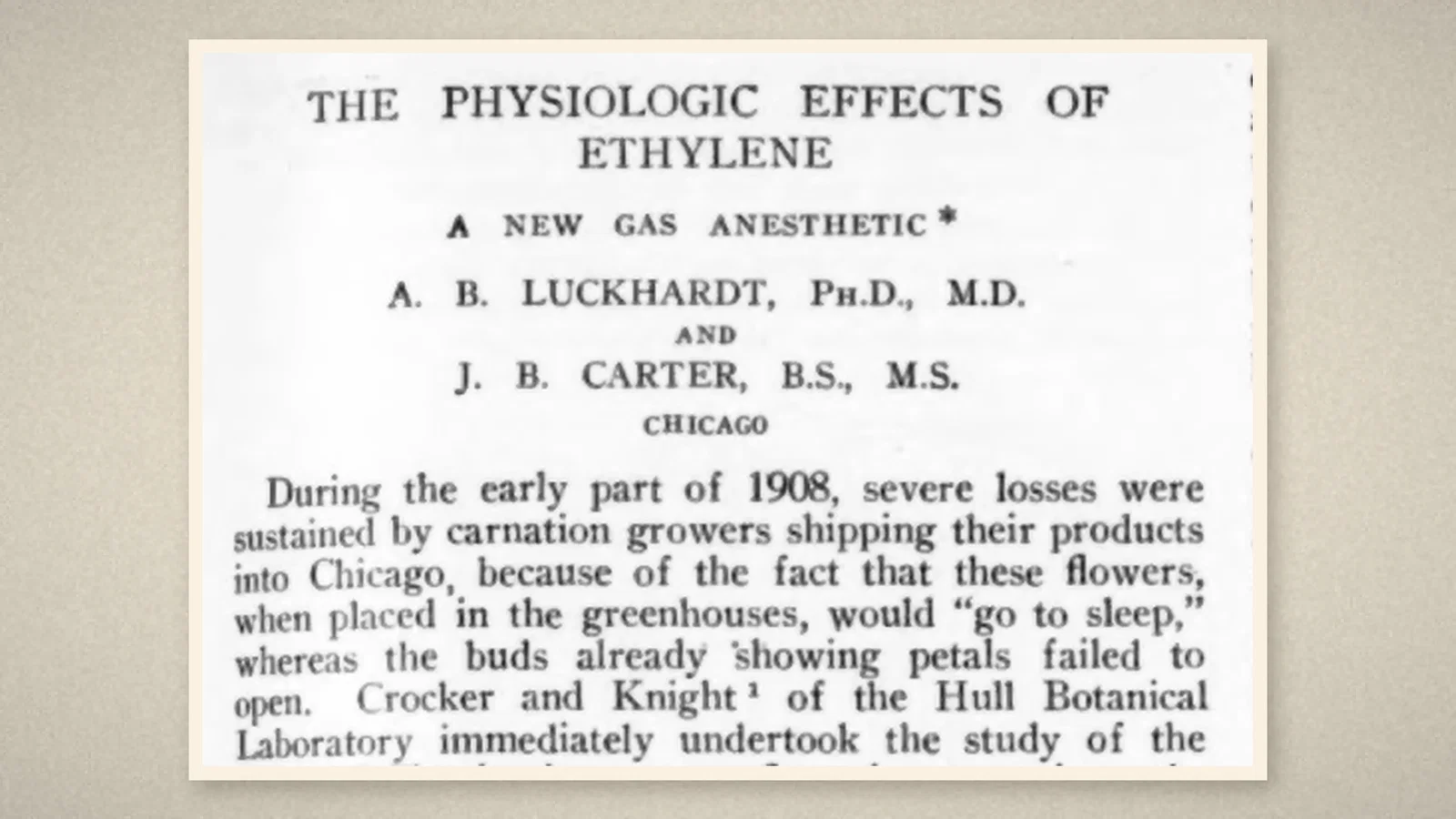
"The Physiologic Effects of Ethylene: A New Gas Anesthetic", by A. B. Luckhardt and J. B. Carter of the Hull Physiological Laboratory, University of Chicago, opens with a trade problem. Early in 1908 carnation growers shipping into Chicago lost heavily because the flowers would "go to sleep" in the greenhouses and the buds failed to open. Crocker and Knight of the Hull Botanical Laboratory found that ethylene, a small part of illuminating gas, was the constituent that made the gas toxic to plants. [1, p. 765]
That raised a second question: was ethylene toxic to animals as well? A footnote records that Luckhardt and R. C. Thompson had tried it in the spring of 1918 on frogs, white rats and one dog, and found the gas relatively non-toxic, with what seemed to be anaesthetic and analgesic properties. [1, p. 765]
Animals, then the authors
For the 1923 paper the authors made and purified their own ethylene and tested it on frogs, mice, rats, guinea-pigs, rabbits, kittens and dogs. Nitrogen and hydrogen were run alongside to separate plain asphyxia from a drug effect, and nitrous oxide, "this well known depressant and anesthetic", was the comparison. In dogs, with oxygen added, ethylene gave surgical anaesthesia with full muscular relaxation and quick recovery. [1, p. 765][1, p. 768]
Then they turned to people. "After what seemed a fruitless search", they bought the gas in tanks from a commercial chemical company and used a Clark gas apparatus on themselves. On 21 January 1923 Carter, reclining, held the mask with one hand and raised the other arm, breathing ethylene well mixed with oxygen until the raised arm wavered. Luckhardt went next. The arm dropped in less than a minute; there were "no asphyxial sensations", only a sense of contentment, and the pain of an active sinus infection went away for the time. [1, p. 768]
Colleagues volunteered next. A blunt safety pin pushed through the skin of the forearm went unnoticed. On 28 January both authors reached complete surgical anaesthesia, and on 4 February two surgeons, Eugene Cary and Dallas B. Phemister, came to watch and were anaesthetised in turn. Twelve people were anaesthetised in all, the authors several times, with nothing worse than brief nausea, some excitement on waking and unsteadiness on standing up too soon. [1, p. 769]
The summary
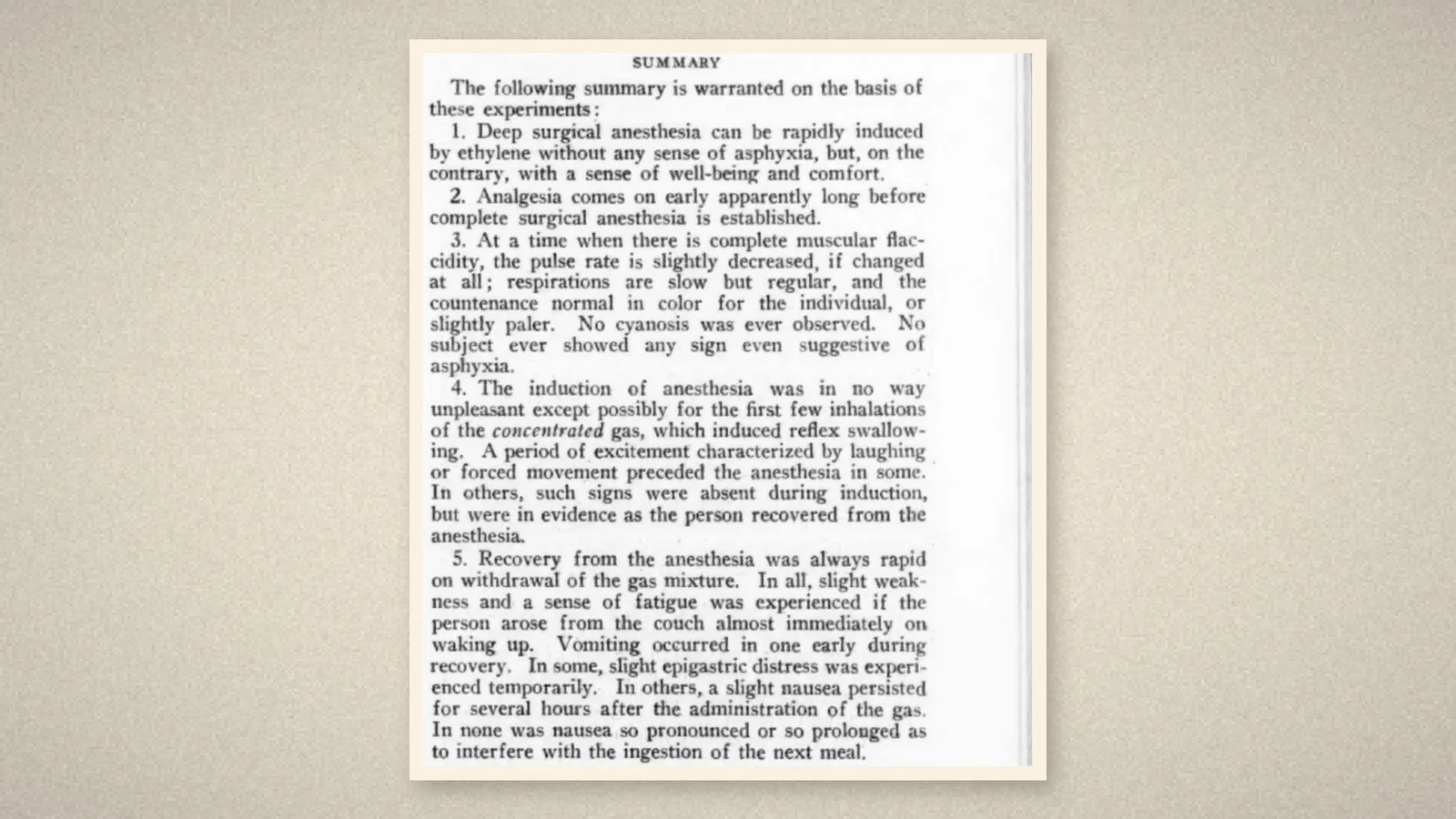
The summary claimed that deep surgical anaesthesia could be induced rapidly "without any sense of asphyxia", that analgesia came early, that no cyanosis was ever seen, and that recovery was rapid. The possible advantages over nitrous oxide were listed: no asphyxia, no effect on blood pressure, full relaxation, and possible use in obstetrics. The authors themselves called these advantages possible. [1, p. 769]
Into the hospital
Two months later, on 19 May 1923, JAMA printed "Ethylene as a Gas Anesthetic: Preliminary Communication", read before the Chicago Institute of Medicine on 27 April. The authors had "gone as far as it was possible to go in a physiologic laboratory". After a demonstration on themselves before surgeons, physicians and professional anaesthetists, with Carl Dragstedt giving the gas, surgical use began at the Presbyterian Hospital, Chicago, on 14 March 1923. By 26 April there had been 106 operations on the head, chest, abdomen, perineum and limbs, and ethylene had also been used in four normal deliveries. [2, p. 1440][2, p. 1441]
The gas was given almost entirely by two anaesthetists, Isabella Herb and Mary Lyons, whose notes speak of better relaxation and a quieter induction than with nitrous oxide. Nineteen surgeons took part. The authors called the report "quite superficial and incomplete", and they admitted two failures. [2, p. 1440][2, p. 1441][2, p. 1442]
The warning
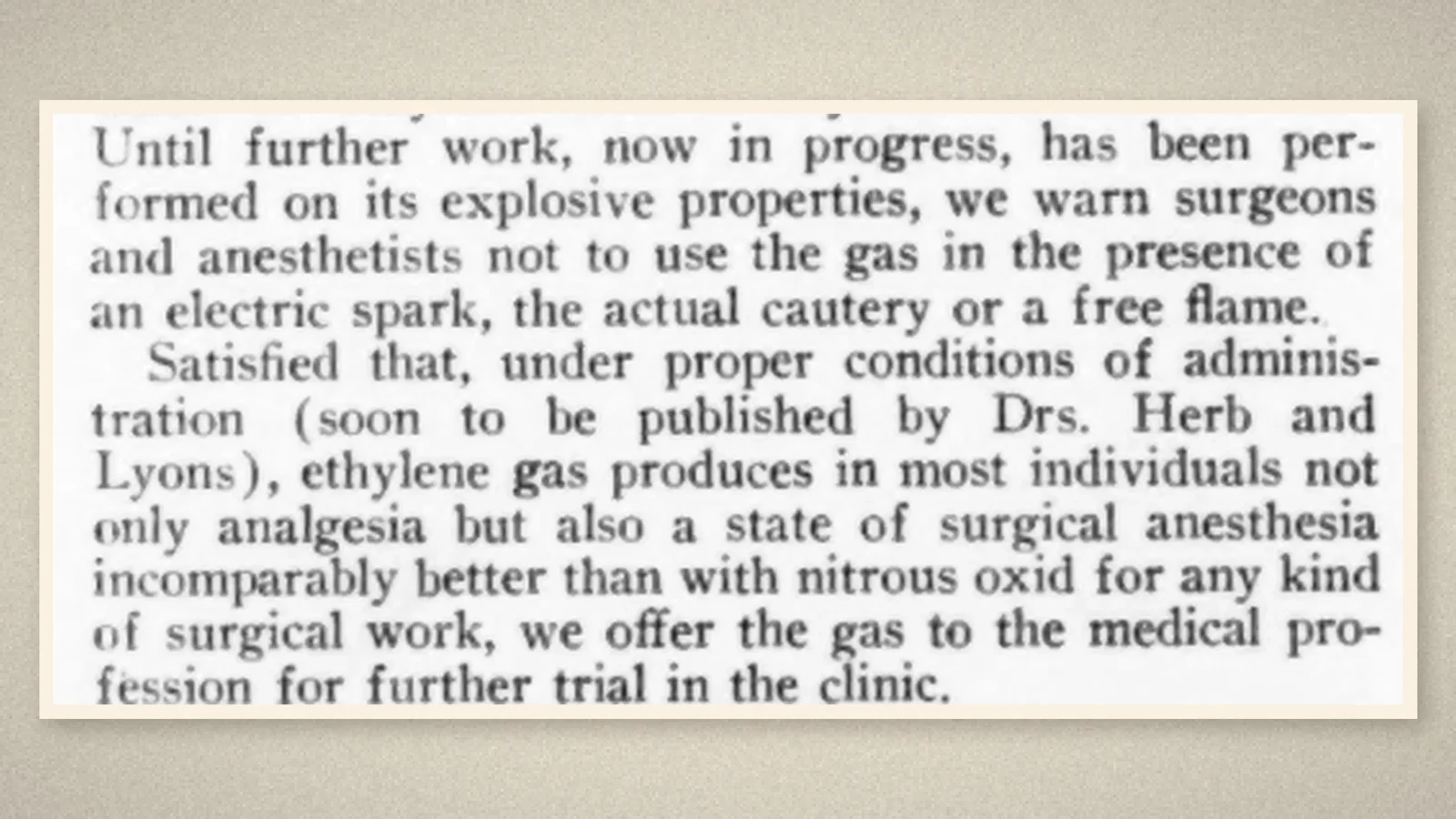
The paper ends with a warning. Ethylene is inflammable and forms an explosive mixture with air or oxygen. Until more work on this had been done, surgeons and anaesthetists were not to use it "in the presence of an electric spark, the actual cautery or a free flame". On that condition the authors offered the gas to the profession for further trial. [2, p. 1442]
What the record shows
A gas that was found by botanists, tested by physiologists on themselves and taken into a hospital within weeks. The same paper that made the clinical case also printed the fire risk. The two papers set out both sides at once: smoother anaesthesia than nitrous oxide gave, and a gas that could burn in the operating room.
Sources and reading limits
Read: A. B. Luckhardt and J. B. Carter, "The Physiologic Effects of Ethylene: A New Gas Anesthetic", JAMA 17 March 1923, pp. 765-770, read in full (the apparatus and animal protocols skimmed); Arno B. Luckhardt and J. B. Carter, "Ethylene as a Gas Anesthetic: Preliminary Communication", JAMA 19 May 1923, pp. 1440-1442, read in full.
Not covered: Crocker and Knight's botanical paper; the paper on administration by Herb and Lyons announced in the May report; later reports of ethylene fires and explosions; other claims about who used ethylene in people, which are mentioned in the timelines; acetylene, divinyl ether, trichloroethylene and other superseded agents.
Limits: the wider subject covers several superseded agents; this article covers only ethylene in these two papers. The self-experiments and the hospital series are uncontrolled and reported by the authors. Concentrations, gas volumes and the explosive ratio are not repeated, and the page crops stop before them. Patients are not identified. Carter's first name is not printed in the papers and is not given.
Three illustrations are crops of JAMA, 17 March 1923 (pp. 765 and 769) and 19 May 1923 (p. 1442); one is a text diagram drawn from both papers, with no people drawn and no concentrations shown.
- Luckhardt AB, Carter JB. The physiologic effects of ethylene: a new gas anesthetic. JAMA. 1923;80(11):765-70. Internet Archive
- Luckhardt AB, Carter JB. Ethylene as a gas anesthetic: preliminary communication. JAMA. 1923;80(20):1440-2. Internet Archive
Continue exploring
Related reading connects shared questions and contexts; it does not by itself establish historical influence.
- 1923: Ethylene-Oxygen Reaches Surgery in Chicago, Given by Herb and Lyons
- 1912: Cotton and Boothby's Nitrous Oxide-Oxygen-Ether Machine
- 1881–1882: Cyclopropane Enters the Record in Freund's Reports
- 1937: McKesson Announces the Model L Nargraf Gas Machine
Anesthesia Epochs · The Source Room · About & Editorial Method
Published November 3, 2026. Sources and reading limits are stated above. Illustrations are labelled as original source images or AI-made. Historical accounts are educational; they are not current treatment instructions.