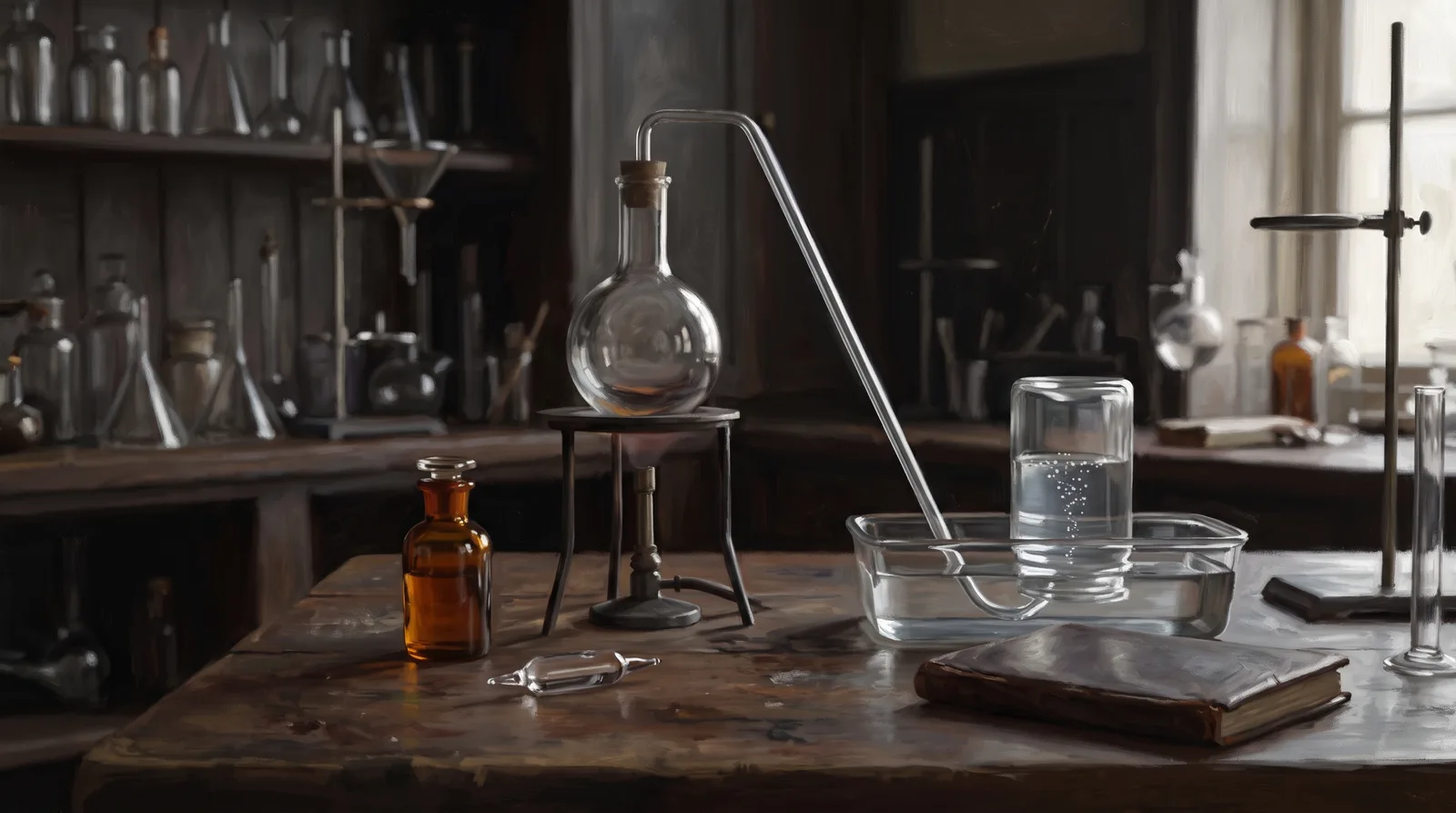
In 1881–1882 August Freund reported a gas that behaved differently from ordinary propylene and argued from chemical comparisons that it had a three-carbon ring; the gas, later called cyclopropane, had not yet been used in anesthesia.
Reading Library · Anesthesia Epochs · 中文版
Watch the education video (for clinicians)
1881–1882: Freund's Trimethylene — Composition Is Not Identity · Anesthesia Epochs Education Series
A one-page preliminary communication titled Über Trimethylen reported a gas that August Freund distinguished from ordinary propylene. Sodium acting on a substance then called Trimethylenbromür produced it. Bromine absorbed the gas less readily, while hydrogen iodide converted it into normal propyl iodide. The final line located the work in the general chemistry laboratory of the technical college in Lemberg. [1, p. 677]
Later anesthesia history identifies the gas as cyclopropane. Yet this communication contains neither a patient nor an anesthetic experiment. Freund’s immediate problem was chemical: what could establish that a gas resembling a familiar substance was something different? [1; 3]
More than one kind of date
The history is often compressed into synthesis in 1882. That is where the History of Anaesthesia Society timeline places Freund. The Wood Library-Museum's page description also uses 1882, although the historical note in a catalog record on the same page uses 1881. [3–4]
The original record provides a more precise distinction. Page 595 of the Vienna Academy’s volume 84, second division, dates a meeting to 21 July 1881. The next page says that Ad. Lieben presented a paper sent by Freund on Trimethylenalcohol and also communicated a notice about Trimethylen from Freund’s letter. It adds that Freund wished to preserve priority for that notice. [1, pp. 595–596]
This dates a meeting, not a synthesis experiment. It establishes that the news had reached that meeting; it does not make 21 July the day the gas was prepared. A wish to establish priority is also distinct from a historical judgment that all competing work has been examined.
The bound volume’s title page calls it Jahrgang 1881 but carries an 1882 imprint. Both belong in the record. Neither should silently replace the other. [1, title page]

Modern editorial cards distinguish the 1881 meeting notice from the 1882 detailed report. They do not represent two verified synthesis dates or reproduce journal covers.
Producing a gas did not settle its identity
The detailed report appeared in the 1882 Journal für praktische Chemie, new series volume 26, pages 367–377. Its opening footnote says the author supplied it from the July issue of the Vienna Academy’s proceedings, second division. This preserves the author’s account; it is not an independent laboratory’s replication. [2, p. 367]
Freund began with the importance of isomerism for understanding organic compounds. Freund described Reboul’s unsuccessful attempt at the sodium reaction, then explained the opportunity to revisit it: processing glycerin fermentation material had provided Trimethylenalcohol from which the starting material could be obtained. [2, pp. 367–368] These earlier investigations remain attributed to Freund’s account here; their originals are not covered here.
The resulting gas burned and had an odor resembling known hydrocarbons. Neither observation established its identity. [2, p. 369] Comparisons of chemical behavior had to do more work than the name.
One slow reaction did not predict another
Ordinary propylene was readily absorbed by bromine in the control comparison. The new gas reacted much less readily. Repeated contact nevertheless yielded enough brominated product for analysis. The report supports a difference in reactivity, not an assertion that the gas never reacted with bromine. [2, pp. 369–371]
Would slow reaction with bromine predict difficulty with hydrogen iodide? Freund reported the opposite: absorption by hydriodic acid was no more difficult than for ordinary propylene. Freund then used boiling behavior, analysis and a further reaction to support identification of the product as normal propyl iodide. [2, pp. 371–373]
These comparisons gave substance to the possibility of the same composition belonging to different compounds. On page 373, the two hydrocarbons share the empirical formula C₃H₆. The question then becomes how their atoms are connected. [2, p. 373]

Three dark dots and three connecting lines form a triangle: a modern, simplified cue to the three-carbon skeleton. Hydrogen atoms are omitted. This is neither a molecular photograph nor a reproduction of Freund’s diagram or an account of electronic structure.
The triangle came at the end of an argument
Page 374 sets out alternative structures. Freund then compared the gases produced by treating two kinds of propyl iodide with alkali. This supported the familiar structural expression for ordinary propylene and narrowed the possibilities considered for the new gas. [2, pp. 374–376]
On page 377, the three-membered ring became the conclusion of that argument. But the discussion also explicitly acknowledged that one proposed step involving the new gas and chlorine had not been established by direct experiment. [2, p. 377] Keeping that qualification lets us distinguish measurements, chemical comparisons and an inference still awaiting a particular test. The paper was not a modern spectroscopic identification, nor did every intermediate step have the same evidential standing.
Freund closed by thanking Joseph Frühling for processing glycerin fermentation residues to obtain material and for other assistance with the investigation. [2, p. 377] That acknowledgment preserves work involved in preparing the materials. It does not supply dialogue or an eyewitness account of a moment of discovery.

An imagined still life of an envelope, book pages and a glass bottle, suggesting the movement from correspondence to meeting notice and detailed paper. None is an authenticated letter, volume or object belonging to Freund.
The chemical report had not yet reached the patient
Cyclopropane’s later use in anesthesia is a separate historical question. The Wood Library-Museum lists the 1929 Lucas and Henderson paper and clinical reports from 1934. Their originals remain leads for subsequent reading, not covered here. Later use cannot be projected backward as the purpose of the 1881 work. [3]
This article is therefore placed under 1881–1882: the meeting notice and preliminary communication lead into the detailed 1882 report. The range identifies that documentary sequence, not an exact synthesis date or the start of clinical use.
What can be followed here is the movement from producing a gas to distinguishing it. Controls, products, alternative structures and the author’s own qualifications turned a name into claims that could be tested.
Sources and reading limits
Read: in the Vienna Academy’s Sitzungsberichte, volume 84, second division (Jahrgang 1881, imprint 1882), the title page, the meeting record on pp. 595–596 and Freund’s preliminary communication on p. 677; Freund’s detailed report in the Journal für praktische Chemie, new series, volume 26 (1882), pp. 367–377; the Wood Library-Museum’s cyclopropane page and its catalogue notes; the History of Anaesthesia Society timeline entry under 1882.
Not covered: the two Monatshefte versions and the full 1882 Academy version; Freund’s original letter and laboratory notebooks; the originals by Reboul and Fitz; later anaesthetic experiments and clinical cases. The timeline writes August von Freund; this article follows the originals’ August Freund. Priority, clinical efficacy and safety are not judged, and no preparation recipe is given. The three illustrations are AI-made interpretive images, not historical evidence.
- Freund A. Über Trimethylen. Vorläufige Mittheilung. Sitzungsber Akad Wiss Wien Math-Naturwiss Cl. 1881;84(2):677. Internet Archive
- Freund A. Ueber Trimethylen. J Prakt Chem. 1882;26:367–77. Internet Archive
- Wood Library-Museum of Anesthesiology. Cyclopropane. Web page
- History of Anaesthesia Society. Timeline. Web page
Continue exploring
Related reading connects shared questions and contexts; it does not by itself establish historical influence.
- 1923: Luckhardt and Carter Breathe Ethylene and Oxygen Themselves
- 1937: Leech's Pharyngeal Bulb Gasway for Closed-Circuit Cyclopropane
Anesthesia Epochs · The Source Room · About & Editorial Method
Updated October 30, 2026. Sources and reading limits are stated above. Illustrations are labelled as original source images or AI-made. Historical accounts are educational; they are not current treatment instructions.