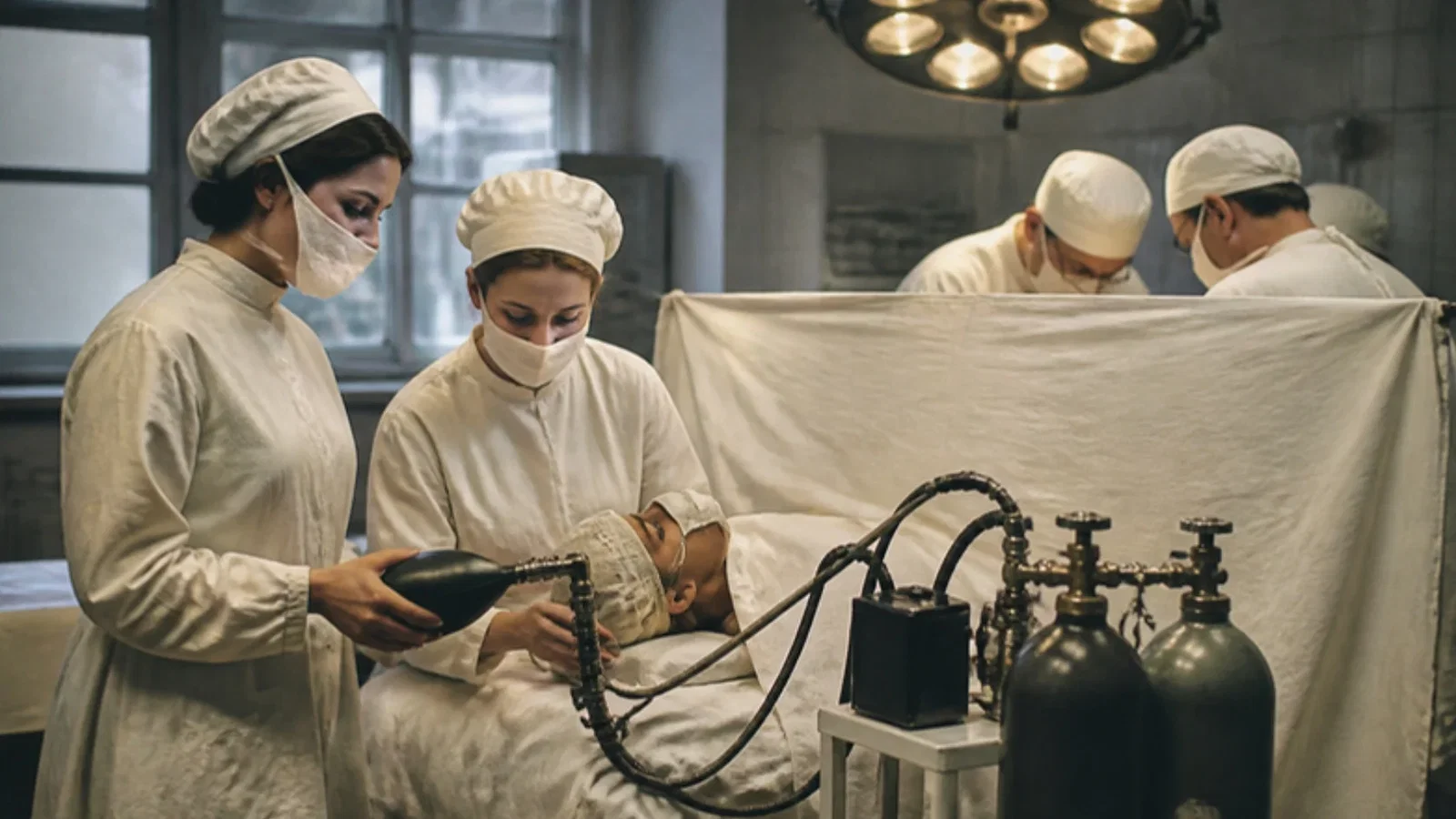
On 19 May 1923 the Journal of the American Medical Association printed 'Ethylene as a gas anesthetic: preliminary communication' by Arno B. Luckhardt and J. B. Carter of the Hull Physiological Laboratory, University of Chicago, read before the Chicago Institute of Medicine on 27 April. Having studied ethylene in animals and healthy men, the authors had it given to themselves by Carl Dragstedt before a group of surgeons, physicians and professional anesthetists on 14 March 1923; within days it was in surgical use at the Presbyterian Hospital, Chicago, and by 26 April 106 operations had been done. The gas was given almost entirely by Isabella Herb and Mary Lyons, whose notes the paper quotes: better relaxation and quieter induction than with nitrous oxide. Nineteen surgeons judged it satisfactory; the authors admitted two failures and offered the gas to the profession. On 1 December Luckhardt and Dean Lewis reported some 800 operations, acknowledged earlier literature they had overlooked, and concluded that there was no evidence anyone had used ethylene gas itself in operative work before.
Reading Library · Anesthesia Epochs · 中文版
Watch the education video (for clinicians)
1923: Ethylene-Oxygen — Read the Administration Record · Anesthesia Epochs Education Series
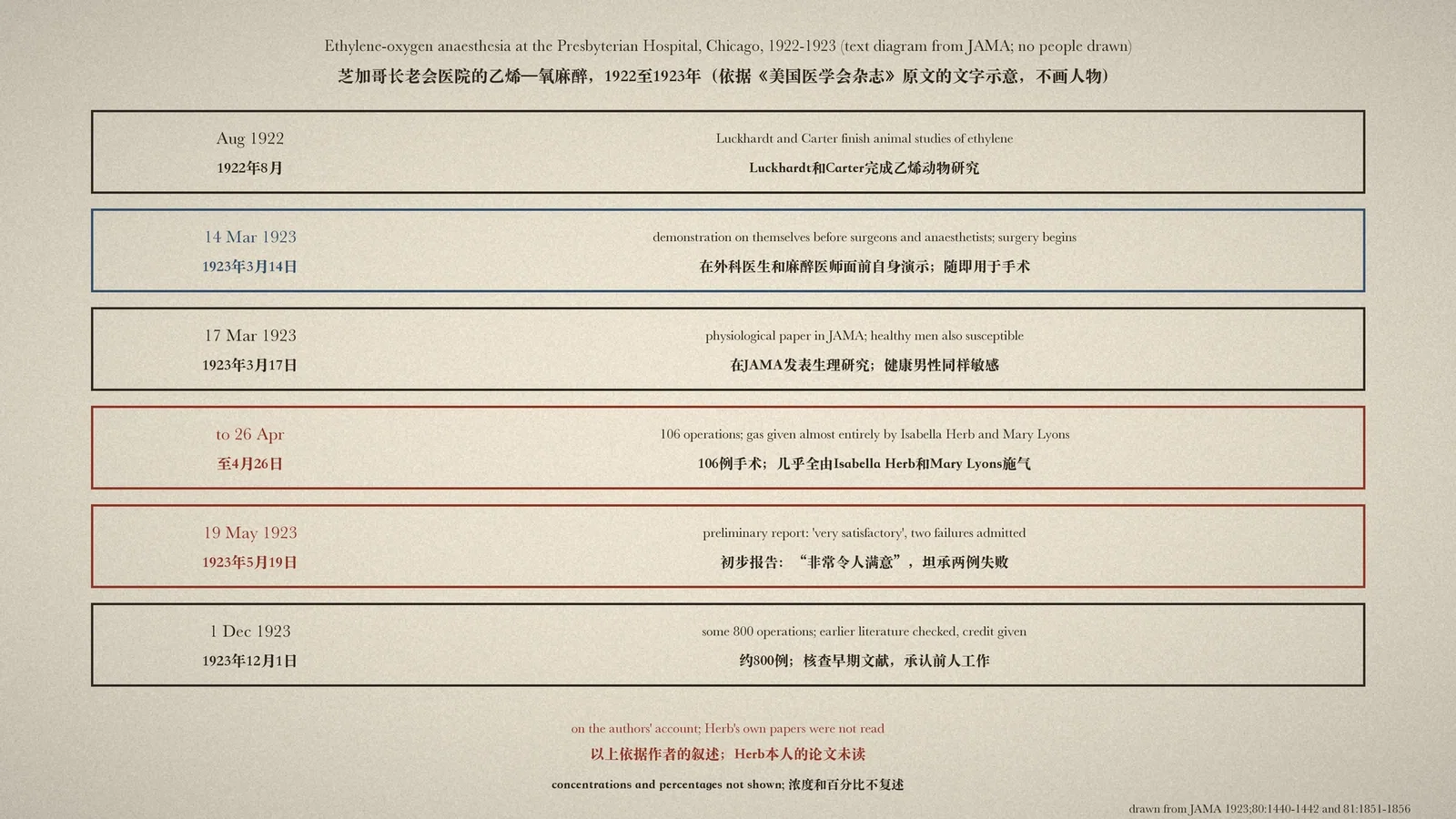
In the spring of 1923 a Chicago physiologist and a graduate student breathed a new anaesthetic gas themselves, and within days it was in the operating theatre. The gas was ethylene. On 19 May the Journal of the American Medical Association printed their preliminary clinical report: in six weeks the Presbyterian Hospital in Chicago had performed 106 operations under ethylene-oxygen, and the gas had been given to the patients almost entirely by two women anaesthetists, Isabella Herb and Mary Lyons. [1, p. 1440][1, p. 1441]
From the laboratory to the theatre
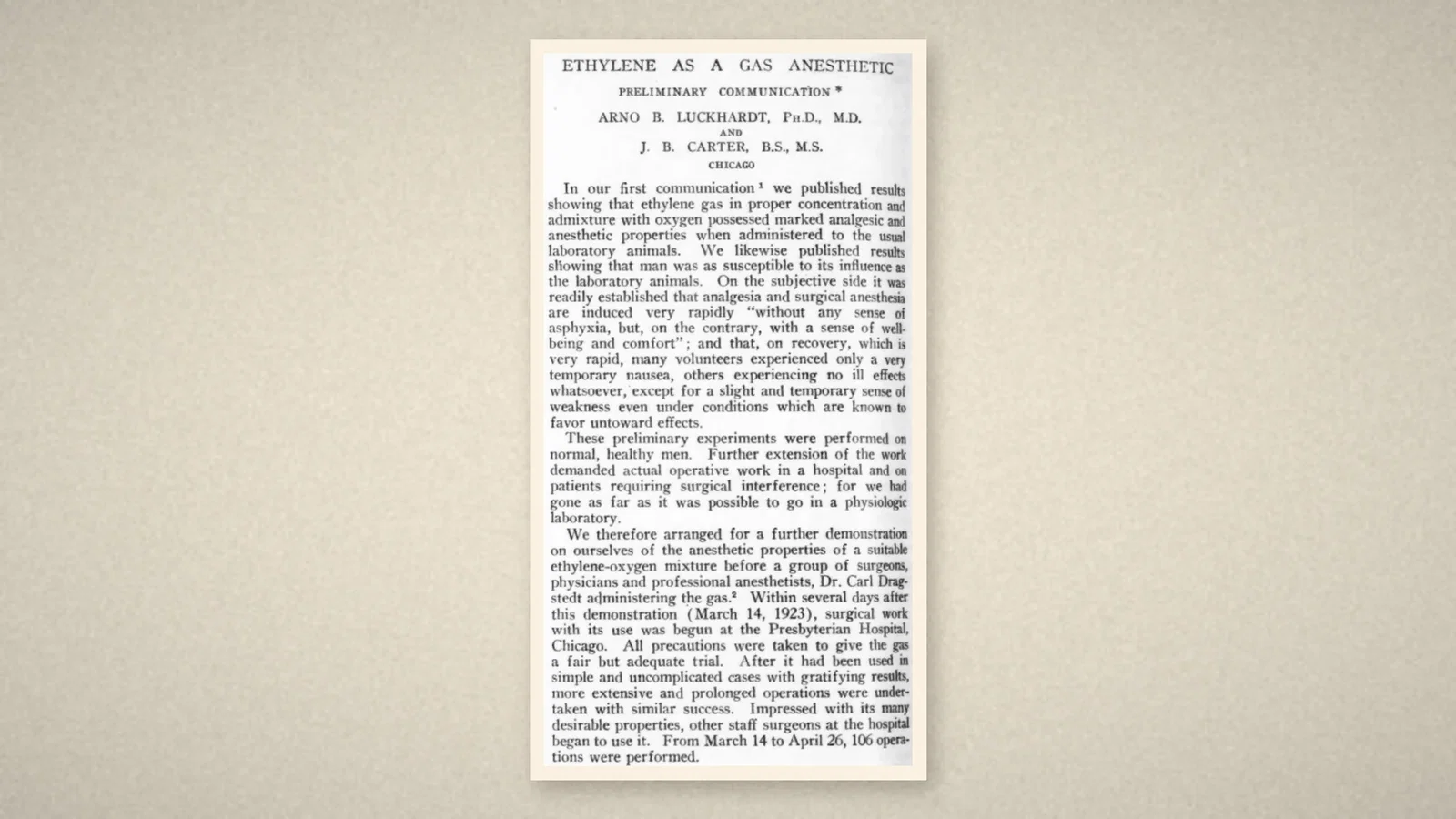
The authors were Arno B. Luckhardt and J. B. Carter of the Hull Physiological Laboratory, University of Chicago, and the report was read before the Chicago Institute of Medicine on 27 April. Their first communication, they recalled, had shown that ethylene mixed with oxygen had marked analgesic and anaesthetic properties in laboratory animals and that man was as susceptible; analgesia and surgical anaesthesia came on very rapidly, "without any sense of asphyxia, but, on the contrary, with a sense of well-being and comfort", and recovery was very rapid. [1, p. 1440]
Those experiments had been on normal, healthy men; to go further they needed patients in hospital. So they arranged another demonstration on themselves of a suitable ethylene-oxygen mixture before a group of surgeons, physicians and professional anaesthetists, with Carl Dragstedt giving the gas; the footnote listing those present includes Isabella Herb and Mary Lyons. The demonstration took place on 14 March 1923, and within several days surgical work with ethylene began at the Presbyterian Hospital, first in simple cases and then in longer operations, with other staff surgeons taking it up. From 14 March to 26 April, 106 operations were performed. [1, p. 1440]
First impressions of 106 operations
The authors called their clinical report "quite superficial and incomplete". Of the 106 patients, 42 were men and 64 women; operations ranged over the head, thorax, abdomen, perineum and limbs, with four normal deliveries. Patients woke quickly when the gas was stopped; a few were nauseated or vomited, briefly and never seriously. The nineteen surgeons involved judged the gas "good" or "very satisfactory", found decidedly better relaxation than with nitrous oxide in some operations, and saw no respiratory infections caused or made worse. [1, p. 1440][1, p. 1441]
The notes of Herb and Lyons
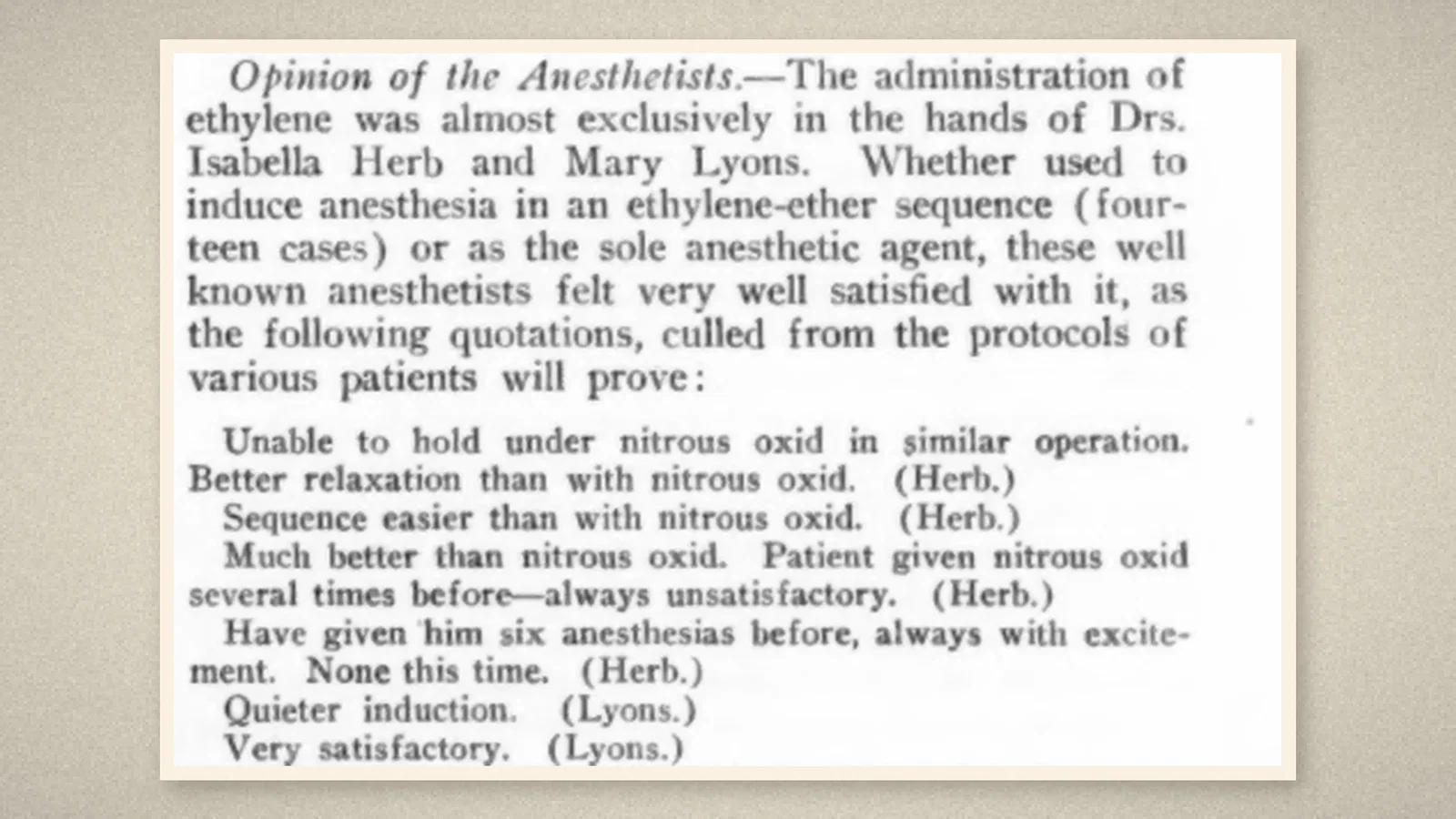
A section headed "Opinion of the Anesthetists" stated that the administration of ethylene "was almost exclusively in the hands of Drs. Isabella Herb and Mary Lyons", and that whether ethylene was used to induce anaesthesia before ether or alone, these well-known anaesthetists were very well satisfied. The authors quoted their protocol notes: "Unable to hold under nitrous oxid in similar operation", "Better relaxation than with nitrous oxid", "Quieter induction"; one patient who had always been excited under six earlier anaesthetics was not excited this time. Many volunteers and patients said that ethylene was the best anaesthetic they had ever had. [1, p. 1441]
The authors also frankly admitted two failures, and suggested that such refractory patients be studied carefully in the hope of learning something about the mechanism of anaesthesia. Their conclusion: in 106 patients with and without cardiovascular, renal and other complications, ethylene-oxygen anaesthesia was "very satisfactory"; enough oxygen could be given to avoid asphyxia, the cyanosis common with nitrous oxide was conspicuously absent, analgesia came early and relaxation was more complete. They offered the gas "to the medical profession for further trial in the clinic". [1, p. 1442]
Six months later: 800 operations and an old account
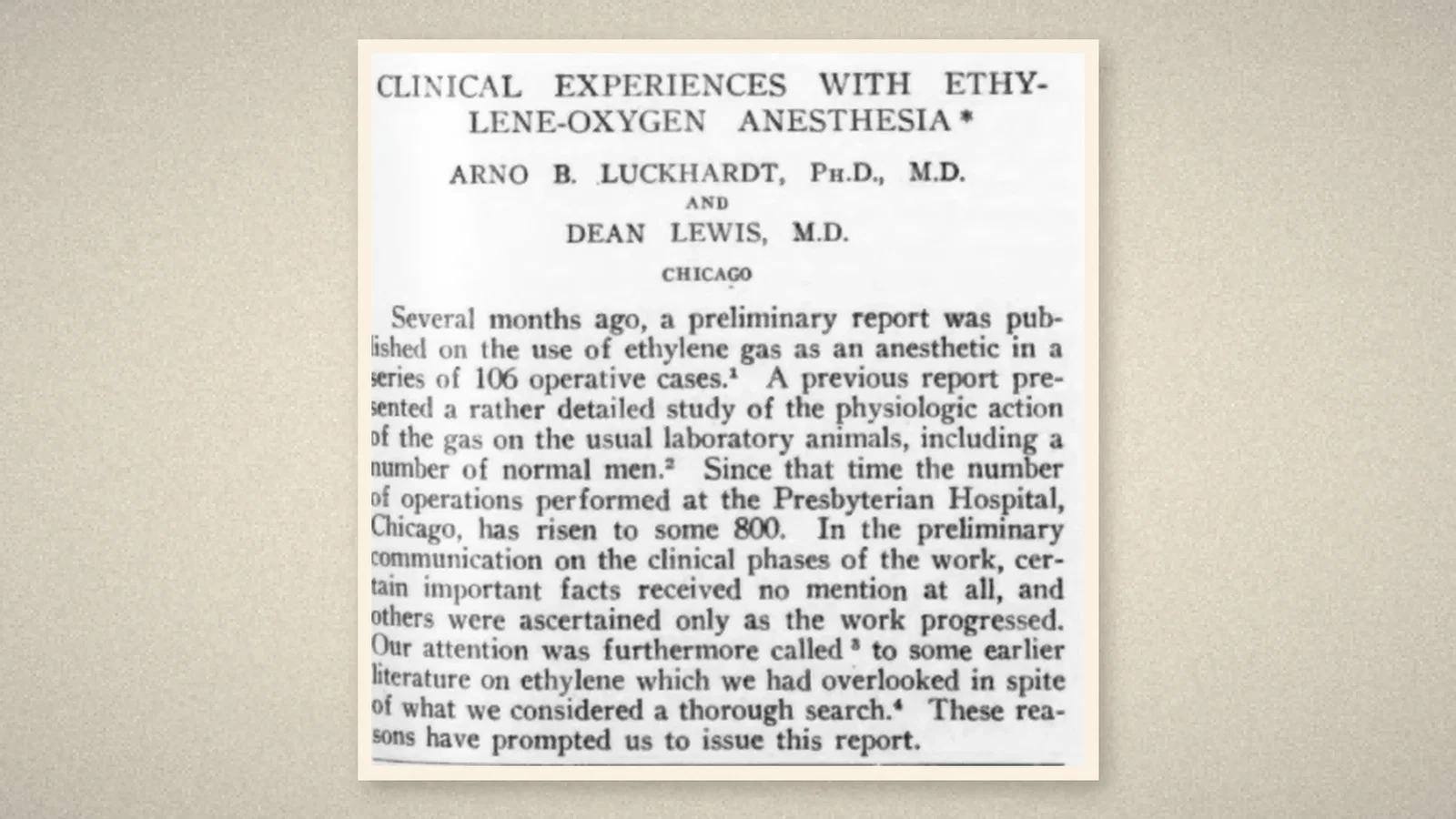
On 1 December 1923 Luckhardt and the surgeon Dean Lewis published "Clinical experiences with ethylene-oxygen anesthesia" in the same journal: operations under ethylene at the Presbyterian Hospital had risen to some 800. Someone had drawn their attention to earlier literature on ethylene "which we had overlooked in spite of what we considered a thorough search"; their work had been done "without the slightest knowledge that any one had ever worked on the subject before", but they welcomed the opportunity "to give credit to whomsoever it is due". [2, p. 1851]
Checking the old sources one by one, they found that a textbook had misquoted both the name and the facts about Nunneley of Leeds in 1849: Nunneley had used ethylene chloride, the so-called Dutch liquid, not ethylene gas, and Simpson had not used ethylene itself either. There was, they concluded, "no available evidence" that ethylene gas had ever been used in operative work. The paper also recorded that Luckhardt and Carter had finished their animal studies in August 1922 and that Brown in Toronto had subsequently confirmed the results in animals, and added that no morphine, scopolamine or ether had been given on purpose as adjuvants to their patients. [2, p. 1851][2, p. 1852][2, p. 1853]
What the record shows
The ethylene story is often told as Luckhardt's discovery, but these two papers record another layer themselves: the first hundreds of administrations depended on the hands and judgement of Herb and Lyons. And going back, six months after announcing a new agent, to give credit for earlier work is a habit worth remembering.
Sources and reading limits
Read: Luckhardt and Carter, "Ethylene as a gas anesthetic: preliminary communication", JAMA 1923;80:1440-2, in full; Luckhardt and Lewis, "Clinical experiences with ethylene-oxygen anesthesia", JAMA 1923;81:1851-1856, including the literature review, the further report and the case material; both from Internet Archive scans of the journal issues, with quotations from the scans' text layer checked against page images.
Not covered: Luckhardt and Carter's physiological paper of 17 March 1923 and the May editorial and correspondence; Isabella Herb's own papers on ethylene, including the December 1923 article in Current Researches in Anesthesia and Analgesia; Brown's Toronto paper in the Canadian Medical Association Journal (March 1923); the Wood Library-Museum and History of Anaesthesia Society items; later reports of ethylene fires and explosions.
Limits: Herb's role is reported as the JAMA authors describe and quote it; Herb's own account was not read. The priority question with Brown in Toronto is mentioned only as the December paper puts it. Concentrations of ethylene and oxygen, percentages and durations are not repeated. Patients are not identified. Any statement of a first is the authors', not made in this article's own voice.
Three illustrations are crops of JAMA 1923, vol. 80, pp. 1440 and 1441, and vol. 81, p. 1851. One is a text diagram drawn from the papers, with no people drawn and no concentrations.
- Luckhardt AB, Carter JB. Ethylene as a gas anesthetic: preliminary communication. JAMA. 1923;80(20):1440-2. DOI
- Luckhardt AB, Lewis D. Clinical experiences with ethylene-oxygen anesthesia. JAMA. 1923;81(22):1851-6. DOI
Continue exploring
Related reading connects shared questions and contexts; it does not by itself establish historical influence.
- 1909: Isabella Herb Wins Anesthesia a Place on the Hospital Staff
- 1923: Luckhardt and Carter Breathe Ethylene and Oxygen Themselves
Anesthesia Epochs · The Source Room · About & Editorial Method
Published November 3, 2026. Sources and reading limits are stated above. Illustrations are labelled as original source images or AI-made. Historical accounts are educational; they are not current treatment instructions.