A 1909 appointment and a 1919 argument about training, judgment and institutional support.
Reading Library · Anesthesia Epochs · 中文版
Watch the companion film
1909: Isabella Herb and the Hospital Anesthetist · Watch on YouTube
Historical anchor: 1909. Date details and source qualifications are explained below.
A hospital could have an operating room, a surgeon and someone to administer an anesthetic. Did that necessarily amount to a qualified anesthesia service?
In 1919, Isabella Coler Herb divided that question into practical responsibilities. Who contributed judgment? Who supervised beginners? Who explained matters to the patient? What support—and payment—should the hospital make possible? Her article, The anesthetist on the hospital staff, was not the announcement of a new drug. It was an argument about what it took to make anesthesia a recognized professional responsibility.[1]
An editorial imagining: an anonymous woman physician discusses anesthesia with two learners. People, room and teaching encounter are invented, not a verified Herb portrait or a record of a particular 1909 class. No administration or procedure is demonstrated.[1–3]
An appointment in 1909, an article in 1919
Ten years earlier, Arthur Bevan had invited Herb to become chief anesthetist at Chicago's Presbyterian Hospital and Rush Medical College. She accepted in 1909, became the first woman on Presbyterian's medical staff, and remained in the position until 1941.[2, p. 602; 3]
That first has an institutional boundary. It does not, by itself, establish the world's first woman physician anesthetist or settle an international chronology of specialty chiefs.
Herb already had a medical degree and experience in anesthesia and pathology in Chicago. In November 1899, she joined Mayo to provide anesthesia for Charles Mayo's patients and to work in pathology; she left in late 1904 and subsequently returned to Chicago.[2, pp. 601–602] Mayo's institutional history describes a specific division of work: Alice Magaw principally cared for Will Mayo's patients, and Herb for Charles's.[4] This documents related roles, not mentorship or identical training and professional views.
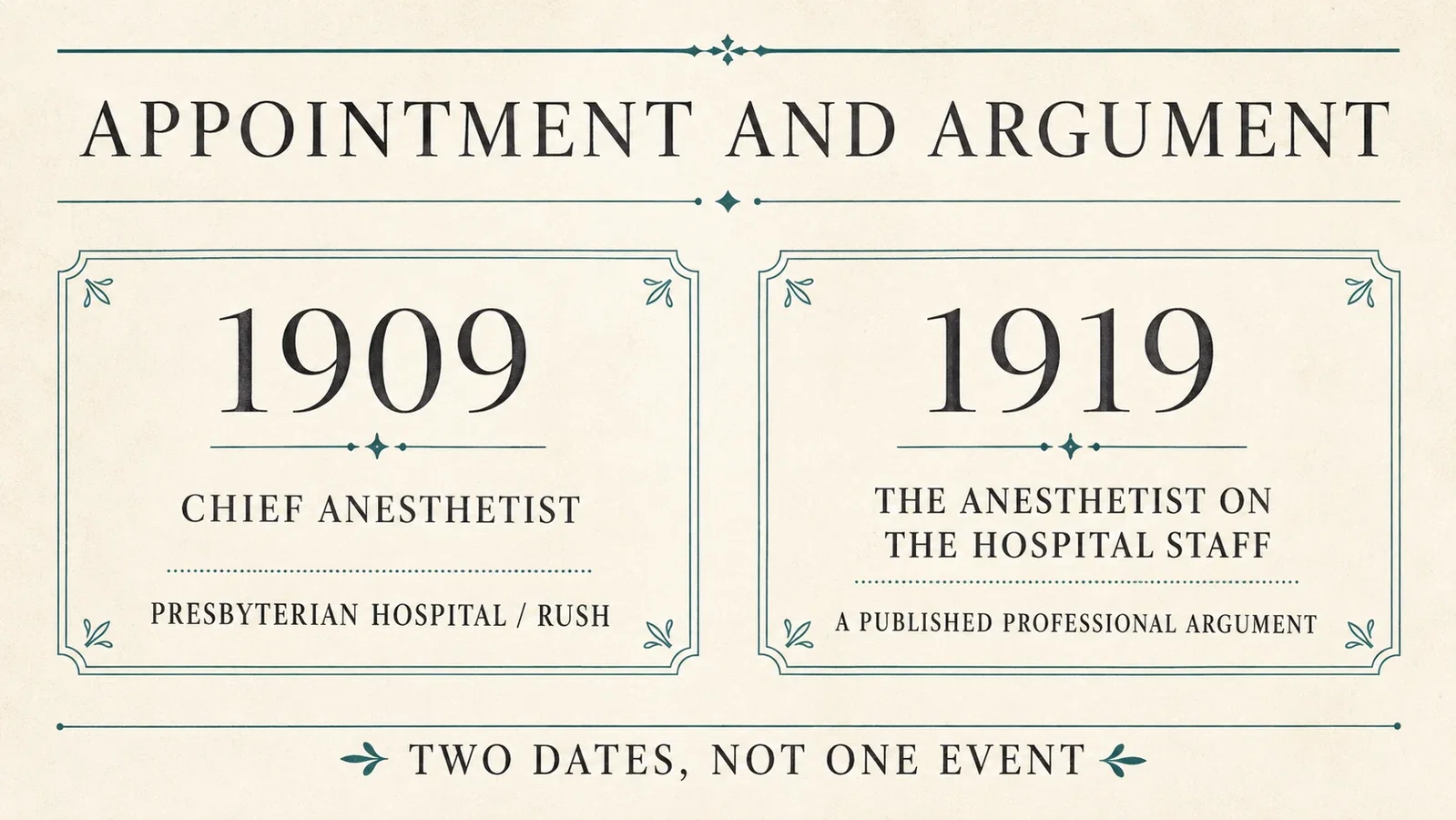
1909 marks the appointment; 1919 dates the original article used here. These date cards are not a proportionally spaced career timeline or evidence that the later program was already implemented in 1909.[1–3]
More than finding someone to give the drug
Herb opened her 1919 article by advocating compulsory theoretical and practical anesthesia education before medical graduation. She then addressed the internship. A degree did not make a beginner ready to administer anesthesia without supervision, any more than it made that graduate ready to perform surgery independently.[1, pp. 98–100]
Supervision was the point. She objected to entrusting anesthesia to an untrained junior intern and treating the assignment as routine. A hospital needed a qualified anesthetist who could teach and supervise the conversion of classroom knowledge into practice.
Nor did she equate medical qualification alone with anesthesia competence. Her proposed standard required specialized theoretical and practical training in addition to medical education. Giving an occasional anesthetic was not enough.[1, p. 100]
This was her historical position on professional qualifications. It is not a present-day ruling on scope of practice, or a comparative outcomes study of physician and nurse anesthesia care.
Judgment the surgeon could hear
Herb wanted surgeon and anesthetist to discuss the patient's condition and the intended operation together, then consider the anesthetic and its administration. The qualified anesthetist was also a consultant, able to advise whether additional operative procedures were appropriate.[1, p. 99]
That did not mean two professionals working in isolation. Her account depended on mutual confidence, communication and sustained attention to changes in the patient. She expected the anesthetist's judgment to be understood and taken seriously.
She also emphasized the relationship with the patient: understanding physical and mental condition, explaining the reasons for arrangements, and gaining trust through a gentle and sympathetic manner.[1, p. 100] These were proposed professional duties, not experimental proof that reassurance abolished anesthetic risk.
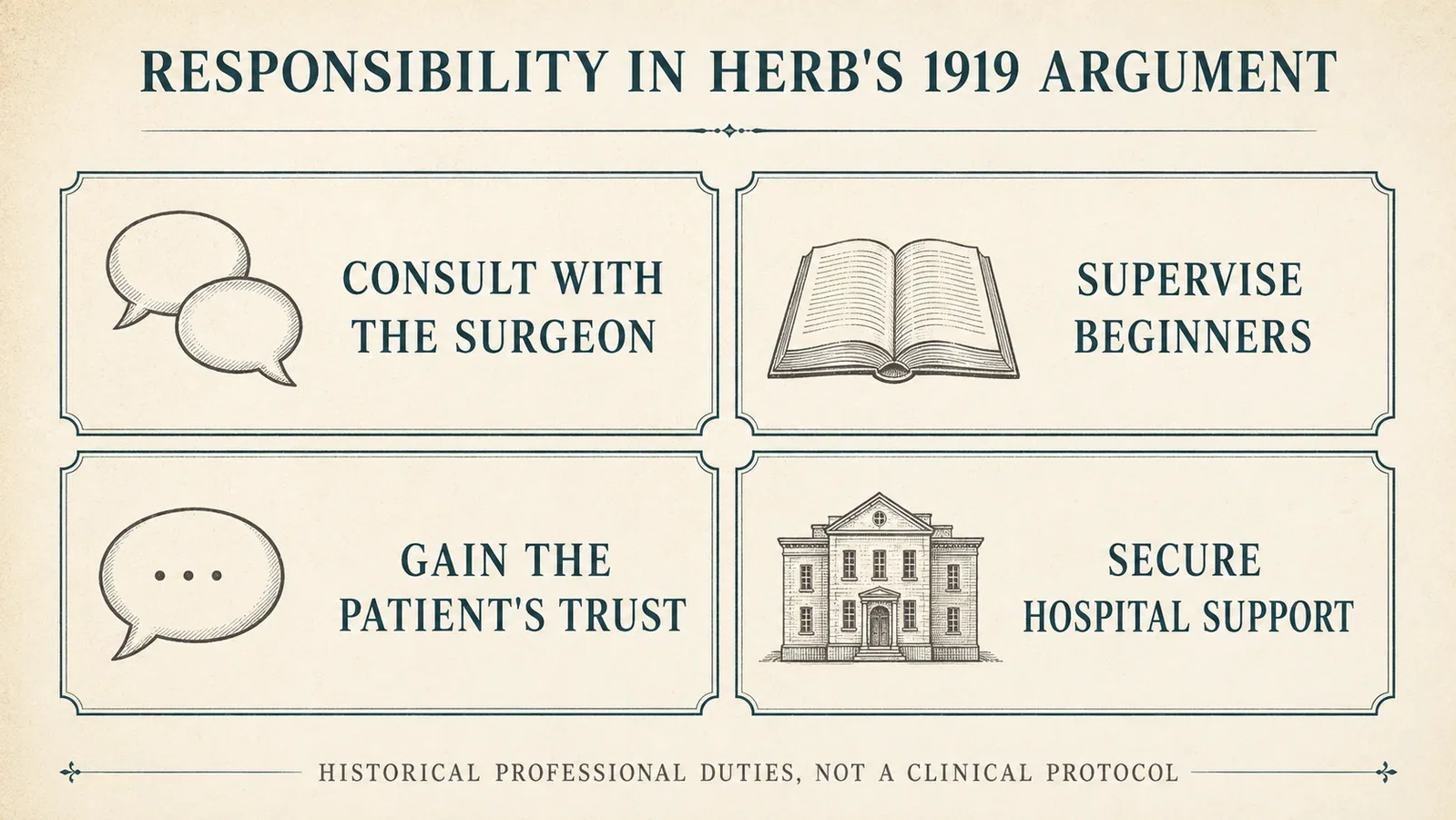
Four themes summarize relationships in the 1919 article. They are not sequential clinical steps or four interventions proven effective in a controlled trial.[1]
The hospital had responsibilities too
Herb turned the argument toward the institution. The anesthetist should protect its reputation and avoid unnecessary waste; the hospital should recognize the person in charge of anesthesia matters and support the purchase of equipment needed for the work.[1, p. 100]
She also objected to using poor patients to demonstrate fashionable new methods.[1, p. 100] The passage matters, but it remains a historical professional appeal, not an already complete modern system of research review and informed consent.
Her closing discussion concerned remuneration. Unless the anesthetist was a full-time teacher receiving stipulated compensation, she advocated payment for professional services directly by the patient, with bills sent by the anesthetist rather than through the surgeon or hospital. The patient's financial circumstances and the difficulty of the anesthesia should inform the fee.[1, pp. 100–101]
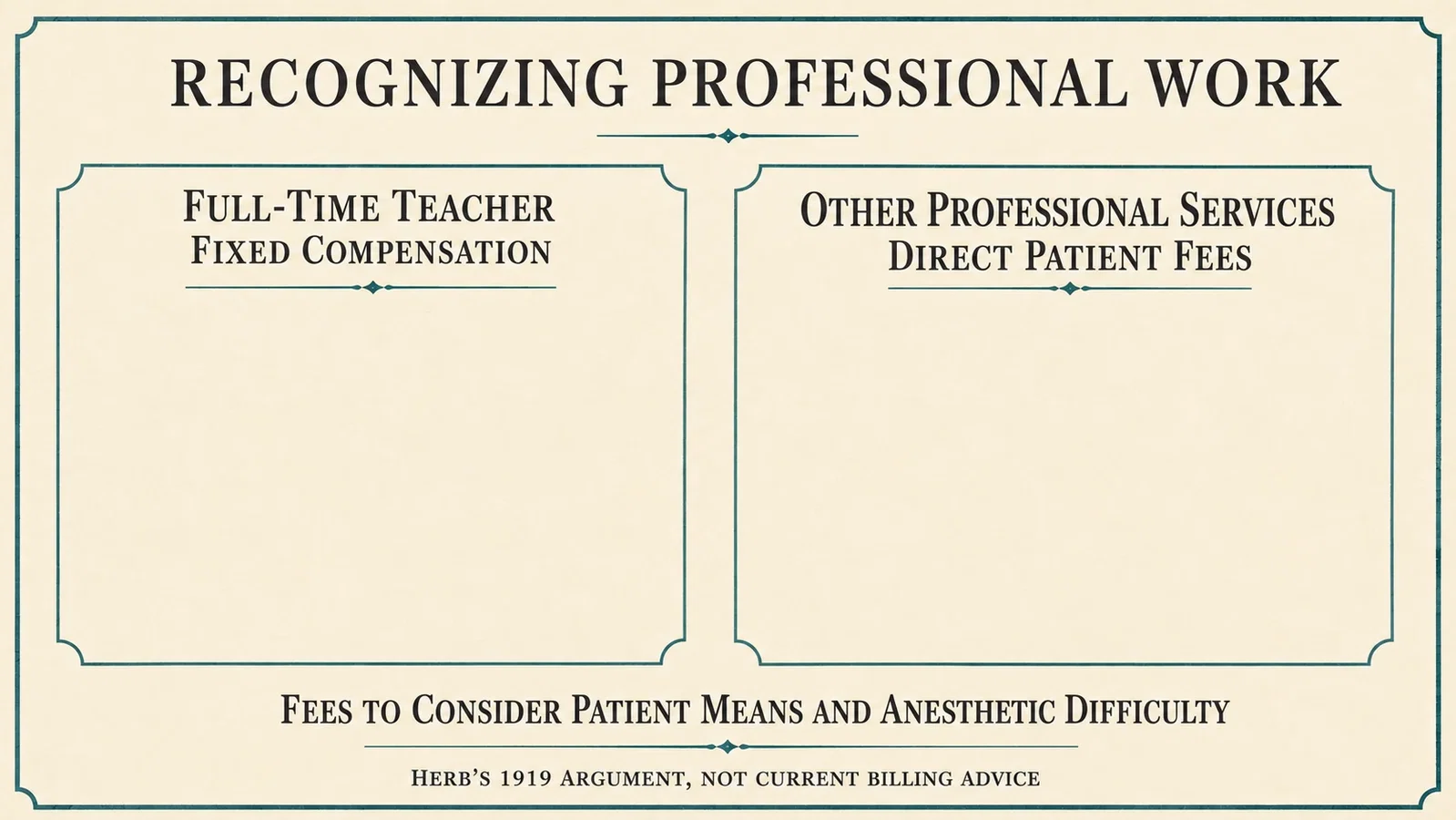
Herb's 1919 argument retained a fixed-compensation exception for full-time teachers and considered patients' financial means. This is not contemporary billing, reimbursement or employment advice.[1, p. 101]
This was more than a demand for an additional charge. In her account, defined responsibility, recognition by the patient and the means to sustain dedicated practice belonged together. The anesthetist should not remain an anonymous part of the hospital's machinery.
A professional program, not an outcome trial
The 1909 appointment gave Herb an institutional position in which to pursue anesthesia. Her 1919 article shows how she argued for such a position: it needed training, judgment, supervision, resources and recognition proportionate to responsibility.
The article had no randomized groups, comparison cohort or measured mortality reduction demonstrating that the whole program worked. Its historical value lies elsewhere. When specialized surgical work was already accepted, Herb asked why anesthesia could still be treated as a task to be assigned to whoever was available.[1]
Sources and reading limits
- Herb IC. The anesthetist on the hospital staff. The Modern Hospital. August 1919;13(2):98–101. Internet Archive original issue: the complete four-page contribution and issue header read, not the entire issue. Not the separate 1919 American Journal of Surgery citation/version.
- Strickland RA. Isabella Coler Herb, MD: An Early Leader in Anesthesiology. Anesth Analg. 1995;80:600–605. PMID 7864432. Mayo-hosted original PDF; all six pages read for this article.
- Rush. Pioneering Women Physicians at Rush, March 10, 2022. Complete Herb section read; other biographies are outside the claimed reading scope.
- Mayo Clinic. Anesthesiology Centennial, Update 12: Anesthesia in Rochester—the Early Years, November 23, 2023. The complete early-years update was read, not the whole cumulative page.
Medical history, not clinical, scope-of-practice or billing advice.
Continue exploring
Related reading connects shared questions and contexts; it does not by itself establish historical influence.
The Source Room · About & Editorial Method
Sources and reading limits are stated above. Illustrations are labelled as original source images or AI-made. Historical accounts are educational; they are not current treatment instructions.