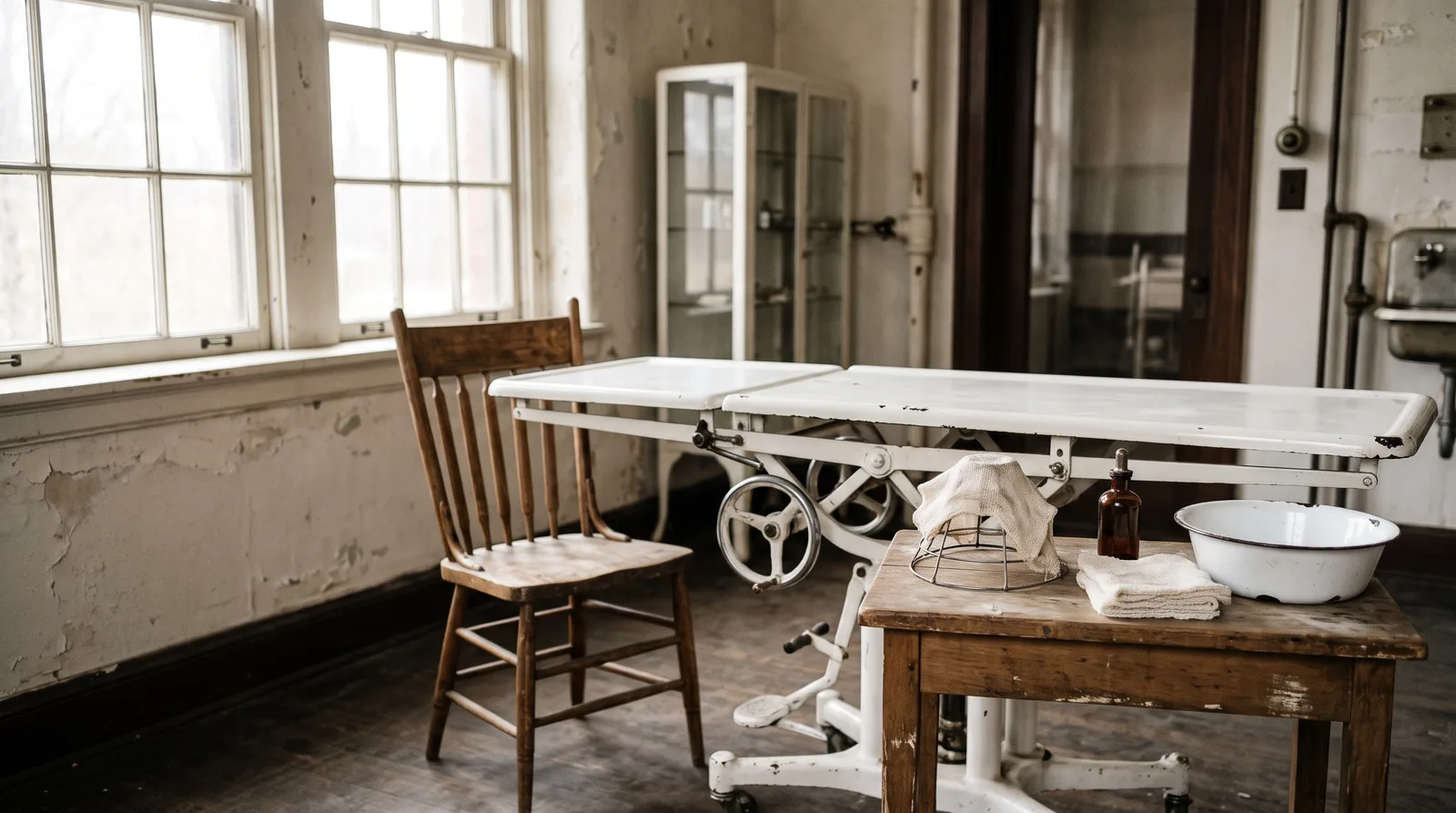
In 1899 Alice Magaw, anesthetist at St. Mary’s Hospital in Rochester, Minnesota, reported over 3,500 anesthetics in six years with no death directly from the anesthetic and argued that the surgeon should not hurry the anaesthetist; in 1906 Magaw reported 14,380.
Reading Library · Anesthesia Epochs · 中文版
Watch the companion film
1899: Alice Magaw and Unhurried Anesthesia · Watch on YouTube
“The surgeon should not hurry the anæsthetist.” Alice Magaw put that demand into print in 1899. On the same page, Magaw argued that an operation should not begin until both patient and anesthetist were ready.[1, p.209]
The setting was an era of ether and chloroform. Yet the paper was not an announcement of a new drug. It made another kind of work visible: explaining, observing, adjusting, and retaining judgment when a surgical team wanted to proceed.
An account from within a team
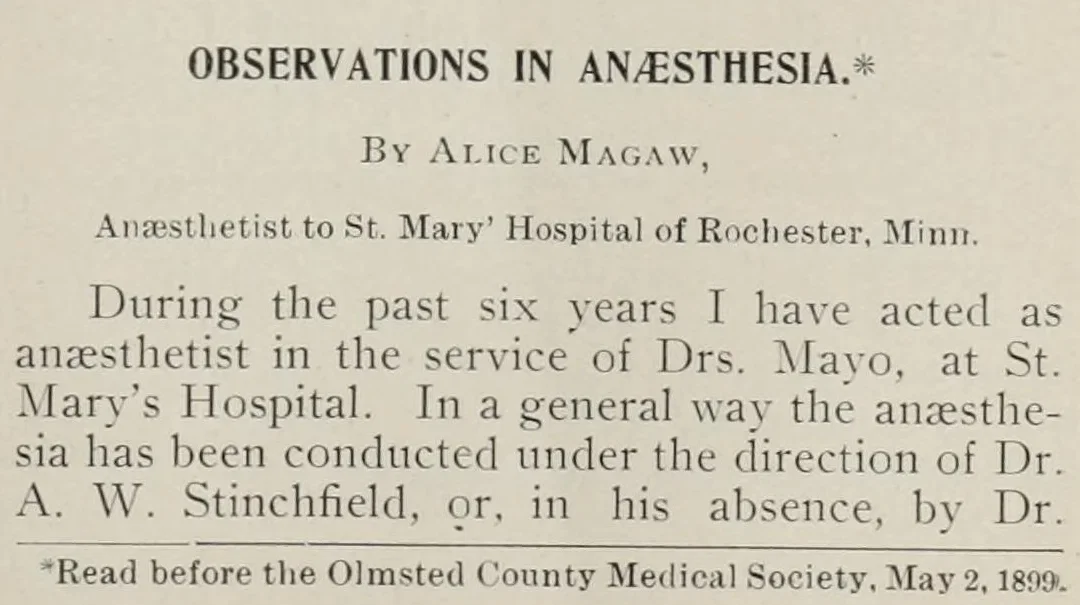
Magaw signed as anesthetist to St. Mary's Hospital in Rochester, Minnesota. A footnote records presentation to the Olmsted County Medical Society on May 2, 1899. That is a presentation date, not proof of the journal's exact publication day.[1, p.207]
Magaw described six years in the Mayos' service, with anesthesia generally directed by A. W. Stinchfield or, in Stinchfield’s absence, Christopher Graham. The paper also stated that, having been educated only as a nurse, Magaw was not expected to select the anesthetic.[1, pp.207–208]
This was not the memoir of an unconstrained lone inventor. It was an account of practical knowledge produced within a particular division of responsibility.
The description of technique acknowledged predecessors. After using Wyeth's modification of the Ormsby inhaler, the team adopted an Esmarch mask and drop method associated with L. H. Prince at Augustana Hospital in Ochsner's service. The paper describes trying and modifying the approach.[1, pp.208–209] Documenting adoption and adjustment is a more faithful description than crediting Magaw with inventing open-drop ether alone.
What the patient and anesthetist needed
Fear mattered in this account. Magaw advocated explanation and encouragement, including for children. Patients could look around the operating room and ask questions.[1, p.208]
But responsibility for a tolerable process did not rest solely with the patient. People differed in how they came under an anesthetic. Magaw challenged the pressure to force that process along, asking the surgeon to wait until patient and anesthetist were ready. The anesthetist, meanwhile, needed to understand the progress of the operation.[1, p.209]
The warning about observation was similarly broad: no single danger signal should be trusted alone. Pulse, breathing, pupils and other observations had to be considered together.[1, pp.209–210] That reveals the demands of contemporary practice; it does not justify dispensing with modern monitoring.
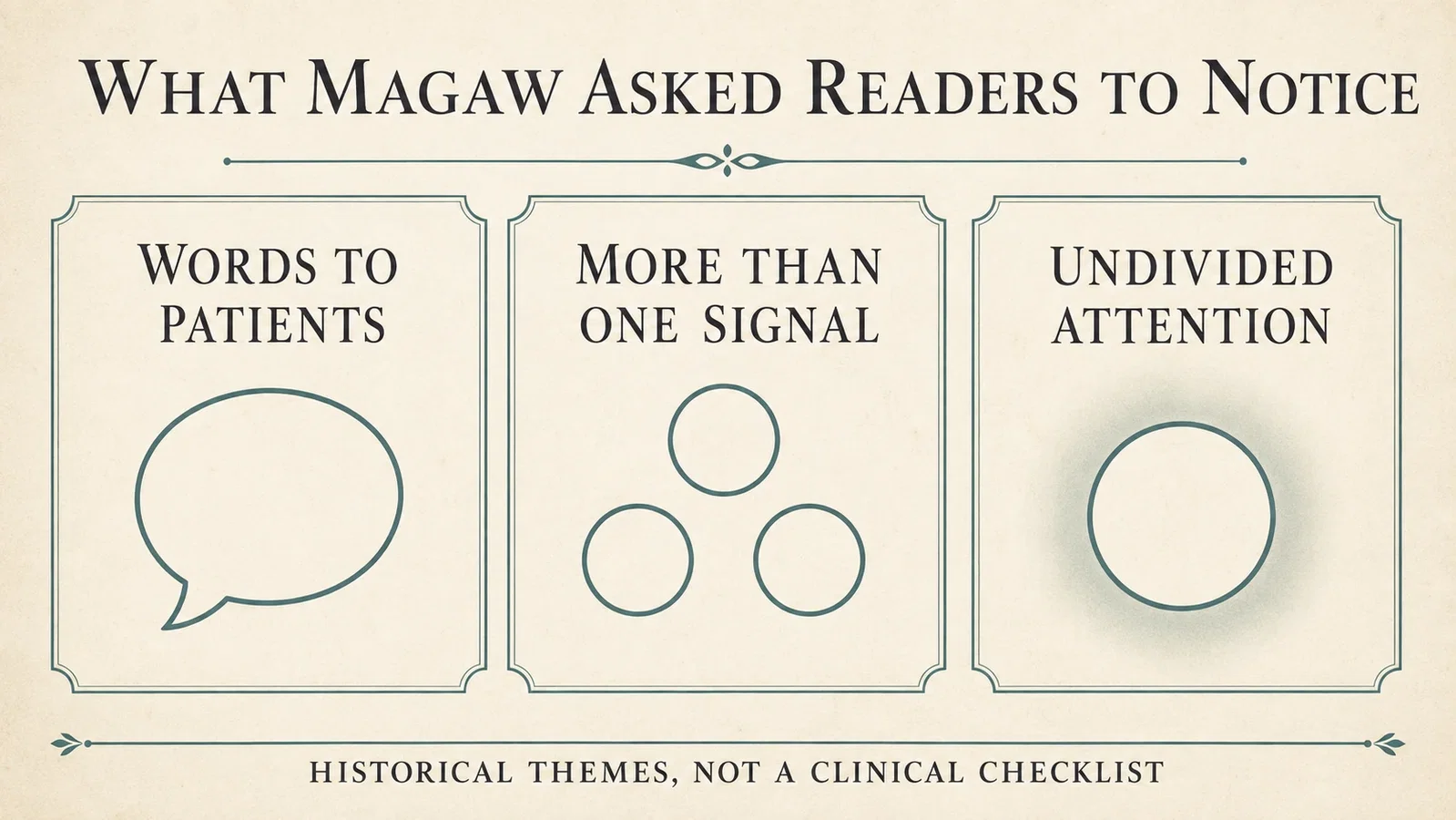
A modern reading guide, not a clinical checklist or three interventions proven effective in a controlled study.[1–2]
Some of the papers' drug choices, administration methods and rescue measures belong firmly to their period. Recognizing an enduring concern about attention does not make the entire historical practice current advice.
Reading the denominator before the legend
The 1899 paper opens with more than 3,000 cases and ends with a more specific threshold: over 3,500 across six years. Magaw reported no case lost directly from the anesthetic, while acknowledging alarming episodes.[1, pp.208,210]
In 1906 Magaw reported 14,380 anesthetics given personally, without having seen a death directly from the anesthetic, though not without trouble in administering it.[2, p.795] Neither statement means zero deaths from all causes, zero complications, or 14,380 uniformly assessed successes with ether alone.
A separate count on that page concerns the hospital's 1905 activity: 3,080 anesthetics, including 2,847 with ether. It cannot be substituted for the denominator of the career report.[2]
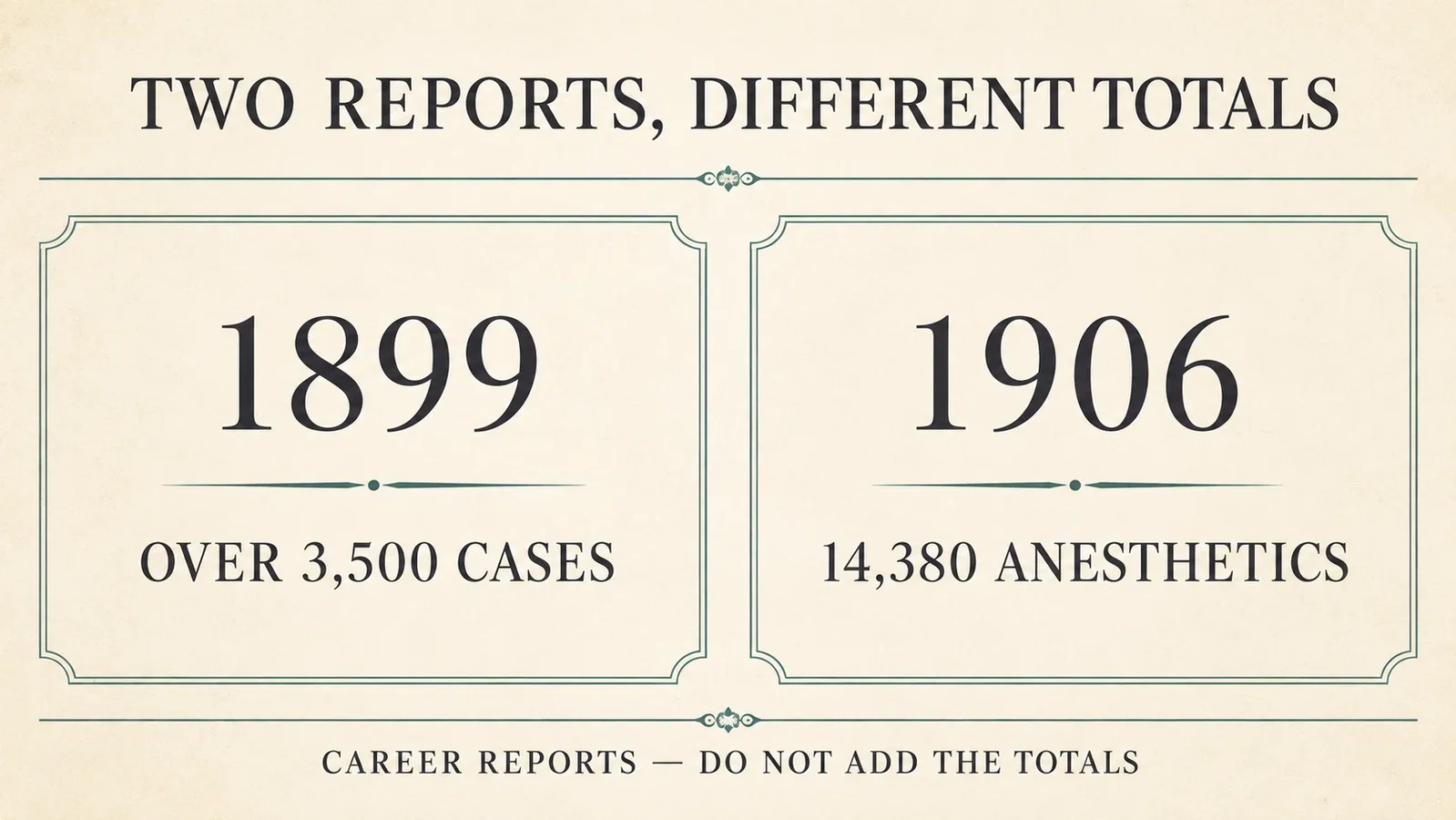
Over 3,500 cases in the 1899 conclusion; 14,380 anesthetics in the 1906 report. These career reports should not be added together or treated as independent comparison groups. Neither number establishes zero risk.[1–2]
The papers preserve how an experienced practitioner summarized years of work. They do not supply the standardized outcomes, complete follow-up and independent attribution needed for a modern comparative study.
A full-time task, not spare attention
At the end of the 1906 paper, Magaw argued that administering an anesthetic properly required one person's full attention. Trying to learn surgery at the same time was a serious mistake. Magaw had instructed several people and argued that nurses could concentrate on anesthesia without being distracted by aspirations to perform surgery.[2, p.799]
This was a historical argument for dedicated work and training, not a comparative trial of nurses and physicians or evidence of an innate sex-based aptitude.
Mayo's institutional history attributes the title “Mother of Anesthesia” to Charles Mayo. The honor conveys recognition, not proof of sole invention or safety.[4]
Nor did the practice consist of one person alone. After Isabella Herb arrived in 1899, the institutional history describes Magaw primarily caring for Will Mayo's patients and Herb for Charles Mayo's. Strickland dates Herb's appointment to November 1899 and departure to late 1904.[3–4]
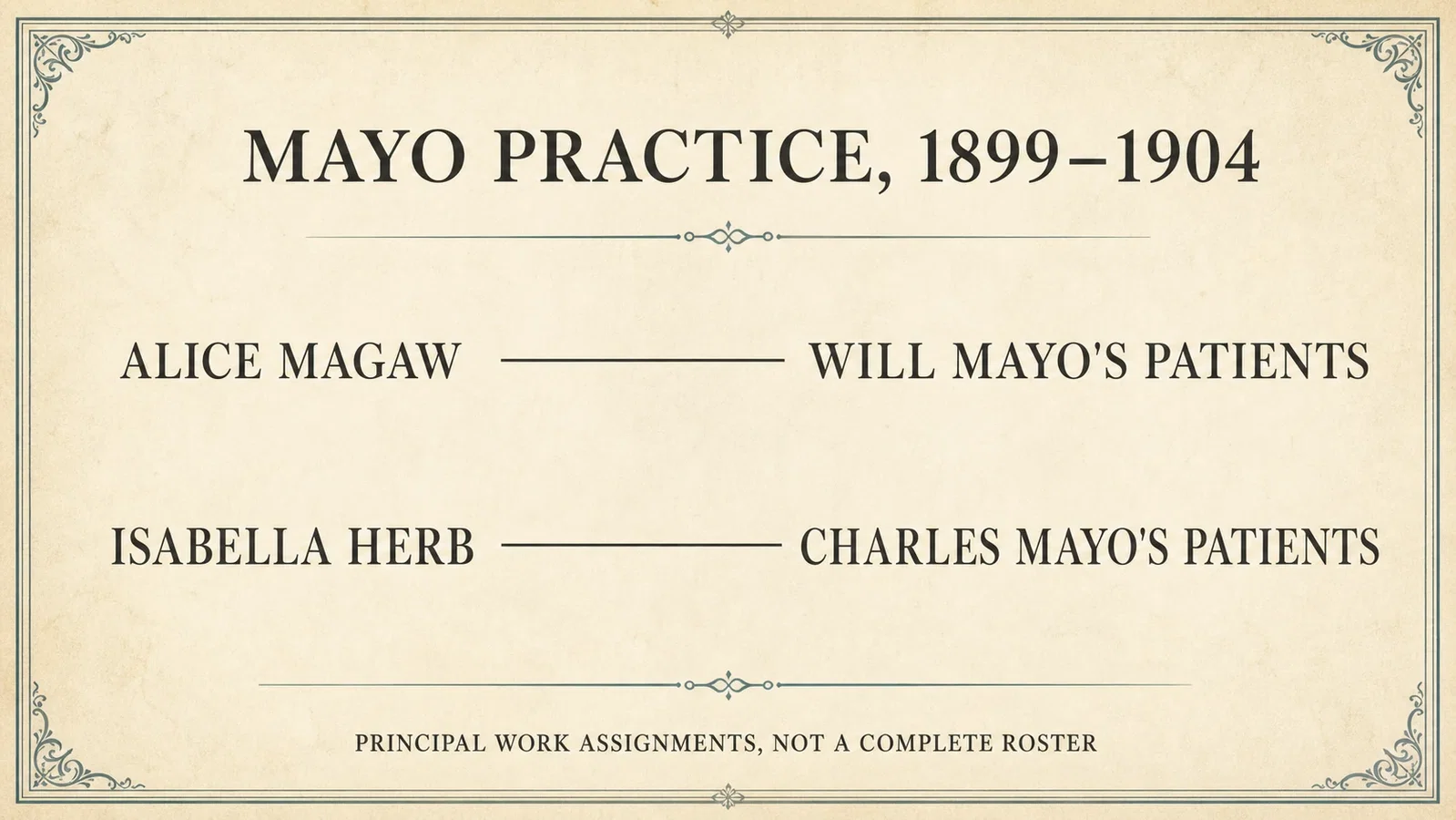
A schematic of principal responsibilities described in the institutional history, not a complete case roster or a statement that the women's authority, training and views were identical.[3–4]
Magaw left more than a reassuring-looking total. Magaw brought the anesthetist's observations, communication with patients and need for unhurried judgment into published medical discussion. Magaw’s own papers show both that contribution and its historical limits.
Sources and reading limits
Read: Magaw’s 1899 paper in full, pp. 207–210, with its page images; Magaw’s 1906 paper in full, pp. 795–799, in the Mayo-hosted scan; Strickland 1995, pp. 600–602 and 605; the full text of Mayo Clinic’s Anesthesiology Centennial Update 12.
Not covered: the remaining pages of Strickland’s article; the 1999 reprint of the 1906 paper; the other updates of the centennial series. The 1899 journal does not give a publication day; May 2 is the date the paper was read to the Olmsted County Medical Society.
- Magaw A. Observations in Anæsthesia. Northwestern Lancet.1899;19:207–210. Countway Library digitized volume.
- Magaw A. A Review of Over Fourteen Thousand Surgical Anæsthesias. Surgery, Gynecology and Obstetrics.1906;3:795–799. Mayo-hosted original scan.
- Strickland RA. Isabella Coler Herb, MD: An Early Leader in Anesthesiology. Anesth Analg.1995;80:600–605. Mayo-hosted six-page PDF.
- Mayo Clinic. Anesthesiology Centennial, Update 12: Anesthesia in Rochester—the Early Years, November 23, 2023.
Continue exploring
Related reading connects shared questions and contexts; it does not by itself establish historical influence.
Anesthesia Epochs · The Source Room · About & Editorial Method
Sources and reading limits are stated above. Illustrations are labelled as original source images or AI-made. Historical accounts are educational; they are not current treatment instructions.