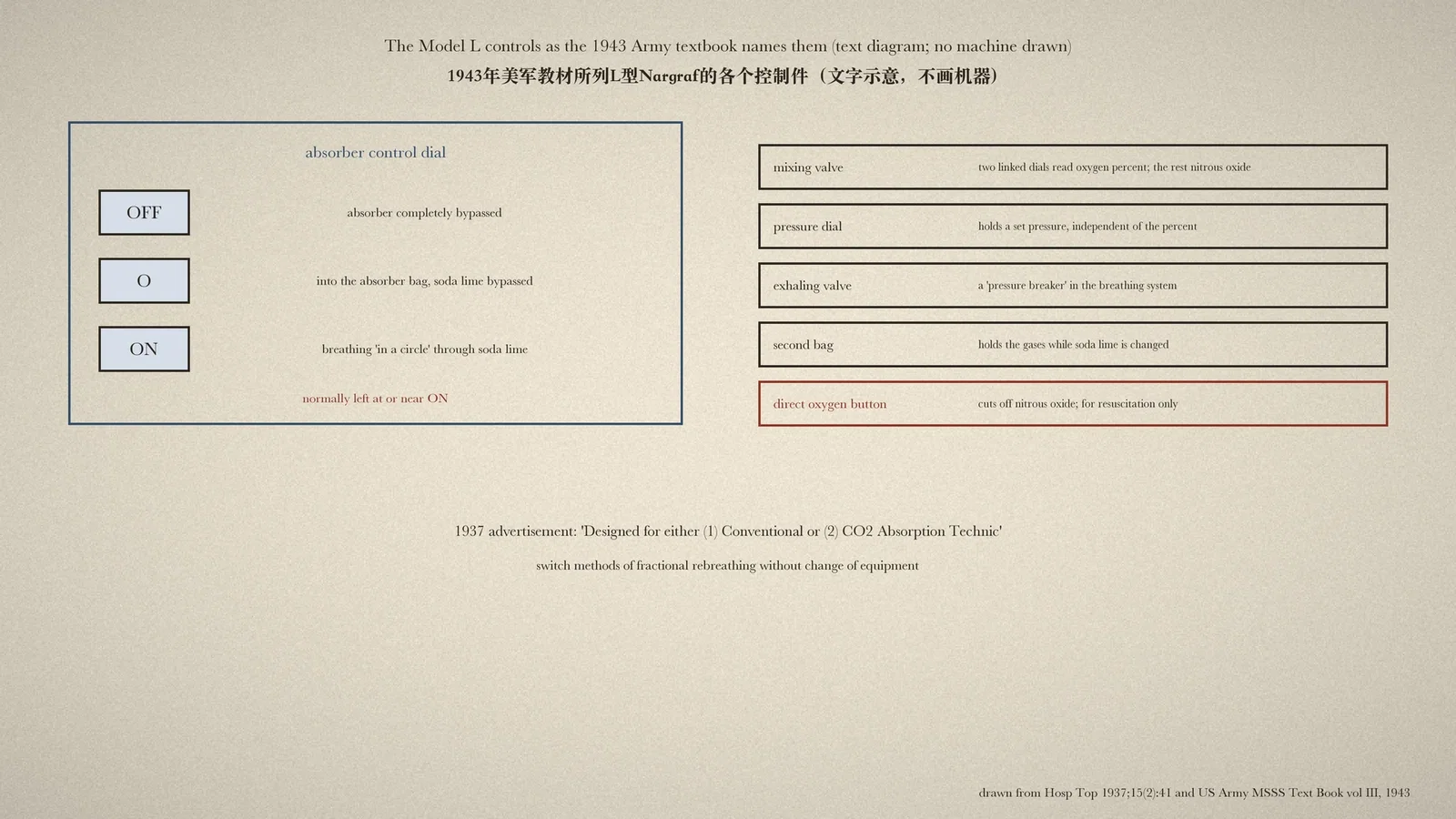
In February 1937 Hospital Topics carried the McKesson Appliance Company's advertisement 'The New McKesson Model L Nargraf', designed for either the conventional technique or CO2 absorption, so that the anaesthetist could 'select or switch to the best method of fractional rebreathing without change of equipment', with a fine-adjustment mixing valve, pressure control and a direct oxygen valve for artificial respiration, at a reduced price. In November 1943 the U.S. Army Medical Supply Services School textbook devoted a section to the Model L: an absorber control set to OFF, O or ON to bypass the absorber, bypass only the soda lime or send all breathing through it; paired dials reading oxygen percent directly; a pressure dial independent of the percentage; and a direct oxygen button for resuscitation only.
Reading Library · Anesthesia Epochs · 中文版
Watch the education video (for clinicians)
1937: McKesson's Model L Nargraf · Anesthesia Epochs Education Series
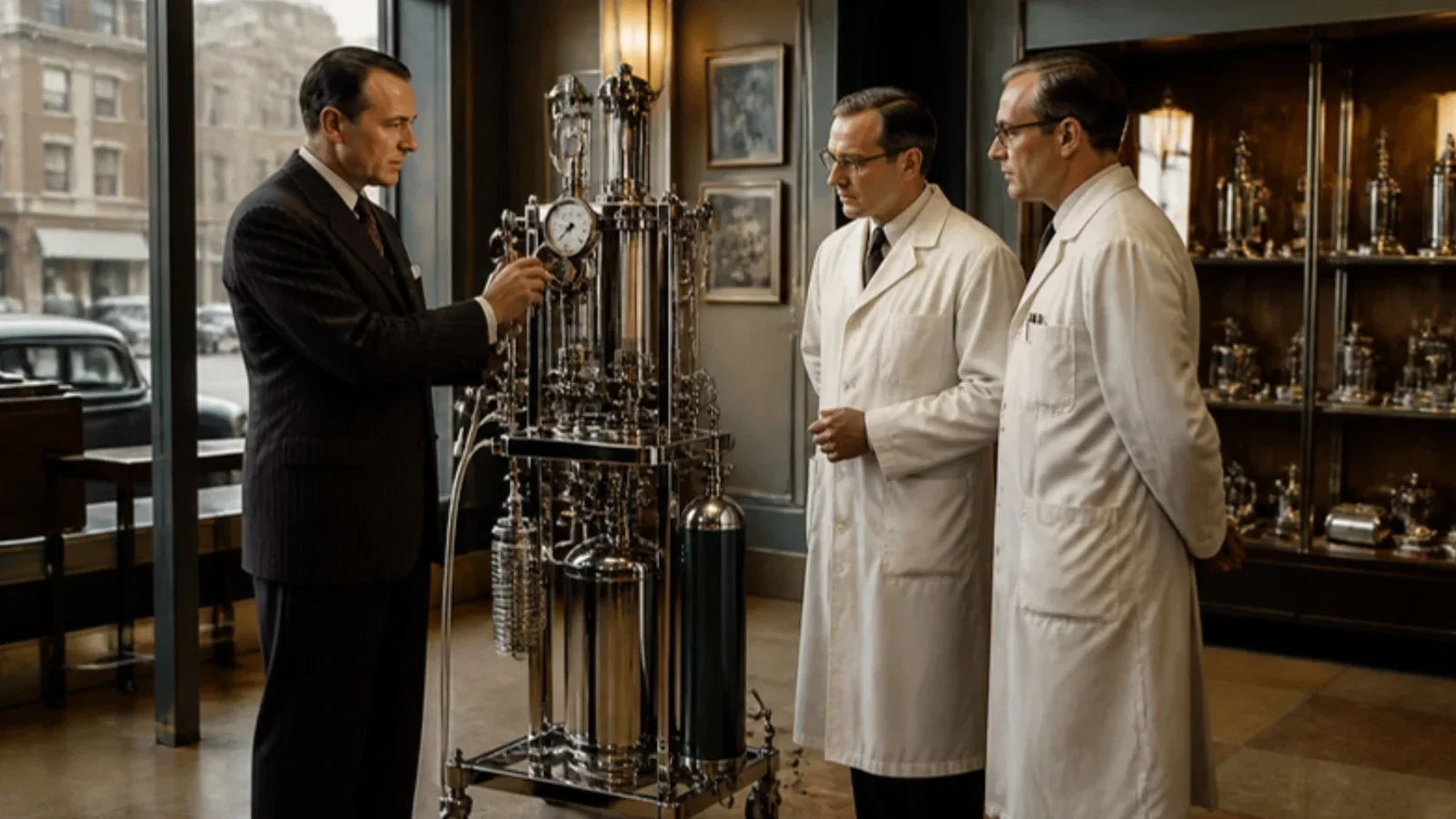
How did an anaesthetist in 1937 choose between an older way of giving gas and a newer one? One answer was a machine that did both. This article follows the McKesson Model L Nargraf through two documents written for very different readers: a hospital trade advertisement and an Army instruction manual. [1][2]
The advertisement
Hospital Topics for February 1937 carried a full-column advertisement from the McKesson Appliance Company of Toledo, Ohio: "Increased Flexibility — Universal Application. The New McKesson Model L Nargraf. Designed for either (1) Conventional or (2) CO2 Absorption Technic." Its photograph showed the side of the Model L head with "combined CO2 absorber, basal oxygen valve, ether vaporizer, etc." [1, p. 41]
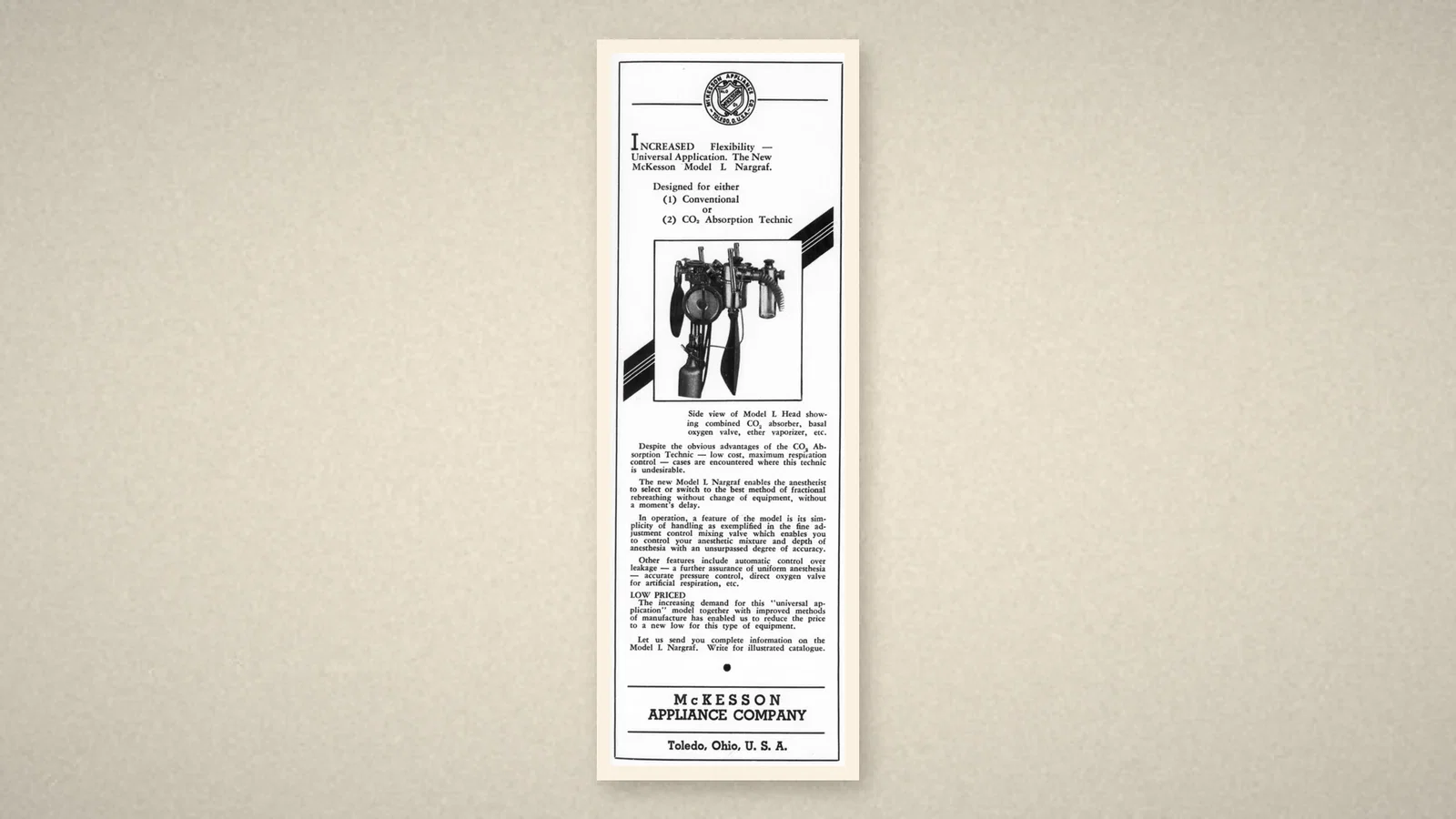
The pitch was flexibility. Carbon dioxide absorption had "obvious advantages", low cost and "maximum respiration control", but, the copy admitted, "cases are encountered where this technic is undesirable". The new model let the anaesthetist "select or switch to the best method of fractional rebreathing without change of equipment, without a moment's delay". The other selling points were a fine-adjustment mixing valve for control of the mixture and depth of anaesthesia, automatic control over leakage, accurate pressure control, and a direct oxygen valve for artificial respiration. Rising demand and better manufacturing, the company said, had brought the price "to a new low for this type of equipment". [1, p. 41]
The manual
In November 1943 the U.S. Army Medical Supply Services School issued volume III of its textbook, "Medical Equipment — General", for instructional use. Its gas anaesthesia section explains how to assemble, operate and repair McKesson units, with photographs and labelled drawings. [2, section I, pp. 24-32]
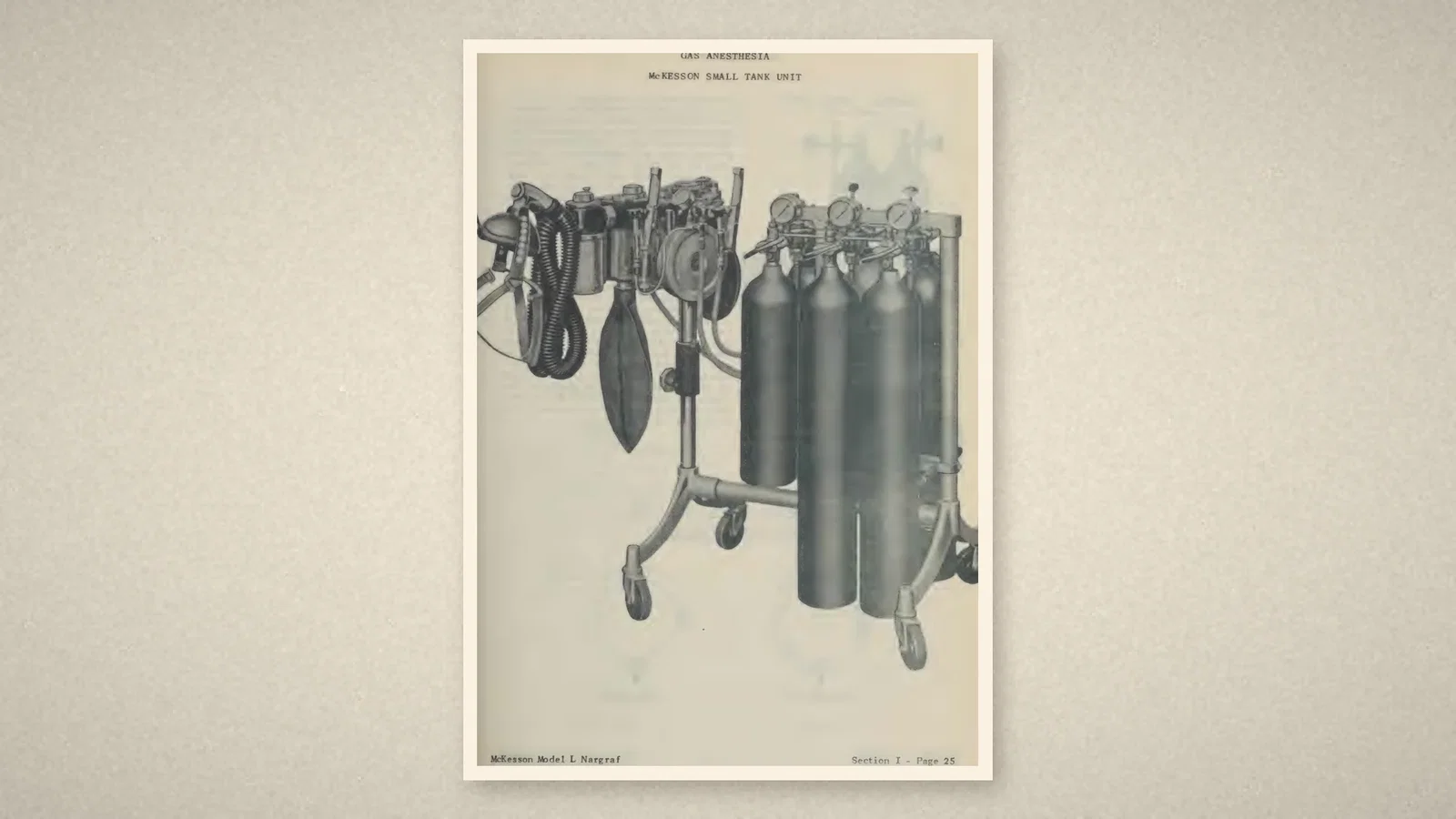
The textbook starts with the absorber control, the dial that made the advertisement's choice possible. It had been made with two different sets of wording, but worked the same way. At "OFF" the gases and the breathing completely bypassed the absorber; this was also the setting for inflating the lungs. At "O" the breathing went into the absorber bag but bypassed the soda lime, so the patient's carbon dioxide built up and breathing deepened. At "ON" the breathing went "in a circle", all of it through the soda lime. Under normal conditions the dial was to stay at or near ON, because letting carbon dioxide accumulate over a long period was dangerous. A second bag at the back of the head held the gases while the soda lime was changed during an anaesthetic. [2, section I, p. 28]
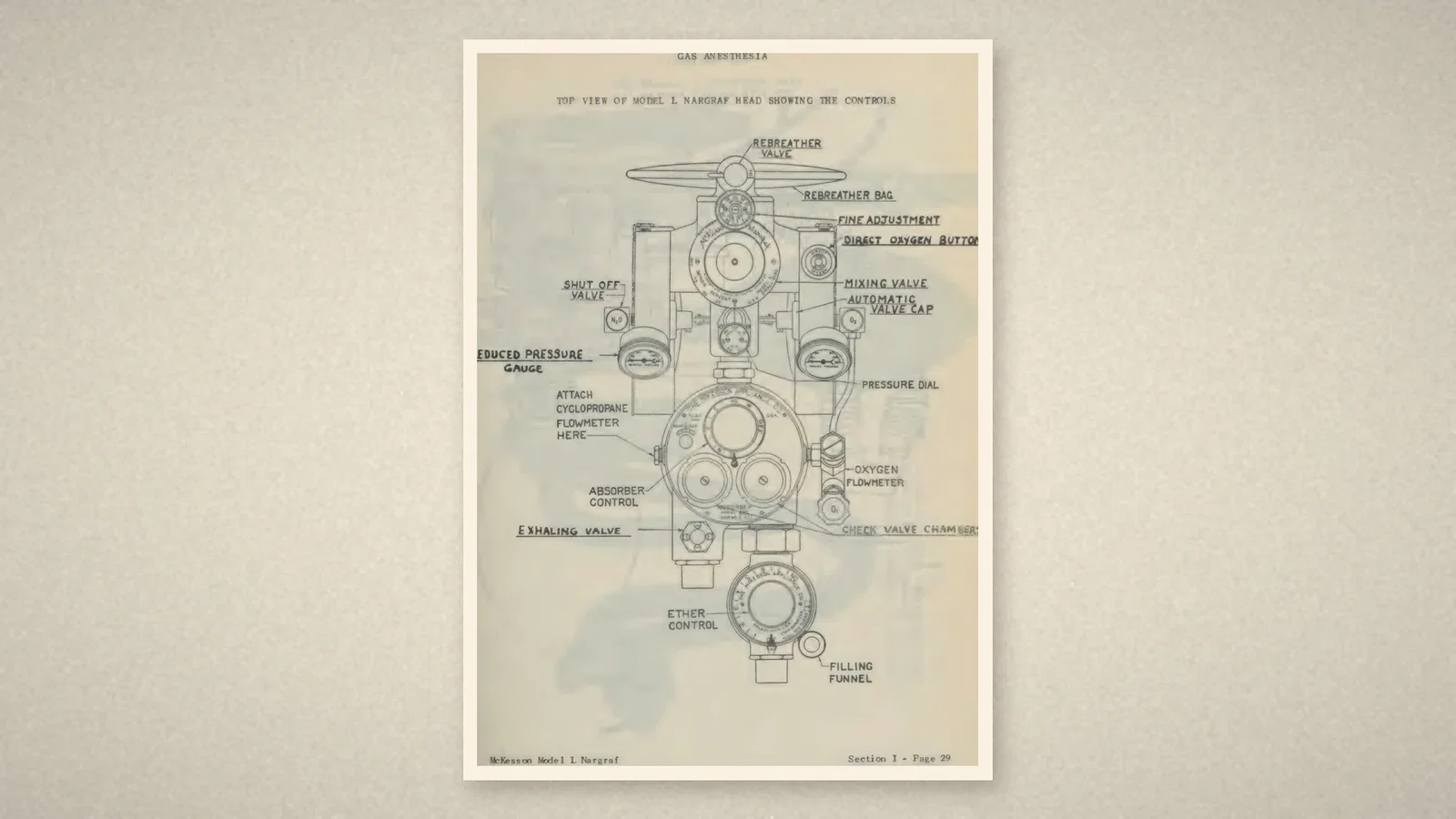
The other controls are described one by one. Two linked mixing-valve dials read directly in oxygen percent, the rest being nitrous oxide. A pressure dial maintained a set pressure independently of the mixture. The exhaling valve acted as "a pressure breaker in the breathing system". The direct oxygen button cut off the nitrous oxide and delivered oxygen under enough pressure to inflate the lungs. For resuscitation, the exhaling valve was tightened first and the button released as soon as the chest rose. The textbook added a warning: this method "is for resuscitation only, and should not be used in ordinary anesthesia". [2, section I, pp. 28, 32]
What the record shows
A machine sold on the idea of choice, and a manual that explains what each choice does. The advertisement promised a switch between techniques; the textbook shows what the switch was, a dial with three named positions, along with the warnings that came with it. The direct oxygen button appears in both: as a selling point in 1937, and as an emergency control in 1943.
Sources and reading limits
Read: the McKesson Appliance Company advertisement, Hospital Topics February 1937, p. 41; the U.S. Army Medical Supply Services School Text Book, vol. III, November 1943, Gas Anesthesia section I, the pages on the McKesson units and the Model L Nargraf (NLM copy; pdftotext and page images).
Not covered: McKesson's own papers on fractional rebreathing; the illustrated catalogue offered in the advertisement; any patent for the Model L; the Wood Library-Museum video.
Limits: the 1937 claims of accuracy and low price are advertising. The 1943 textbook states that it "has not been officially approved by the War Department" and was issued for instruction only. Neither source names the designer, so none is named here. Gas percentages, pressures and dial settings are not repeated beyond the names of the positions.
Three illustrations are crops of Hospital Topics (1937, p. 41) and the Army textbook (1943, section I, pp. 25 and 29); one is a text diagram drawn from them, with no machine drawn.
- McKesson Appliance Company. The new McKesson Model L Nargraf [advertisement]. Hosp Top. 1937;15(2):41. Internet Archive
- U.S. Army Medical Supply Services School. Text book. Vol III, Medical equipment - general. 1943 Nov. Gas anesthesia, section I. Internet Archive
Continue exploring
Related reading connects shared questions and contexts; it does not by itself establish historical influence.
- 1944: The AMA Accepts the Kreiselman Bellows Resuscitator, for Physicians Only
- 1923: Waters Keeps the Anesthetic and Removes the Carbon Dioxide
Anesthesia Epochs · The Source Room · About & Editorial Method
Published November 3, 2026. Sources and reading limits are stated above. Illustrations are labelled as original source images or AI-made. Historical accounts are educational; they are not current treatment instructions.