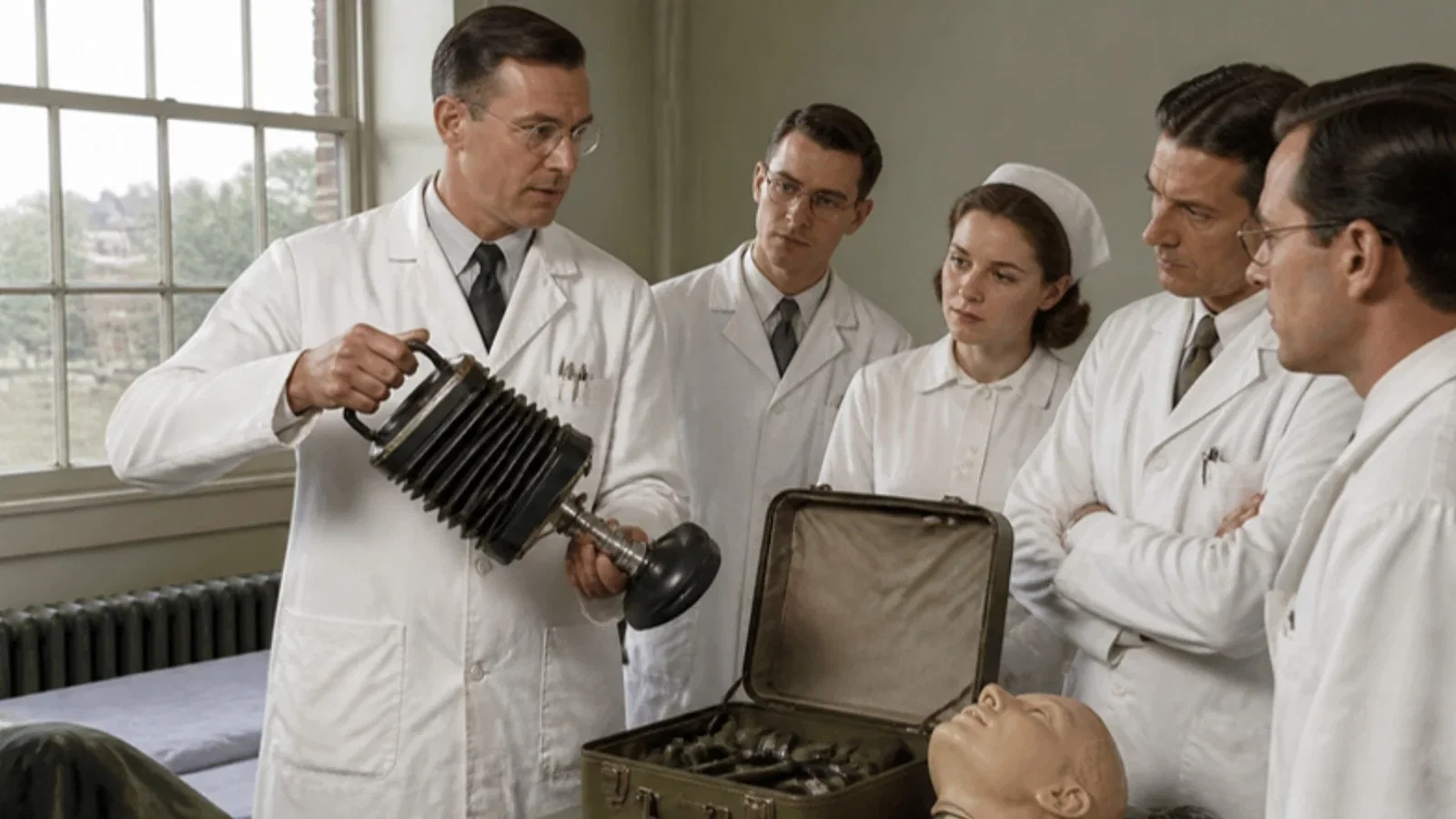
On 9 September 1944 JAMA printed the Council on Physical Medicine's report on the Kreiselman Resuscitator, Bellows Type, Model 110, made by the Ohio Chemical & Manufacturing Co.: a bellows with air and oxygen intake valves, exhaust and relief valves, a handle, an elbow connector for the mask, an airway and a carrying case, filled by lifting and emptied by pressing until the chest rose. The Council accepted it for use in operating rooms and medical institutions under a physician's direction, but not for lay organizations, because no evidence showed that a layman had resuscitated an asphyxiated person with it. The report also recorded that in the 12 patients submitted, respiratory arrest had been produced deliberately with an anaesthetic overdose to test the apparatus. A year later Joseph Kreiselman described the device in the Southern Medical Journal.
Reading Library · Anesthesia Epochs · 中文版
Watch the education video (for clinicians)
1944: The Kreiselman Bellows Resuscitator · Anesthesia Epochs Education Series
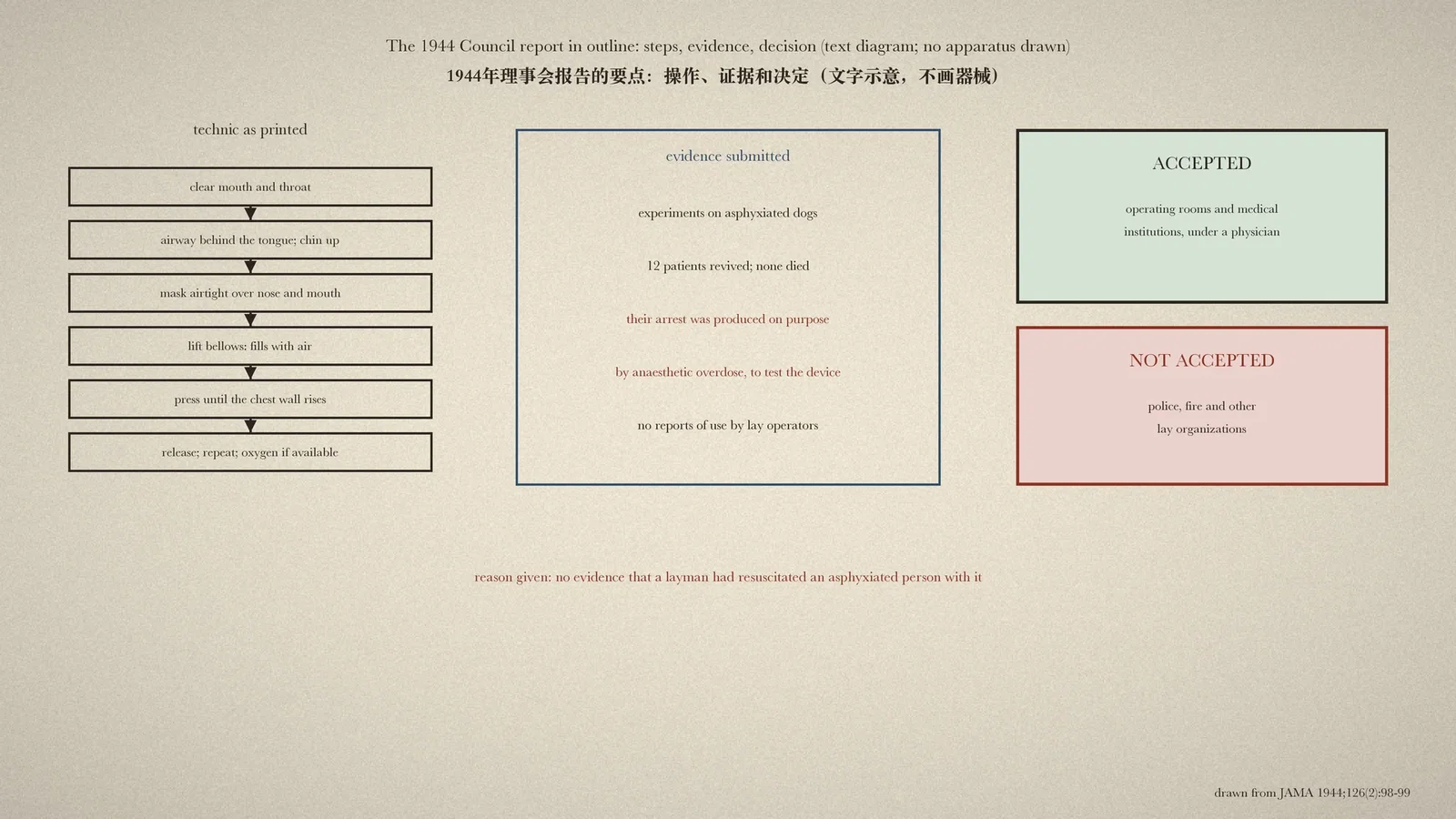
A hand-operated bellows, a mask and an airway, small enough to carry in a case: in 1944 a manufacturer wanted to offer such a resuscitator to anyone who might find someone not breathing. In 1944 the American Medical Association had to decide who that "anyone" should be. [1, pp. 98-99]
The report
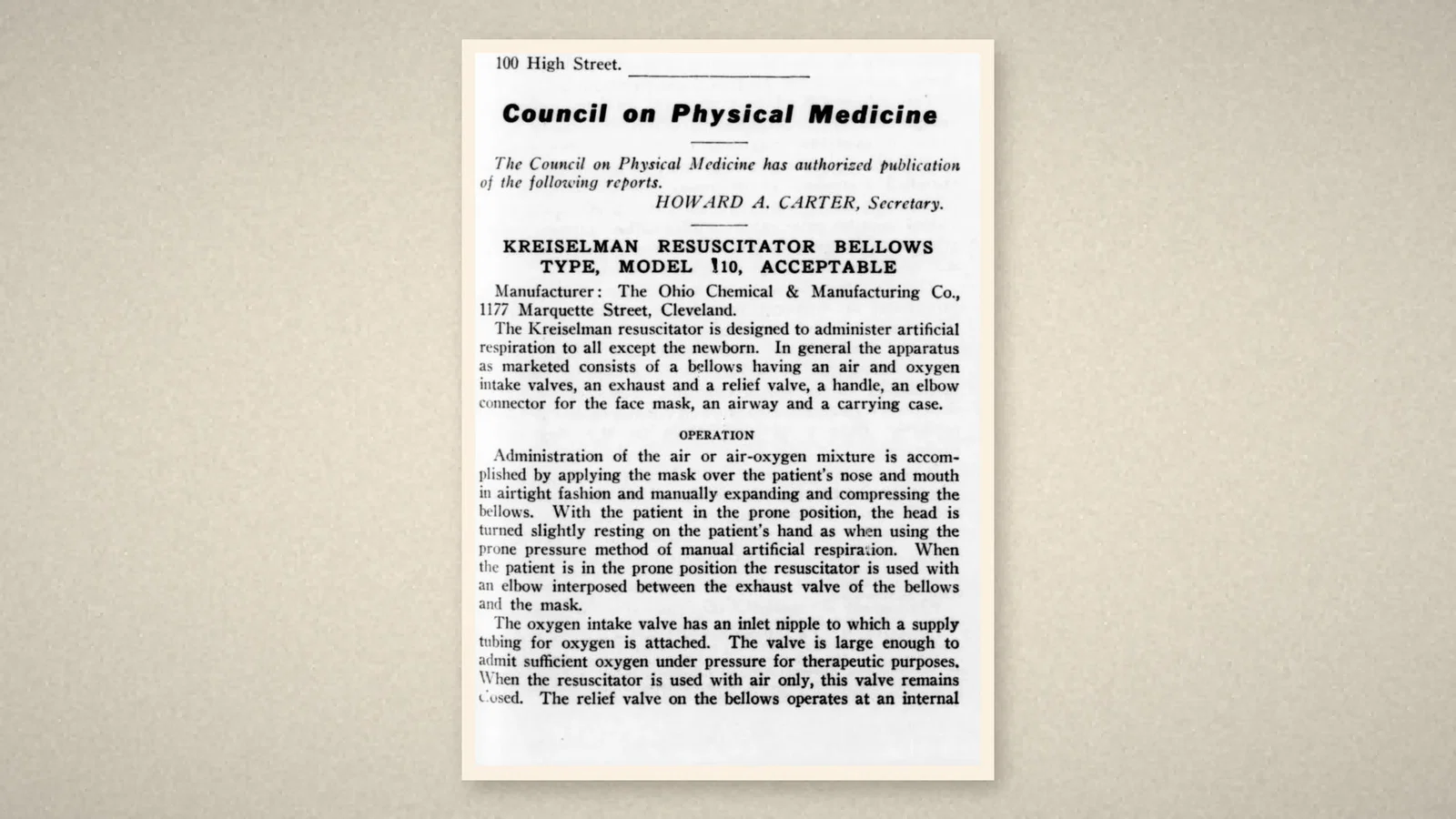
On 9 September 1944, JAMA printed a report of the AMA's Council on Physical Medicine, signed by its secretary, Howard A. Carter: "Kreiselman Resuscitator Bellows Type, Model 110, Acceptable". The maker was the Ohio Chemical & Manufacturing Co. of Cleveland. The resuscitator was "designed to administer artificial respiration to all except the newborn". As sold, it consisted of a bellows with air and oxygen intake valves, an exhaust valve and a relief valve, a handle, an elbow connector for the face mask, an airway and a carrying case. [1, p. 98]
The report printed the technique as a numbered list. Clear the mouth and throat. With the patient on the back, slide the airway along the roof of the mouth until it sits behind the tongue, and keep the chin raised. Hold the mask airtight over nose and mouth with one hand. With the other, lift the bellows by its strap handle to fill it with air, press down "until chest wall rises", and release at once. When the patient starts to breathe, press the bellows in time with each inspiration. If the patient lies on the side or face down, put the elbow connector between bellows and mask. Attach oxygen when available. [1, p. 99]
The evidence
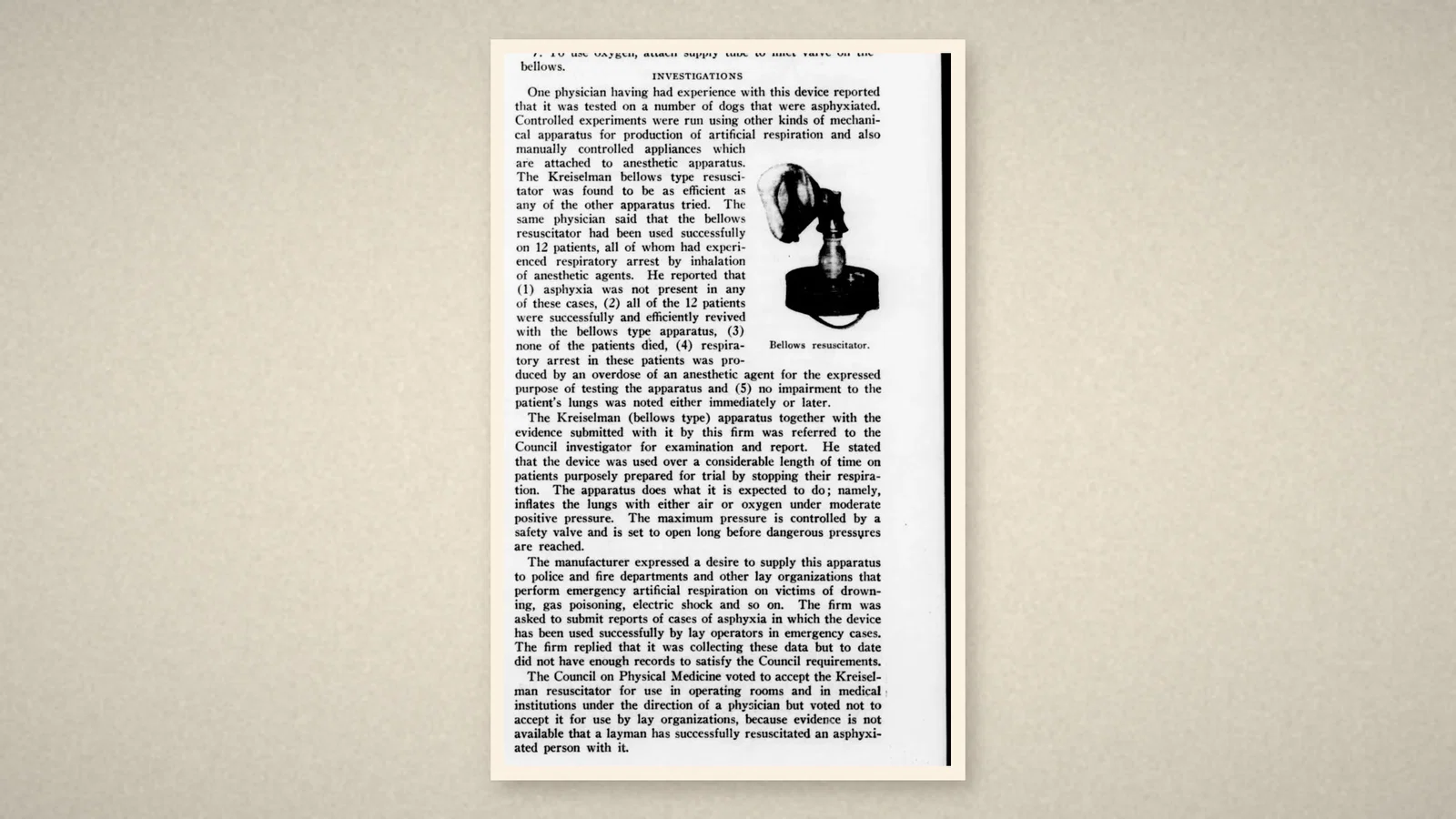
The evidence section is short, and it is uncomfortable to read now. One physician reported controlled experiments on asphyxiated dogs, in which the bellows performed as well as the other apparatus tried. The same physician reported 12 patients revived with it after respiratory arrest. None died, and no lung damage was seen. The arrests, the report says, had been "produced by an overdose of an anesthetic agent for the expressed purpose of testing the apparatus". The Council's own investigator described the device as used "on patients purposely prepared for trial by stopping their respiration", and found that it did what it was meant to do: it inflated the lungs with air or oxygen under moderate positive pressure, with a safety valve set to open well before dangerous pressures. [1, p. 99]
The decision
The manufacturer wanted to supply the resuscitator to police and fire departments and other lay groups who dealt with drowning, gas poisoning and electric shock. The Council asked for reports of successful use by lay operators. The firm replied that it was collecting them but did not yet have enough to meet the Council's requirements. The Council therefore voted to accept the device "for use in operating rooms and in medical institutions under the direction of a physician", but not for lay organizations, "because evidence is not available that a layman has successfully resuscitated an asphyxiated person with it". [1, p. 99]
The designer's case
By June 1945 the device was already being described in a teaching feature in Clinical Medicine as a hand bellows "approved by the Surgeon General's office of the Army", the Kreiselman Resuscitator Model No. 110. [2, p. 202]
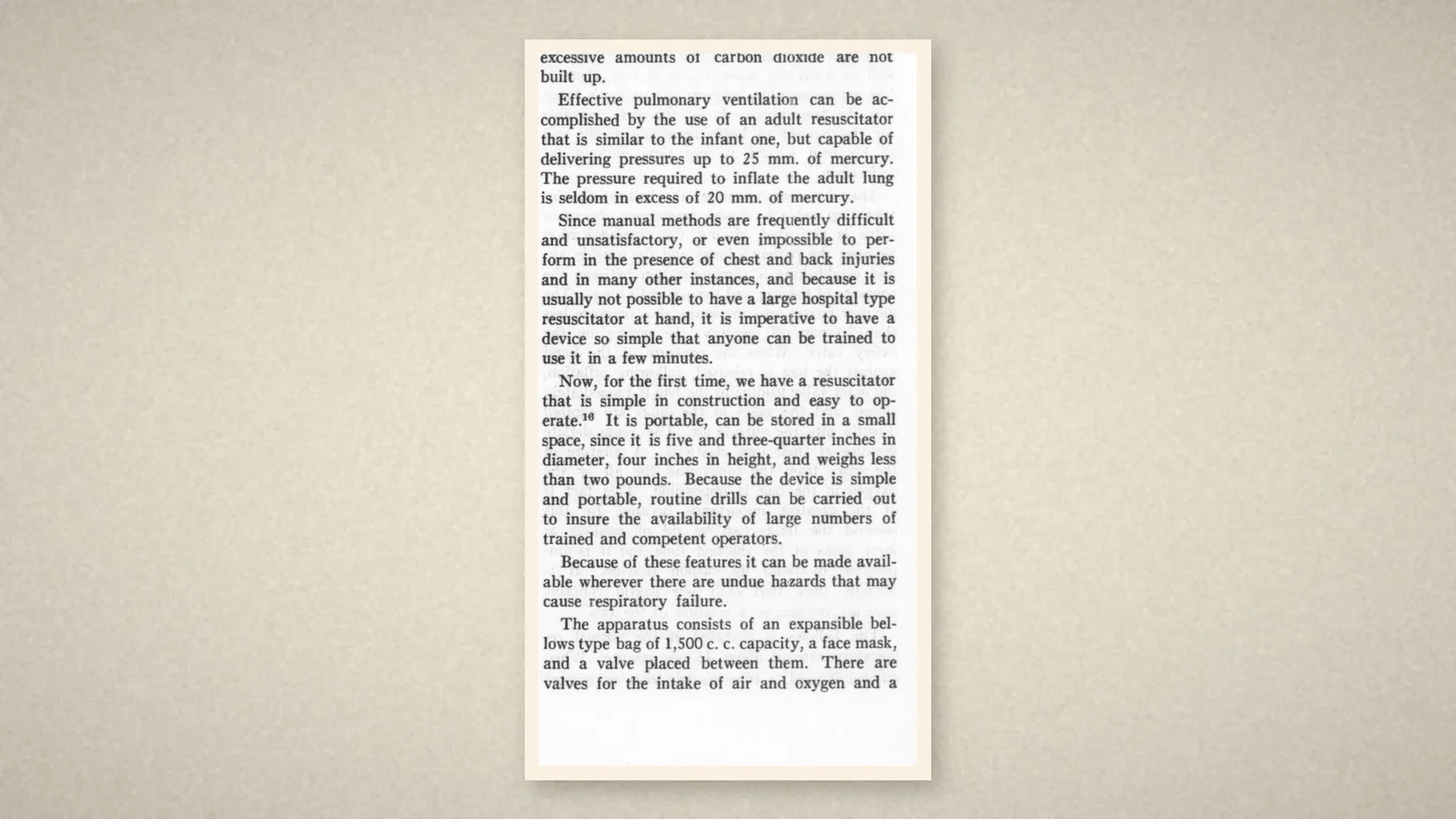
In September 1945 Joseph Kreiselman of Washington, D.C., published "The treatment of asphyxia" in the Southern Medical Journal; it had been read to the anaesthesia section of the Southern Medical Association the previous November. Kreiselman quoted Ralph Waters on physicians who "rush to the telephone to call rescue squads" while patients die. For newborns, an apparatus "was first described by Kreiselman, Kane and Swope in 1928", by the author's account, and had since become a heated bassinet with suction, a mask and controlled oxygen inflation. For adults, the paper argued that the first person on the scene had to start manual artificial respiration at once, but that manual methods were tiring and often ineffective, so a device was needed "so simple that anyone can be trained to use it in a few minutes". Kreiselman described the bellows as portable and light, usable with air at once and with oxygen when it arrived, and built so that expired gas went straight out and each new bagful held only fresh air or oxygen. [3, pp. 598-602]
What the record shows
A small, practical machine and a careful answer about who may use it. The Council accepted the evidence that the bellows worked in a doctor's hands, and refused to extend that to lay rescuers without evidence from lay rescuers. The same report also shows how that evidence was obtained, by stopping patients' breathing on purpose.
Sources and reading limits
Read: the Council on Physical Medicine report, JAMA 9 September 1944;126:98-99, in full; Kreiselman, "The treatment of asphyxia", Southern Medical Journal September 1945;38:598-602, in full; Clinical Medicine June 1945, "Graduate Course: Artificial Respiration", p. 202.
Not covered: Kreiselman, Kane and Swope's 1928 paper; the Council's 1942 report on the infant model, seen only as an index entry; the Army approval itself; any record of who supplied the 12 test cases; the manufacturer's catalogue; the Wood Library-Museum video.
Limits: the efficacy evidence is what the manufacturer submitted, as summarised by the Council. The physician who induced respiratory arrest in patients to test the device is not named, and the report says nothing about consent. "For the first time" in Kreiselman's paper is the author's claim. Pressures, rates, flows and volumes given in the sources are not repeated.
Three illustrations are crops of JAMA (1944, p. 99) and the Southern Medical Journal (1945, p. 601); one is a text diagram drawn from the Council report, with no apparatus drawn.
- Council on Physical Medicine. Kreiselman resuscitator bellows type, model 110, acceptable. JAMA. 1944;126(2):98-9. Internet Archive
- Graduate course: artificial respiration. Clin Med. 1945;52(6):202-3. Internet Archive
- Kreiselman J. The treatment of asphyxia. South Med J. 1945;38(9):598-602. Internet Archive
Continue exploring
Related reading connects shared questions and contexts; it does not by itself establish historical influence.
Anesthesia Epochs · The Source Room · About & Editorial Method
Published November 3, 2026. Sources and reading limits are stated above. Illustrations are labelled as original source images or AI-made. Historical accounts are educational; they are not current treatment instructions.