
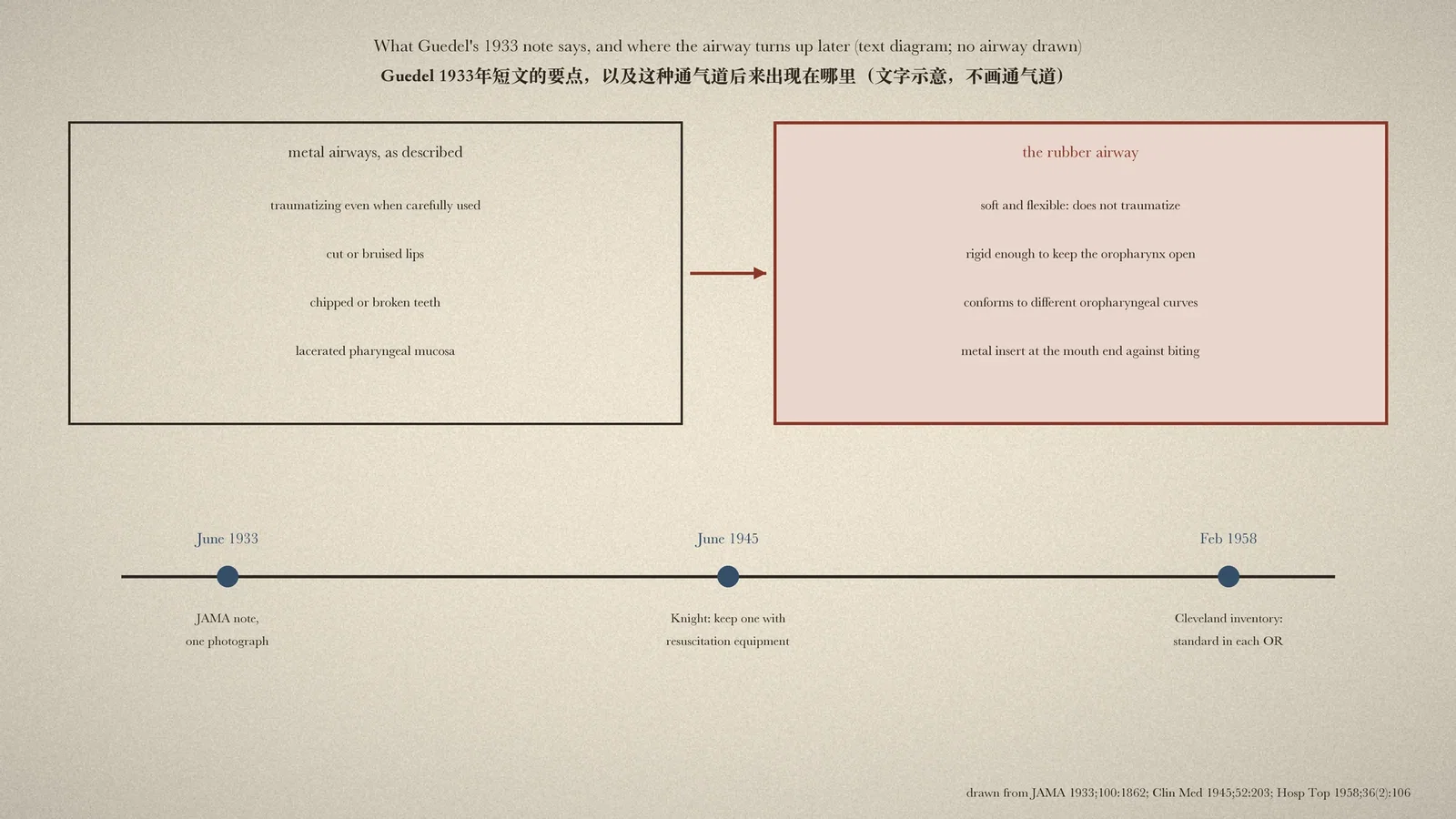
On 10 June 1933, under 'Clinical Notes, Suggestions and New Instruments', JAMA printed 'A nontraumatic pharyngeal airway' by Arthur E. Guedel of Beverly Hills: metal airways, even carefully used, cut lips, broke teeth and tore the pharyngeal mucosa; the new airway was made of rubber, soft and flexible enough not to injure yet rigid enough to keep the oropharynx open, conforming to different curves, with a metal insert at the mouth end to stop the teeth collapsing it. In 1945 Ralph T. Knight of Minnesota wrote that a Guedel rubber airway should always be kept with resuscitation equipment, and in 1958 a Cleveland hospital's anaesthesia inventory listed Guedel rubber airways first among the standard airway equipment of each operating room.
Reading Library · Anesthesia Epochs · 中文版
Watch the education video (for clinicians)
1933: Guedel's Rubber Pharyngeal Airway · Anesthesia Epochs Education Series
Some of the most familiar objects in anaesthesia arrived with very little fuss. The oral airway that carries Arthur Guedel's name was introduced in a note that fits in less than a column of a weekly journal, with a single photograph and no cases. [1]
The note
On 10 June 1933, JAMA printed under "Clinical Notes, Suggestions and New Instruments" a piece titled "A nontraumatic pharyngeal airway", by Arthur E. Guedel of Beverly Hills, California. The issue's index lists it as "nontraumatic pharyngeal airway", p. 1862. [1, p. 1862]
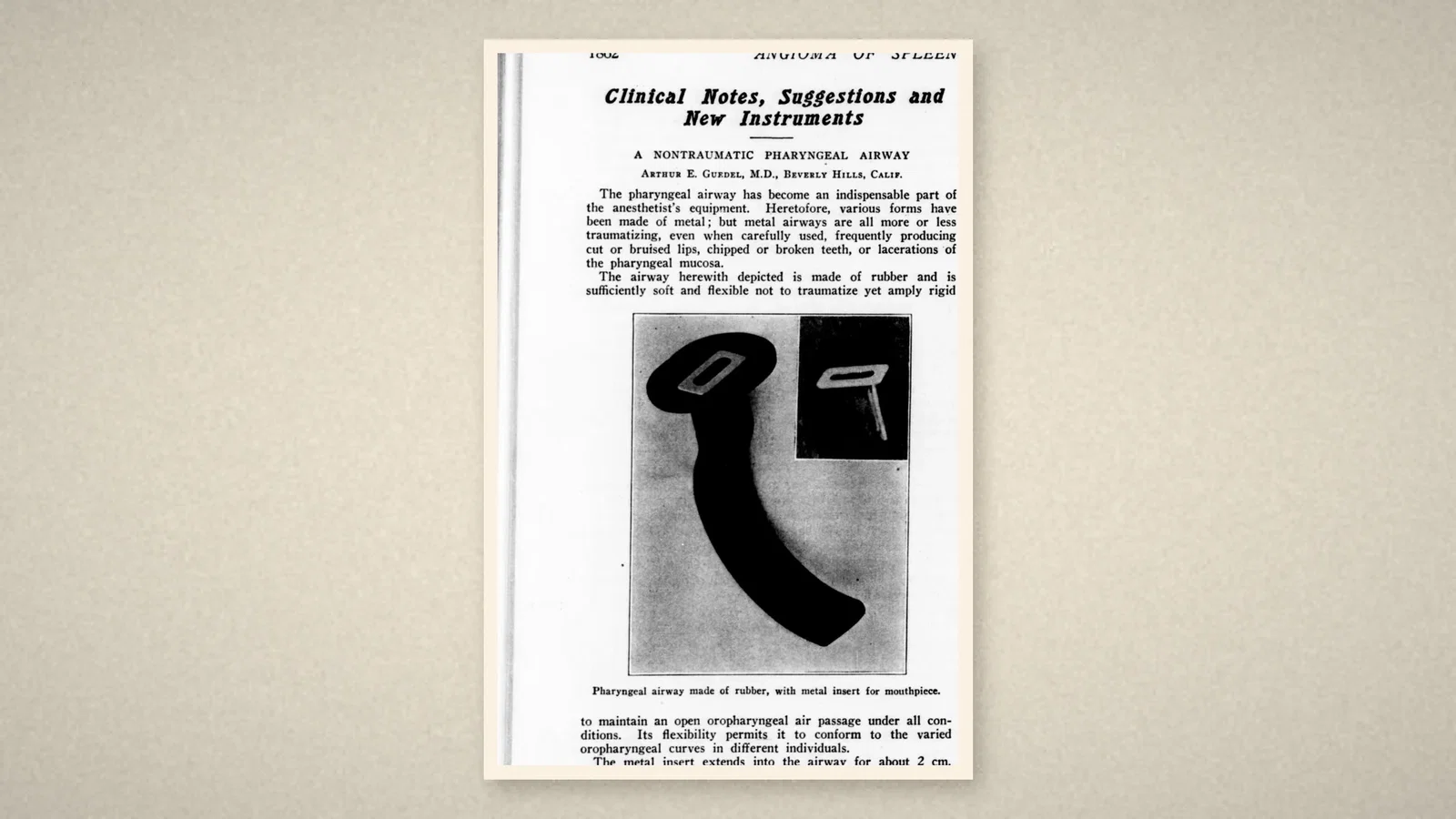
The argument is in the first sentences. "The pharyngeal airway has become an indispensable part of the anesthetist's equipment." So far, the various forms had been made of metal, and metal airways were "all more or less traumatizing, even when carefully used, frequently producing cut or bruised lips, chipped or broken teeth, or lacerations of the pharyngeal mucosa". [1, p. 1862]
The answer was a change of material. "The airway herewith depicted is made of rubber and is sufficiently soft and flexible not to traumatize yet amply rigid to maintain an open oropharyngeal air passage under all conditions." Because it was flexible, it could follow "the varied oropharyngeal curves in different individuals". One part was not rubber: a metal insert at the mouth end, which stopped the rubber from being squeezed shut between the teeth. The caption under the photograph reads: "Pharyngeal airway made of rubber, with metal insert for mouthpiece." [1, p. 1862]
That is the whole description. The note gives no series of patients, no comparison with metal airways and no range of sizes, and it does not say who manufactured the airway.
Twelve years later: part of resuscitation
In June 1945 the journal Clinical Medicine ran a "Graduate Course" feature on artificial respiration, with short discussions by several physicians. Ralph M. Waters of the University of Wisconsin argued that the best method was the one applied at once. Ralph T. Knight, director of anesthesia at the University of Minnesota Medical School, described the hospital approach: an anaesthesia machine, a tightly fitting mask and a bag of oxygen squeezed rhythmically, and a simple portable outfit of mask, bag and small oxygen cylinder to carry from floor to floor. [2, pp. 202-3]
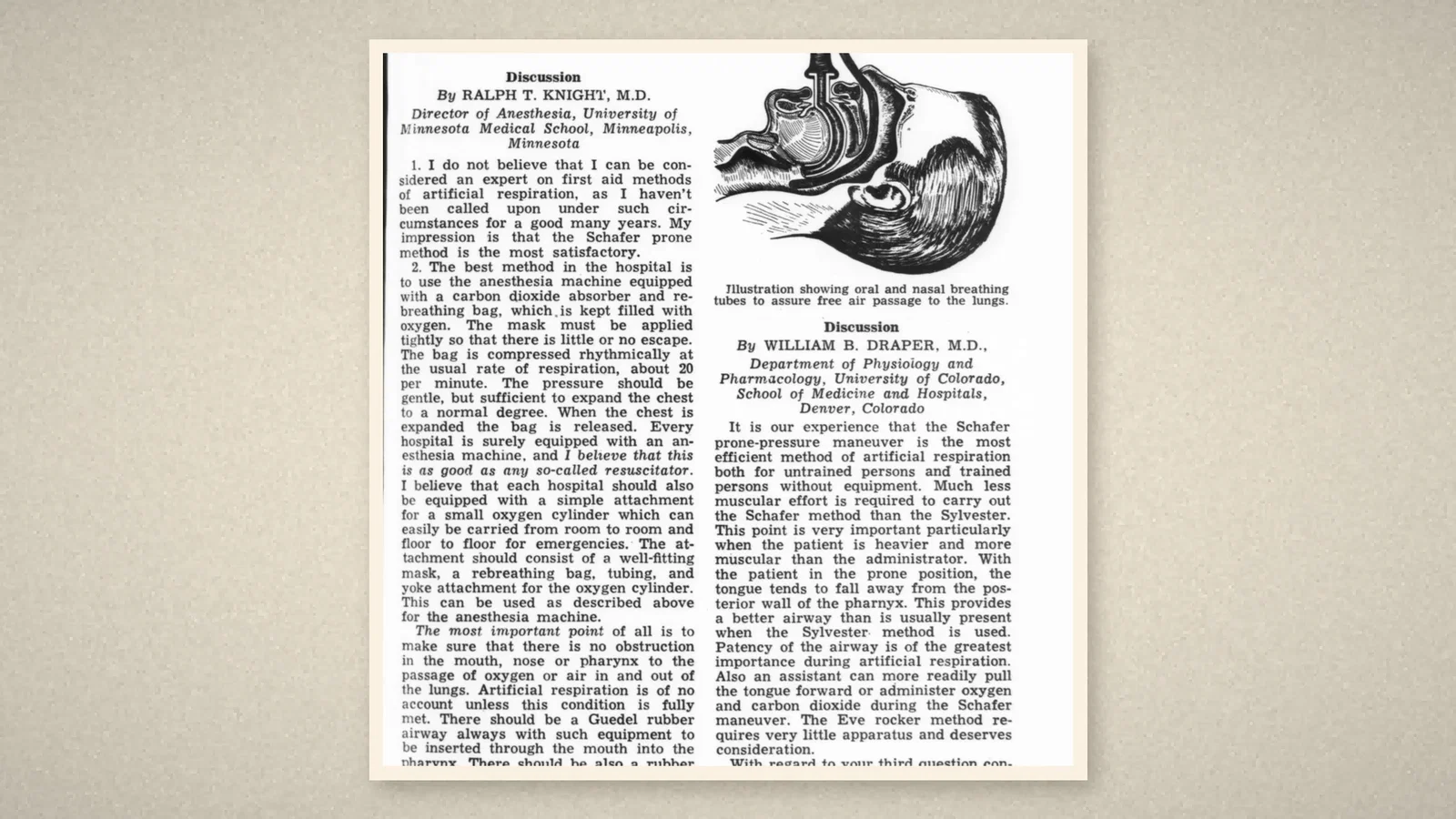
Then came Knight's main point. The most important thing was to make sure there was no obstruction in the mouth, nose or pharynx: "Artificial respiration is of no account unless this condition is fully met. There should be a Guedel rubber airway always with such equipment to be inserted through the mouth into the pharynx." By then the airway was referred to by name, without further description. [2, p. 203]
Twenty-five years later: an inventory line
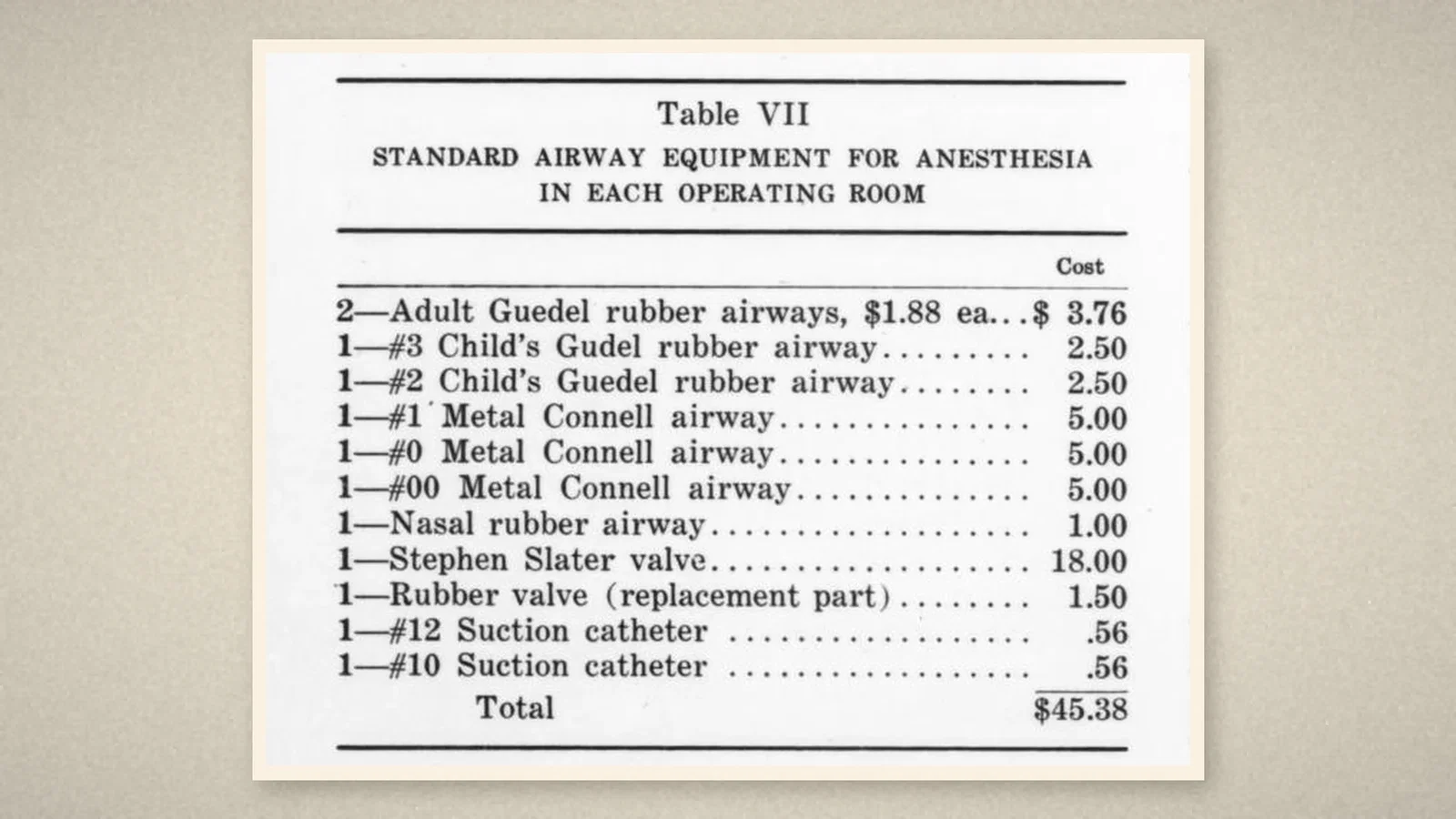
In February 1958 Robert A. Hingson, Edwin F. Ross and E. Christine Costley published in Hospital Topics an analysis of the cost of anaesthetic agents and equipment, to help departments and administrators plan their budgets. Table VII, "Standard airway equipment for anesthesia in each operating room", begins with adult and child Guedel rubber airways. Below them are still several sizes of metal Connell airway, a nasal rubber airway, valves and suction catheters. [3, pp. 105-6]
What the record shows
A short note that solved a practical problem by changing the material. Earlier airways held the pharynx open but injured lips, teeth and mucosa; Guedel's was soft enough to be safe and firm enough to work. The two later documents show where it ended up: in the resuscitation kit and on the standard list for every operating room. The 1958 table also shows that metal airways had not disappeared.
Sources and reading limits
Read: Guedel, "A nontraumatic pharyngeal airway", JAMA 10 June 1933;100:1862, in full; Clinical Medicine June 1945, "Graduate Course: Artificial Respiration", pp. 202-3, the discussions of Waters and Knight; Hingson, Ross and Costley, Hospital Topics February 1958, the cost analysis and Tables V to VIII.
Not covered: any patent or maker's description of the airway; Guedel's later writing on airway care; Wood Library-Museum material. The earlier metal airways belong to other articles in this series, Hewitt's of 1908 and Leech's of 1937.
Limits: the 1933 note is the whole published description read here; it reports no cases or measured benefit. The 1945 and 1958 documents show recommendation and inventory, not outcomes. Dimensions and prices are not repeated, and the office address printed under the note is left out of the crop.
Three illustrations are crops of JAMA (1933, p. 1862), Clinical Medicine (1945, p. 203) and Hospital Topics (1958, p. 106); one is a text diagram drawn from them, with no airway drawn.
- Guedel AE. A nontraumatic pharyngeal airway. JAMA. 1933;100(23):1862. Internet Archive
- Graduate course: artificial respiration. Discussions by Waters RM, Knight RT, Draper WB. Clin Med. 1945;52(6):202-3. Internet Archive
- Hingson RA, Ross EF, Costley EC. A current analysis of the cost of anesthetic agents. Hosp Top. 1958;36(2):105-6. Internet Archive
Continue exploring
Related reading connects shared questions and contexts; it does not by itself establish historical influence.
- 1920: Guedel Divides Ether's Third Stage into Four Strata
- 1931: Guedel and Waters' Cuffed Endotracheal Tube
Anesthesia Epochs · The Source Room · About & Editorial Method
Published November 3, 2026. Sources and reading limits are stated above. Illustrations are labelled as original source images or AI-made. Historical accounts are educational; they are not current treatment instructions.