
In the British Journal of Pharmacology of December 1956, J. Raventós of the Research Department of Imperial Chemical (Pharmaceuticals) Ltd. described 'The Action of Fluothane—A New Volatile Anaesthetic'. Earlier fluorinated compounds tried as non-explosive anaesthetics had caused severe hypotension and arrhythmias, or were still explosive. Among a series made by C. W. Suckling of ICI's General Chemicals Division, CF3CHClBr (Fluothane) was a non-inflammable volatile liquid with outstanding anaesthetic properties: in animals more potent than ether and chloroform, with rapid smooth induction and recovery and good relaxation, but lowering blood pressure and sensitising the heart to adrenaline; Johnstone was conducting clinical trials. In a lecture of May 1957, Suckling recalled that the search began in 1951 by asking anaesthetists what a good anaesthetic should do, worked from the stable, non-flammable Arcton refrigerants, and that halothane was 'at the time an unknown compound', specially made for testing.
Reading Library · Anesthesia Epochs · 中文版
Watch the education video (for clinicians)
1951: Halothane — Designing a Candidate · Anesthesia Epochs Education Series
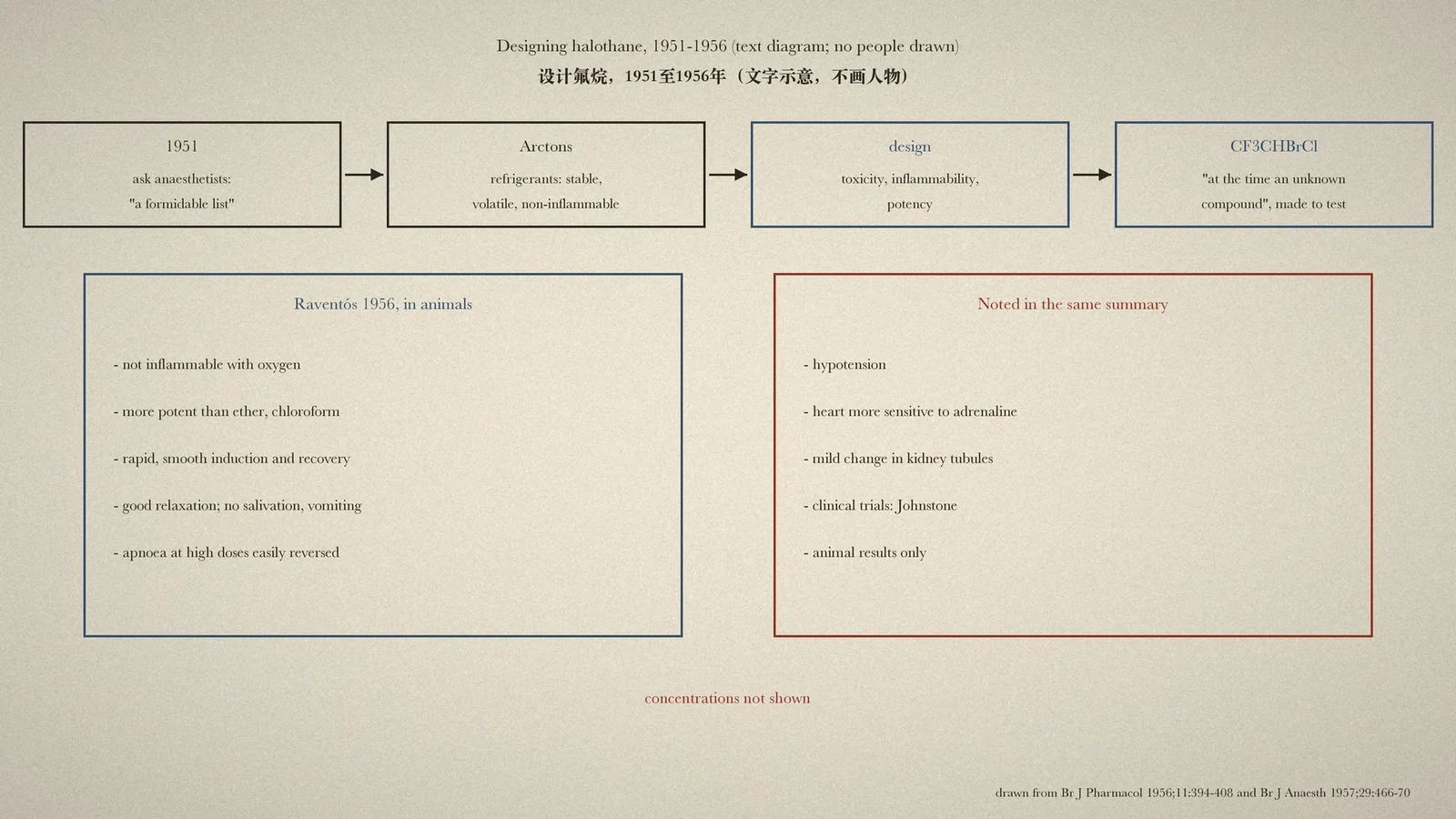
Ether and ethylene had been found and then tamed; divinyl ether had been predicted from structure. Halothane was chosen by a chemist in an industrial laboratory, working from a list of what anaesthetists wanted and from compounds sold for refrigerators and aerosol cans. Two papers from Imperial Chemical Industries (ICI), one on the animal pharmacology and one by the chemist looking back, show how it was done and what was already known to be wrong with it. [1, p. 466][1, p. 470][2, p. 394][2, p. 408]
A formidable list
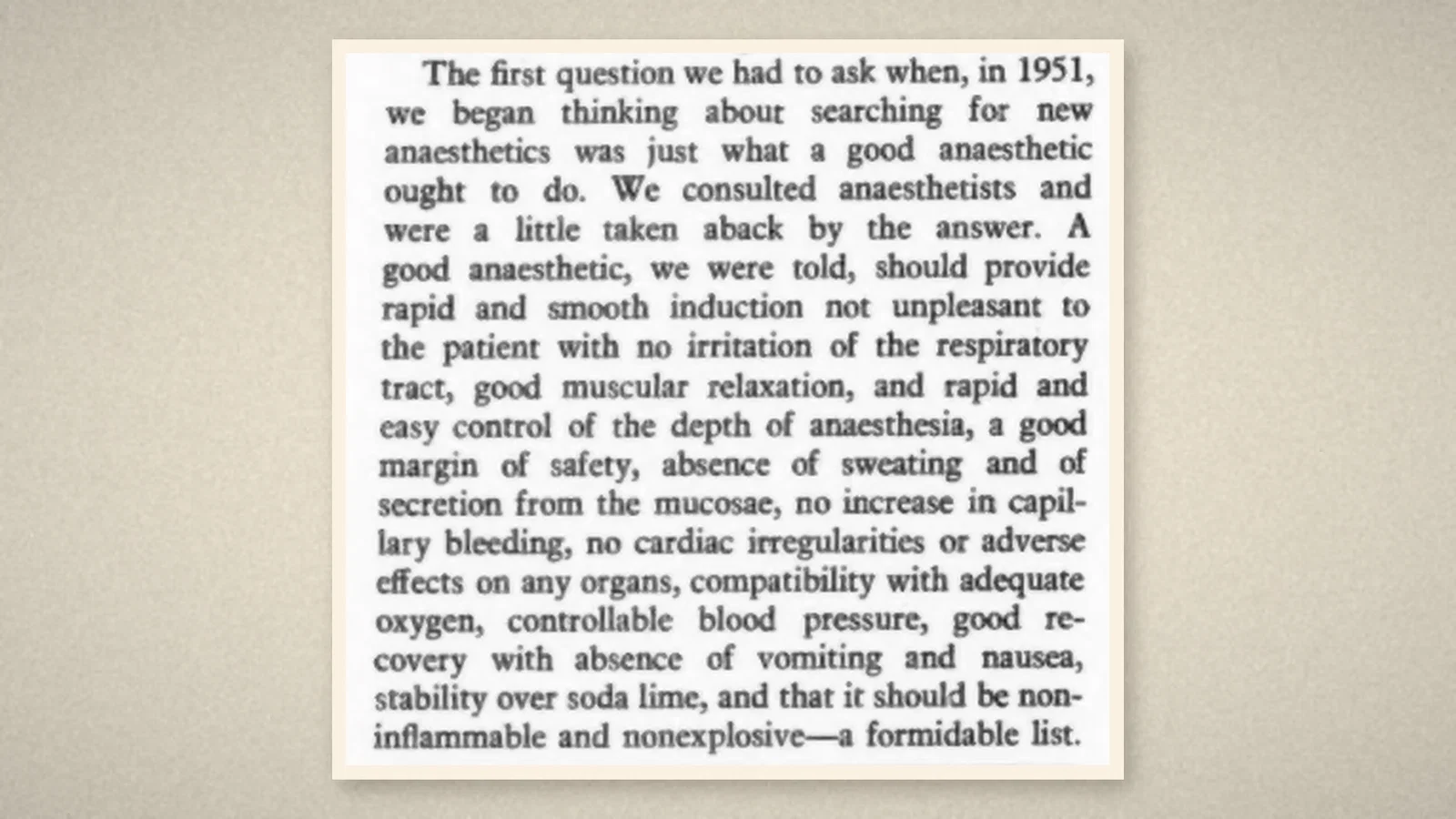
On 15 May 1957 C. W. Suckling, of the Research Department of ICI's General Chemicals Division at Widnes, lectured to the Section of Anaesthetics of the Manchester Medical Society; the British Journal of Anaesthesia printed the lecture that October. Suckling set out to show how chemistry and physics could help choose compounds to test, using "the discovery of halothane (Fluothane)" as the example. Three properties could be designed for: no chemical toxicity, no "inflammability and explosive hazards", and anaesthetic potency. [1, p. 466]
"The first question we had to ask when, in 1951, we began thinking about searching for new anaesthetics was just what a good anaesthetic ought to do." The chemists asked anaesthetists and "were a little taken aback by the answer". The list ran from smooth induction and good relaxation to a wide margin of safety, no cardiac irregularities, good recovery without vomiting, stability over soda lime, and, last, non-inflammability: "a formidable list". [1, p. 466]
From refrigerants
To reduce toxicity, Suckling worked with compounds that were chemically inert. The fluorinated paraffins were very stable, and ICI already made them under the trade name Arcton, as refrigerants and aerosol propellants. They were used for those purposes because of volatility, low toxicity and non-inflammability, "properties which are desirable in an anaesthetic inhalant". Earlier attempts had not gone well: compounds of this type tested on mice by Booth and Bixby in 1932 caused convulsions, and Robbins had tested forty-two compounds in 1946. [1, p. 467]
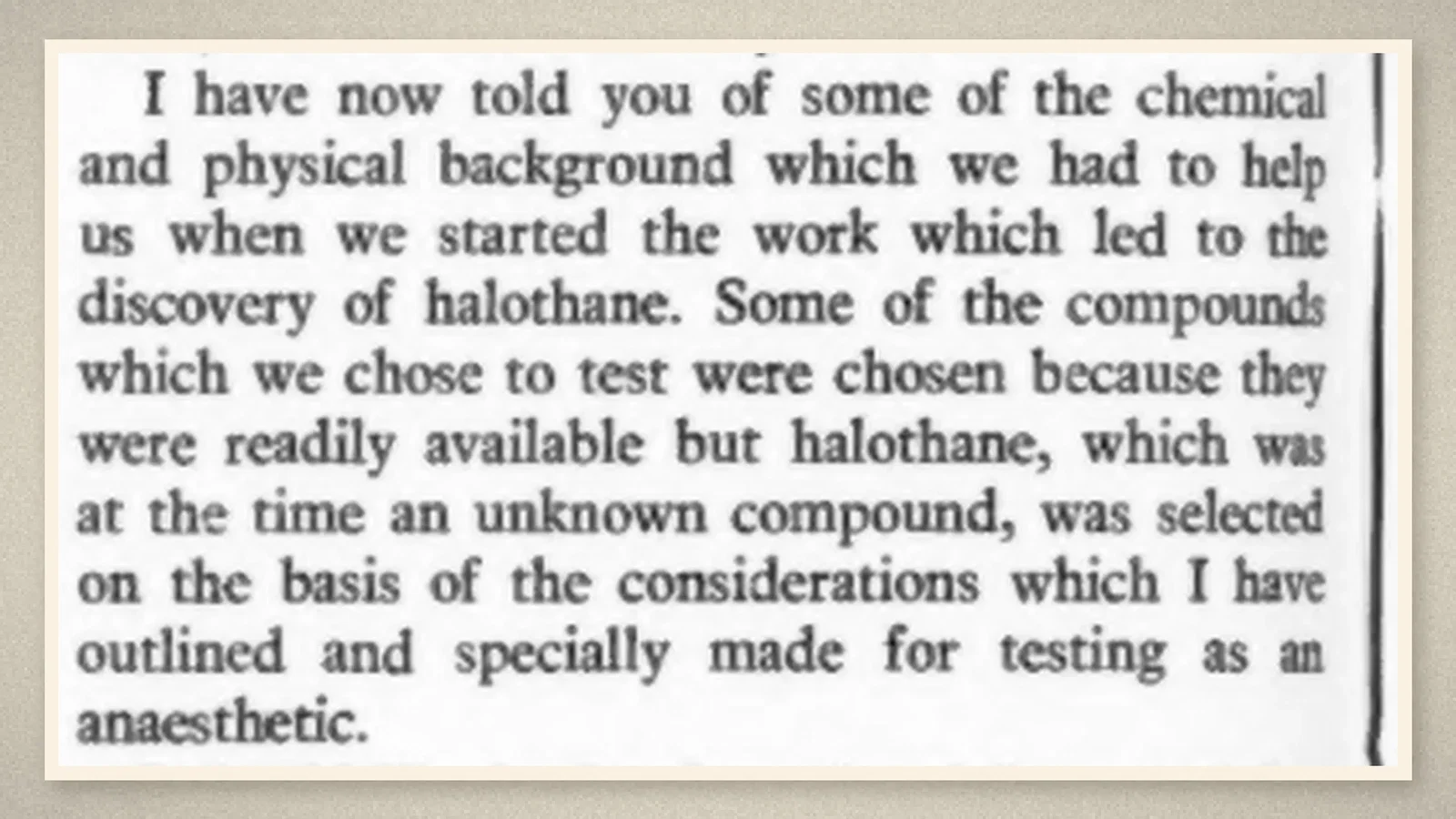
Some compounds were tested only because they were to hand. Halothane was different: it was "at the time an unknown compound", selected on these chemical and physical considerations and "specially made for testing as an anaesthetic". [1, p. 470]
In the animal laboratory
The animal work had appeared a year earlier. J. Raventós of the Research Department of Imperial Chemical (Pharmaceuticals) Ltd., Manchester, sent "The Action of Fluothane—A New Volatile Anaesthetic" to the British Journal of Pharmacology on 31 May 1956. Earlier searches for a non-explosive agent had found fluorinated compounds that caused "intense hypotension" and abnormal heart rhythms, or that were still explosive with oxygen. Among the fluorinated hydrocarbons that Suckling had made, CF3CHClBr was "a non-inflammable volatile liquid with outstanding anaesthetic properties". [2, p. 394]
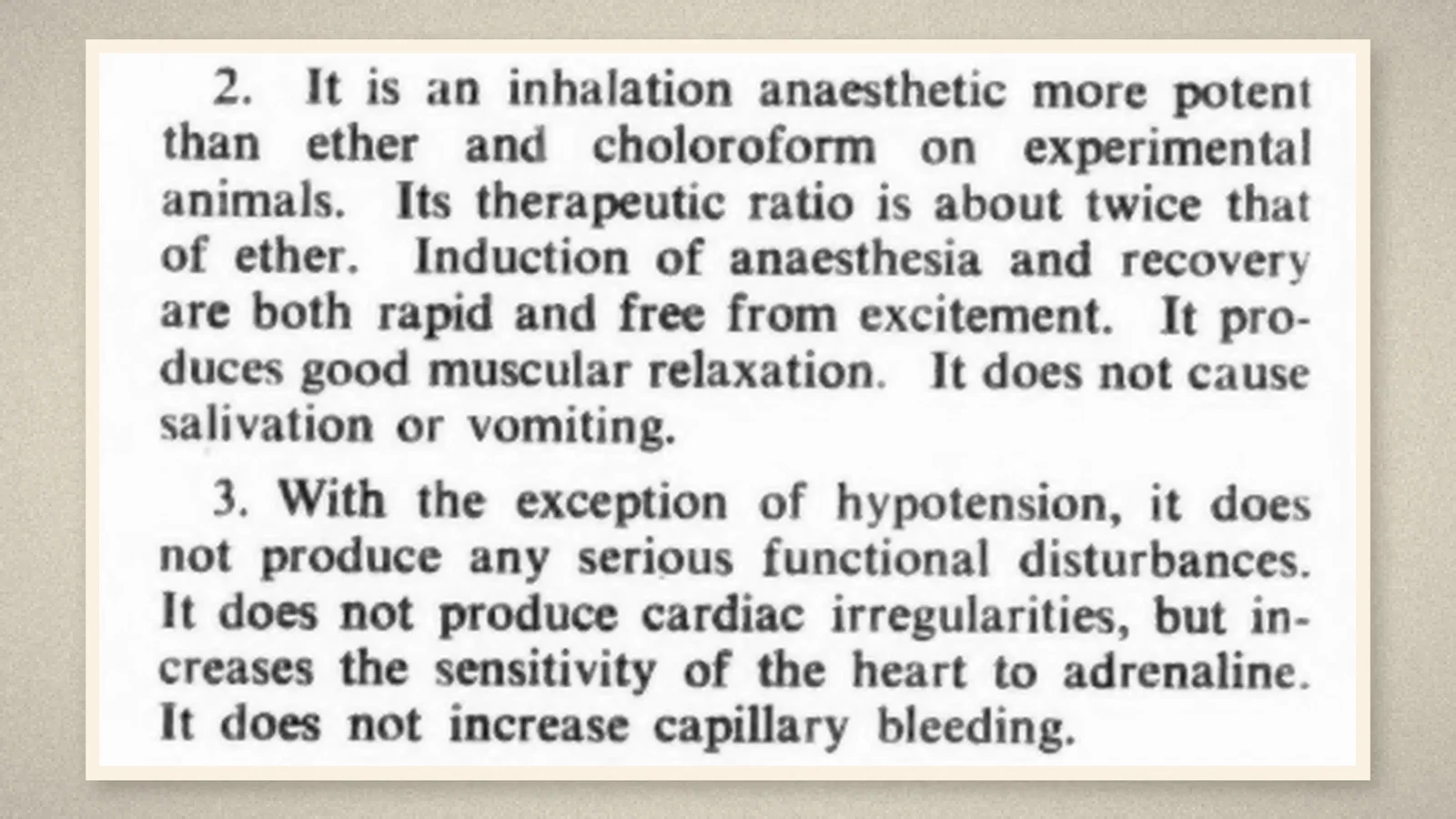
The summary set out both sides. In experimental animals it was "more potent than ether and chloroform"; induction and recovery were rapid "and free from excitement"; relaxation was good, and it caused neither salivation nor vomiting. But it lowered blood pressure, and although it caused no irregularities by itself, it "increases the sensitivity of the heart to adrenaline". High concentrations stopped breathing, though the apnoea was easily reversed. A note at the end says clinical trials were being carried out by Dr. M. Johnstone and that results in 500 patients had since been published. [2, p. 408]
What the record shows
An anaesthetic designed against a checklist. The chemistry answered the danger that had followed ether and ethylene into the operating room: it would not burn. The pharmacology, in the same pages, recorded the price in animals: lower blood pressure and a heart more sensitive to adrenaline. How these turned out in patients is for the clinical article.
Sources and reading limits
Read: C. W. Suckling, "Some Chemical and Physical Factors in the Development of Fluothane", British Journal of Anaesthesia 1957;29:466 onwards, pp. 466-470 closely, the later theory section skimmed; J. Raventós, "The Action of Fluothane—A New Volatile Anaesthetic", British Journal of Pharmacology 1956;11:394-410, the opening and summary closely, the methods and results skimmed.
Not covered: ICI's patent and laboratory records of the first synthesis; Booth and Bixby's and Robbins's papers; Johnstone's clinical paper, which belongs to a separate article; later reports of liver damage and arrhythmias.
Limits: some timelines date this event to 1951-1953. Suckling dates the start of the search to 1951, but neither paper gives the date the compound was first made, so no synthesis date is given here. Raventós's findings are in animals. Concentrations, boiling points and vapour pressures are not repeated, and the page crops leave them out. Some first names were not printed in full in the pages read and are not given.
Three illustrations are crops of the British Journal of Anaesthesia of October 1957 (pp. 466 and 470) and the British Journal of Pharmacology of December 1956 (p. 408); one is a text diagram drawn from both papers, with no people drawn and no concentrations shown.
- Suckling CW. Some chemical and physical factors in the development of Fluothane. Br J Anaesth. 1957;29(10):466-72. Internet Archive
- Raventós J. The action of Fluothane—a new volatile anaesthetic. Br J Pharmacol. 1956;11(4):394-410. Internet Archive
Continue exploring
Related reading connects shared questions and contexts; it does not by itself establish historical influence.
- 1923: Luckhardt and Carter Breathe Ethylene and Oxygen Themselves
- 1930: Leake and Chen Reason Their Way to Divinyl Ether
- 1951: Thesleff Brings Succinylcholine into the Operating Room
- 1956: Johnstone's Halothane, a Nonflammable Agent Still Needing Measurement
Anesthesia Epochs · The Source Room · About & Editorial Method
Published November 3, 2026. Sources and reading limits are stated above. Illustrations are labelled as original source images or AI-made. Historical accounts are educational; they are not current treatment instructions.