
In the British Journal of Anaesthesia of October 1952, S. Thesleff, O. v. Dardel and G. Holmberg of the Karolinska Institutet and Karolinska Sjukhuset, Stockholm, described 'Succinylcholine Iodide: A New Muscular Relaxant'. The compound had been found in 1906 by Hunt and Taveau, who did not discover its paralysing effect; Bovet demonstrated that in 1949. It acted quickly and briefly, was broken down rapidly by esterases, and had no antidote. Since January 1951 it had been used more than a thousand times at Karolinska Sjukhuset, in surgery and in electroshock treatment, with good results. In the same issue Nancy S. G. Butt of Liverpool reported a thousand thoracic cases and unanimous support for it in bronchoscopy, while listing recent reports of prolonged respiratory paralysis. In the New England Journal of Medicine that month, Francis F. Foldes and colleagues in Pittsburgh used it by infusion in 202 patients and called it the closest to the ideal relaxant.
Reading Library · Anesthesia Epochs · 中文版
Watch the education video (for clinicians)
1951: Succinylcholine — Speed and Recovery · Anesthesia Epochs Education Series
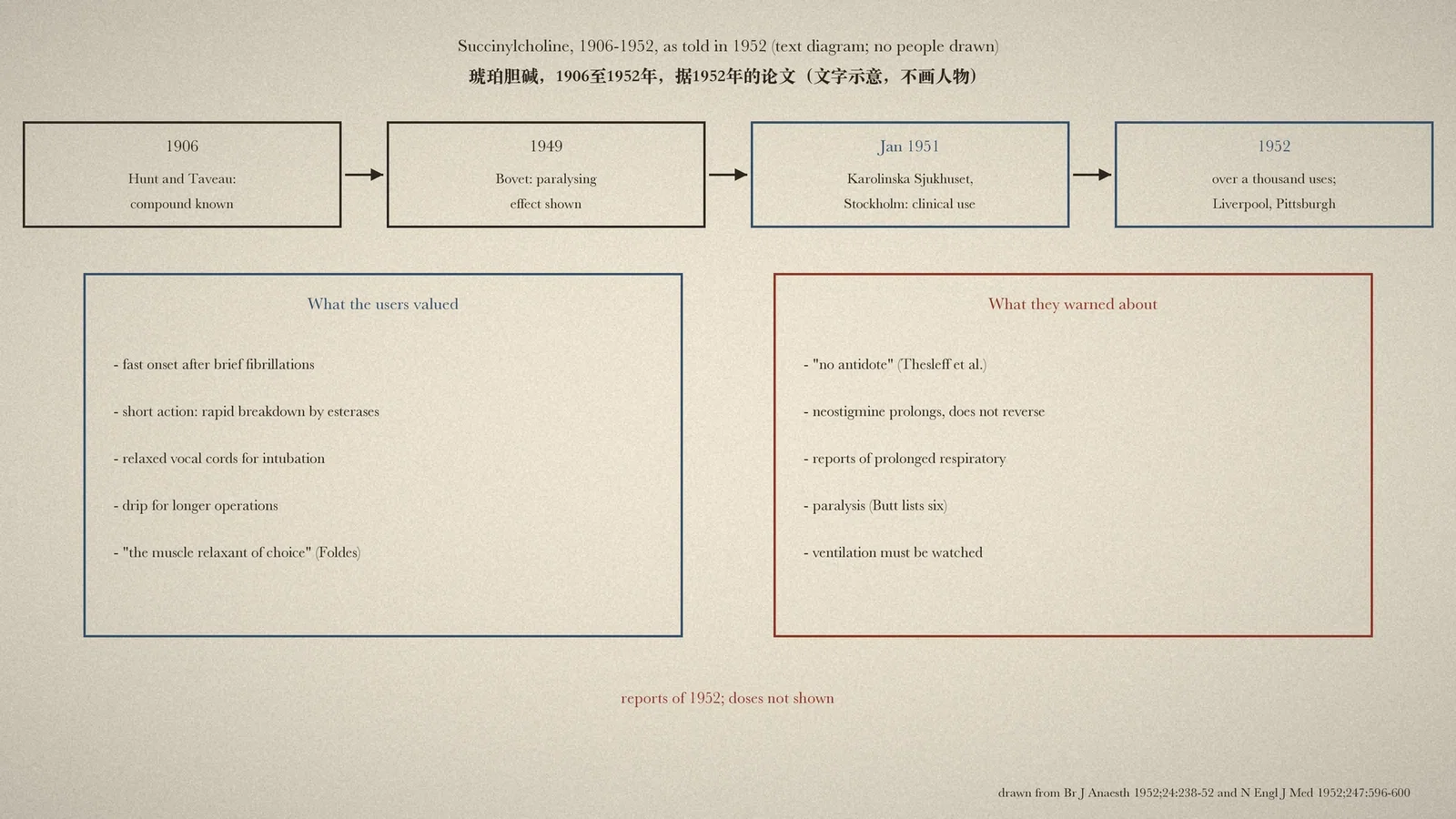
Succinylcholine is an old molecule with a short clinical history. By 1952 it had gone from a compound nobody used to the relaxant of choice in some hospitals, and the same journals that praised it were already listing patients who did not start breathing again. This article reads three papers from October 1952, from Stockholm, Liverpool and Pittsburgh. [1, p. 238][2, p. 249][3, p. 600]
An old molecule
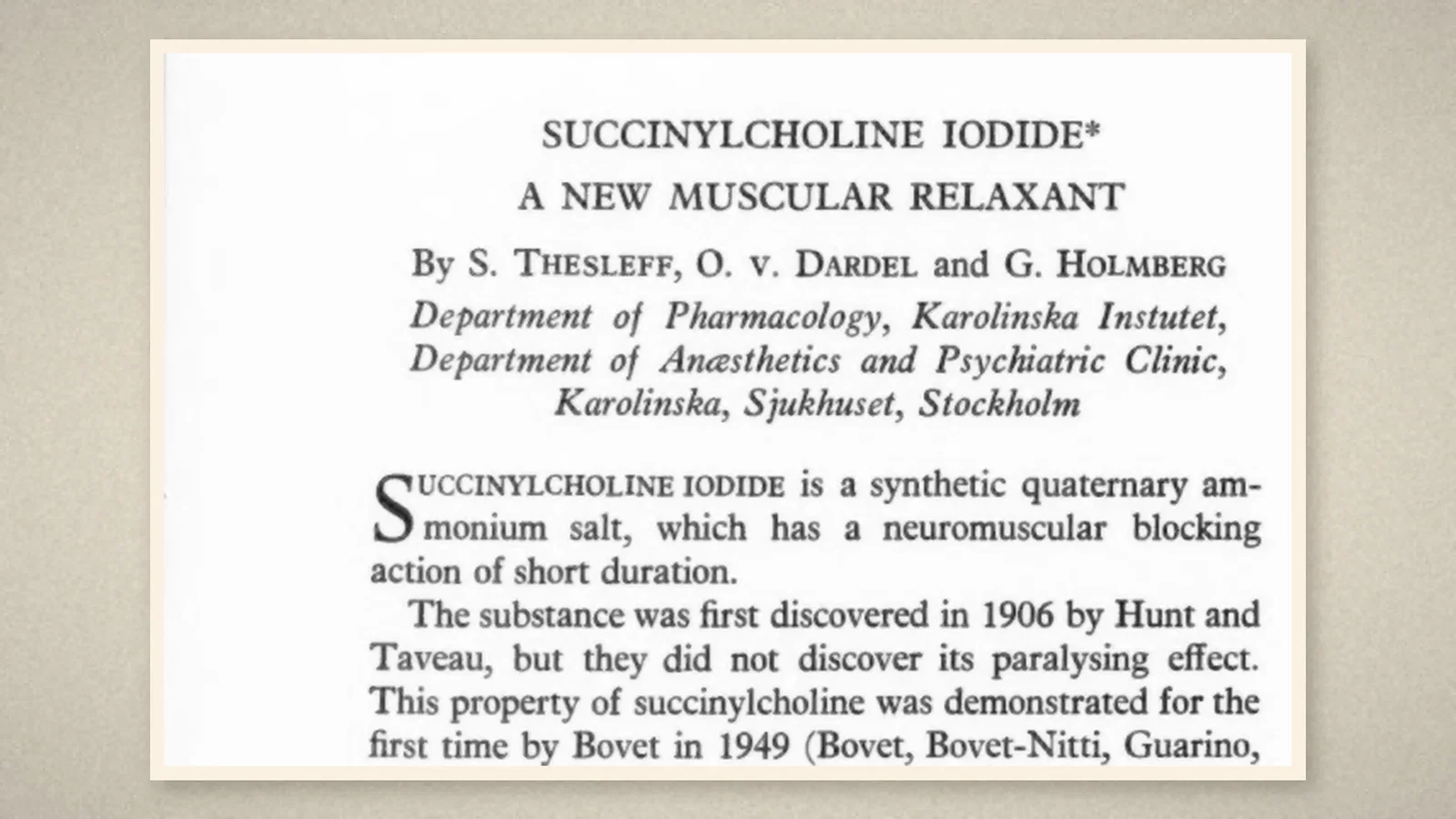
"Succinylcholine Iodide: A New Muscular Relaxant" was written by S. Thesleff, O. v. Dardel and G. Holmberg of the Karolinska Institutet and Karolinska Sjukhuset in Stockholm, from pharmacology, anaesthetics and psychiatry. They began with its history. "The substance was first discovered in 1906 by Hunt and Taveau, but they did not discover its paralysing effect." That property, they wrote, was demonstrated "for the first time by Bovet in 1949", and Bovet also showed that cholinesterases broke it down. The iodide used in Stockholm was made by Löw and Tammelin in 1950. [1, p. 238]
Rapid breakdown by esterases, probably into succinic acid and choline, explained its "short duration of its action and extremely low toxicity". The authors thought it worked differently from d-tubocurarine, "by depolarizing the muscle end-plate". After an intravenous injection the muscles relaxed within seconds, preceded by "very transient muscular fibrillations", which they considered harmless. They saw no notable effect on blood pressure and no release of histamine. [1, p. 238][1, p. 239]
No antidote
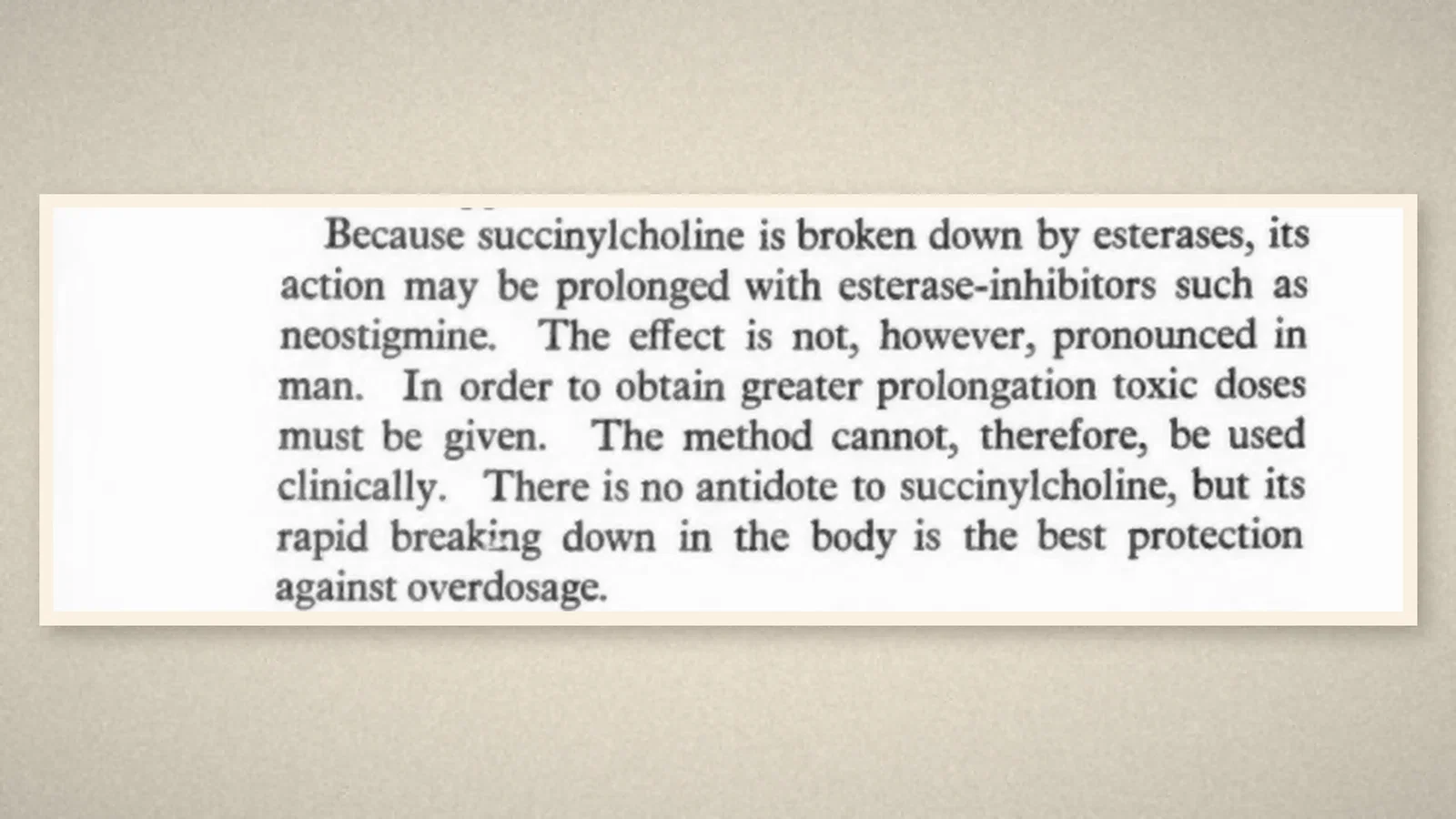
One sentence in the Stockholm paper set out the bargain. Neostigmine, which prolongs the action of succinylcholine, did not reverse it, and "There is no antidote to succinylcholine, but its rapid breaking down in the body is the best protection against overdosage." The drug could be given by drip to keep a patient paralysed for hours, with the depth easy to control. [1, p. 240]
"Since January 1951", the authors reported, it had been used at Karolinska Sjukhuset "more than 1,000" times: 132 surgical operations, 512 electroshock treatments at the Psychiatric Clinic, and operations on out-patients, in all age groups except infants. It went with every common anaesthetic, for intubation and abdominal surgery. They saw no complications they could blame on it, and their summary said that "In every case the results were good". [1, p. 240][1, p. 241][1, p. 243]
A thoracic unit, and a warning
In the same issue Nancy S. G. Butt of the Liverpool Thoracic Surgical Centre reported its use for bronchoscopy. After Bovet's group and, "independently in this country", Buttle and Zaimis had shown its action in 1949, there had been much discussion of its merits and demerits. Rapid relaxation of the vocal cords made the bronchoscope easy to pass, and opinion in the unit was "now unanimously in favour" of succinylcholine. [2, p. 245][2, p. 249]
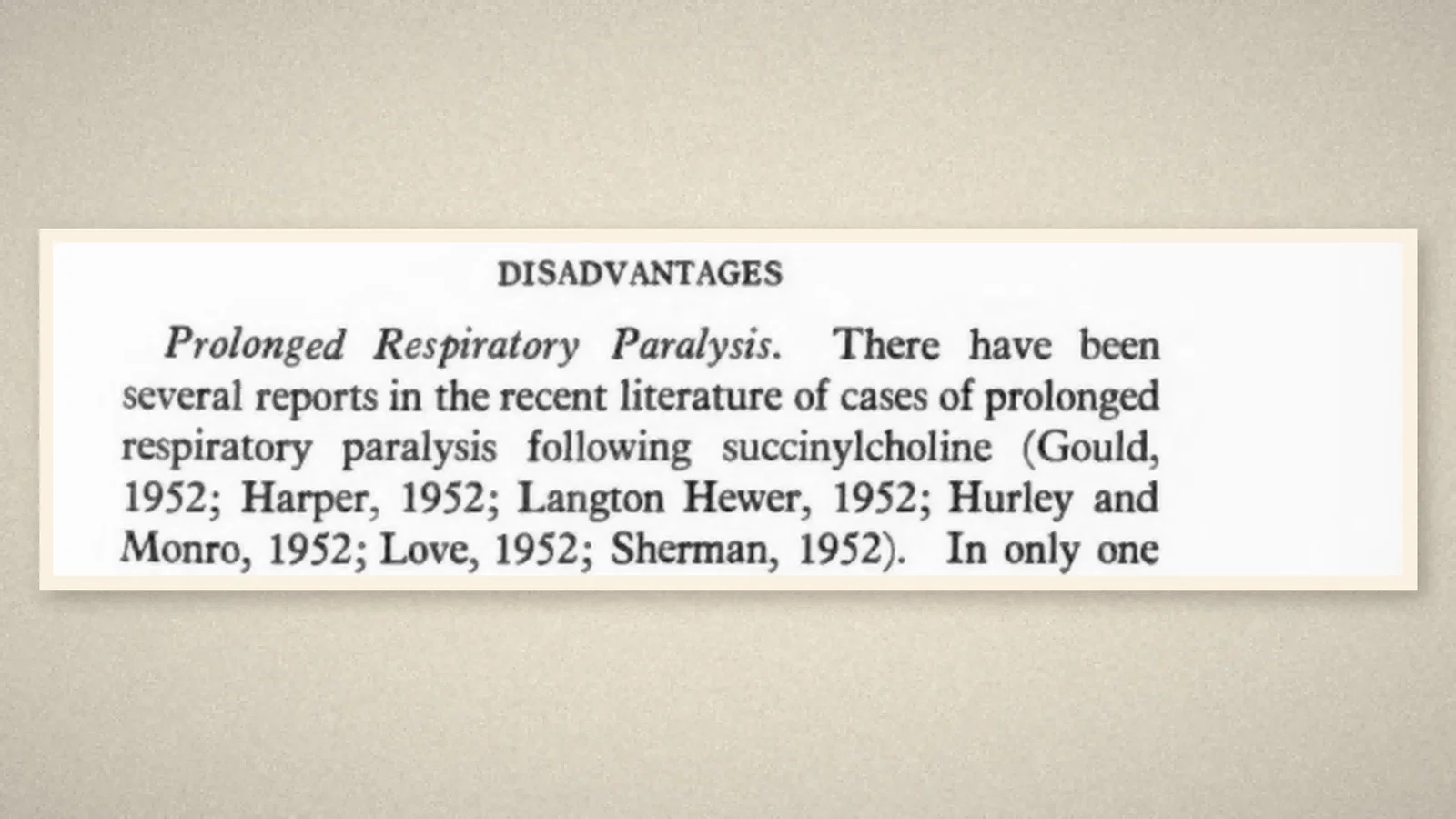
But Butt also wrote a section headed "Disadvantages". There had been "several reports in the recent literature of cases of prolonged respiratory paralysis following succinylcholine", and Butt listed six of them, all from 1952. In Butt's own series of a thousand, only one patient stayed apnoeic for more than six minutes after a single dose. [2, p. 249][2, p. 250]
Pittsburgh
On 16 October 1952, the New England Journal of Medicine printed "Succinylcholine: A New Approach to Muscular Relaxation in Anesthesiology" by Francis F. Foldes, Pearl G. McNall and Jose M. Borrego-Hinojosa of the Mercy Hospital, Pittsburgh. They described the ideal relaxant: specific and fast, easy to control, with a wide margin between relaxation and respiratory arrest, and quick, complete recovery. The earlier agents "all fell short". In 202 unselected consecutive patients, succinylcholine given by continuous infusion came closest. Ten patients in the series died after operation; the authors found no connection with the drug. On limited experience, it seemed "the muscle relaxant of choice". [3, p. 596][3, p. 597][3, p. 598][3, p. 600]
What the record shows
A drug that waited more than forty years for its use, and then spread within two years. The early reports praised its speed and its short action, and the same reports carried the problem: once given, it could not be undone, and some patients stayed paralysed longer than expected. Why that happened is not explained in these pages.
Sources and reading limits
Read: S. Thesleff, O. v. Dardel and G. Holmberg, "Succinylcholine Iodide: A New Muscular Relaxant", British Journal of Anaesthesia 1952;24:238-244, in full; Nancy S. G. Butt, "A Report on the Use of Succinylcholine Chloride in a Thoracic Unit", same issue pp. 245-252, the opening, observations and "Disadvantages", the rest skimmed; Francis F. Foldes, Pearl G. McNall and Jose M. Borrego-Hinojosa, "Succinylcholine: A New Approach to Muscular Relaxation in Anesthesiology", New England Journal of Medicine 16 October 1952;247:596-600, the opening, methods, deaths and summary, the tables skimmed.
Not covered: Hunt and Taveau's paper of 1906; Bovet and colleagues of 1949; Buttle and Zaimis of 1949; Thesleff's own earlier reports; the reports from Vienna and London of 1951-1952; the six reports of prolonged paralysis that Butt cites; later work on why some patients stay paralysed.
Limits: the wider story has several steps; this article reads only the 1952 papers, so the 1906 and 1949 steps, and Bovet's priority, are reported as these authors state them. "In every case the results were good" is the Stockholm authors' own claim. Doses, infusion rates and concentrations are not repeated, and the page crops leave them out. Patients are not identified. The first names of Hunt, Taveau and Bovet were not read and are not given.
Three illustrations are crops of the British Journal of Anaesthesia of October 1952 (pp. 238, 240 and 249); one is a text diagram drawn from the three papers, with no people drawn and no doses shown.
- Thesleff S, von Dardel O, Holmberg G. Succinylcholine iodide: a new muscular relaxant. Br J Anaesth. 1952;24(4):238-44. Internet Archive
- Butt NSG. A report on the use of succinylcholine chloride in a thoracic unit. Br J Anaesth. 1952;24(4):245-52. Internet Archive
- Foldes FF, McNall PG, Borrego-Hinojosa JM. Succinylcholine: a new approach to muscular relaxation in anesthesiology. N Engl J Med. 1952;247(16):596-600. Internet Archive
Continue exploring
Related reading connects shared questions and contexts; it does not by itself establish historical influence.
- 1931: Roche Picks Prostigmin from 44 Physostigmine Analogues
- 1949: Decamethonium and Gallamine Tried in Man
- 1940–1952: From Curare to Succinylcholine in Convulsive Therapy
Anesthesia Epochs · The Source Room · About & Editorial Method
Published November 3, 2026. Sources and reading limits are stated above. Illustrations are labelled as original source images or AI-made. Historical accounts are educational; they are not current treatment instructions.