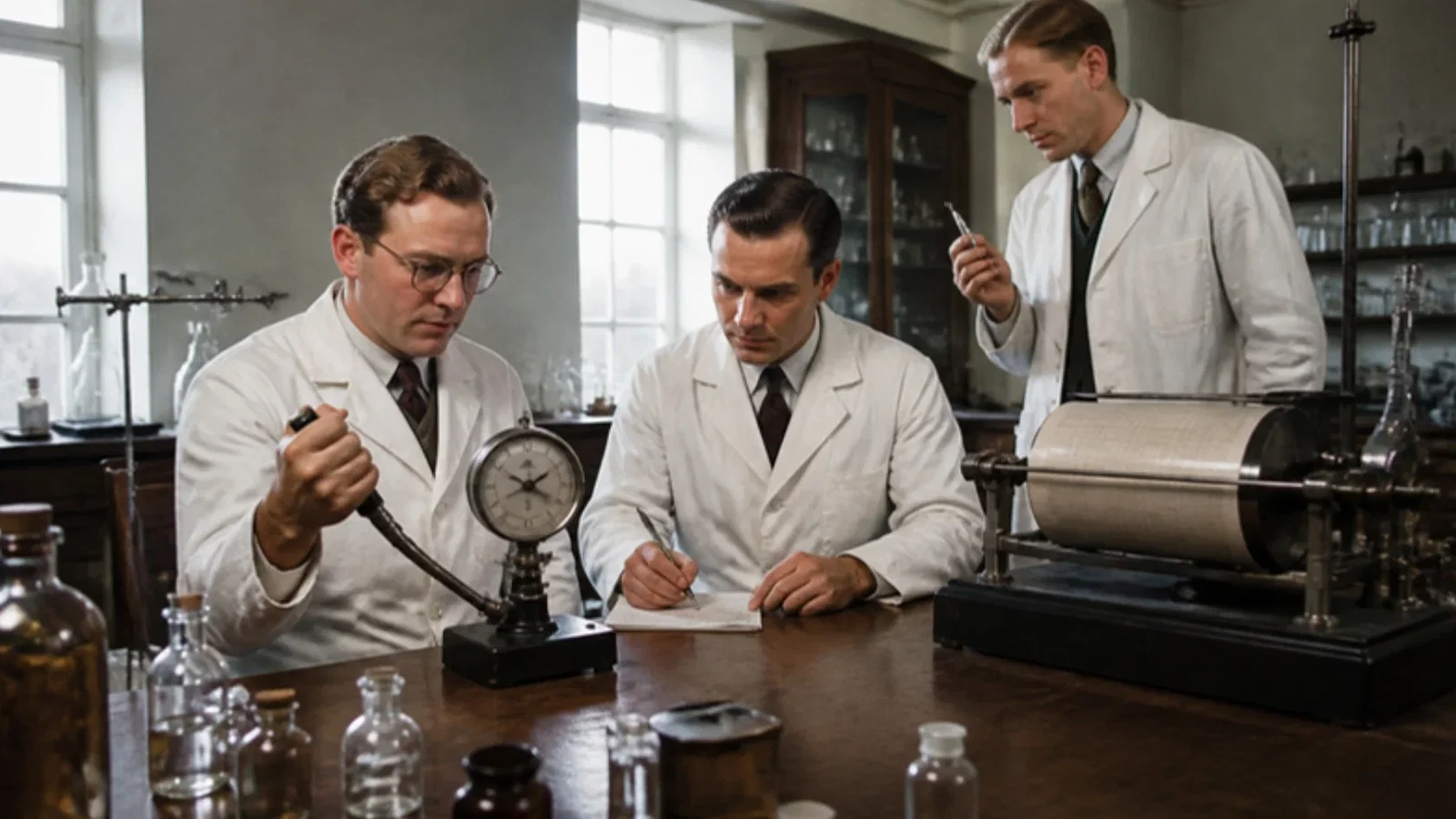
The synthetic C10 is tried on three volunteers whose initials match the authors; Mushin's group tries Flaxedil in conscious volunteers and 45 surgical patients: two early synthetic relaxants after curare.
Reading Library · Anesthesia Epochs · 中文版
Watch the education video (for clinicians)
1949: Decamethonium and Gallamine — Two Synthetic Relaxants · Anesthesia Epochs Education Series
Anaesthetists today choose from a range of synthetic muscle relaxants by duration and mechanism. In the years after the Second World War that range was only beginning: curare (d-tubocurarine) had entered the operating theatre, and the first synthetic compounds were moving from laboratory to patient. This article reads two papers in the Lancet of 1949: Organe, Paton and Zaimis's report on C10 (decamethonium) and C5 on 1 January, and Mushin and colleagues' report on Flaxedil (gallamine) on 30 April.
C10: three volunteers
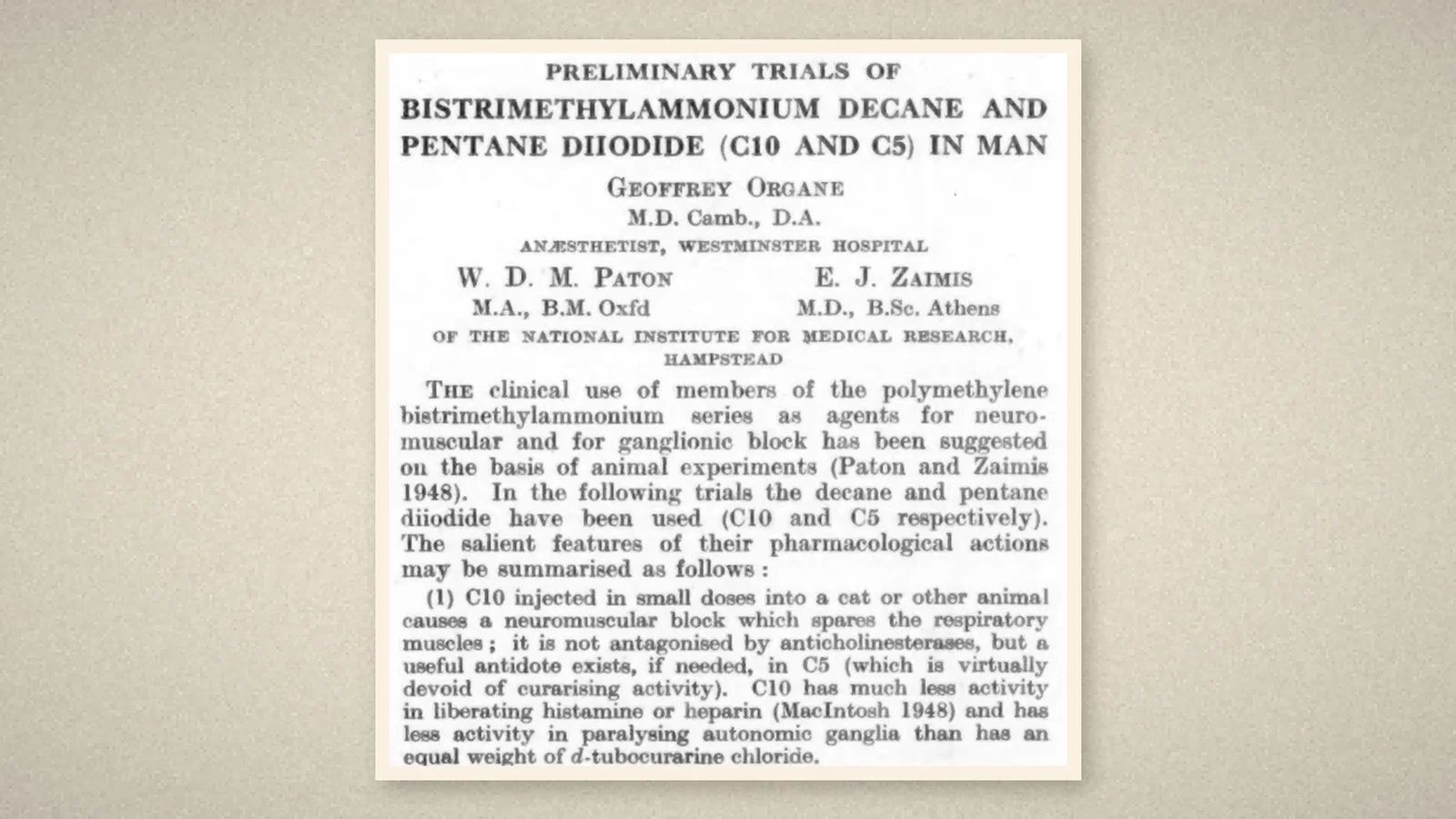
Organe was anaesthetist at Westminster Hospital; Paton and Zaimis came from the "National Institute for Medical Research", Hampstead. The clinical use of the polymethylene bistrimethylammonium series as neuromuscular and ganglion blockers had been suggested "on the basis of animal experiments" (Paton and Zaimis 1948), and the decane and pentane diiodides, C10 and C5, were used. [1, p. 21] In cats C10 gave a block sparing the respiratory muscles; it was "not antagonised by anticholinesterases", but C5, virtually without curarising action, was a useful antidote; "C5 is powerful in paralysing autonomic ganglia". With C10 there was "great variation of" potency between species. [1, p. 21]
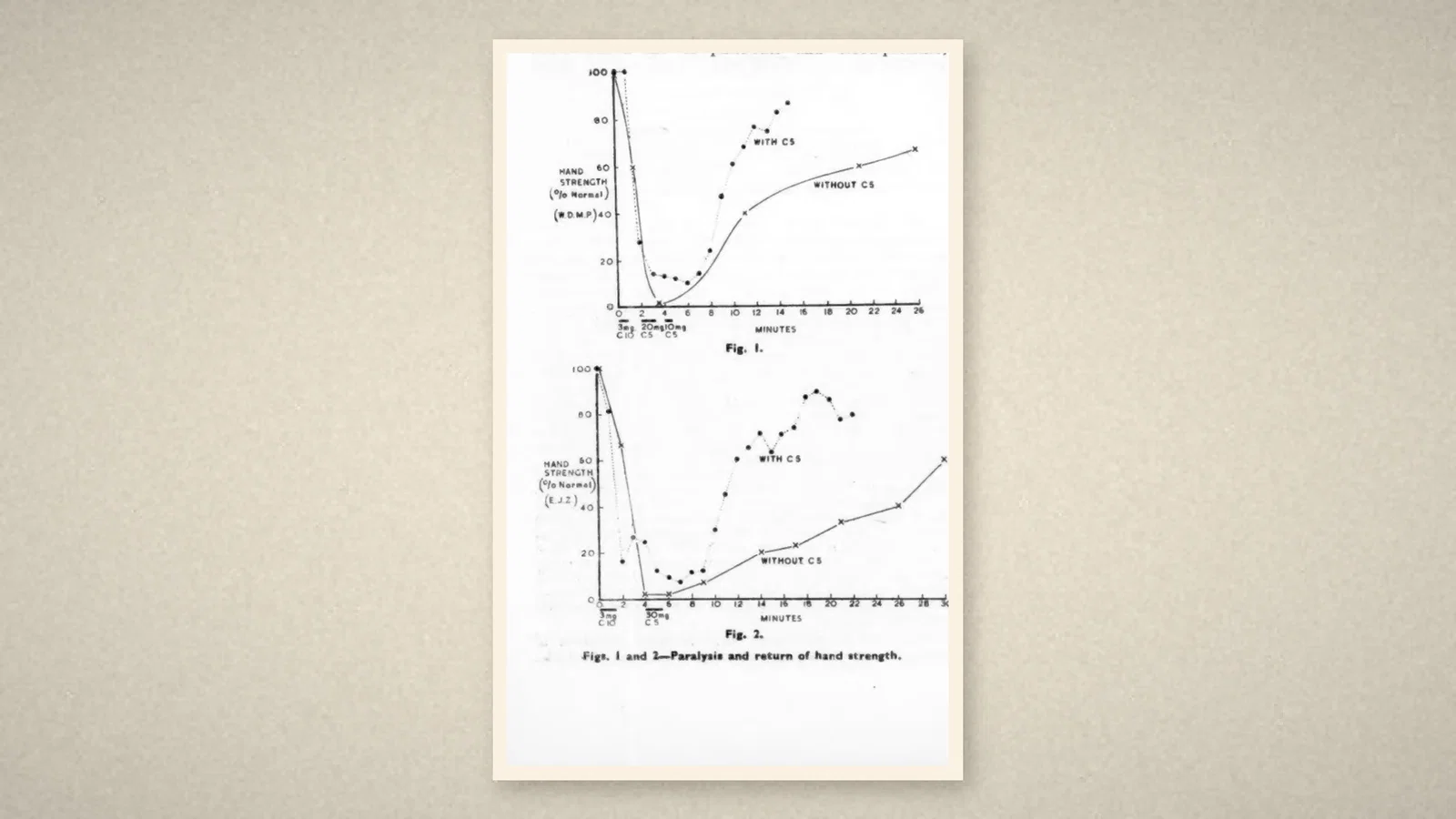
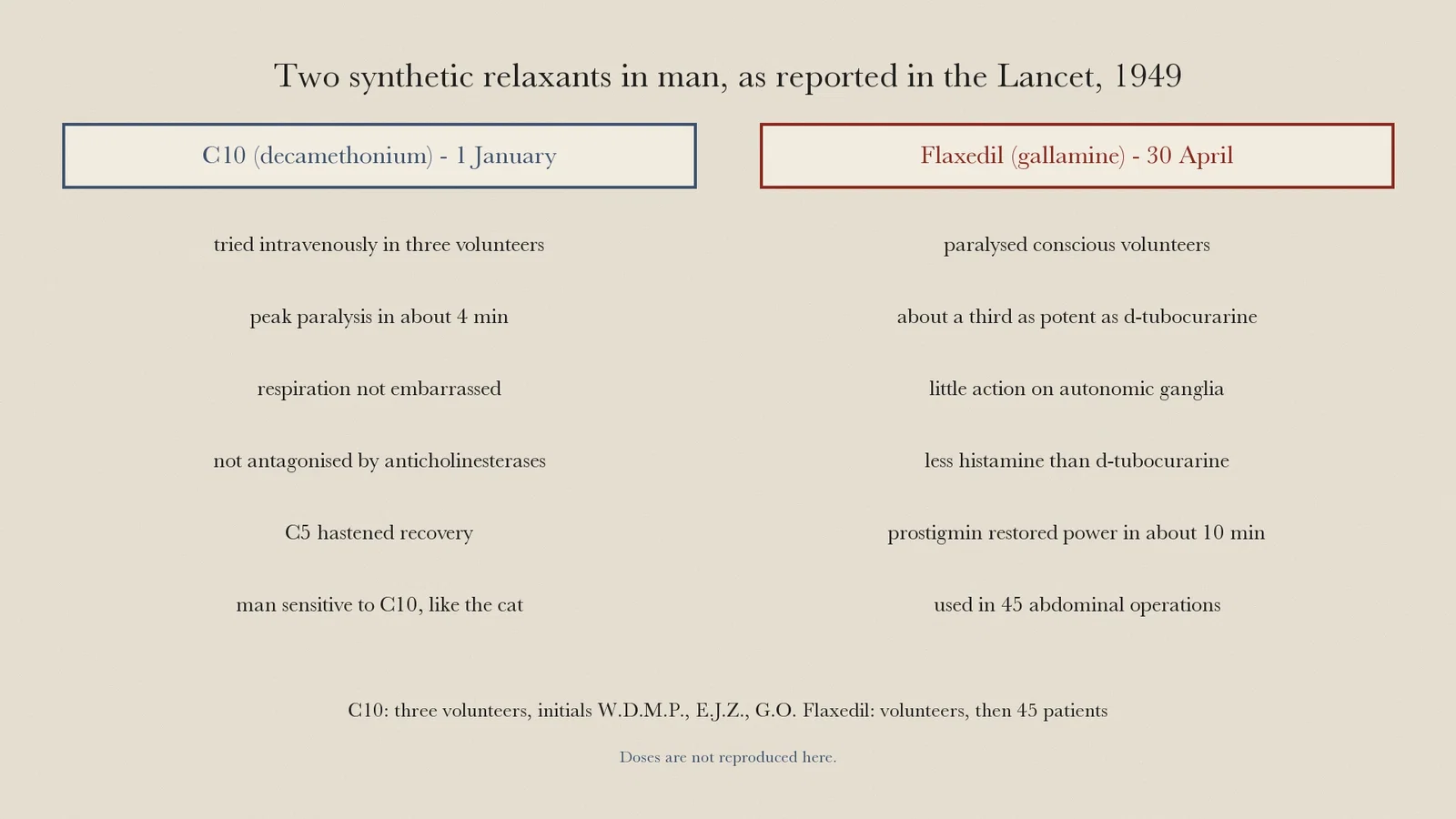
"Tests have been made on three volunteers", recorded by initials as W. D. M. P., E. J. Z. and G. O., matching the three authors, on five occasions, twice with C5 as well. C10 was injected slowly into a vein. The eyelids were affected within 20 seconds; "paralysis reached a maximum in about 4 min.", recovery began in about 10 minutes and was complete in 1–2 hours. Weakness spread from eyelids, eye and face to neck, trunk and limbs; at the peak two subjects were "incapable of moving their limbs or head" at all, and the third lost about 60% of hand strength. [1, p. 22]
"The respiration, however, was not" embarrassed, though vital capacity fell by about 35% at the peak; the voice weakened, but coughing remained possible and swallowing never disappeared. The authors likened the paralysis to that produced by d-tubocurarine in a conscious subject. "No important side-effects were seen", and electrocardiograms were normal. C5, given at the peak of a C10 paralysis, "substantially accelerated" recovery; given alone, it left supine blood pressure unchanged but made it fall by 20–35 mm on standing, and one subject had a "severe syncopal attack". [1, p. 22]
They concluded that "man is very sensitive to C10", resembling the cat rather than monkey, rabbit, mouse or rat, and that its relative sparing of respiration in the cat seemed to hold in man. "Full clinical trials" were under way with the Medical Research Council. [1, p. 22–23]
Flaxedil: volunteers and 45 patients
On 30 April William W. Mushin, director of the department of anaesthetics at the Welsh National "School of Medicine, Cardiff", with Wien, Mason and Langston of the biological division of May & Baker, reported on tri-(diethylaminoethoxy)-benzene "triethyliodide or R.P. 3697", now called Flaxedil. Bovet and colleagues had described it in animals in 1946 and 1947, and Huguenard had given a preliminary clinical account in 1948; they reported new pharmacology and "the first clinical experiments in this country". [2, p. 726]
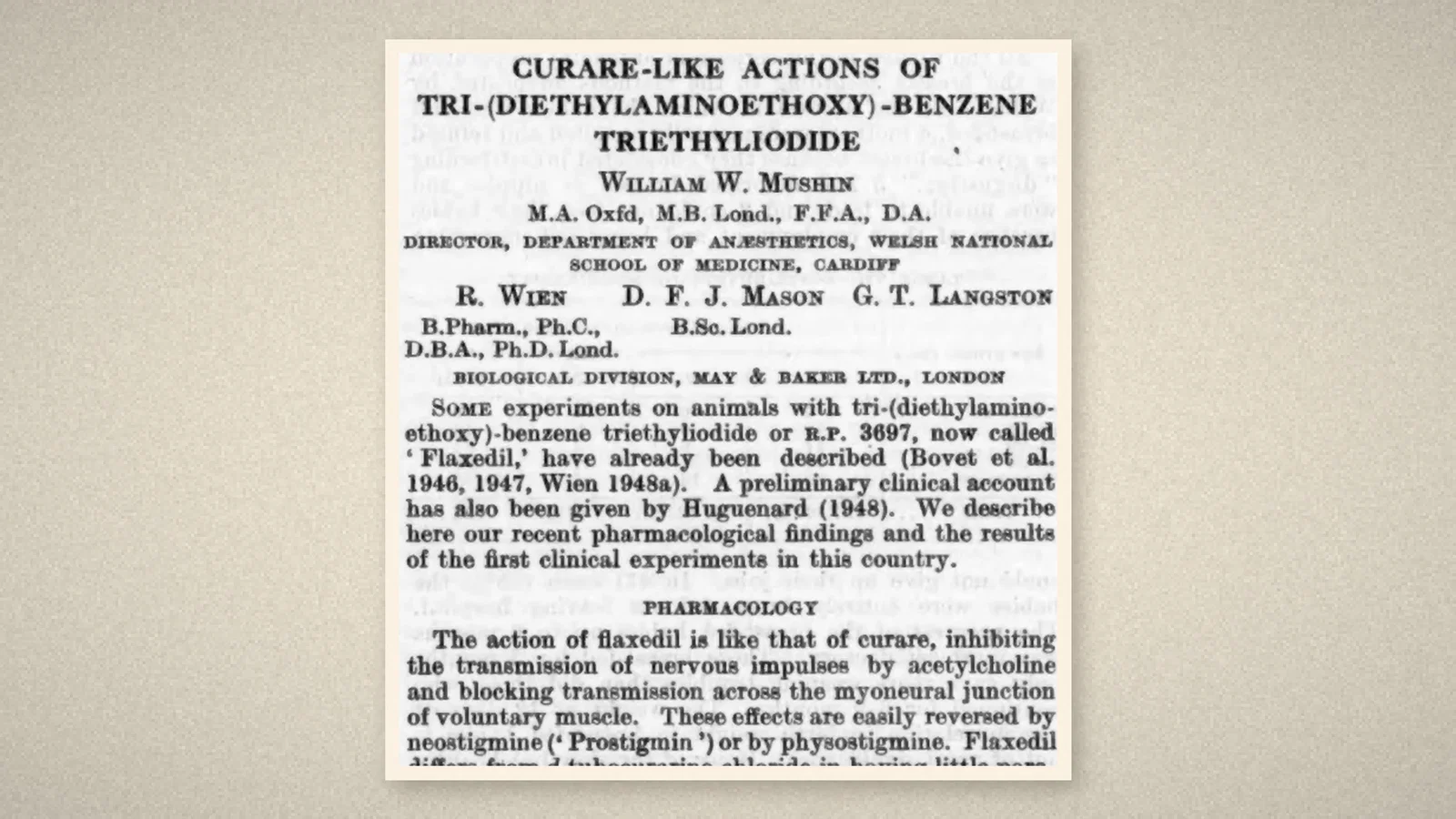
Flaxedil acted like curare, and its effects were "easily reversed by neostigmine" or physostigmine; unlike d-tubocurarine, "Flaxedil has but little paralysing action on ganglia". By the rabbit head-drop assay it was "about a third as potent as d-tubocurarine", and in isolated tissue it "liberated less histamine". [2, p. 726–727]
"Experiments were made on conscious volunteers" to measure finger flexing power, the force of the recti abdominis, ventilation and, in some, diaphragmatic movement on a fluorescent screen. The authors determined a "paralysing dose in conscious men"; intravenous prostigmin "restored full muscular power in about 10 min.", so that the volunteers could at once help with other experiments. Flaxedil had also been used in "45 adult patients" under light nitrous oxide and ether to relax the abdominal wall, usually in two doses, and the authors compared its strength with that of Tubarine. [2, p. 728] "Flaxedil is an effective curarising agent", they concluded. [2, p. 728]
What the record shows
These two papers of 1949 mark an early step in bringing synthetic relaxants to man. Both began with conscious volunteers, and both asked the same question: could skeletal muscle be paralysed while breathing was preserved? C10 could not be reversed by an anticholinesterase and needed another compound as antidote; Flaxedil was quickly reversed by neostigmine and was soon used in abdominal surgery.
Sources and reading limits
Read: Organe, Paton and Zaimis, Lancet 1 January 1949, pp. 21–23, in full (with table and figures); Mushin, Wien, Mason and Langston, Lancet 30 April 1949, pp. 726–728, in full.
Not covered: Paton and Zaimis's 1948 notes in Nature, Bovet's 1946–47 papers on R.P. 3697, Huguenard's 1948 clinical report, the MRC trials of C10, and the later history of suxamethonium and of the depolarising/non-depolarising classification are not covered. The C10 volunteers appear in the paper only by initials; the article says only that the initials match the authors. Doses reported in the papers are not repeated here.
Three illustrations are crops of the two papers; one is a comparison drawn from them.
- Organe G, Paton WDM, Zaimis EJ. Preliminary trials of bistrimethylammonium decane and pentane diiodide (C10 and C5) in man. Lancet. 1949;1:21-3. Internet Archive
- Mushin WW, Wien R, Mason DFJ, Langston GT. Curare-like actions of tri-(diethylaminoethoxy)-benzene triethyliodide. Lancet. 1949;1:726-8. Internet Archive
Continue exploring
Related reading connects shared questions and contexts; it does not by itself establish historical influence.
- 1940–1952: From Curare to Succinylcholine in Convulsive Therapy
- 1942: Griffith and Johnson Use Curare in Twenty-Five Patients
Anesthesia Epochs · The Source Room · About & Editorial Method
Published November 2, 2026. Sources and reading limits are stated above. Illustrations are labelled as original source images or AI-made. Historical accounts are educational; they are not current treatment instructions.