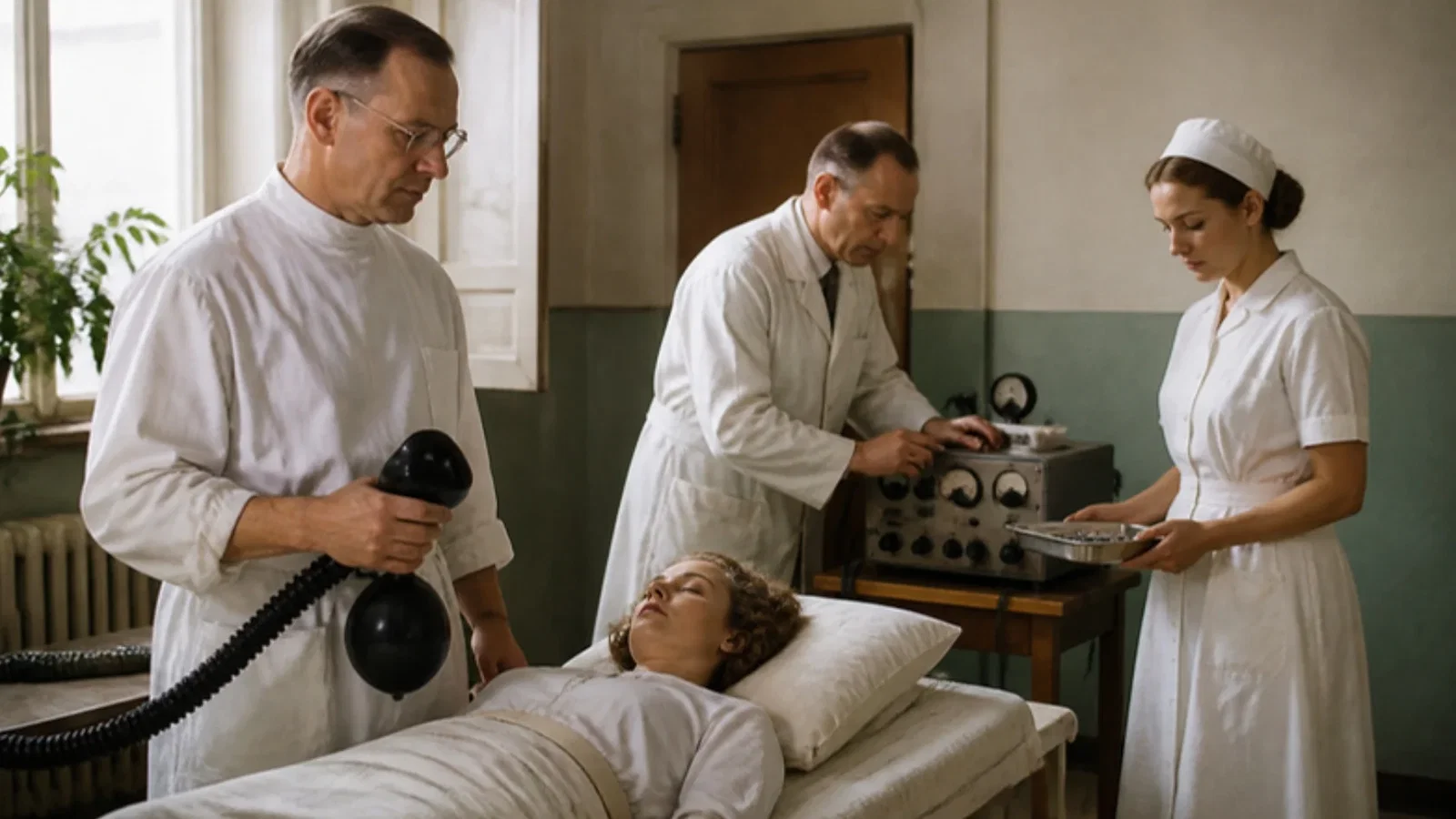
Bennett uses curare in 1940 to soften metrazol convulsions and prevent spinal fractures; in 1952 Holmberg and Thesleff turn electroshock into a brief anaesthetic with succinylcholine, a barbiturate, oxygen and airway equipment.
Reading Library · Anesthesia Epochs · 中文版
Watch the education video (for clinicians)
1940: Bennett's Curare for Convulsive Therapy — A Quiet Limb · Anesthesia Epochs Education Series
Electroconvulsive therapy today is a brief general anaesthetic given by an anaesthetist: an intravenous induction agent, a short-acting relaxant, oxygen by mask, and a patient who wakes when it is over. It did not start that way. This article reads two primary papers: the American psychiatrist A. E. Bennett's report on curare in JAMA in 1940, and the Swedish report by Holmberg and Thesleff on succinylcholine in the American Journal of Psychiatry in 1952. Between them lies the road from a convulsion that broke bones to a small anaesthetic.
1940: convulsions that broke spines
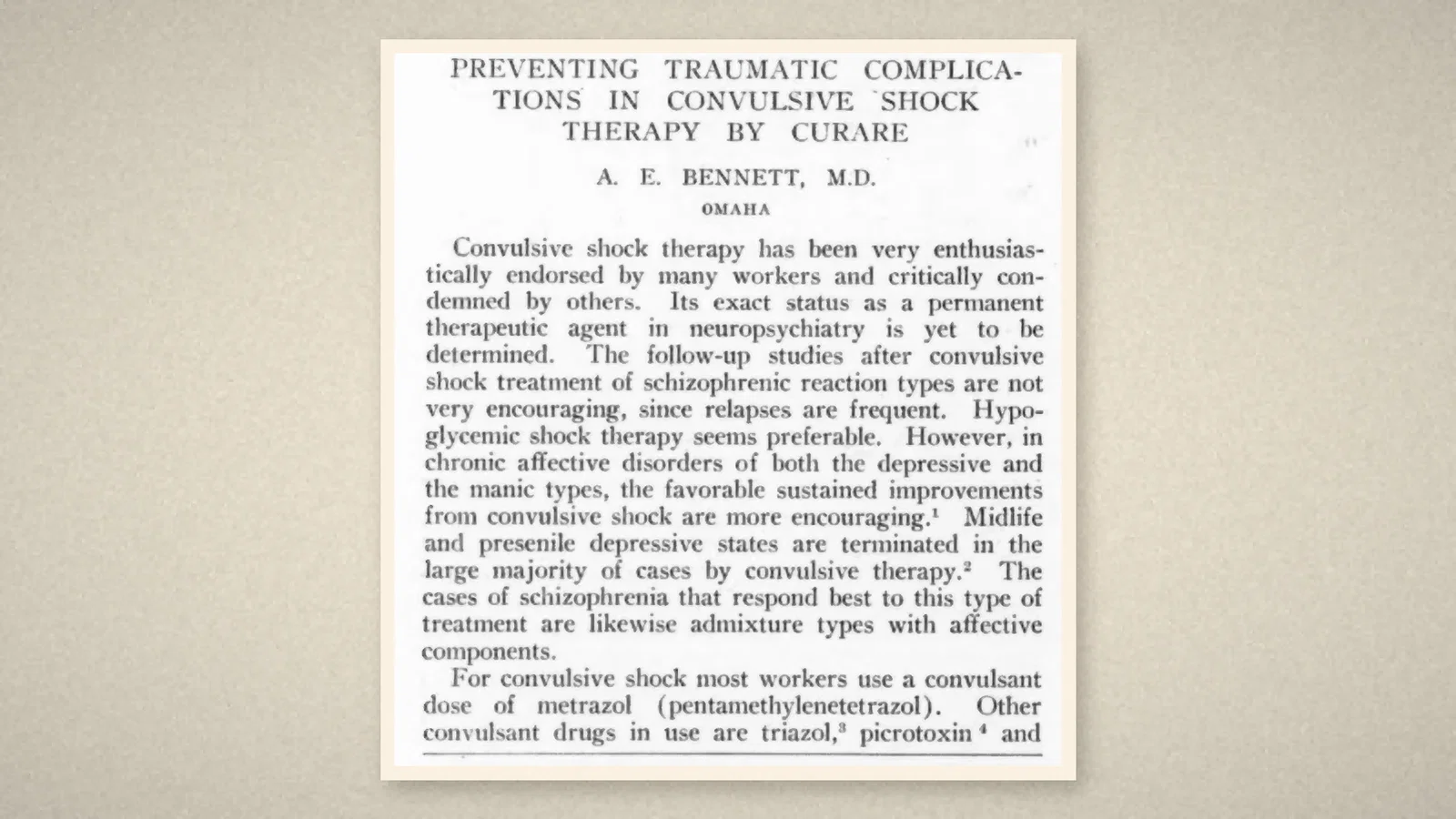
Bennett wrote from the Bishop Clarkson Memorial Hospital and the University of Nebraska College of Medicine in Omaha. The place of convulsive shock therapy was not settled, Bennett said, but sustained improvement in chronic depressive and manic states was encouraging, and "for convulsive shock most workers use a convulsant" dose of metrazol (pentamethylenetetrazol). [1, p. 322]
The trouble was fracture. One of the serious drawbacks of the therapy was traumatic complications in the form of "fractures of the spine and extremities", a hazard serious enough that "many workers have given up convulsive" shock therapy despite good results. Orthopaedic restraints, hyperextension of the spine, preliminary insulin coma, even spinal anaesthesia gave no constant protection. The fundamental problem was "the severity of the tonic muscular contraction" producing fracture by direct muscle pull. The answer was to lessen the convulsion itself: "The principle of curarization, or blocking the neuromuscular junction, seems to be the proper approach." [1, p. 322]
For six months Bennett had been using curare at the Nebraska State Orthopedic Hospital on many spastic paralytic children, which convinced Bennett of its safety. [1, p. 322] One reason earlier clinical use had been inconclusive, Bennett believed, was the lack of enough authenticated crude curare; "through the courtesy of Mr. Richard C. Gill", of New York, and E. R. Squibb & Sons, a large quantity of the crude drug could now be standardised. [1, p. 323]
Standardised on mice, judged by the head
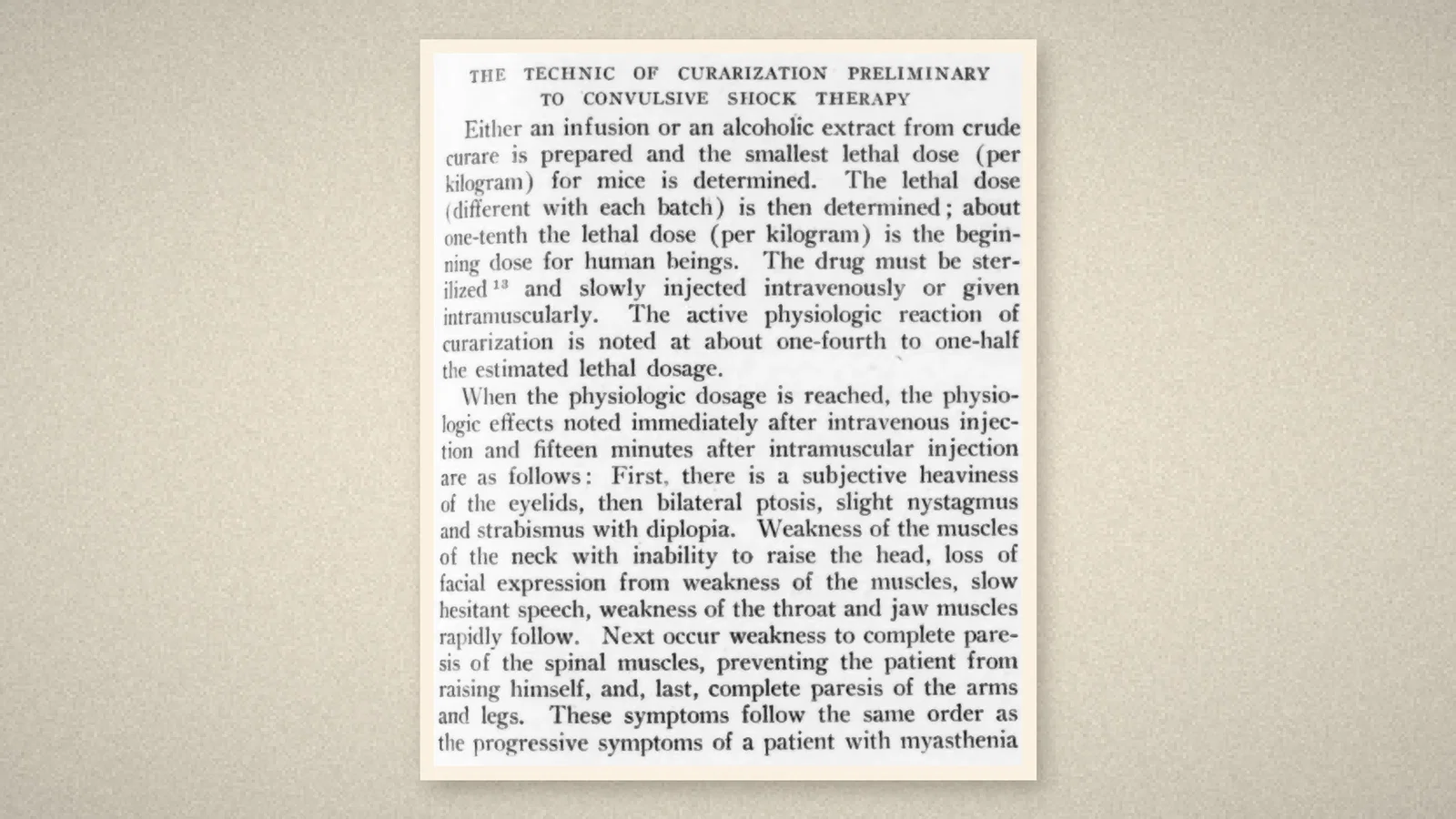
The method was specific. An infusion or alcoholic extract of crude curare was made and the smallest lethal dose per kilogram for mice determined; it differed with each batch, and about "one-tenth the lethal dose" per kilogram was the starting dose for human beings, sterilised and injected slowly intravenously or intramuscularly. At the physiological dose the patient first felt heavy eyelids, then ptosis and diplopia, weakness of the neck with inability to raise the head, loss of facial expression, slow speech, then weakness of the spinal muscles and limbs, in the same order as "the progressive symptoms of a patient with myasthenia" gravis. [1, p. 323]
When that effect appeared within five minutes of intravenous curare, the metrazol was given; the convulsion followed with much less tonic and clonic contraction. Bennett warned that the powerless neck must not let the head fall back, that epinephrine and prostigmine should be at hand, and that if respiratory failure occurred, "artificial respiration should be effective". The criterion was enough curare to paralyse the muscles of the neck and back: "When the patient is unable to raise the head", metrazol could be given. [1, p. 323] Fracture in a "properly curarized patient" was, Bennett was convinced, almost impossible, yet "further experimentation is indicated" before general psychiatric use. [1, p. 323–324]
1952: a short-acting relaxant
Twelve years later Holmberg and Thesleff, at the psychiatric clinic of the Karolinska Hospital in Stockholm, looked back. The most common complication "with electroshock therapy is fracture", especially of the vertebrae, at rates other authors had put at 23, 14 and 39 per cent; the muscular effort, anoxia and rise in blood pressure strained the circulation. Since Bennett in 1940 introduced curare, they wrote, the method had been widely used, but "many writers consider curare preparations" risky for routine use, because their prolonged action forced staff to anticipate respiratory failure. [2, p. 842]
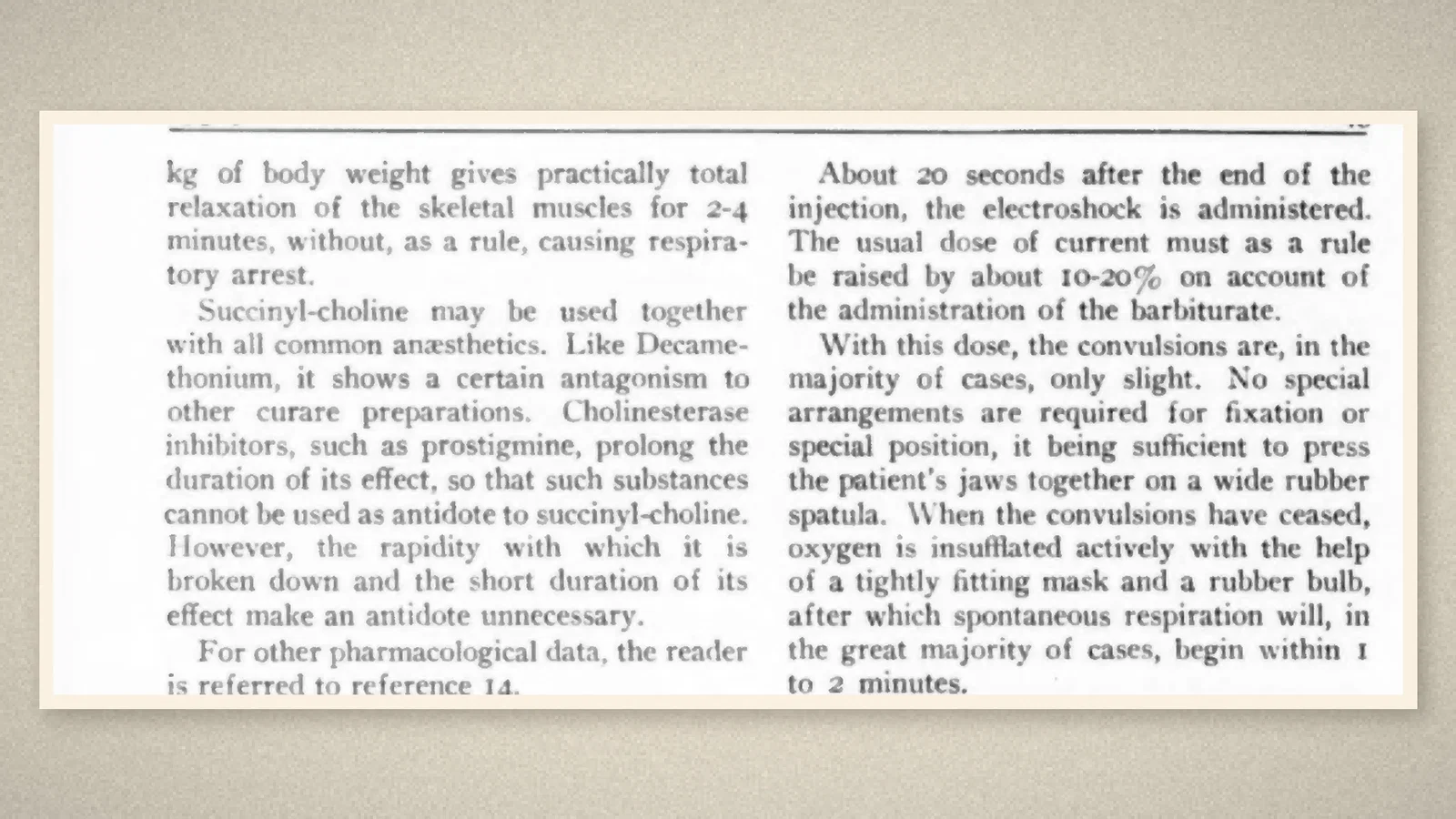
They described Bennett as introducing curare "in electroshock therapy"; Bennett's 1940 paper in fact concerned metrazol convulsions. Their new drug was succinylcholine. Bovet in 1949 had "discovered the short curare-like effect" of succinylcholine iodide; in 1951 it was produced in pure crystalline form and Thesleff studied its pharmacology. Broken down by esterases, it acted for a few minutes; 0.3 mg per kg gave practically total relaxation of the skeletal muscles for 2–4 minutes, usually without respiratory arrest, and no antidote was needed. [2, p. 842–843]
One electroshock in seven minutes
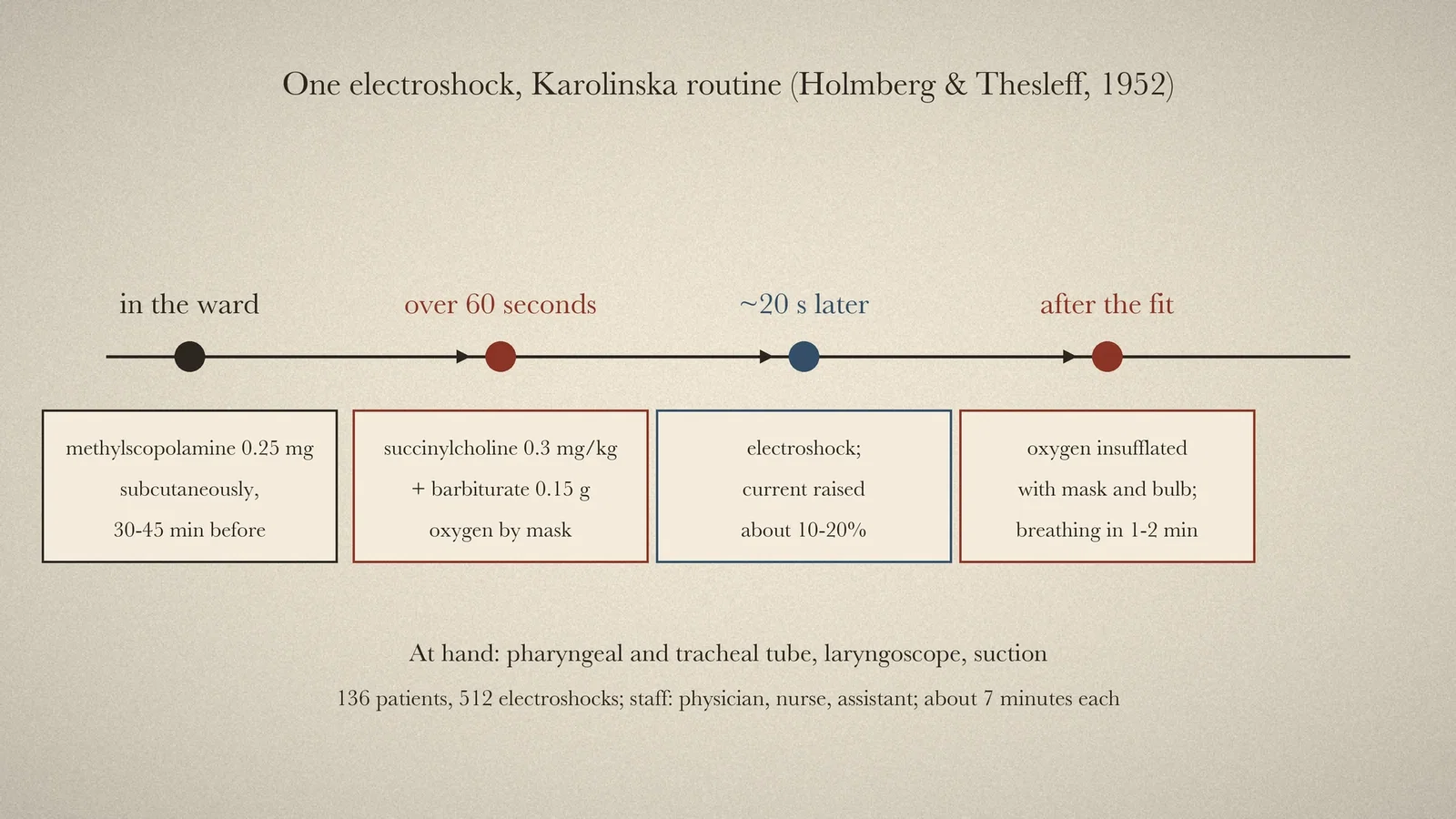
Their routine: 0.25 mg of methylscopolamine nitrate subcutaneously on the ward 30–45 minutes before, to dry secretions. In the treatment room the physician injected succinylcholine (0.3 mg per kg) mixed in the syringe with "0.15 g of Pentothal, Evipan, or Narkotal", evenly over 60 seconds while the patient breathed oxygen by mask. About 20 seconds later the shock was given; after the convulsion, oxygen was insufflated with a tight mask and a rubber bulb, and spontaneous breathing returned within 1–2 minutes in most cases. [2, p. 843] The barbiturate was there because limpness and twitching would be unpleasant for a patient awake. A pharyngeal and tracheal tube, laryngoscope and suction had to be ready, and the physician had to be "able to perform intratracheal intubation". The staff was a physician, a nurse and an assistant; each treatment took about 7 minutes. [2, p. 844–845]
The drug had been used for every electroshock at the clinic "since February 1951": 136 patients, 512 treatments. Monitored by oximetry in 40 treatments, arterial saturation "did not fall below 90%". Respiratory arrest after the fit sometimes lasted 3 minutes or more, twice 5 minutes, but difficulties never persisted. The only fracture was a slight compression of two thoracic vertebrae in one patient whose convulsion had been of normal strength, probably because part of the injection went outside the vein. [2, p. 845–846]
What the record shows
Bennett carried a laboratory poison, standardised batch by batch on mice, into psychiatry so that the convulsion would stop breaking spines, and judged the dose by whether the patient could lift the head. Holmberg and Thesleff replaced curare with a drug broken down in minutes and added a hypnotic, oxygen, assisted ventilation and readiness to intubate. By then, what electroshock required were the skills of anaesthesia.
Sources and reading limits
Read: Bennett, JAMA 27 January 1940, pp. 322–324, complete; Holmberg and Thesleff, American Journal of Psychiatry May 1952, pp. 842–846, complete.
Not covered: Cerletti and Bini's original reports on electroshock, Bennett's later papers, Squibb's commercial curare preparation, and later British and Australian reports on anaesthetists giving ECT are not covered. Bennett's 1940 paper concerns metrazol convulsions, not electroshock; Holmberg and Thesleff call it an introduction "in electroshock therapy", and the article notes the difference. The fracture rates of 23, 14 and 39 per cent are other authors' figures as Holmberg and Thesleff cite them.
Three illustrations are crops of the two papers (the patient photographs in Bennett's paper are not used); one is a timeline drawn from the 1952 paper.
- Bennett AE. Preventing traumatic complications in convulsive shock therapy by curare. JAMA. 1940;114(4):322-4. Internet Archive
- Holmberg G, Thesleff S. Succinyl-choline-iodide as a muscular relaxant in electroshock therapy. Am J Psychiatry. 1952;108(11):842-6. Internet Archive
Continue exploring
Related reading connects shared questions and contexts; it does not by itself establish historical influence.
- 1940: Bennett Uses Curare to Prevent Fractures in Shock Therapy
- 1937: Oxford Creates the Nuffield Chair of Anaesthetics
Anesthesia Epochs · The Source Room · About & Editorial Method
Published November 2, 2026. Sources and reading limits are stated above. Illustrations are labelled as original source images or AI-made. Historical accounts are educational; they are not current treatment instructions.