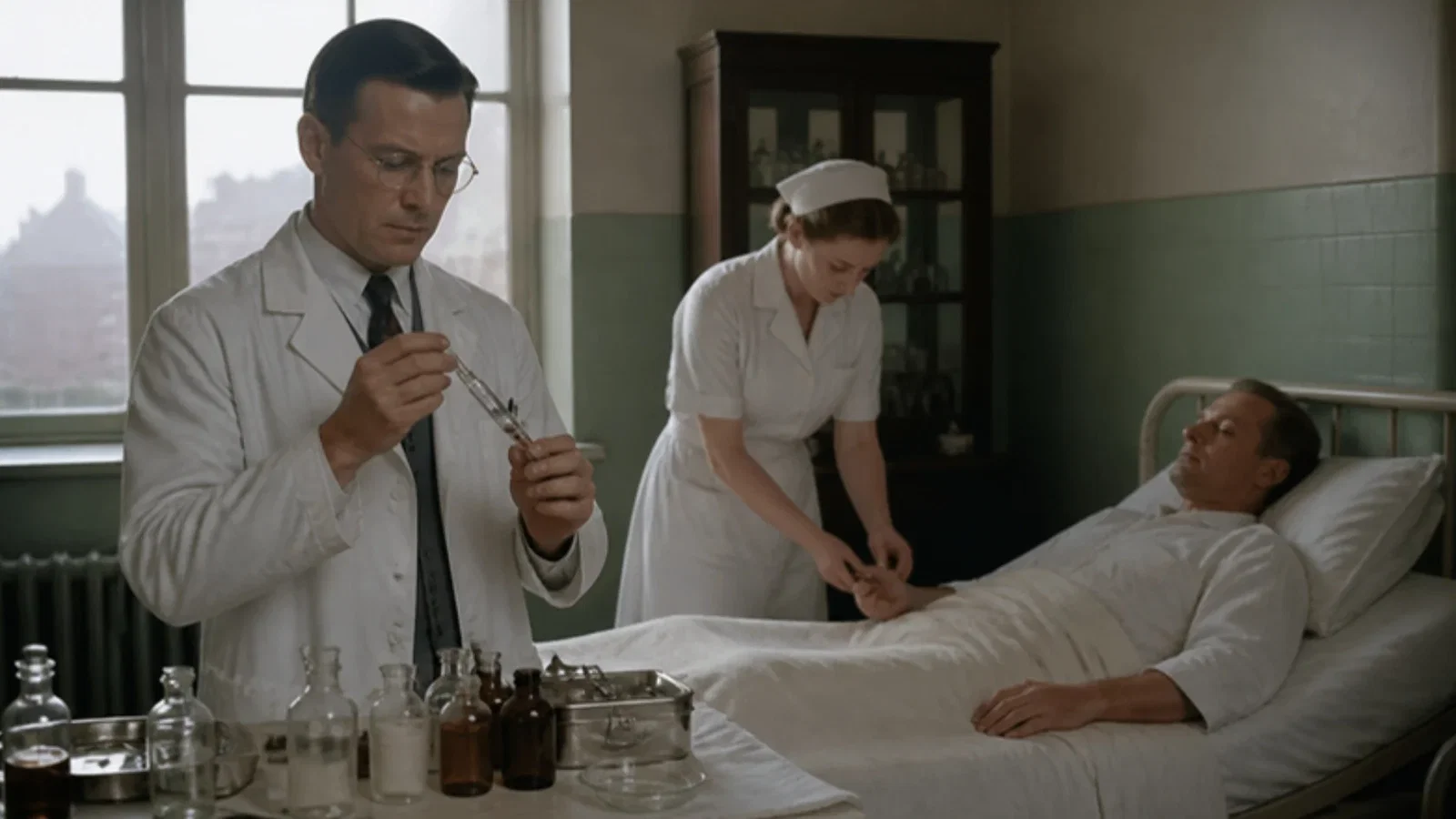
The Journal of the American Medical Association of 27 January 1940 printed 'Preventing traumatic complications in convulsive shock therapy by curare' by A. E. Bennett of Omaha. Convulsions induced with metrazol were being used to treat depression and other psychiatric illness, and the violent muscle contraction often broke the spine and limbs. Bennett argued that the remedy was to soften the convulsion itself by blocking the neuromuscular junction, having already given curare for six months to many spastic children and become convinced of its safety. Richard C. Gill and E. R. Squibb & Sons supplied crude curare, standardized first on mice. After injection the patient developed heavy eyelids, ptosis, double vision and an inability to lift the head, then limp limbs, much as in myasthenia gravis; metrazol was then given, and the convulsion came with far less tonic and clonic contraction. Bennett had seen no danger, but advised having epinephrine, prostigmine and artificial respiration ready, and called for more experiment before general use.
Reading Library · Anesthesia Epochs · 中文版
Watch the education video (for clinicians)
1940: Bennett's Curare in JAMA — Preventing Convulsive Fractures · Anesthesia Epochs Education Series
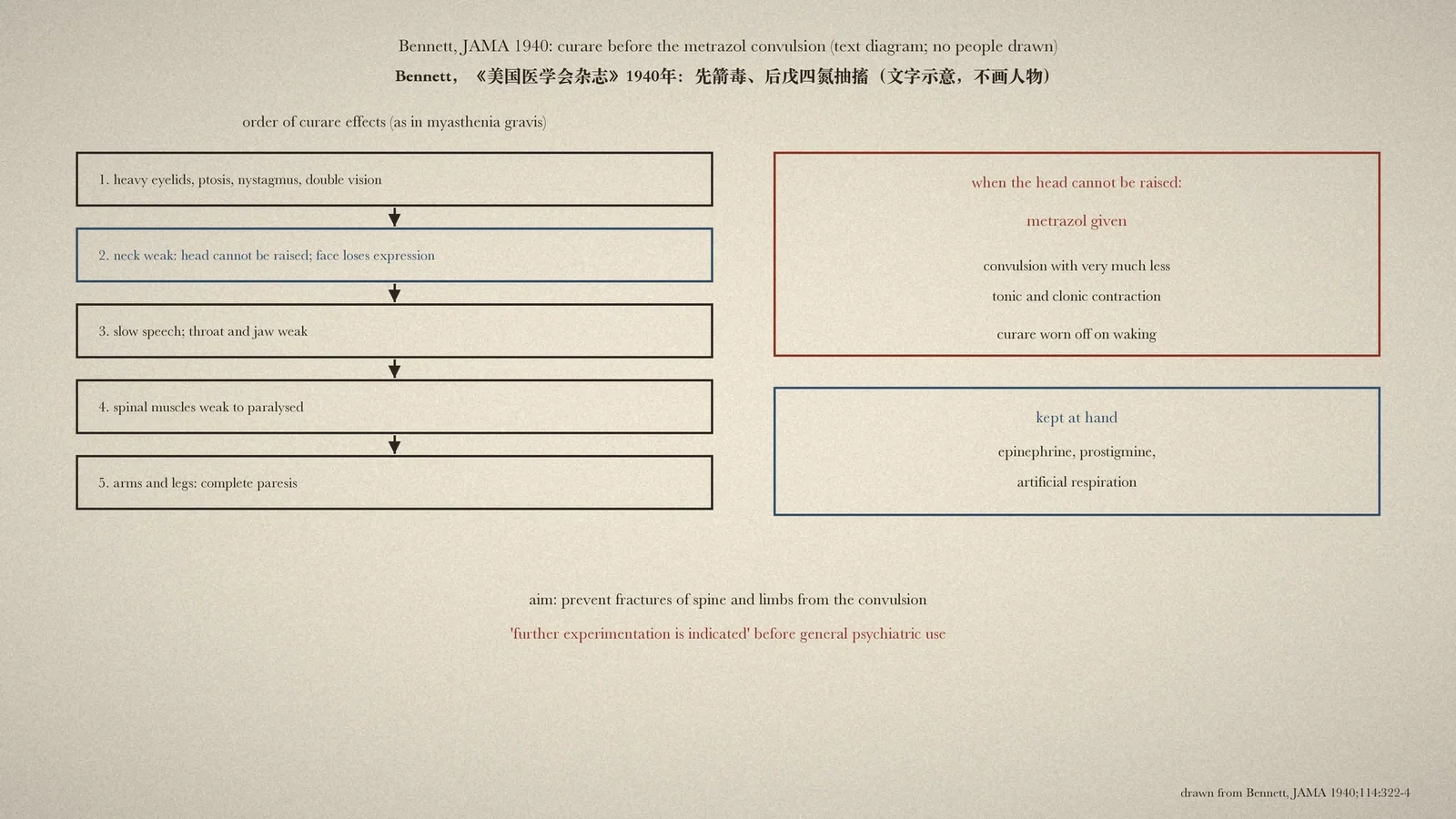
In 1940, Bennett wrote, curare "has not as yet gained a definitely useful application in clinical medicine". Early that year an American psychiatrist reported in the Journal of the American Medical Association that if patients were given curare before a drug-induced convulsion for depression, their muscles would be too weak for the convulsion to break bones. The three-page paper sets out how curare acted in a person step by step, and also the limits the author recognised. [1, p. 322][1, p. 323]
The problem: convulsions that break bones
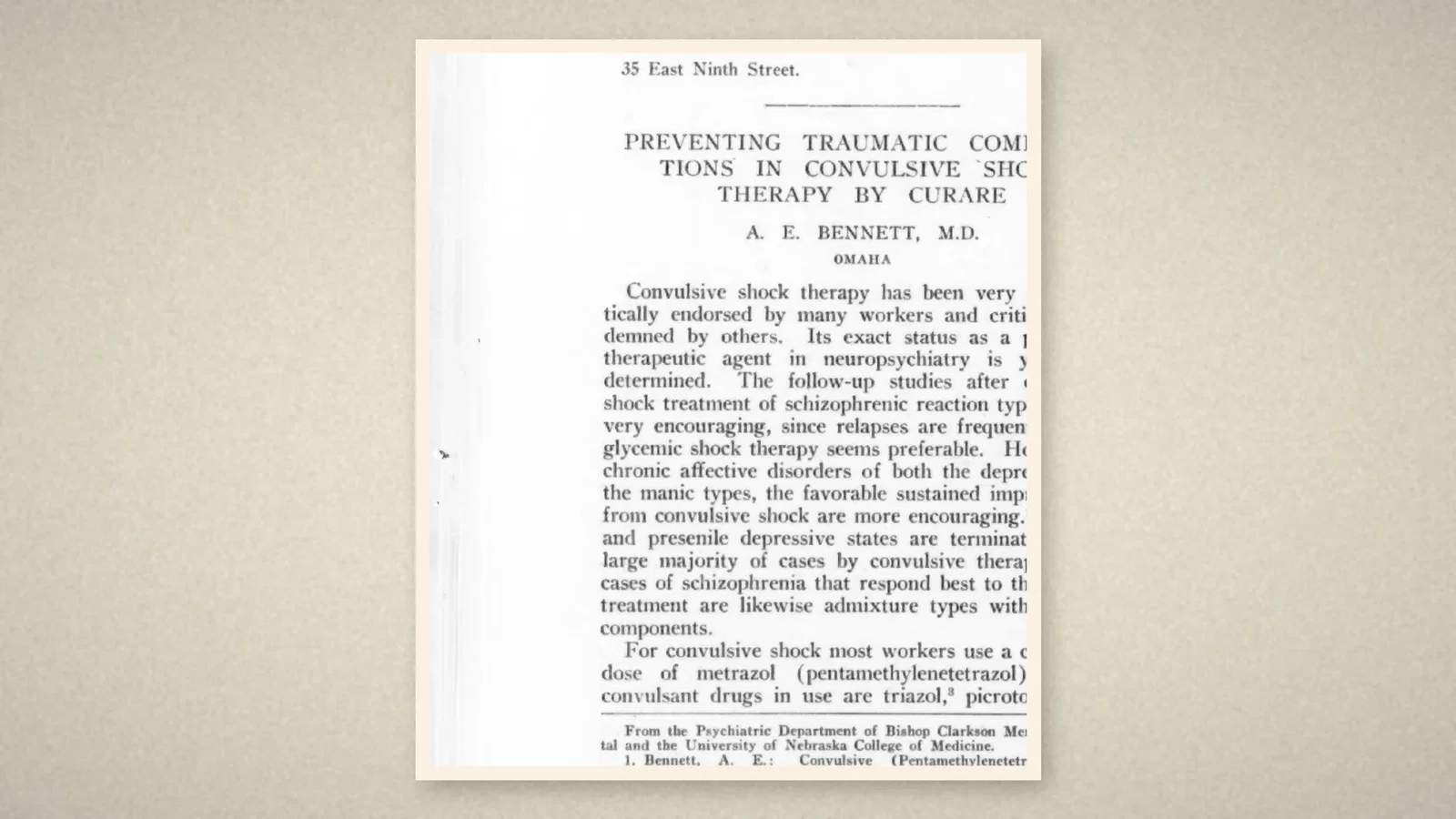
The Journal of the American Medical Association of 27 January 1940, pp. 322-324, carried "Preventing traumatic complications in convulsive shock therapy by curare" by A. E. Bennett of the Psychiatric Department of Bishop Clarkson Memorial Hospital and the University of Nebraska College of Medicine, Omaha. [1, p. 322]
Bennett begins by noting that convulsive shock therapy had been enthusiastically endorsed by some and condemned by others, and that its permanent place was undecided: follow-up in schizophrenia was not encouraging, but most midlife and presenile depressions were ended by it. Most workers induced the convulsion with metrazol (pentamethylenetetrazol). [1, p. 322]
One serious drawback was fracture of the spine and limbs, serious enough that many workers had given the treatment up. Restraint devices, hyperextension of the spine, a preliminary insulin coma and even spinal anaesthesia gave no constant assurance against it. The basic problem, Bennett argued, was the force of the tonic muscular contraction itself, so the convulsion had to be made less severe: "the principle of curarization, or blocking the neuromuscular junction, seems to be the proper approach". [1, p. 322]
Why curare
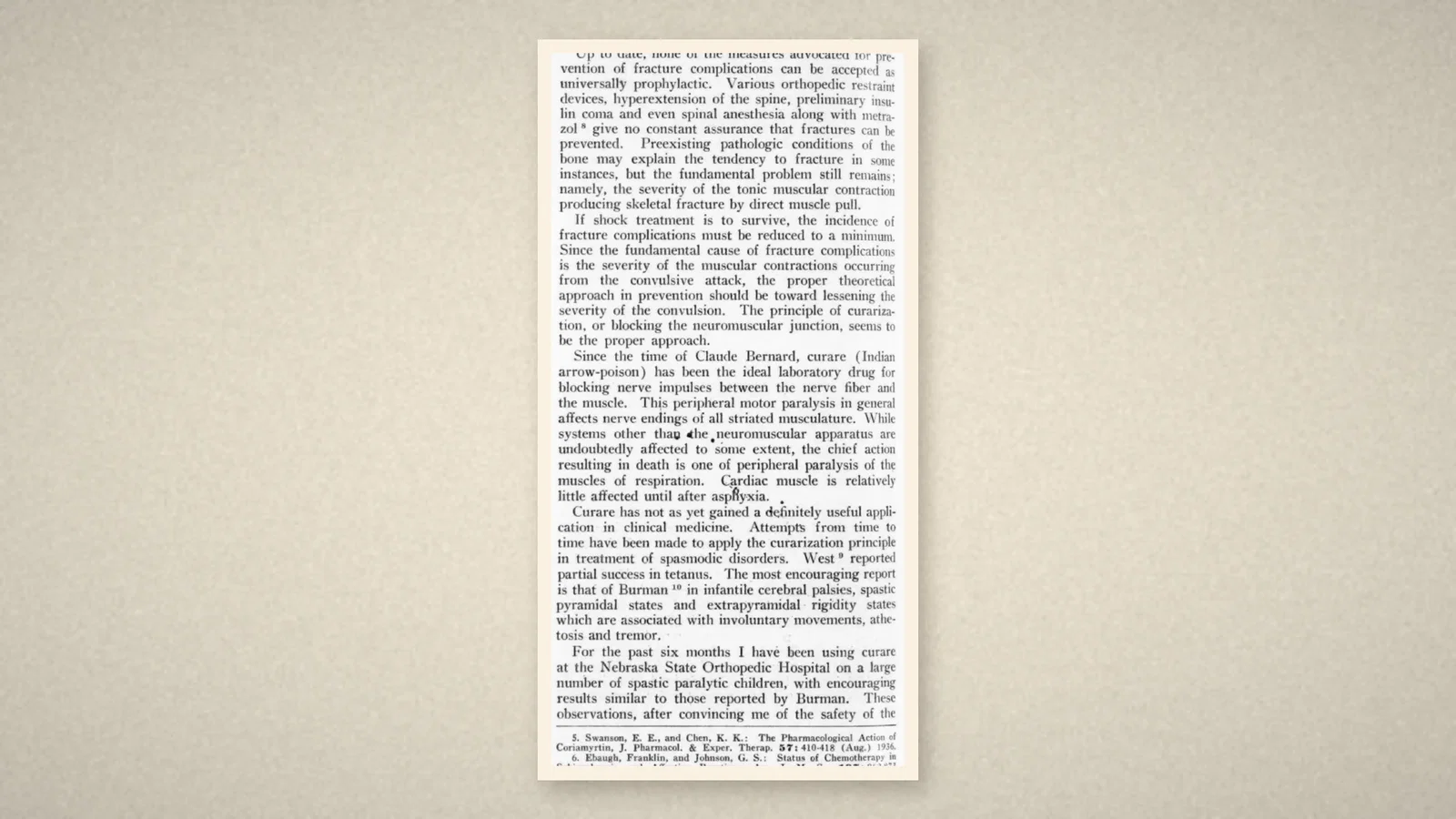
Since the time of Claude Bernard, Bennett wrote, curare had been the ideal laboratory drug for blocking impulses between nerve fibre and muscle, killing chiefly by paralysis of the respiratory muscles. Yet it had found no settled clinical use: West had reported partial success in tetanus, and Burman's report on spastic and dystonic states was the most encouraging. For the past six months Bennett had been giving curare to a large number of spastic paralytic children at the Nebraska State Orthopedic Hospital, with encouraging results that also convinced Bennett of its safety. [1, p. 322][1, p. 323]
Earlier clinical results had been inconclusive, Bennett believed, partly because enough proved, pure crude curare could not be had. Through Richard C. Gill of New York and E. R. Squibb & Sons, a large quantity of the crude drug could now be standardized: an infusion or alcoholic extract was made, its lethal dose determined in mice, and the starting dose for patients set from that, given slowly into a vein or into muscle. [1, p. 323]
Paralysis, step by step
At the working dose, Bennett describes, the patient first feels heaviness of the eyelids, then has ptosis on both sides, slight nystagmus, squint and double vision; then weakness of the neck, so that the head cannot be raised, loss of facial expression, slow and hesitant speech, and weak throat and jaw muscles; then weakness going on to paralysis of the spinal muscles, so that the patient cannot sit up; and last complete paresis of arms and legs. The order, Bennett noted, is that of myasthenia gravis, and the double ptosis and "nasal smile" mimic the myasthenic patient. [1, p. 323]
The estimated convulsant dose of metrazol was then given. The convulsion followed at once but with "very much less tonic and clonic contraction", needing no special precaution beyond a tongue gag, and by the time the patient regained consciousness the curare had worn off. Bennett still placed a folded blanket between the shoulder blades, and took care that the head did not fall back, since the neck muscles were powerless. [1, p. 323]
Safeguards and the working rule
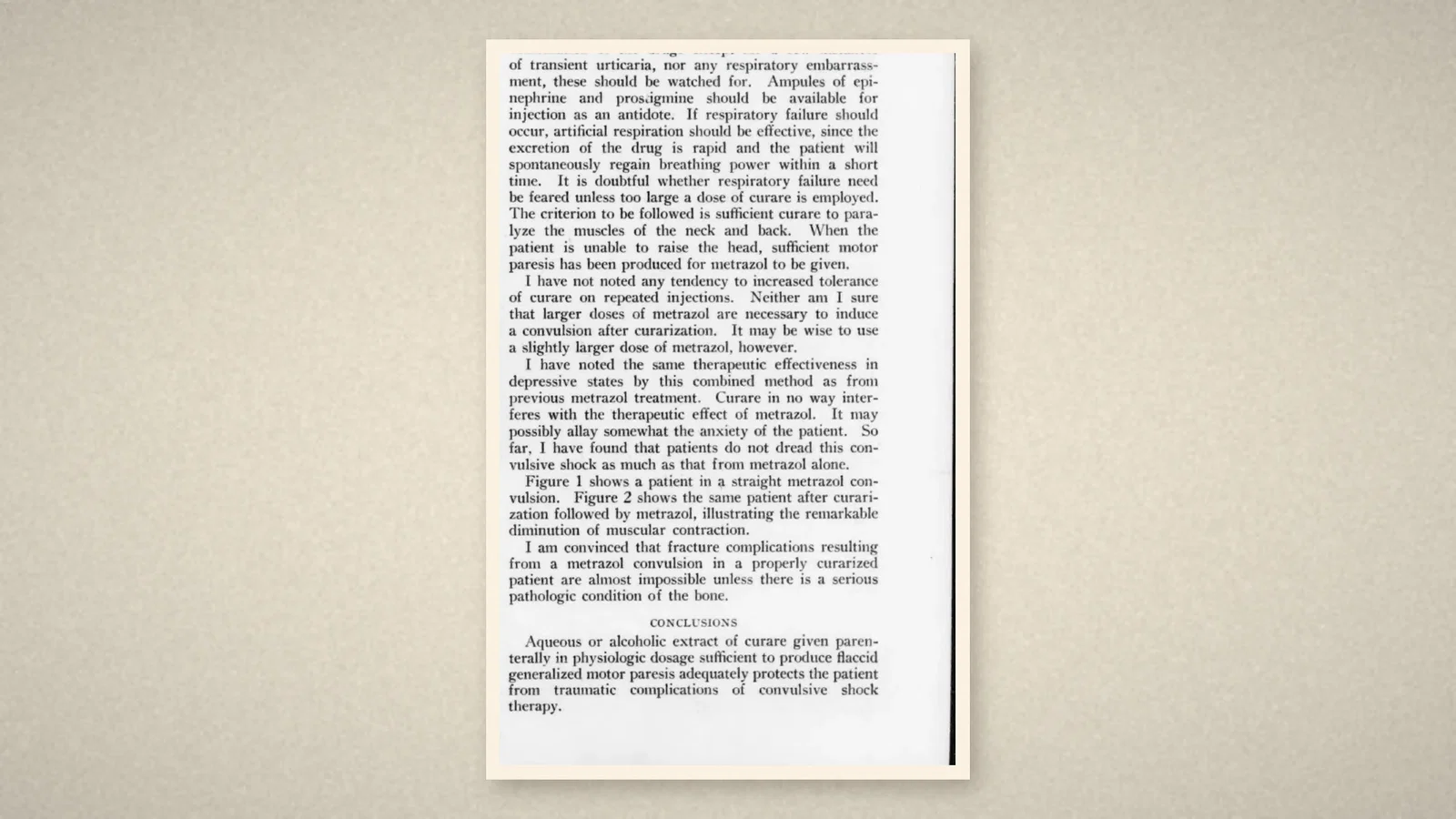
Apart from a few instances of transient urticaria, Bennett had seen no side effects and no respiratory embarrassment, but these were to be watched for. Ampoules of epinephrine and prostigmine should be at hand as antidotes, and if breathing failed, artificial respiration should be effective, since the drug was excreted quickly and breathing would return on its own. The working rule was enough curare to paralyse the muscles of the neck and back: when the patient could not raise the head, metrazol could be given. [1, p. 323]
Two photographs in the paper compare the same patient in a plain metrazol convulsion and after curarization. The effect on depression, Bennett reported, was unchanged; curare did not interfere with metrazol and might lessen the patient's anxiety; and in a properly curarized patient fracture was almost impossible unless the bone was seriously diseased. [1, p. 323]
The author's own limits
The conclusion is brief: curare given in a dose enough to produce flaccid, generalised motor paresis adequately protects the patient from the traumatic complications of convulsive shock therapy; so far no danger or drawback had been met and the therapeutic effect was kept. But, Bennett added, "further experimentation is indicated" before the method could be safely recommended for general psychiatric practice. A footnote says that A. R. McIntyre, professor of pharmacology at the University of Nebraska, was carrying out biological standardization, and that a safe commercial preparation should soon be available. [1, p. 323][1, p. 324]
What the record shows
A clinical use of curare that was not about relaxing muscles for surgery but about softening the muscular storm of convulsive therapy. The paper turns a laboratory idea, blocking the neuromuscular junction, into a sequence that can be watched at the bedside, eyelids, neck, back, limbs, and into a working rule: when the head cannot be lifted, go ahead.
Sources and reading limits
Read: A. E. Bennett, "Preventing traumatic complications in convulsive shock therapy by curare", Journal of the American Medical Association 27 January 1940;114(4):322-4, in full, with footnotes and the captions of figures 1 and 2.
Not covered: the fuller report Bennett promised; Burman's 1939 paper and West's papers cited by Bennett; Gill's 1935 Natural History article; McIntyre's standardization work; a Canadian Anesthesiologists' Society article, which could not be accessed.
Limits: this is Bennett's own preliminary report; it gives no number of psychiatric patients, no controls and no follow-up, and "no danger or drawback" is Bennett's statement at the time. The two figures are photographs of a patient and are not reproduced here. Doses and dose ratios are not repeated.
Three illustrations are crops of JAMA, 27 January 1940 (two from p. 322, one from p. 323), excluding the patient photographs; one is a text diagram drawn from the paper, with no people drawn.
- Bennett AE. Preventing traumatic complications in convulsive shock therapy by curare. JAMA. 1940;114(4):322-4. Internet Archive
Continue exploring
Related reading connects shared questions and contexts; it does not by itself establish historical influence.
- 1850: Pelouze and Bernard Show Curare Kills Injected, Not Swallowed
- 1856: Bernard Shows Curare Paralyses Movement but Not Feeling
- 1940–1952: From Curare to Succinylcholine in Convulsive Therapy
Anesthesia Epochs · The Source Room · About & Editorial Method
Published November 3, 2026. Sources and reading limits are stated above. Illustrations are labelled as original source images or AI-made. Historical accounts are educational; they are not current treatment instructions.