Lord Nuffield's gift to Oxford creates a Chair of Anaesthetics; the British Journal of Anaesthesia names R. R. Macintosh its first occupant and sets out the planned department.
Reading Library · Anesthesia Epochs · 中文版
Today university departments of anaesthesia, professors of the subject, and residents taught and doing clinical and laboratory research within a department are taken for granted. In Britain all of this has a point one can name: the Nuffield Chair of Anaesthetics at the University of Oxford. This article follows four numbers of the British Journal of Anaesthesia, from October 1936 to January 1938, to see how anaesthetists greeted the chair and what the journal expected of its first professor and the new department.
A chair inside a gift
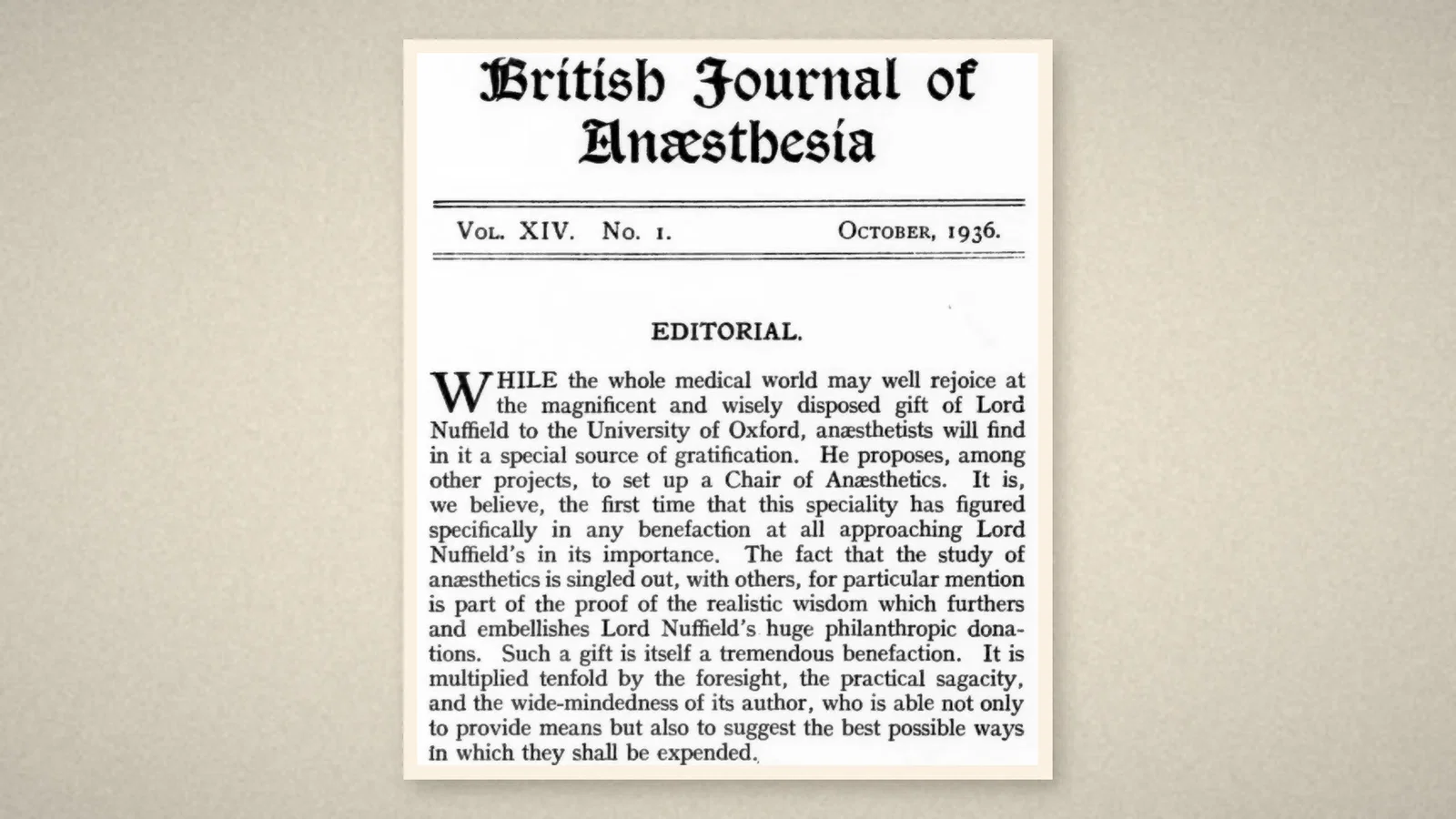
The editorial of October 1936 began by saying that the whole medical world might rejoice at Lord Nuffield's gift to the University of Oxford, but anaesthetists had a special reason for gratification: "He proposes, among other projects, to set up a Chair of Anaesthetics." It was, "we believe, the first time that this speciality has figured specifically in any benefaction at all approaching Lord Nuffield's in its importance". [1, p. 1]
The editorial went on to state the anaesthetist's position. Nobody could doubt, it said, that anaesthetics had "received too little academic attention", given their importance to a surgical patient's welfare and safety; a question on anaesthetics was "still a rarity in a surgical 'viva'", and rarer still on a written paper. The position of anaesthetists at teaching hospitals was "often much below their just deserts": either they gave up honorary status and its privileges because of scanty honoraria, or, unpaid, they were denied equality with their medical and surgical colleagues, while "the hospital gets as much work as possible for as little pay as possible". Not the least benefit of Nuffield's proposals, the editors thought, was that hospital authorities would now be more likely to attend to the recognition of anaesthetists. [1, p. 1–2]
The same number reported the annual general meeting of the Association of Anaesthetists on 30 October. Membership was "within a few of the 150 to which it is limited", and the meeting unanimously added an honorary member, Lord Nuffield, who had said that accepting gave great pleasure. [1, p. 33]
The first professor
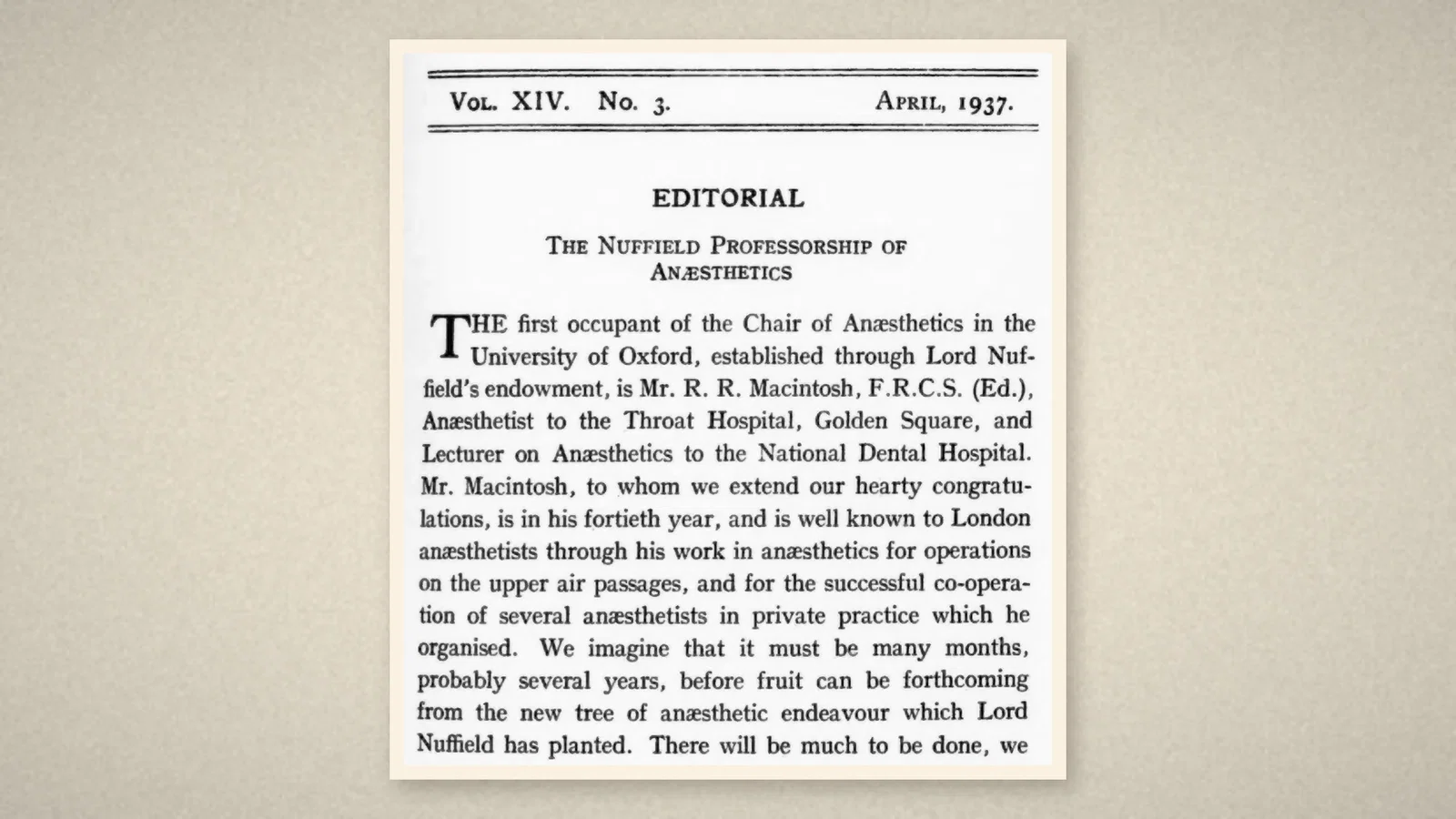
The editorial of April 1937 was headed "The Nuffield Professorship of Anaesthetics". The first occupant of the chair, established through Lord Nuffield's endowment, was Mr R. R. Macintosh, F.R.C.S. (Ed.), anaesthetist to the Throat Hospital, Golden Square, and lecturer on anaesthetics to the National Dental Hospital. Macintosh was "in his fortieth year" and known to London anaesthetists for work in anaesthesia for operations on the upper air passages and for the co-operation of several anaesthetists in private practice which Macintosh had organised. [2, p. 93]
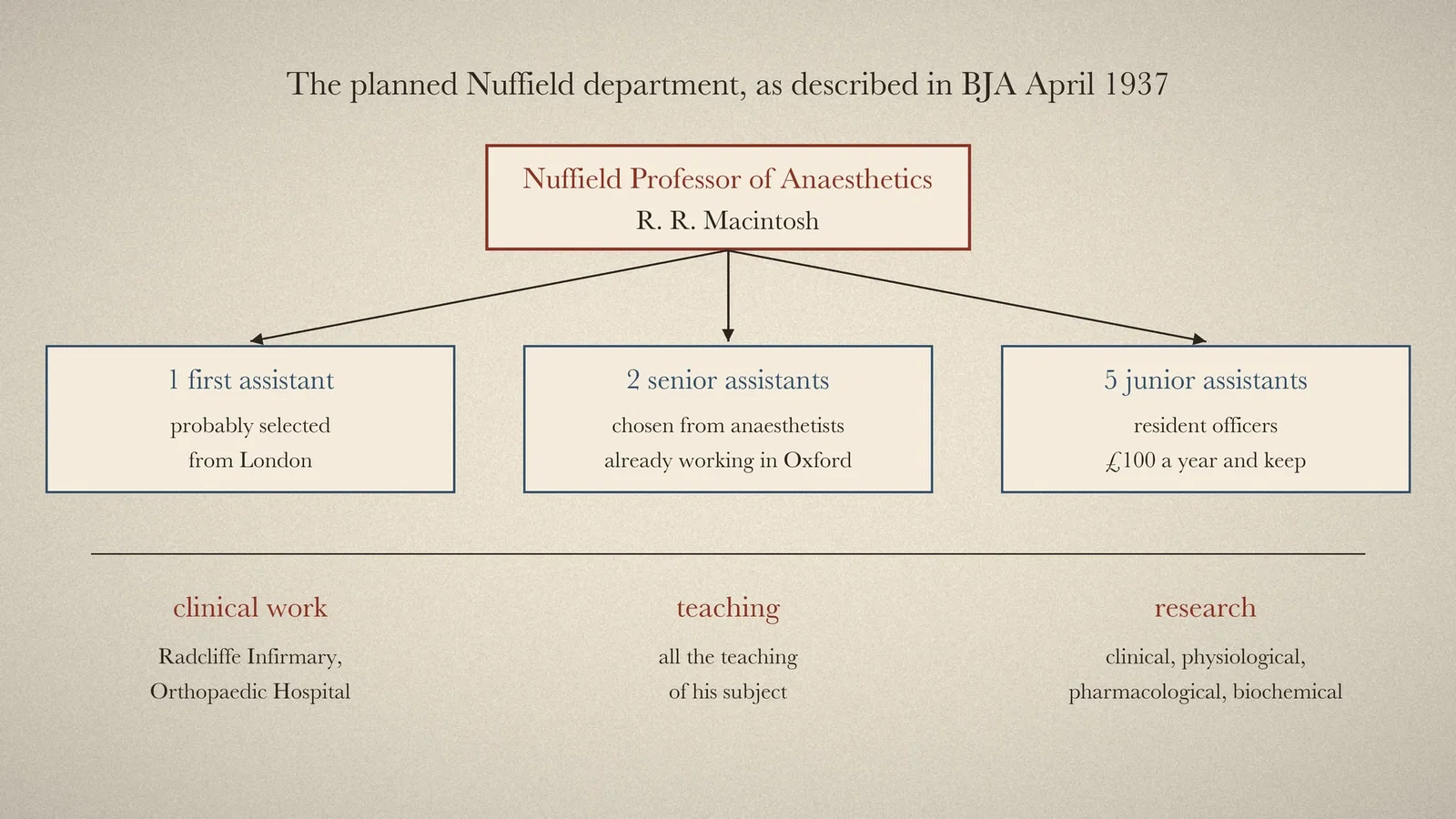
The editors expected no quick harvest: it would be many months, probably several years, before fruit came from "the new tree of anaesthetic endeavour" that Nuffield had planted. The clinical work already done at Oxford in the Radcliffe Infirmary, the Orthopaedic Hospital and elsewhere had to be extended and organised; the professor would also organise all the teaching of the subject and originate, if not supervise, research on the clinical, physiological, pharmacological or biochemical aspects of anaesthesia. It was a difficult but most promising task, and the editors credited Macintosh with initiative, open-mindedness, energy and courage. [2, p. 93–94]
The department on paper
The editorial also printed what the journal understood of the staff. Working with the professor would be one first assistant, "probably selected from London", two senior assistants chosen from anaesthetists already working in Oxford, and five junior assistants. The juniors would be resident officers, "receiving £100 a year and their keep", and would stay long enough to become skilled administrators and teachers. [2, p. 94] A professor, assistants and residents, with clinical work, teaching and research: the outline of a university department of anaesthesia.
The same year
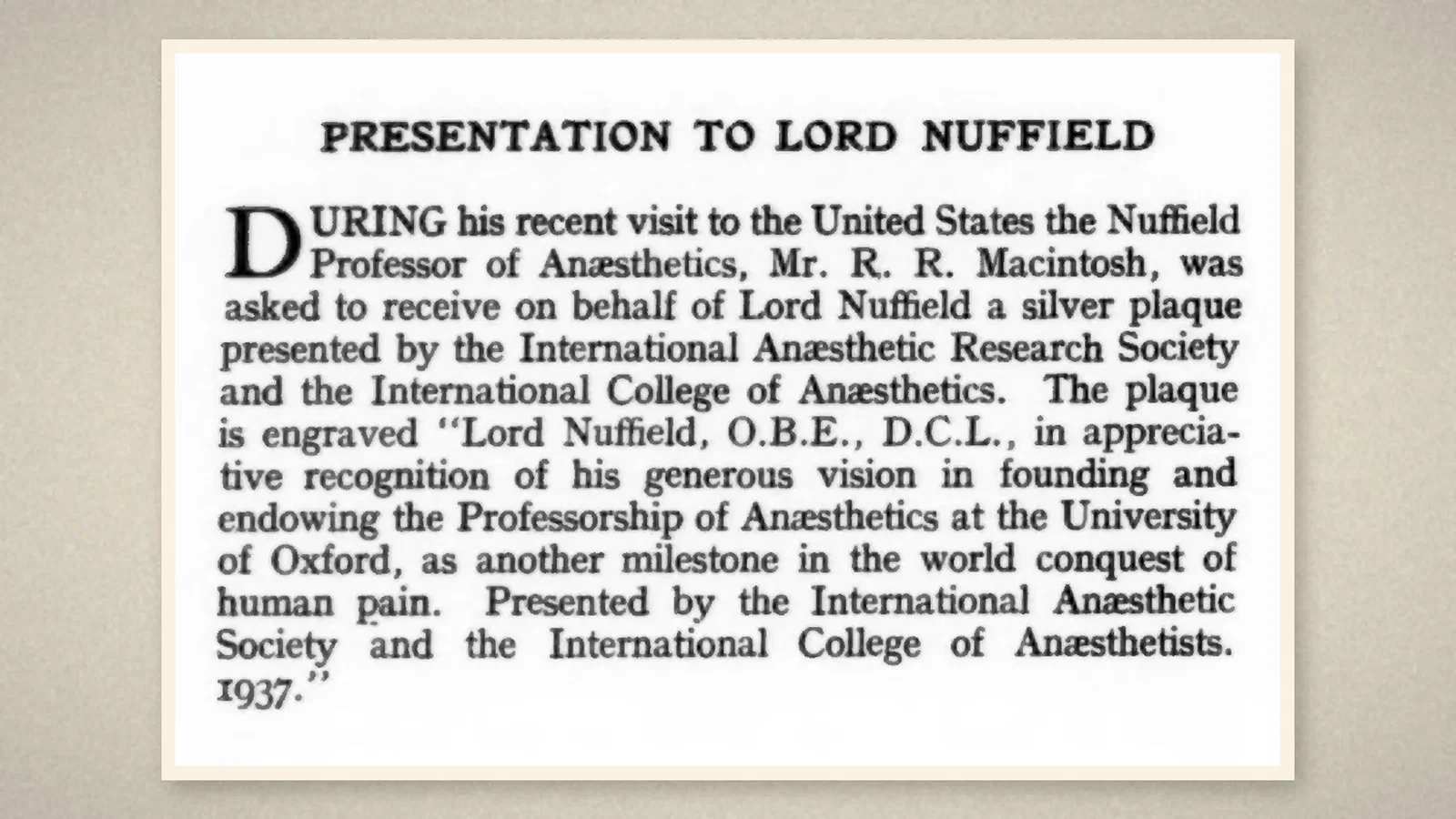
In October 1937 the journal reported that during a recent visit to the United States the Nuffield Professor had been asked to receive, on Lord Nuffield's behalf, a silver plaque from the International Anesthesia Research Society and the International College of Anaesthetists. Its inscription thanked Nuffield for the vision "in founding and endowing the Professorship of Anaesthetics at the University of Oxford", calling it "another milestone in the world conquest of human pain". [3, p. 28] On 30 November 1937 the Association's annual general meeting elected Professor Macintosh to its Council; the report also noted that Lord Nuffield and R. M. Waters of Wisconsin had been elected honorary members. [4, p. 71–72]
What the record shows
Welcoming the gift in 1936, the British Journal of Anaesthesia set down in the same breath how marginal anaesthetics was academically and how poorly anaesthetists stood in their hospitals. Within a year Oxford had its first professor of anaesthetics, and the journal sketched for the professor a department with assistants and residents, joining clinical work, teaching and research. The chair could not change hospital conditions overnight, but it brought anaesthesia into a British university as a subject in its own right.
Sources and reading limits
Read: BJA October 1936, editorial (pp. 1–2) and report of the Association's annual general meeting (p. 33); BJA April 1937, editorial "The Nuffield Professorship of Anaesthetics" (pp. 93–94); BJA October 1937, "Presentation to Lord Nuffield" (p. 28); BJA January 1938, report of the Association's annual general meeting (pp. 71–72).
Not covered: the University of Oxford's decree, the deed of the Nuffield benefaction and the BMJ reports of 1936. The sources read give no exact date for Macintosh's election to the chair; the article is dated by the April 1937 editorial. The size of the benefaction, Macintosh's background and career, and the later Macintosh laryngoscope are not on the pages read and are not described. The sources do not call this the "first" chair of anaesthesia in Europe or the Commonwealth; the 1936 editorial says only that it was, "we believe", the first time the specialty figured in a benefaction of such importance.
Three illustrations are crops of these journal pages; one is a chart drawn from the April 1937 editorial.
- Editorial [Lord Nuffield's gift; Chair of Anaesthetics]; The Association of Anaesthetists of Great Britain and Ireland [annual general meeting]. Br J Anaesth. 1936;14(1):1-2, 33. Internet Archive
- Editorial: The Nuffield Professorship of Anaesthetics. Br J Anaesth. 1937;14(3):93-4. Internet Archive
- Presentation to Lord Nuffield. Br J Anaesth. 1937;15(1):28. Internet Archive
- Association of Anaesthetists, Great Britain and Ireland [annual general meeting, 30 November 1937]. Br J Anaesth. 1938;15(2):71-2. Internet Archive
Continue exploring
Related reading connects shared questions and contexts; it does not by itself establish historical influence.
- 1943: The Macintosh Laryngoscope Exposes the Larynx a Different Way
- 1935: London Holds the Diploma in Anaesthetics Examination
- 1932: The Association of Anaesthetists of Great Britain and Ireland Forms
Anesthesia Epochs · The Source Room · About & Editorial Method
Published November 2, 2026. Sources and reading limits are stated above. Illustrations are labelled as original source images or AI-made. Historical accounts are educational; they are not current treatment instructions.