A society 'primarily political and economic': from a preliminary meeting in April to its constitution at the London Clinic on 1 July.
Reading Library · Anesthesia Epochs · 中文版
Watch the education video (for clinicians)
1932: The AAGBI Is Formed — Who Speaks for the Anaesthetist? · Anesthesia Epochs Education Series
British anaesthetists in 1932 already had a scientific forum, the Section of Anaesthetics of the Royal Society of Medicine. What they lacked was a body that could speak for them on posts, pay and training. The British Journal of Anaesthesia followed the creation of such a body over three issues, and its reports are the record used here.
"Sheep" and "goats"
The July 1932 editorial looked forward to it. It mentioned "the newly forming 'Association of Anaesthetists'" and hoped it would further the development of the specialty; "particularly, we imagine, will the item of a 'Diploma in Anaesthetics' appeal to our readers". There was "undoubted need" for a way to tell "between the sheep and the goats, i.e. between those who are anaesthetists by name only and those who are the real thing by position, experience and competence". [1, p. 141–142] In the same number J. Ross Mackenzie argued that "the time is ripe" for "the institution of a Diploma in Anaesthetics". [1, p. 177]
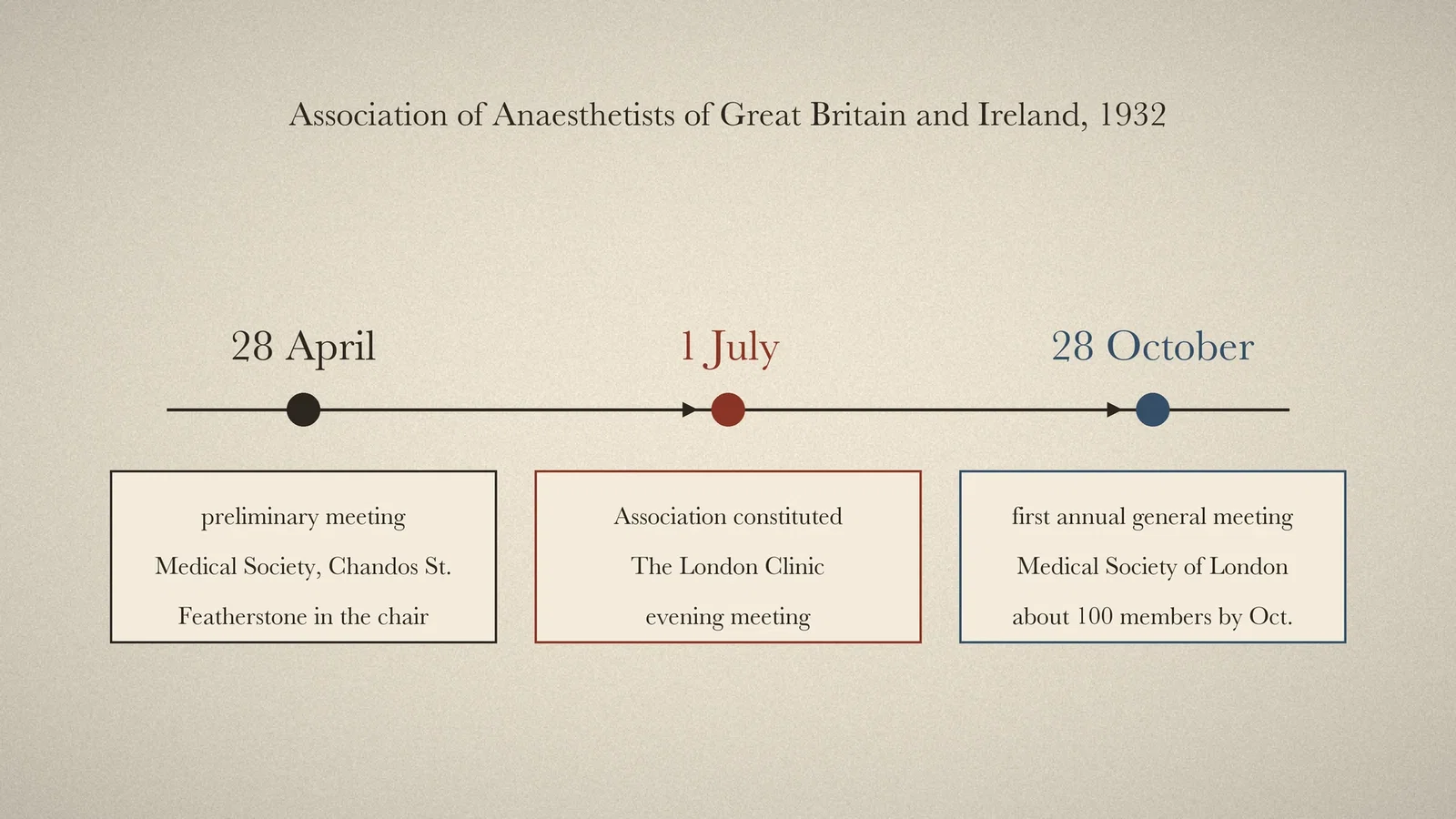
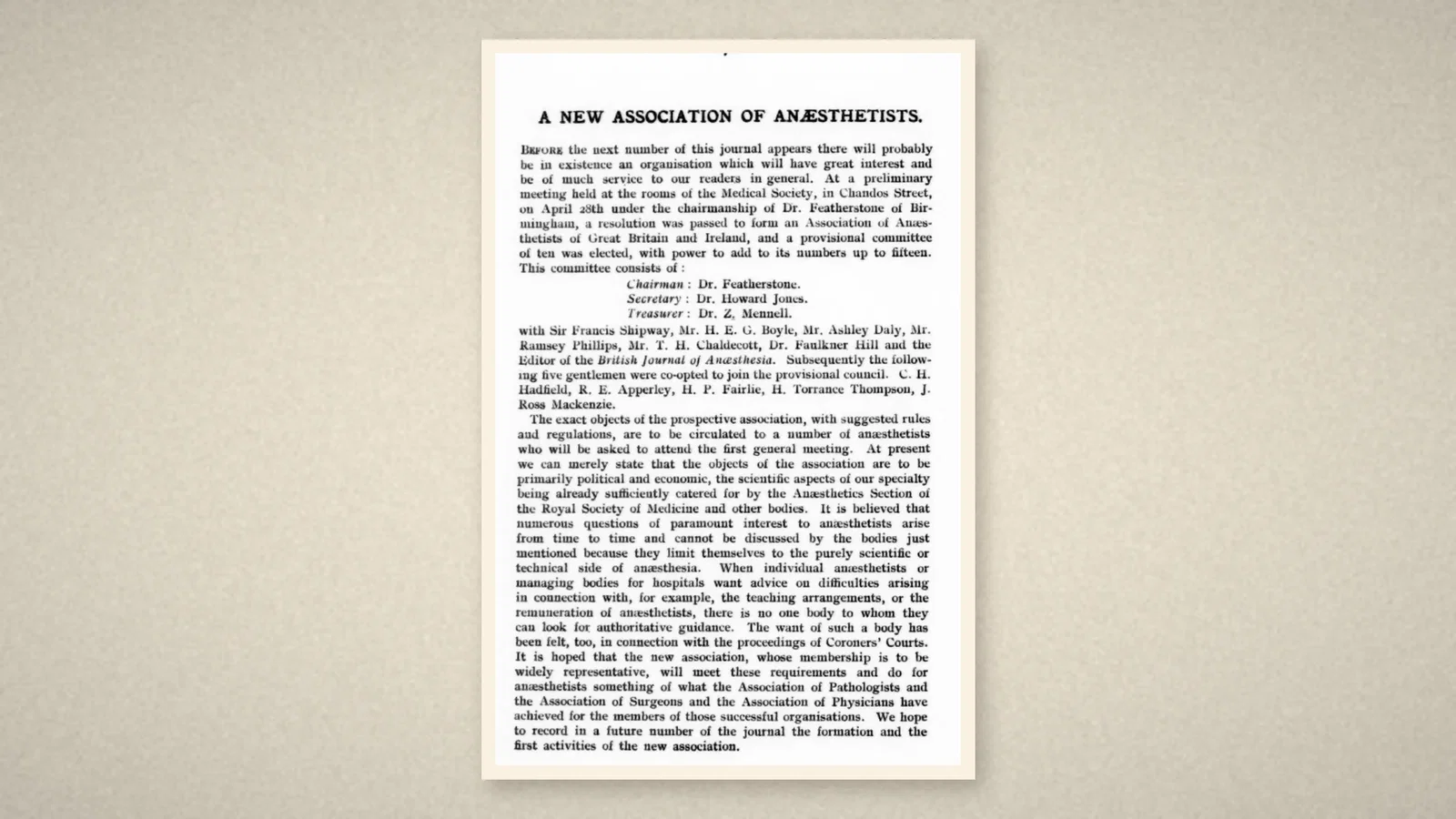
April: a preliminary meeting
"A New Association of Anaesthetists" described how it began. "At a preliminary meeting held at the rooms of the Medical Society, in Chandos Street, on April 28th under the chairmanship of Dr. Featherstone of Birmingham, a resolution was passed to form an Association of Anaesthetists of Great Britain and Ireland." A provisional committee of ten was elected, with Featherstone as chairman, Dr. Howard Jones as secretary and Dr. Z. Mennell as treasurer, together with Sir Francis Shipway, H. E. G. Boyle and others, including the editor of the journal. [1, p. 178]
Its aims were stated frankly: "the objects of the association are to be primarily political and economic", since the scientific side was "already sufficiently catered for by the Anaesthetics Section of the Royal Society of Medicine and other bodies". Anaesthetists and hospital boards had nowhere to turn for "authoritative guidance" on "the teaching arrangements, or the remuneration of anaesthetists"; the want had been felt "in connection with the proceedings of Coroners' Courts" too. The model was what "the Association of Pathologists and the Association of Surgeons and the Association of Physicians" had achieved for their members. [1, p. 178]
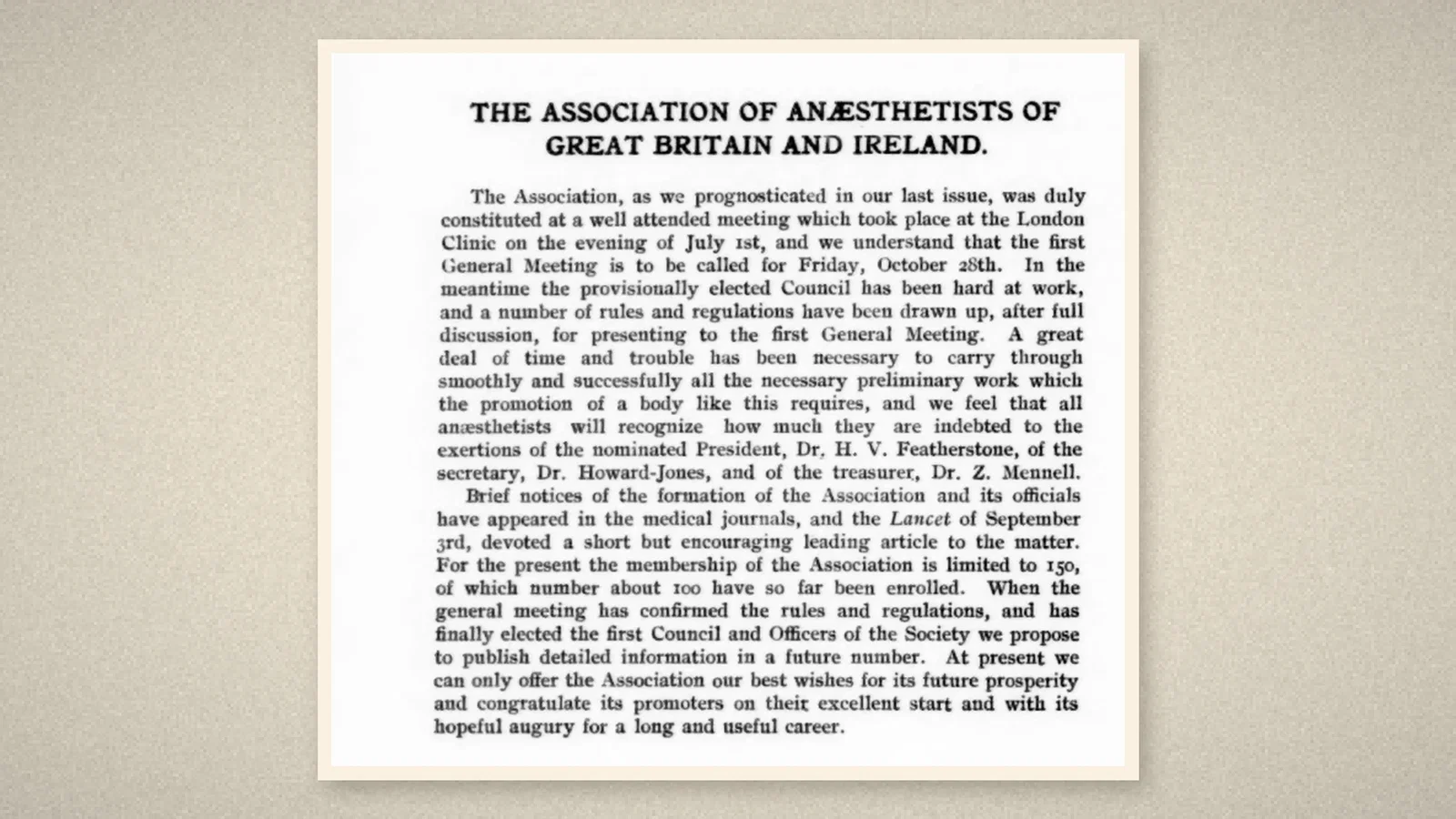
1 July: the Association constituted
In October the journal reported the result. "The Association, as we prognosticated in our last issue, was duly constituted at a well attended meeting which took place at the London Clinic on the evening of July 1st", and the first general meeting was called for Friday, 28 October. The provisional council had drafted rules and regulations; the journal thanked "the nominated President, Dr. H. V. Featherstone", the secretary and the treasurer. The Lancet of 3 September had devoted "a short but encouraging leading article" to it. Membership was "limited to 150, of which number about 100 have so far been enrolled". [2, p. 38]
October: the first annual general meeting
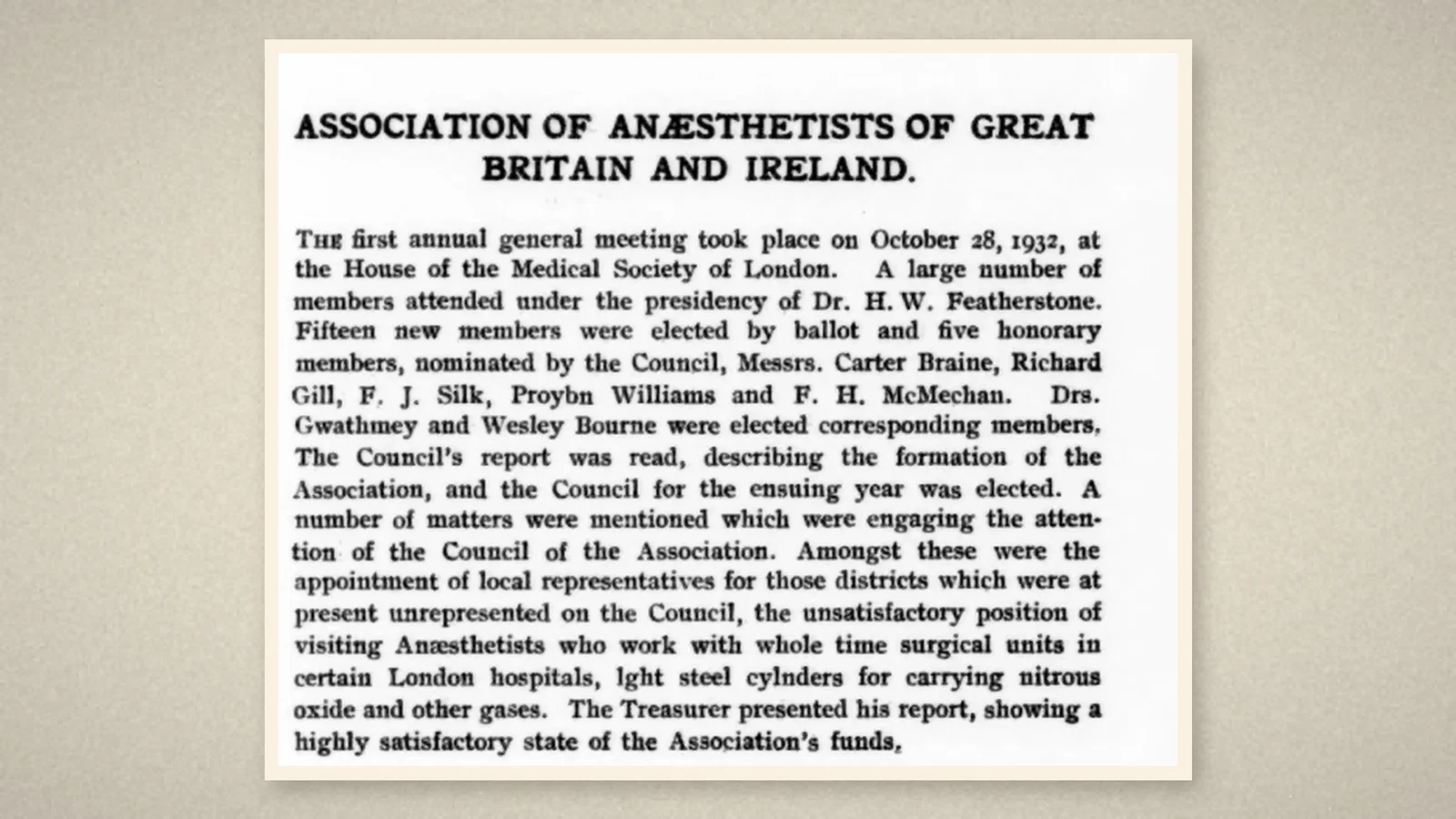
"The first annual general meeting took place on October 28, 1932, at the House of the Medical Society of London", under Featherstone's presidency. Fifteen new members were elected and five honorary members, including F. H. McMechan; Gwathmey and Wesley Bourne of Montreal became corresponding members. The Council's report described the formation of the Association. Among the matters before it were local representatives for unrepresented districts, "the unsatisfactory position of visiting Anaesthetists who work with whole time surgical units in certain London hospitals", and light steel cylinders for nitrous oxide. The funds were in "a highly satisfactory state". [3, p. 85]
What the record shows
In 1932 British anaesthetists created an association for the questions their scientific section could not take up: who should hold anaesthetic posts, how they should be trained and paid, and how they should be represented. Within months it had about a hundred members, and a diploma to separate "the real thing" from anaesthetists "by name only" was already being discussed.
Sources and reading limits
Read: BJA July 1932 (editorial; Ross Mackenzie; "A New Association of Anaesthetists"), October 1932 (p. 38) and January 1933 (p. 85).
Not covered: Featherstone's 1946 account in Anaesthesia, Boulton's 1999 history and the ASA timeline are not covered. The journal reports a preliminary meeting in Chandos Street on 28 April and the constituting meeting at the London Clinic on 1 July, with membership limited to 150. The Royal Charter argument, the 1935 Diploma, the 1946 journal and its motto, the 1948 Faculty and NHS consultant status are not in what was read and are not told. The President's initials appear as "H. V." in October 1932 and "H. W." in January 1933.
Three illustrations are crops of the 1932–1933 journal pages; one is a timeline drawn for this article from them.
- Editorial; A new association of anaesthetists. Br J Anaesth. 1932;9(4):141-2, 177-9. Internet Archive
- The Association of Anaesthetists of Great Britain and Ireland. Br J Anaesth. 1932;10(1):38. Internet Archive
- Association of Anaesthetists of Great Britain and Ireland [first annual general meeting]. Br J Anaesth. 1933;10(2):85. Internet Archive
Continue exploring
Related reading connects shared questions and contexts; it does not by itself establish historical influence.
- 1893: London's Society of Anaesthetists Brings Experience Before Peers
- 1923: The First Number of the British Journal of Anaesthesia
- 1911: Hewitt on How Anaesthetics Entered the Medical Curriculum
Anesthesia Epochs · The Source Room · About & Editorial Method
Published November 2, 2026. Sources and reading limits are stated above. Illustrations are labelled as original source images or AI-made. Historical accounts are educational; they are not current treatment instructions.