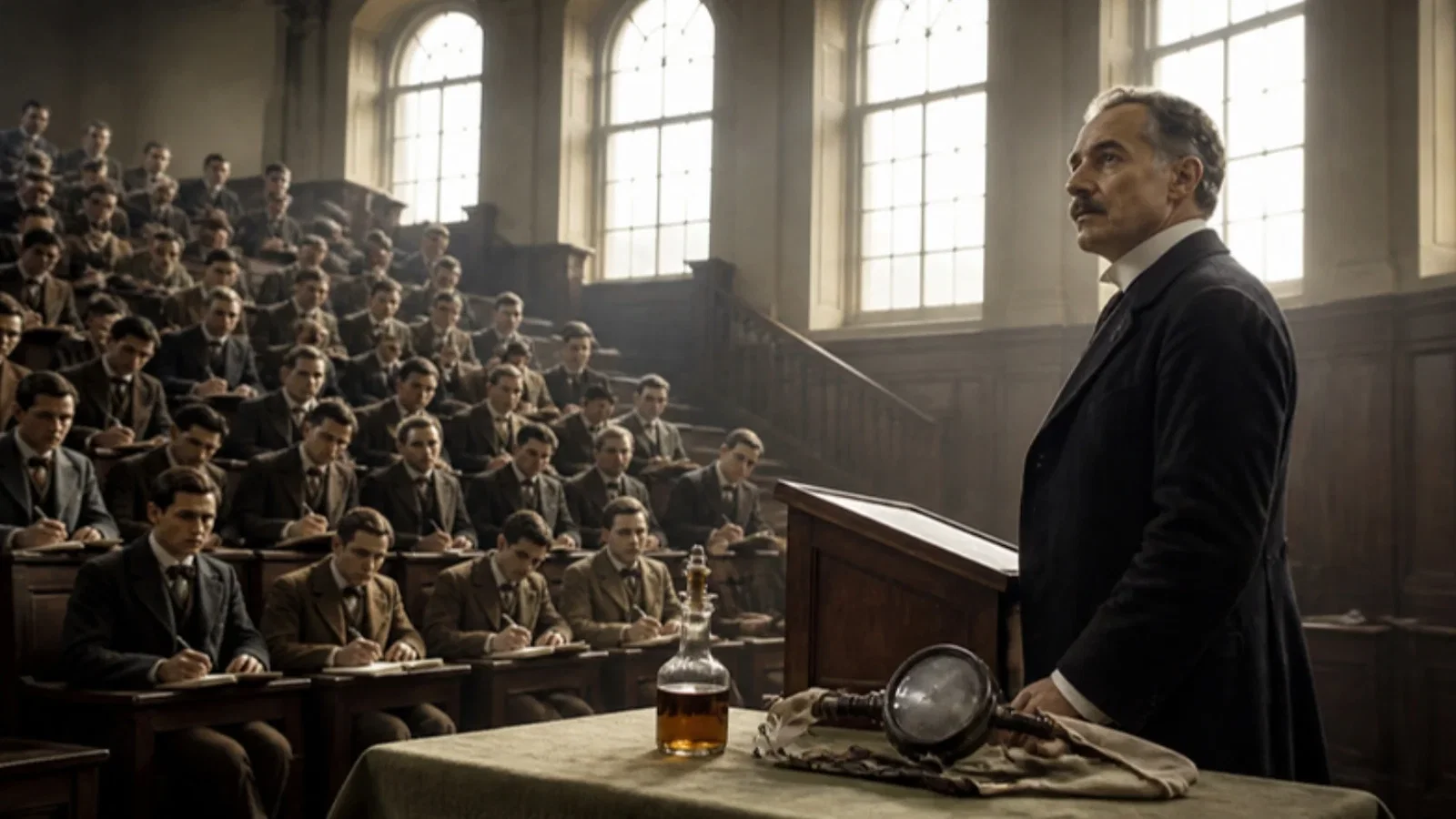
From the General Medical Council's refusal in 1901 to the 1909 requirement of lectures and supervised practice.
Reading Library · Anesthesia Epochs · 中文版
Watch the education video (for clinicians)
1911: Hewitt on Anaesthetics in the Medical Curriculum · Anesthesia Epochs Education Series
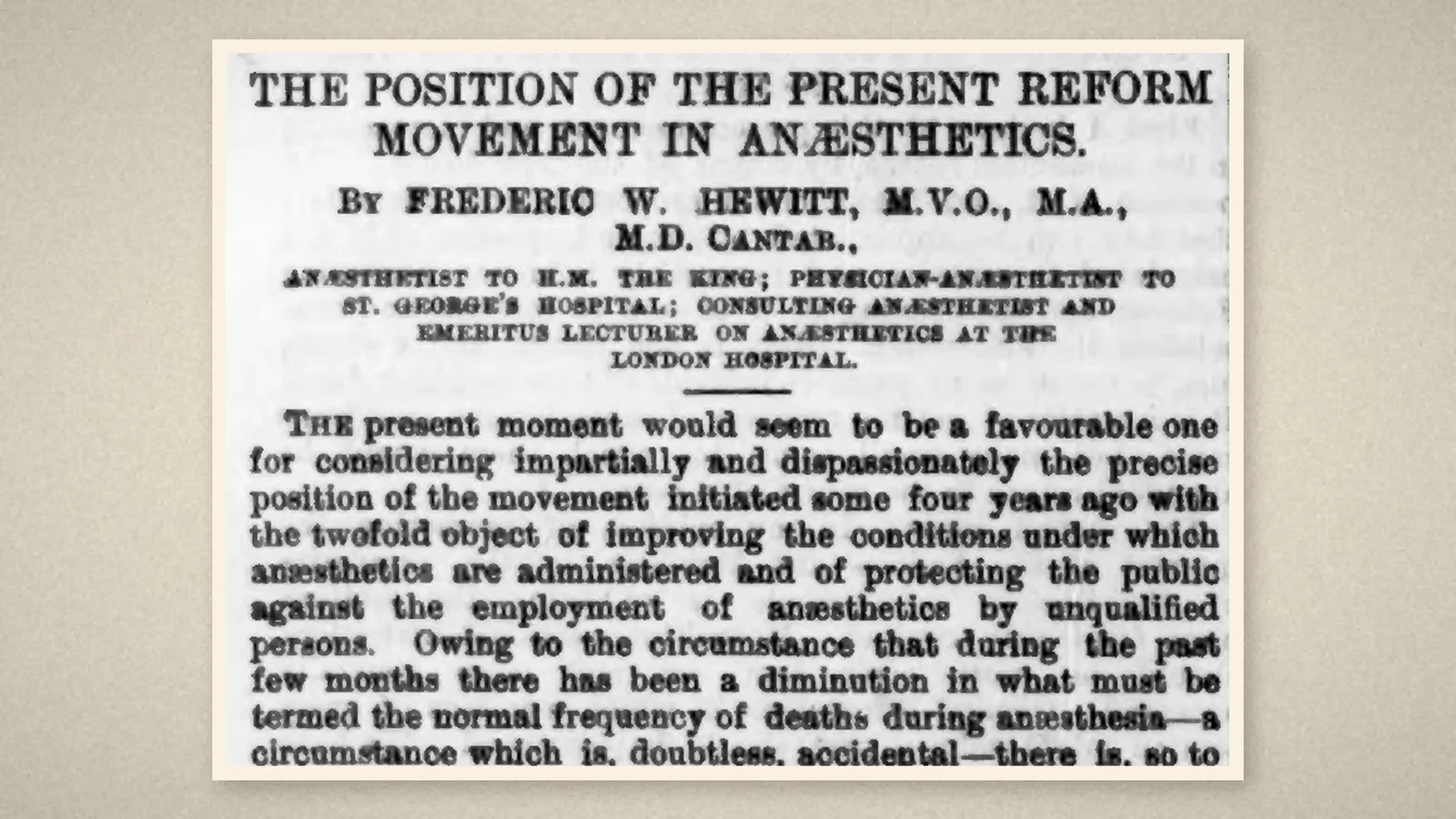
On 3 and 10 June 1911 the Lancet published, in two parts, a long paper by Frederic Hewitt, "The position of the present reform movement in anaesthetics". The byline gave Hewitt's titles: anaesthetist to H.M. the King, physician-anaesthetist to St George's Hospital, consulting anaesthetist and emeritus lecturer on anaesthetics at the London Hospital. [1, p. 1486] Nine years earlier Hewitt had given King Edward VII the emergency anaesthetic on the eve of the coronation.
Hewitt began by saying that the moment seemed right for a calm review of the movement begun some four years earlier with a twofold object: to improve the conditions under which anaesthetics were given, and to protect the public against their use by unqualified persons. [1, p. 1486] The premise was explicit. If most deaths under anaesthetics were unavoidable Hewitt would not press so hard for reform; but experience showed that "the great majority of accidents are preventable", and the key lay in the person giving the anaesthetic. [1, p. 1486]
1907: eight bodies out of 22
Hewitt dated the reform movement to the meeting of the British Association for the Advancement of Science at Leicester in 1907. Deaths under anaesthetics were discussed there, and the first steps proposed were to find out whether medical students were properly instructed, to press the educational authorities if necessary, and to urge hospitals to put anaesthetics in the hands of people with special aptitude and enough experience. [1, p. 1486] Statistics supplied by the coroner Dr F. J. Waldo suggested that accidents were much more common in hospitals that took no special precautions and often used inadequately trained administrators. [1, p. 1486]
The medical examining bodies of the United Kingdom were then written to, and it was found that of 22 such bodies only eight required candidates to produce evidence of instruction in anaesthetics. [1, p. 1486]
From "not expedient" to a Recommendation
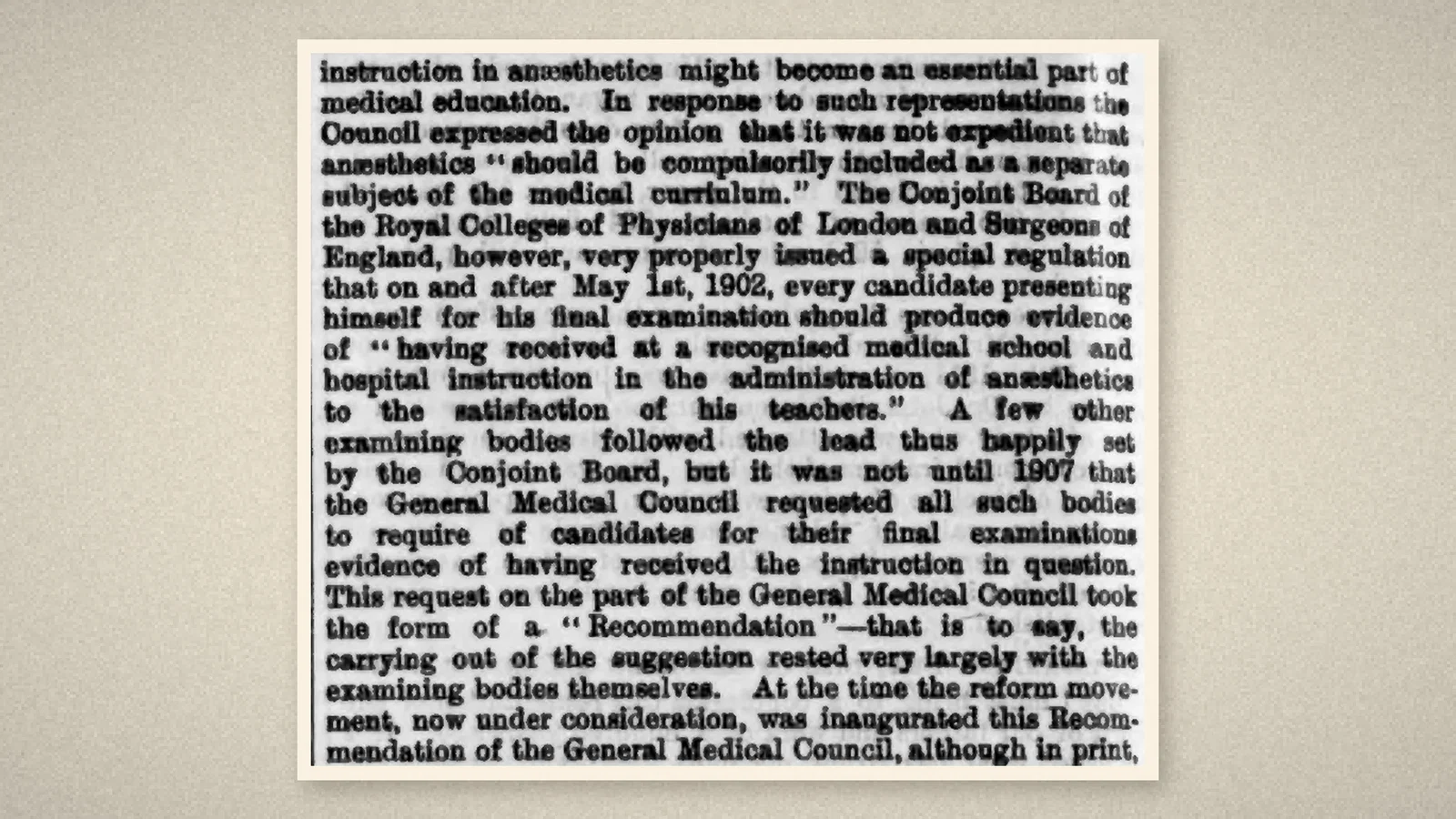
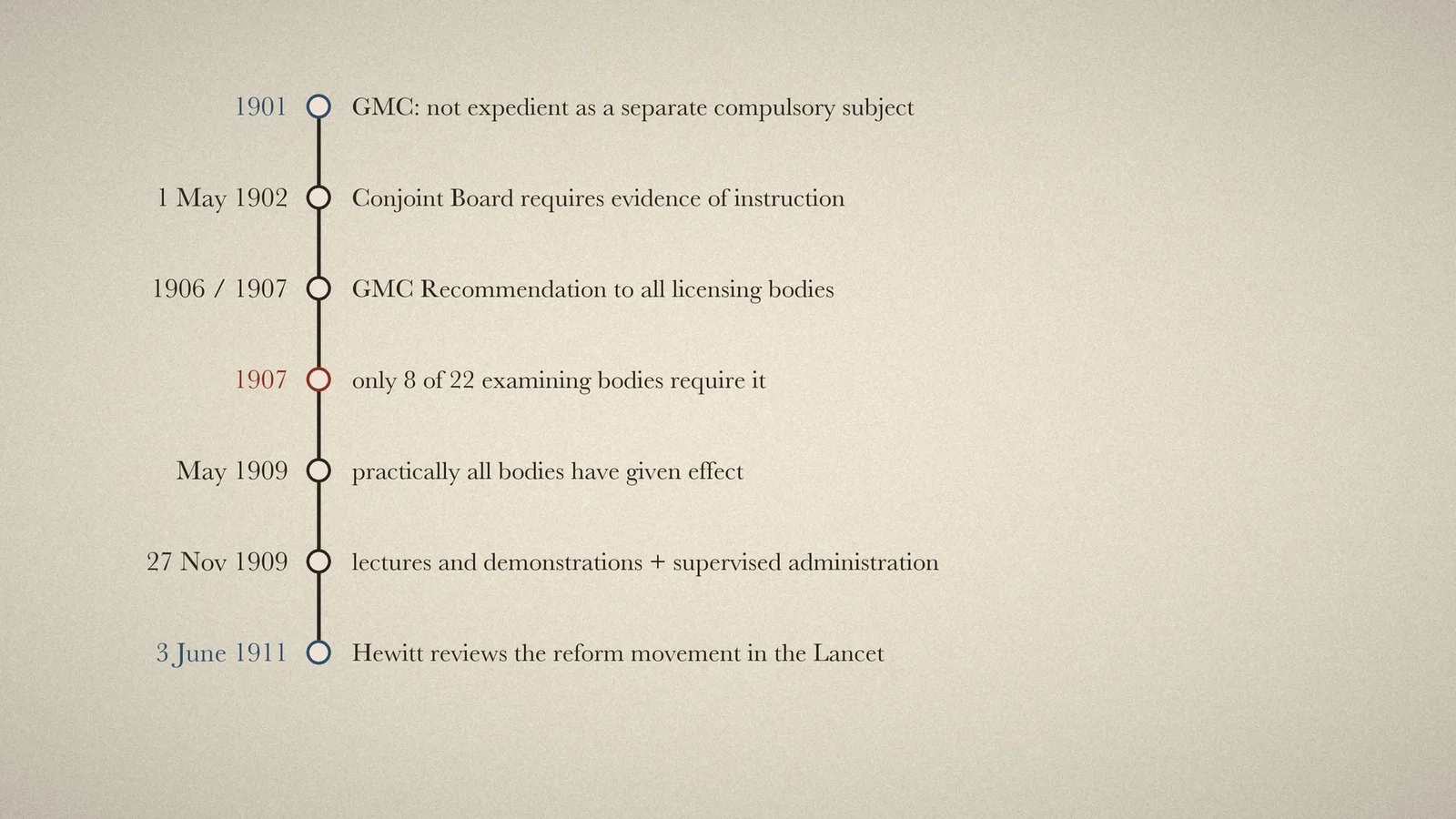
Hewitt went back further. In 1901 the Society of Anaesthetists had asked the General Medical Council to make instruction in anaesthetics an essential part of medical education; the Council replied that it was not expedient that anaesthetics "should be compulsorily included as a separate subject of the medical curriculum". [1, p. 1486] The Conjoint Board of the Royal Colleges of Physicians of London and Surgeons of England nonetheless issued its own regulation: from 1 May 1902 every candidate for its final examination had to show having received instruction in the administration of anaesthetics at a recognised medical school and hospital, to the satisfaction of the candidate's teachers. [1, p. 1486]
Only later did the GMC ask all examining bodies to require such evidence. It was not until 1907, Hewitt wrote, that the Council made the request, and it took the form of a "Recommendation", leaving compliance largely to the bodies themselves; when the reform movement began, the Recommendation, though in print, "was little more than a dead letter". [1, p. 1486] There is a discrepancy of date: answering a Commons question from Sir William Collins in 1910, the Home Secretary cited the evidence of Sir Donald MacAlister, President of the GMC, that the Council had issued the recommendation in 1906. [2, p. 1562]
1908–1909: from recommendation to requirement
In March 1908 the Medico-Legal Society passed two resolutions: one asking the GMC to add instruction in anaesthetics to its "requirements", the other asking the Privy Council to seek legislation making the administration of anaesthetics for operations by unqualified persons "a penal offence". [1, p. 1486] In November 1908 the GMC approved the principle of the General Anaesthetics Bill and had its Registrar ask the bodies how far they had acted on its recommendation. [1, p. 1487]
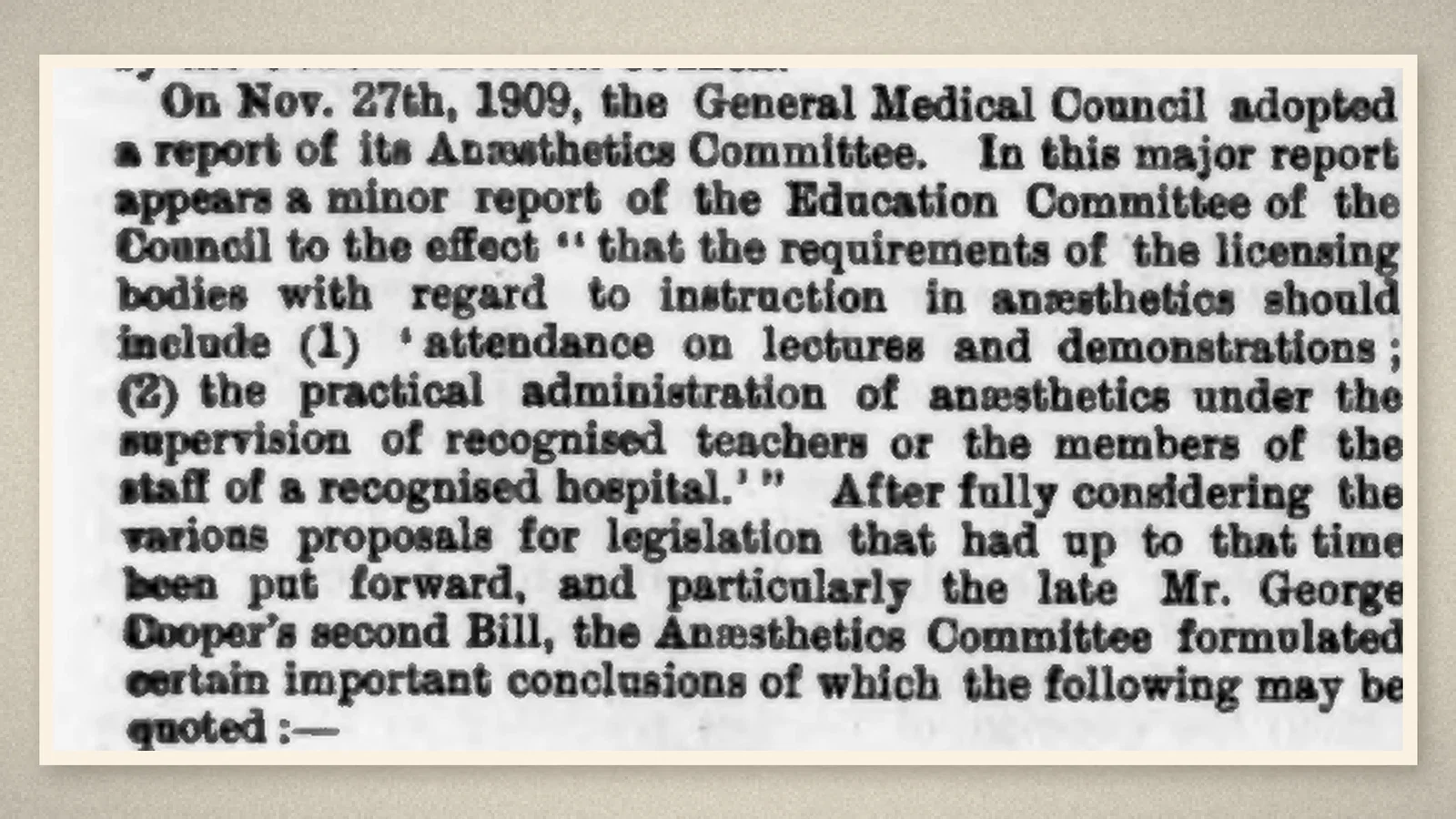
In May 1909 MacAlister reported in the presidential address that practically all the examining bodies had given effect to the Council's recommendation. [1, p. 1487] On 27 November 1909 the GMC adopted a report of its Anaesthetics Committee, which included the Education Committee's view that instruction in anaesthetics should comprise attendance on lectures and demonstrations, and practical administration of anaesthetics under the supervision of recognised teachers or members of the staff of a recognised hospital. [1, p. 1488] The report's conclusions also held that the person giving the anaesthetic should not be the person performing the operation, and left the precise form of evidence of "adequate practical instruction" to the licensing bodies for the present. [1, p. 1488]
1911: still under way
When Hewitt wrote, the teaching requirement was largely in place but legislation was not. The second part of the paper records Collins's question in the Commons on 19 July 1910 and the Home Secretary's reply expressing the hope of proposing legislation when time permitted. [2, p. 1562] Hewitt saw the whole as three linked reforms: thorough training of every medical student, careful choice of anaesthetists by hospitals, and a law against unqualified administration.
What the record shows
"Every medical student must learn anaesthetics" did not arrive as a single decree. It was pushed through over a decade: refused in 1901, adopted first by one examining board in 1902, recommended by the GMC in 1906 or 1907, observed by only a third of the bodies in 1907, nearly universal by 1909, and then spelt out as lectures plus supervised practice. Hewitt's review is the fullest contemporary account by someone who took part.
Sources and reading limits
Read: Hewitt, "The position of the present reform movement in anaesthetics", Lancet, 3 June 1911, pp. 1486–1489, and the continuation of 10 June 1911, pp. 1562–1565.
Not covered: the GMC minutes and the texts of its 1901, 1906/1907 and November 1909 decisions were not read; they are reported here as Hewitt quotes and summarizes them. Hewitt dates the Recommendation to (May) 1907, while MacAlister's evidence, as quoted by the Home Secretary in 1910, gives 1906; both are given. The 1911 evidence is Hewitt's review, which describes recommendations, the committee report of 27 November 1909 and pending legislation, not a 1911 decree.
Of the four illustrations, three are crops of the 1911 Lancet pages and one is a diagram drawn for this article from the sources.
- Hewitt FW. The position of the present reform movement in anaesthetics. Lancet. 1911;177(4579):1486-9. doi:10.1016/S0140-6736(01)62750-8. Internet Archive
- Hewitt FW. The position of the present reform movement in anaesthetics [continued]. Lancet. 1911;177(4580):1562-5. doi:10.1016/S0140-6736(00)78272-9. Internet Archive
Continue exploring
Related reading connects shared questions and contexts; it does not by itself establish historical influence.
Anesthesia Epochs · The Source Room · About & Editorial Method
Published November 2, 2026. Sources and reading limits are stated above. Illustrations are labelled as original source images or AI-made. Historical accounts are educational; they are not current treatment instructions.