The Conjoint Board of the two Royal Colleges creates the D.A.: a threshold of a thousand anaesthetics, written and oral papers, and forty-six first successful candidates.
Reading Library · Anesthesia Epochs · 中文版
Watch the education video (for clinicians)
1935: The Diploma in Anaesthetics — The First Examination · Anesthesia Epochs Education Series
Today an anaesthetist becomes a specialist through defined training and examinations. In Britain that road began with a diploma. In July 1935 the British Journal of Anaesthesia said in its editorial that the most notable recent event was "the establishment by the Royal Colleges of Medicine and Surgery of a Diploma in Anaesthetics", whose details it printed at page 184. [1, p. 149] Most readers, it added, knew "the part which has been played by the Association of Anaesthetists of Great Britain and Ireland in bringing the Diploma to life", and it thanked the Association. [1, p. 149] This article uses the regulations, the lists and the Association's annual report printed in the July 1935, October 1935 and January 1936 numbers of the journal to tell how the diploma was set up, what its first examination asked, and who received it.
The regulations: what was examined, and who could sit
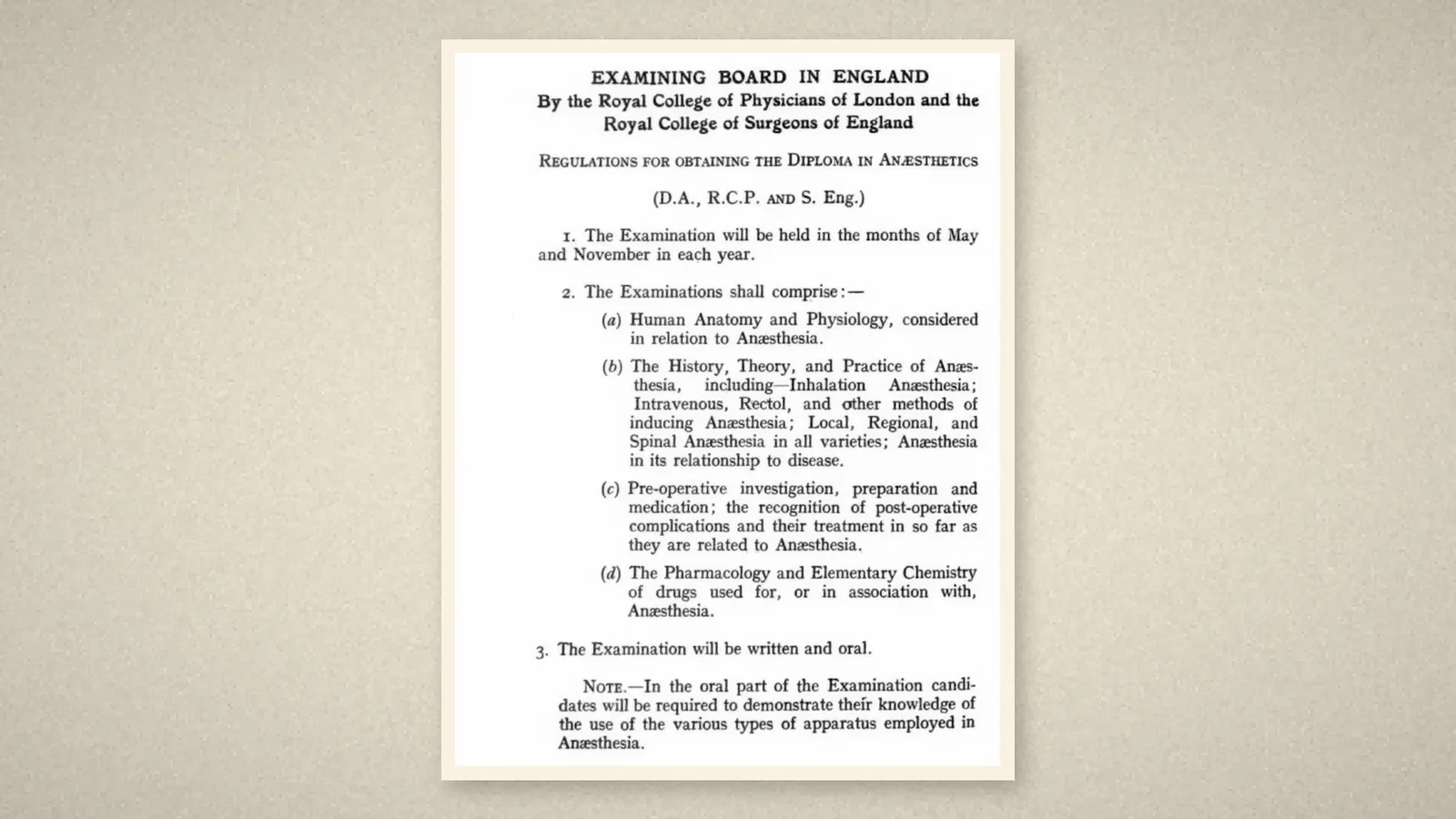
The regulations were headed "Examining Board in England", by the Royal College of Physicians of London and the Royal College of Surgeons of England, for a diploma styled D.A. The examination would be held in May and November each year. [1, p. 184] It had four parts: (a) human anatomy and physiology in relation to anaesthesia; (b) the history, theory and practice of anaesthesia, including inhalation, intravenous, rectal and other methods of induction, local, regional and spinal anaesthesia in all varieties, and anaesthesia in relation to disease; (c) pre-operative investigation, preparation and medication, and the recognition and treatment of post-operative complications as they relate to anaesthesia; (d) the pharmacology and elementary chemistry of the drugs used. "The Examination will be written and oral", and in the oral candidates had to "demonstrate their knowledge of the use of the various types of apparatus employed in Anaesthesia". [1, p. 184]
Eligibility was just as concrete. A candidate needed a registrable qualification in medicine, surgery and midwifery, or a recognised Indian, colonial or foreign medical degree. After qualifying, the candidate must either have held resident posts in recognised general hospitals for at least twelve months, "of which at least six months shall have been as Resident Anaesthetist", or have personally given anaesthetics "on not less than one thousand recorded occasions, at least one half of which shall have been for major surgical procedures", with a detailed list of those operations and the anaesthetic used in each, signed by the senior anaesthetist or senior surgeon. [1, p. 185] The fee was £6 6s. Forms came from the Board's secretary, Horace H. Rew, at the Examination Hall, 8–11 Queen Square, London. And: "The first Examination will begin on Friday, November 8th, 1935." [1, p. 186–187]
Election without examination: the Association's clause
One clause was transitional. Until 1 May 1938 the Colleges could, on the recommendation of the Board's Committee of Management, grant the diploma without examination to an anaesthetist to a general hospital associated with a recognised medical school in the British Empire who had held the post for at least ten years; the fee was six guineas. [1, p. 186]
The Association's annual report, printed in January 1936, explains where that clause came from. The previous annual meeting had empowered its Council to negotiate with the Royal College of Surgeons of England. Four representatives, "Dr. Blomfield, Dr. Hadfield, Dr. Magill and I", met the College's President and Council representatives. "It was suggested that the Conjoint Board should undertake the Diploma", in line with the diplomas in public health and ophthalmology. The representatives then met Mr Rew; the Association's Diploma Sub-Committee drafted a schedule from those of other diplomas; the whole Council discussed it; the President of the College sent it to a committee of the Royal College of Physicians, on which Dr Morris served; and the Board's Committee of Management received the representatives and approved it. [3, p. 72]
There was agreement on nearly everything except election without examination, which the Colleges did not accept "until strong representations were laid before them". The Association cited the precedent of the surgical Fellowship, and argued that it did not want a difficult or competitive examination: "we sought for a hall-mark which should signify that an anaesthetist possessed satisfactory skill and knowledge". For the diploma to become a force within a few years, "it was essential that the acknowledged anaesthetists of the country should possess it". [3, p. 72]
The lists: first the elected, then the examined
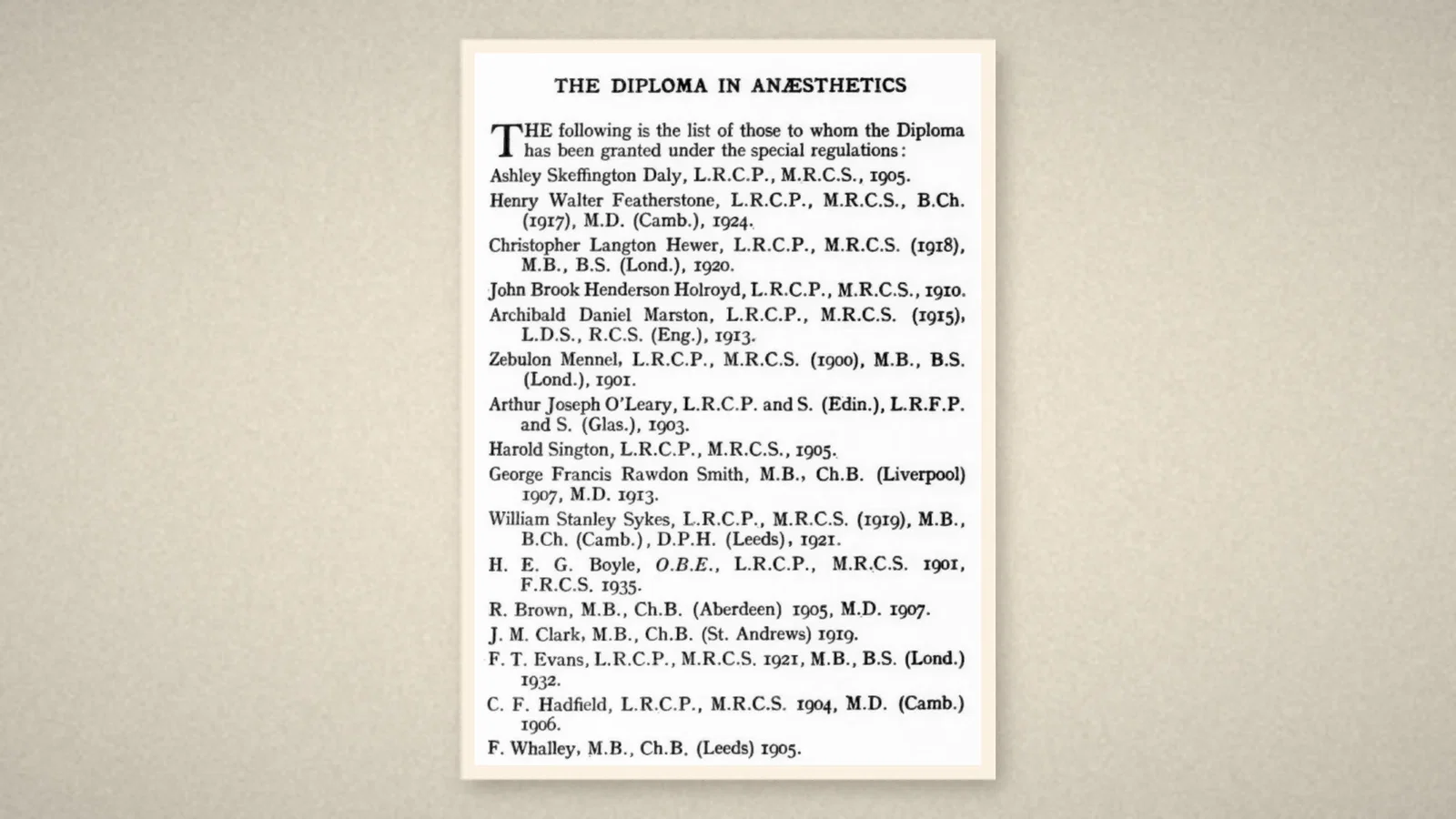
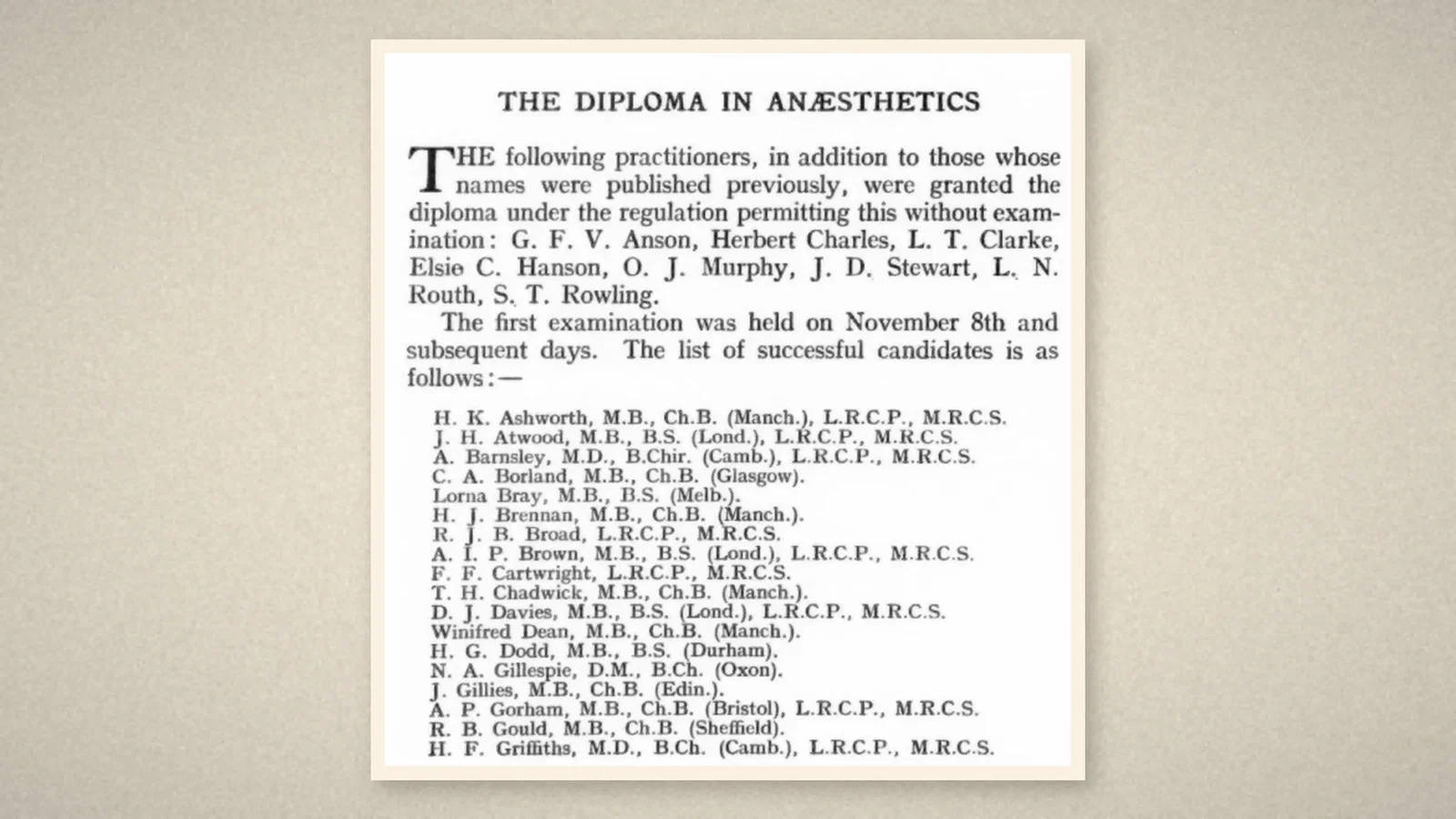
In October 1935 the journal printed "the list of those to whom the Diploma has been granted under the special regulations": sixteen names, among them Featherstone, Hewer, Boyle and Hadfield. [2, p. 33] In January 1936 it added eight more elected without examination, and reported that "the first examination was held on November 8th and subsequent days", followed by the list of successful candidates. [3, p. 54] Counted from that list, 46 passed; the journal gives no total. Most held degrees from British medical schools, but the list also includes graduates of Melbourne and Sydney and a surgeon commander of the Royal Navy. [3, p. 54–55]
The first paper
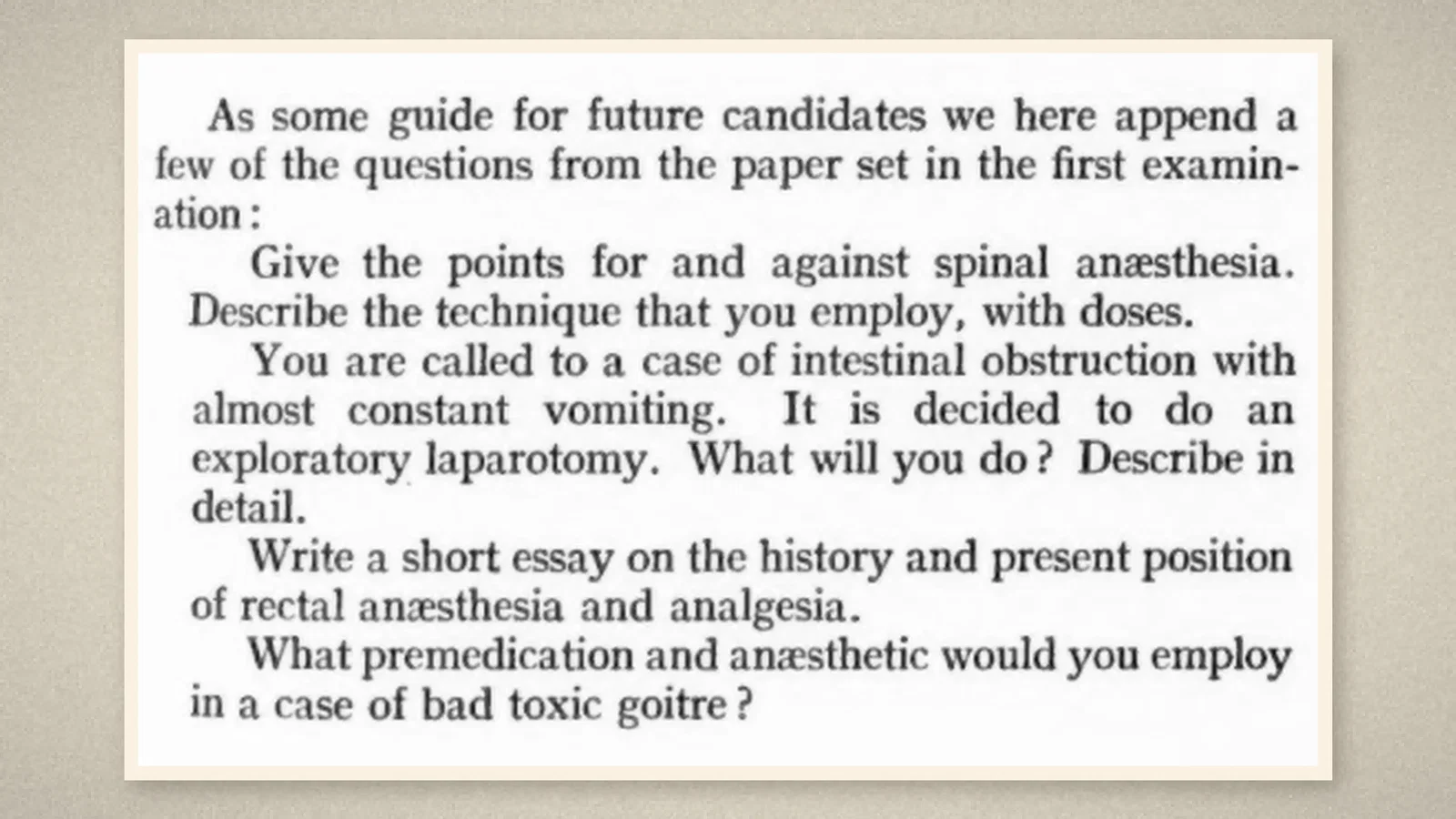
"As some guide for future candidates", the journal printed a few questions from the first paper. Give the points for and against spinal anaesthesia, and describe your technique, with doses. You are called to a case of intestinal obstruction with almost constant vomiting; an exploratory laparotomy is decided on; what will you do? Write a short essay on the history and present position of rectal anaesthesia and analgesia. What premedication and anaesthetic would you use in a bad toxic goitre? [3, p. 55] None of them asks for recall alone; each asks what the candidate would do at the bedside.
What the record shows
In 1935 British anaesthetists gained, for the first time in what these sources describe, a specialist diploma granted by the two Royal Colleges and won by examination. The Association pressed for it, drafted it, and secured a transitional route for senior colleagues, arguing that a hall-mark would only count if the recognised anaesthetists held it. The first examination required twelve months of resident posts or a thousand recorded anaesthetics, and its questions tested clinical judgement.
Sources and reading limits
Read: BJA July 1935, editorial (p. 149) and the regulations (pp. 184–187); BJA October 1935, the list granted under the special regulations (p. 33); BJA January 1936, the notice of the first examination and its successful candidates (pp. 54–55) and the part of the Association's annual report on the negotiations (pp. 71–73).
Not covered: the Examining Board's own records are not covered. The figure of 46 successful candidates is a count of the printed list; the journal gives no total. The annual report is unsigned in the part read and speaks as "I", so its author is not named here. The sources read do not name the examiners of the first examination, so none is named.
All four illustrations are crops of pages from these three numbers of the journal.
- Editorial; Examining Board in England. Regulations for obtaining the Diploma in Anaesthetics. Br J Anaesth. 1935;12(4):149, 184-7. Internet Archive
- The Diploma in Anaesthetics. Br J Anaesth. 1935;13(1):33. Internet Archive
- The Diploma in Anaesthetics; Association of Anaesthetists of Great Britain and Ireland [annual report]. Br J Anaesth. 1936;13(2):54-5, 71-3. Internet Archive
Continue exploring
Related reading connects shared questions and contexts; it does not by itself establish historical influence.
- 1932: The Association of Anaesthetists of Great Britain and Ireland Forms
- 1948: The RCS Faculty of Anaesthetists Holds Its Opening Meeting
- 1941: The American Board of Anesthesiology Becomes a Separate Board
Anesthesia Epochs · The Source Room · About & Editorial Method
Published November 2, 2026. Sources and reading limits are stated above. Illustrations are labelled as original source images or AI-made. Historical accounts are educational; they are not current treatment instructions.