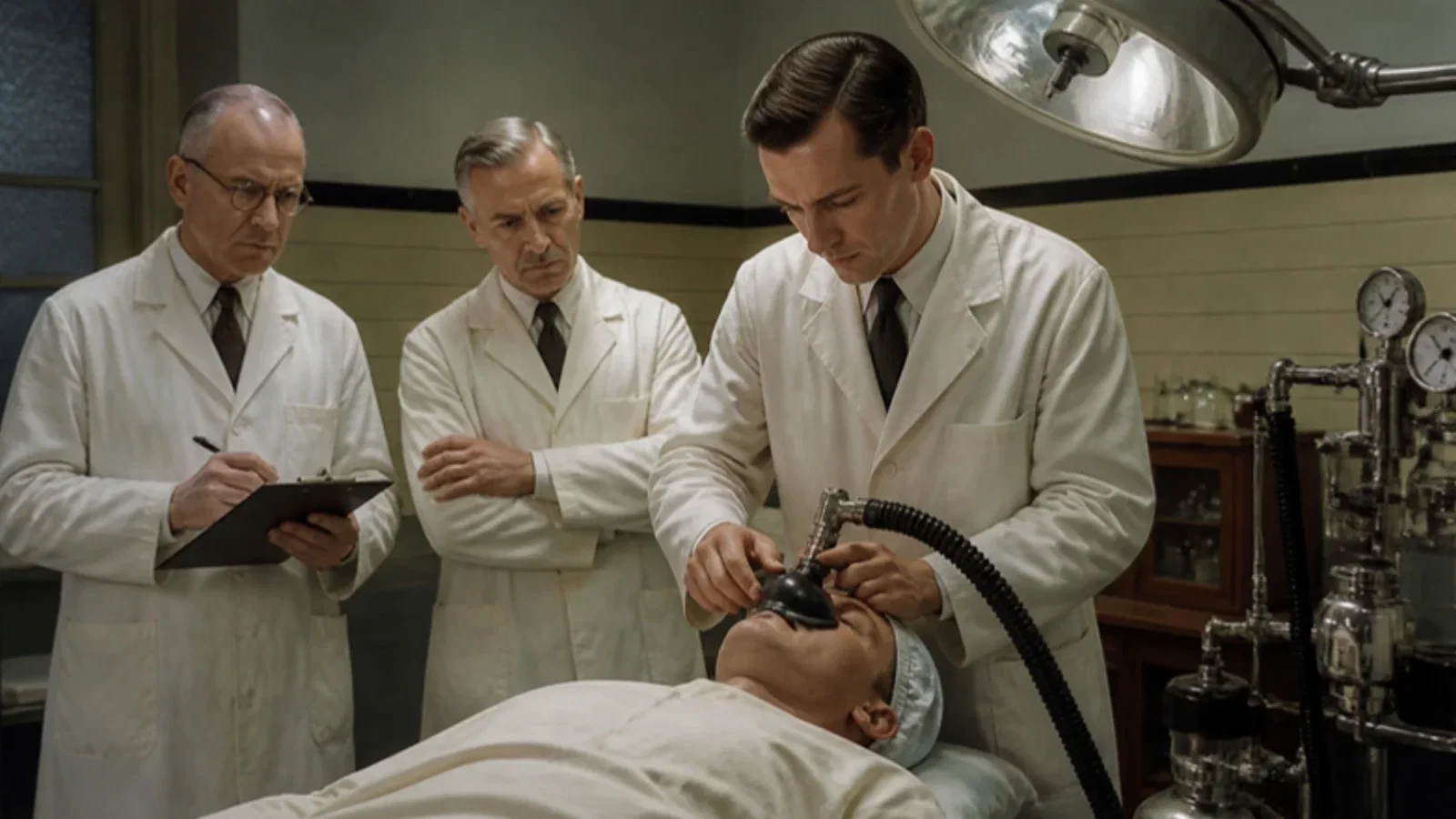
From an affiliate of the surgical board to a board of its own: five years in the specialty, written and oral examinations, and examiners in the operating room.
Reading Library · Anesthesia Epochs · 中文版
Watch the education video (for clinicians)
1941: The American Board of Anesthesiology — A Separate Major Board · Anesthesia Epochs Education Series
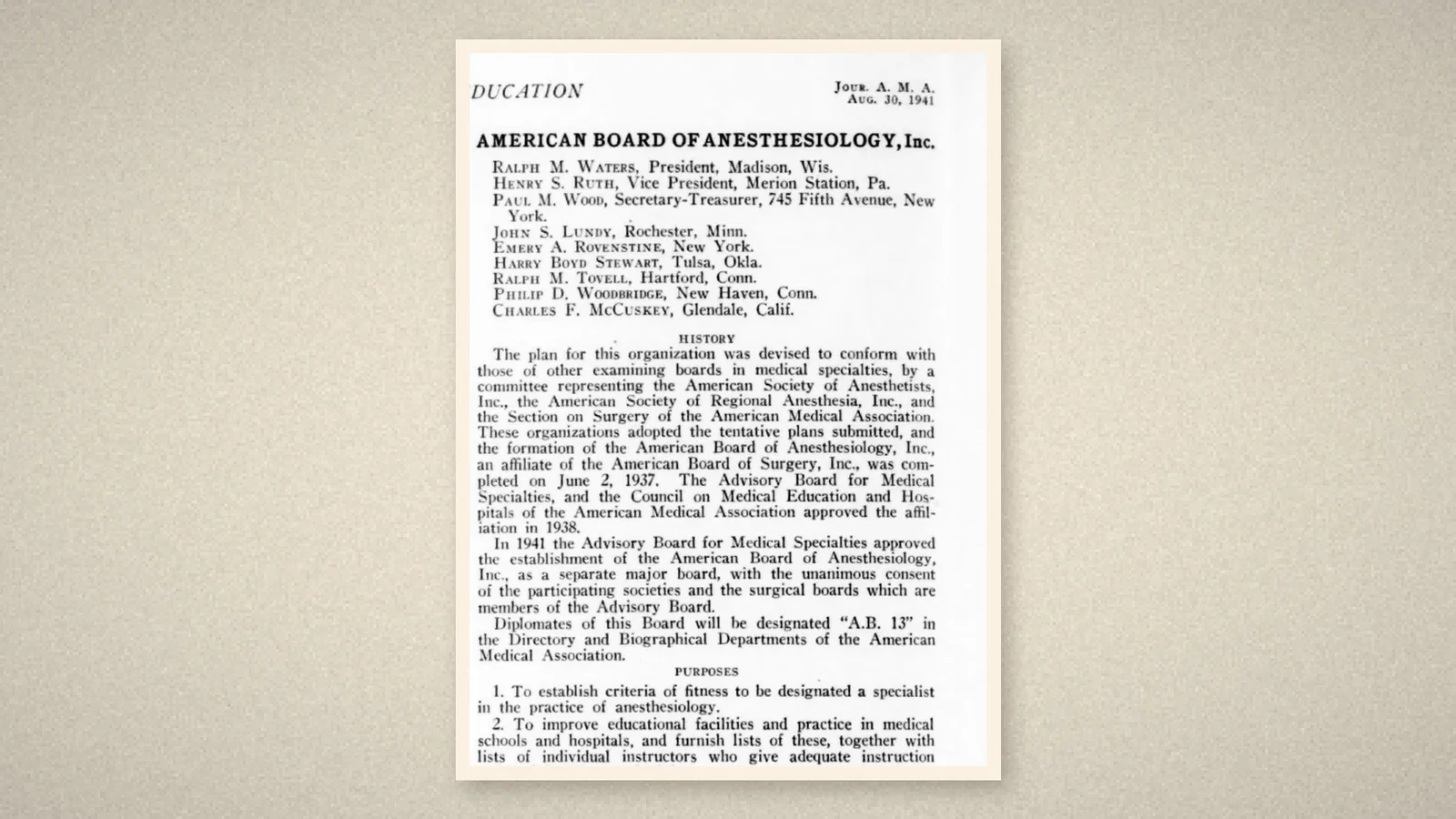
Board certification is now how a hospital, a patient or a court recognizes an anaesthesiologist in the United States. Every year the Journal of the American Medical Association printed, in its educational number, the boards approved by its Council on Medical Education and Hospitals, each in its own words. The number of 30 August 1941 shows the American Board of Anesthesiology at the moment it became a board in its own right. [1, p. 727–729]
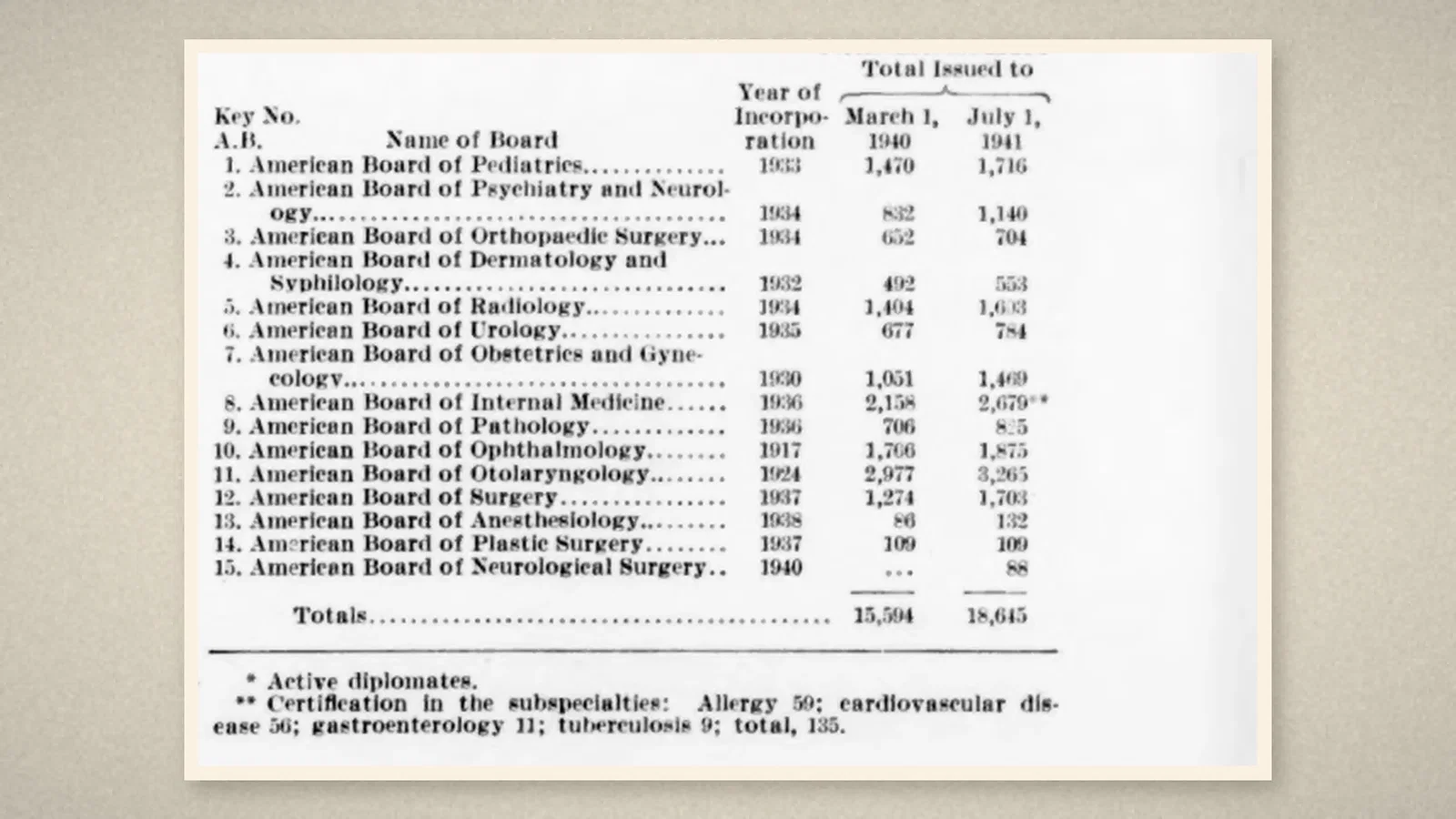
Fifteen boards
"Fifteen specialty boards, eleven of which have been organized since 1933, meet the standards of the Council and are now fully approved by the Council", JAMA reported, and anaesthesiology headed the alphabetical list. [1, p. 728] The table gives each board's year of incorporation and certificates issued. For the American Board of Anesthesiology the year is 1938, with 86 certificates by 1 March 1940 and 132 by 1 July 1941, beside thousands for the older boards of otolaryngology, internal medicine and ophthalmology. [1, p. 727]
From affiliate to separate board
The Board's own history ran as follows. The plan was devised "to conform with those of other examining boards" by a committee of the American Society of Anesthetists, "the American Society of Regional Anesthesia, Inc., and the Section on Surgery of the American Medical Association". The formation of the Board, "an affiliate of the American Board of Surgery, Inc.", was "completed on June 2, 1937", and the Advisory Board for Medical Specialties and the AMA Council approved the affiliation in 1938. Then: "In 1941 the Advisory Board for Medical Specialties approved the establishment of the American Board of Anesthesiology, Inc., as a separate major board, with the unanimous consent of the participating societies and the surgical boards." Its diplomates would be designated "A.B. 13" in the AMA's directories. [1, p. 728]
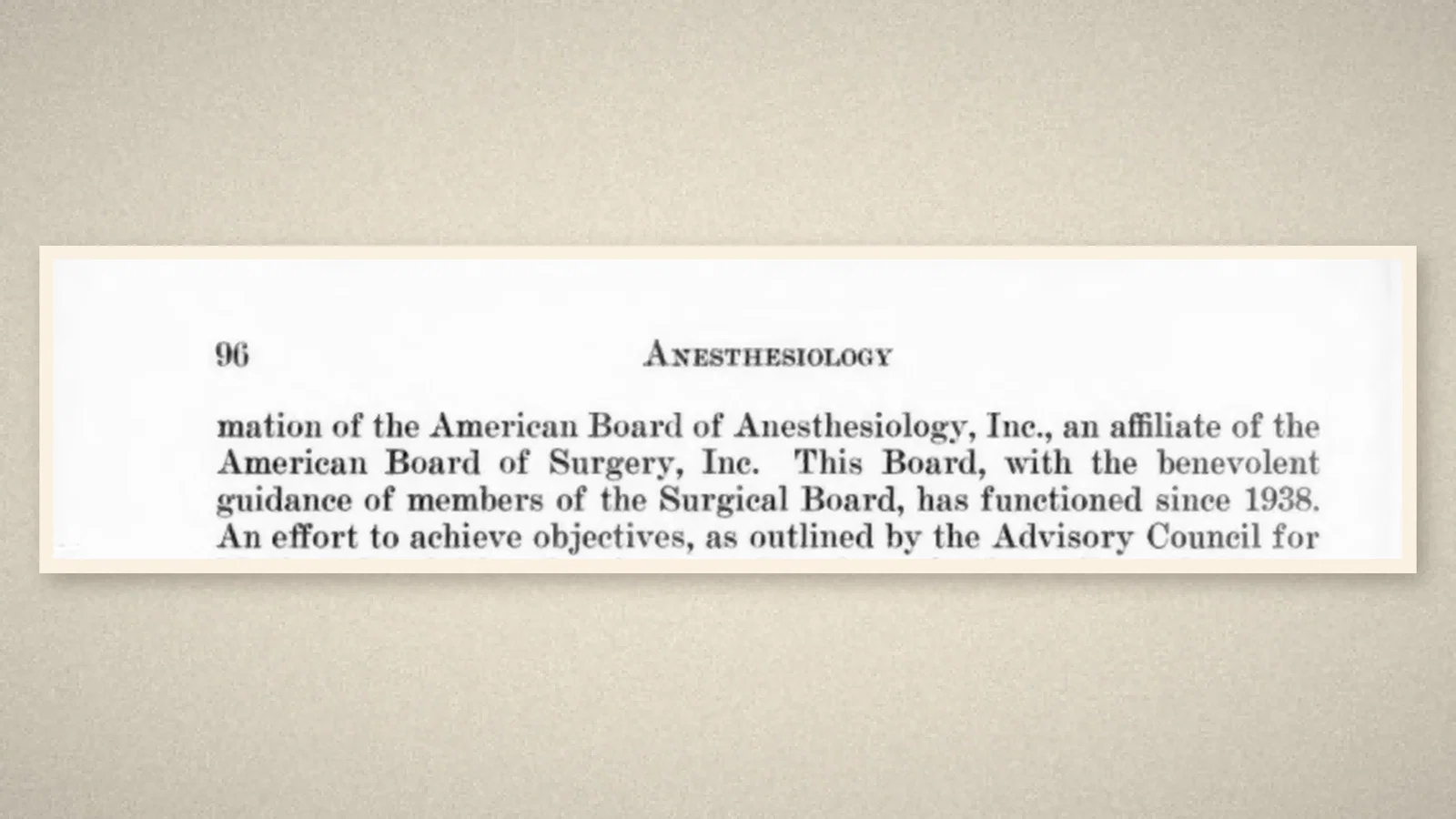
The first number of Anesthesiology, in July 1940, had told the same story from the society's side. The New York Society of Anesthetists had been reorganized "on a national rather than a local basis" as the American Society of Anesthetists. Together with the AMA's surgical section and the regional anaesthesia society, it sponsored the Board as an affiliate of the surgical board, which "with the benevolent guidance of members of the Surgical Board, has functioned since 1938". The new journal was "the latest project". [2, p. 95–96]
The officers in 1941 were Ralph M. Waters of Madison, president; Henry S. Ruth, vice president; Paul M. Wood of New York, secretary-treasurer; and directors including John S. Lundy and Emery A. Rovenstine. [1, p. 728]
What the Board asked for
Its purposes began "to establish criteria of fitness to be designated a specialist in the practice of anesthesiology" and "to improve educational facilities and practice in medical schools and hospitals"; it also offered to help institutions organize new departments. [1, p. 728] Candidates' practice "must be limited to anesthesiology", with "not less than five (5) calendar years (including period of training)", and the Board recommended "at least two years of carefully supervised instruction in the clinical phases of anesthesiology". For those entering after 1 January 1944 it expected "not less than three years" of training after internship. [1, p. 728–729]
The examination had three parts: "Part I, written, Part II, oral, and Part III, practical". The written part covered anatomy, biochemistry, physiology, pharmacology, pathology, physical diagnosis, therapeutics, clinical practice and public health. The practical part was unusual: the examiners "will observe the work of the candidates in their own or similar operating room surroundings", their relations to other staff and their professional standing, and might inspect clinical records, library and apparatus. [1, p. 729] The Board meant to avoid "unduly exacting standards above present facilities" and also "to prevent laxity, which would nullify the main purpose of the certificate". A passing average was 75 per cent, and the fee was $75. [1, p. 729]
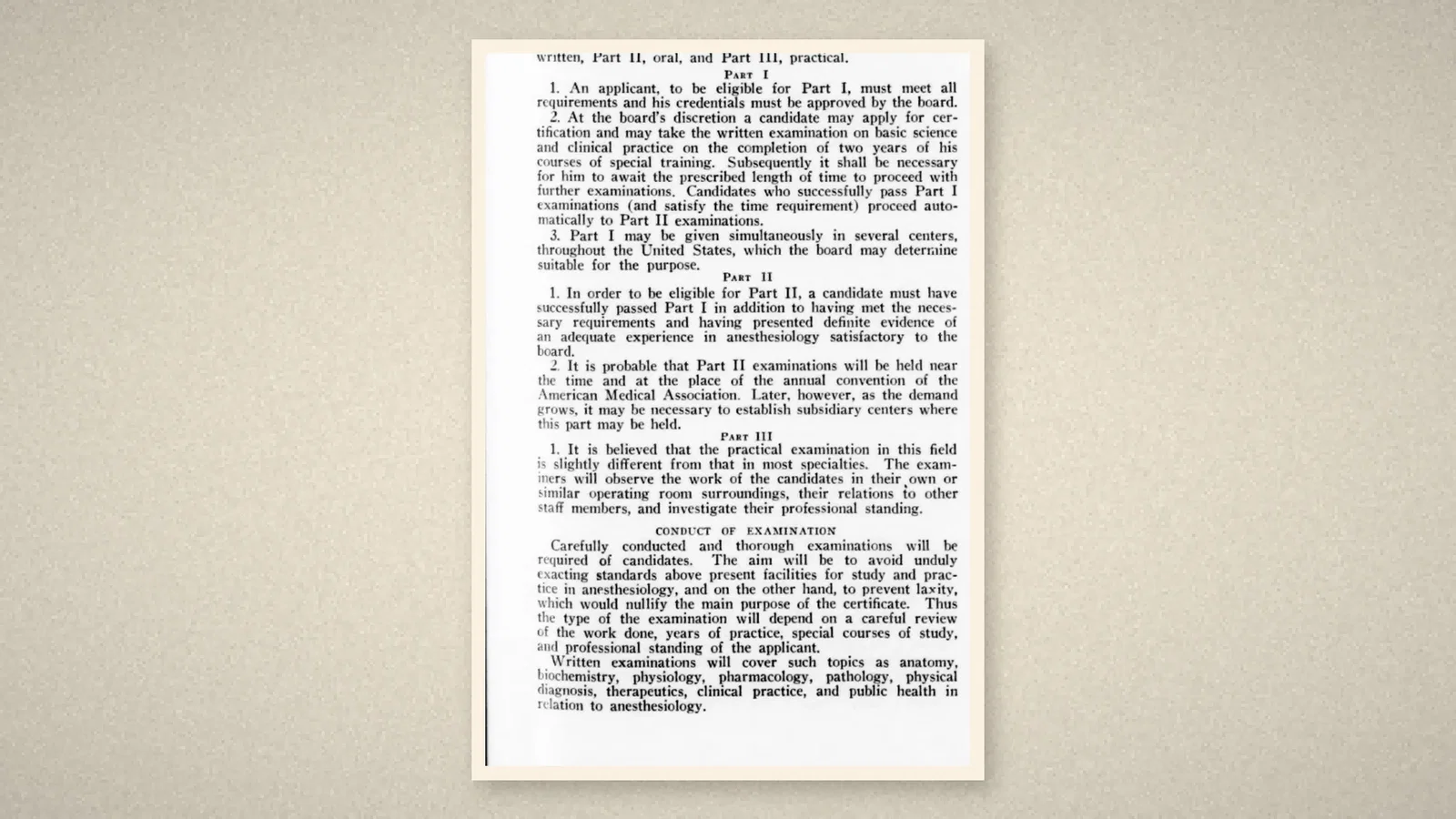
What the record shows
Within four years anaesthesiology went from a board sheltered by surgery to one of fifteen independent specialty boards. It set five years of limited practice, supervised training that would grow to three years, written and oral examinations, and examiners who came to see the candidate at work. In mid-1941 it had certified 132 specialists.
Sources and reading limits
Read: JAMA, 30 August 1941, pp. 727–729; Anesthesiology, July 1940, pp. 95–96.
Not covered: the 1937 articles of incorporation, Slocum's 1988 history of the Board and the WLM and ASA timelines are not covered. JAMA gives the year 1941 but not the month, and it numbers the Board 13 among fifteen. The sources read do not mention a FASA credential of 1935–1936, first examinations in March and June 1938, or a "Certificate No. 1" to Buchanan. The certificate counts (86 and 132) were read from the page image of the table.
All four illustrations are crops of the 1941 and 1940 journal pages.
- Approved examining boards in medical specialties: American Board of Anesthesiology, Inc. JAMA. 1941;117(9):727-9. Internet Archive
- Editorial. Anesthesiology. 1940;1(1):95-6. Internet Archive
Continue exploring
Related reading connects shared questions and contexts; it does not by itself establish historical influence.
- 1927: Ralph Waters Joins Wisconsin with a Three-Year Residency
- 1911: Hewitt on How Anaesthetics Entered the Medical Curriculum
Anesthesia Epochs · The Source Room · About & Editorial Method
Published November 2, 2026. Sources and reading limits are stated above. Illustrations are labelled as original source images or AI-made. Historical accounts are educational; they are not current treatment instructions.