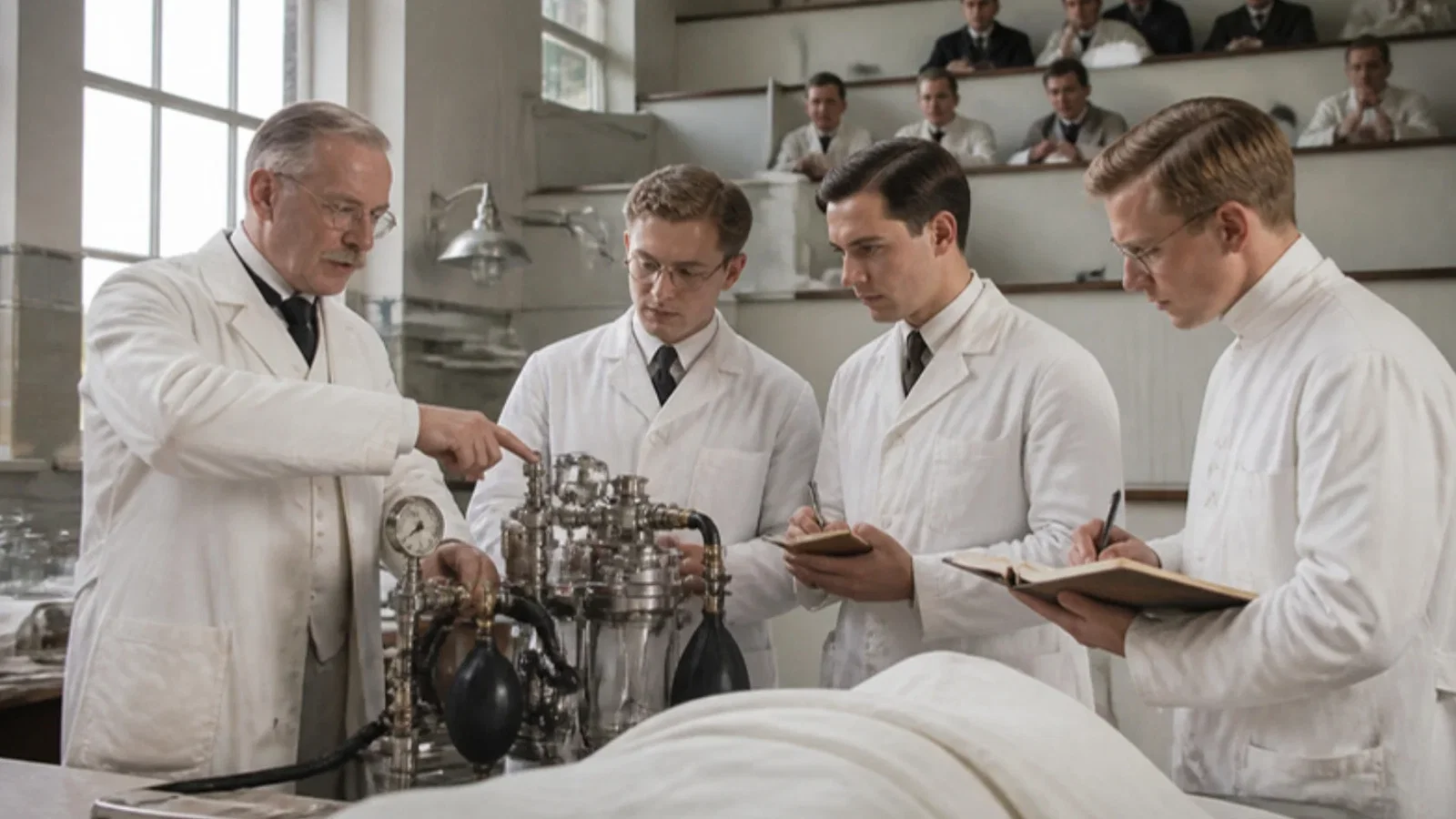
Why a specialist from a small Iowa city decided that 'the medical school was the answer'.
Reading Library · Anesthesia Epochs · 中文版
Watch the education video (for clinicians)
1927: Ralph Waters at Wisconsin — A Three-Year Residency · Anesthesia Epochs Education Series
Academic departments of anaesthesiology, with residents, lectures for medical students and laboratories, are now taken for granted. Ralph M. Waters, one of the people who built the model, explained in Waters's own words how the path led there. This article follows those accounts, written about twenty years after the move to Madison.
A specialist "in similar fashion"
In January 1913, Waters recalled, general practice began in Sioux City, Iowa, a town of about 65,000. [3, p. 595] In "Pioneering in Anesthesiology" (1948) Waters described taking over a colleague's office "in the winter of 1912-13", giving somnoform for a neighbouring dentist, and volunteering to use a surgeon's nitrous oxide apparatus that no one else could work: "and thus the foundation for my career of specialization was laid". [1, p. 265–266] Waters's cards first read "Practice Limited to Obstetrics and Anesthesia"; after three years and a month with an eastern anaesthetist, "limited to anesthesia". [1, p. 266] In the fall of 1915 Waters visited Ira McKesson in Toledo. [3, p. 596]
Waters soon saw the problem: interest in anaesthesia in the United States was superficial, training was scarce, and "real specialists in anesthesia were rare indeed". [1, p. 266]
"The medical school was the answer"
"After ten years of private practice", two things seemed obvious to Waters. Progress in the science and art of anaesthesia depended on close cooperation between those who gave drugs in the operating room and those who worked in laboratories, and "only in the medical school can such cooperation be established". And as long as most physicians did not understand the dangers and possibilities of anaesthesia, nothing would improve: "Again the medical school was the answer." [1, p. 267] Waters rejected the old belief that the best in anaesthesia lay in the "choice of agent". What made anaesthesia safe, Waters wrote, was anticipating and managing the physiological disturbances that every drug can cause. [1, p. 267]
1927: four objectives
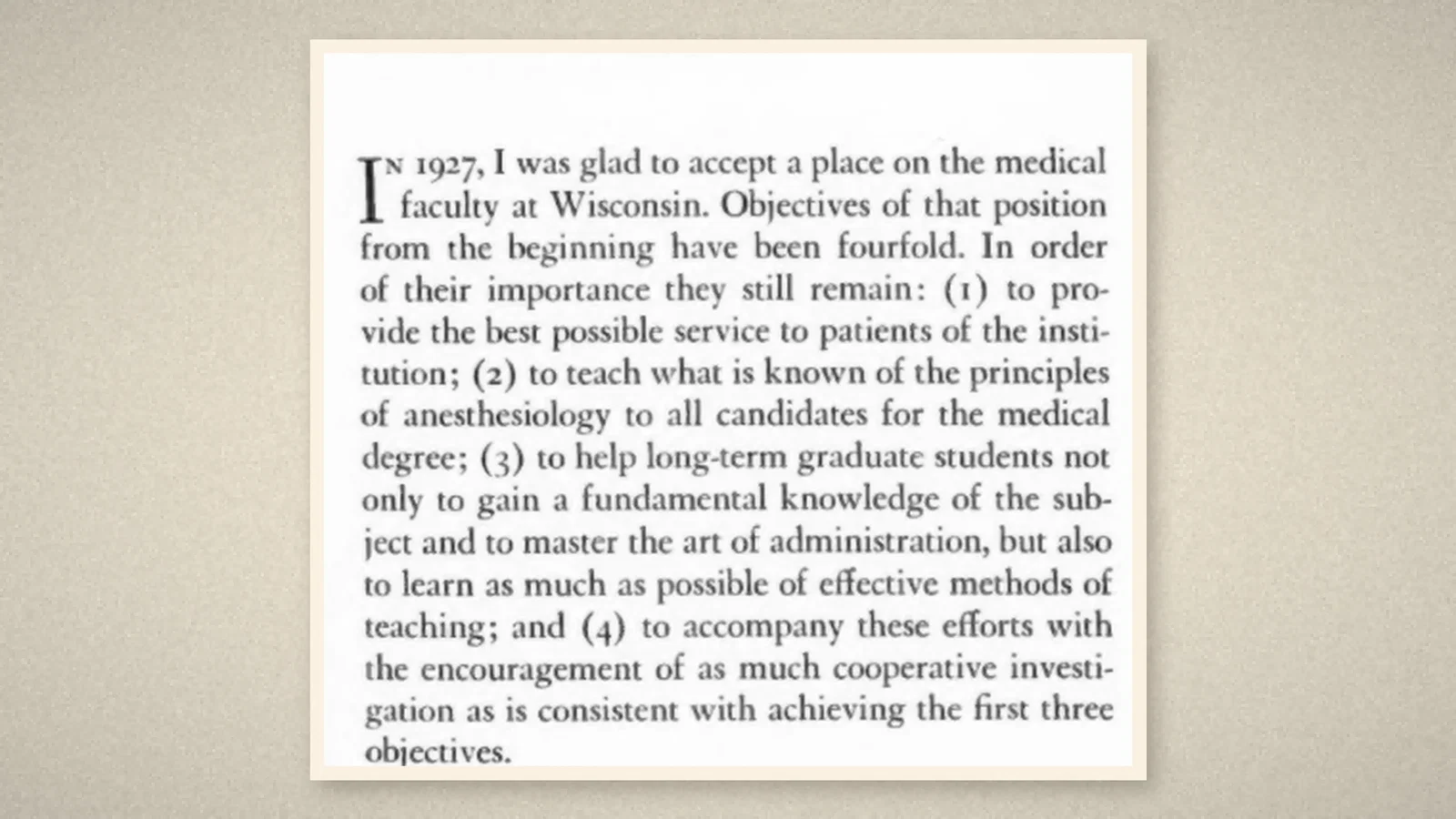
"In 1927, I was glad to accept a place on the medical faculty at Wisconsin. Objectives of that position from the beginning have been fourfold." In order of importance: "to provide the best possible service to patients of the institution"; to teach the principles of anaesthesiology "to all candidates for the medical degree"; to help long-term graduate students master the subject and the art, and also "to learn as much as possible of effective methods of teaching"; and to encourage "as much cooperative investigation as is consistent with achieving the first three objectives". [1, p. 267]
For undergraduates this meant a weekly didactic period in the second half of the third year and "a service of two weeks in the operating room during their senior year". For a future specialist, "a residency of at least three years' duration seems to be advisable". [1, p. 267] Writing "after twenty years", Waters preferred residents who had first spent two or three years in general practice. They accepted "record-keeping, cooperation, and the like" more easily and brought more original ideas, and Waters treated the first six months of every residency as a trial period. [1, p. 267–269] Waters warned against hospitals that replaced anaesthetic nurses with "residents" at 25 dollars a month and called it training. [1, p. 268]
What a department means
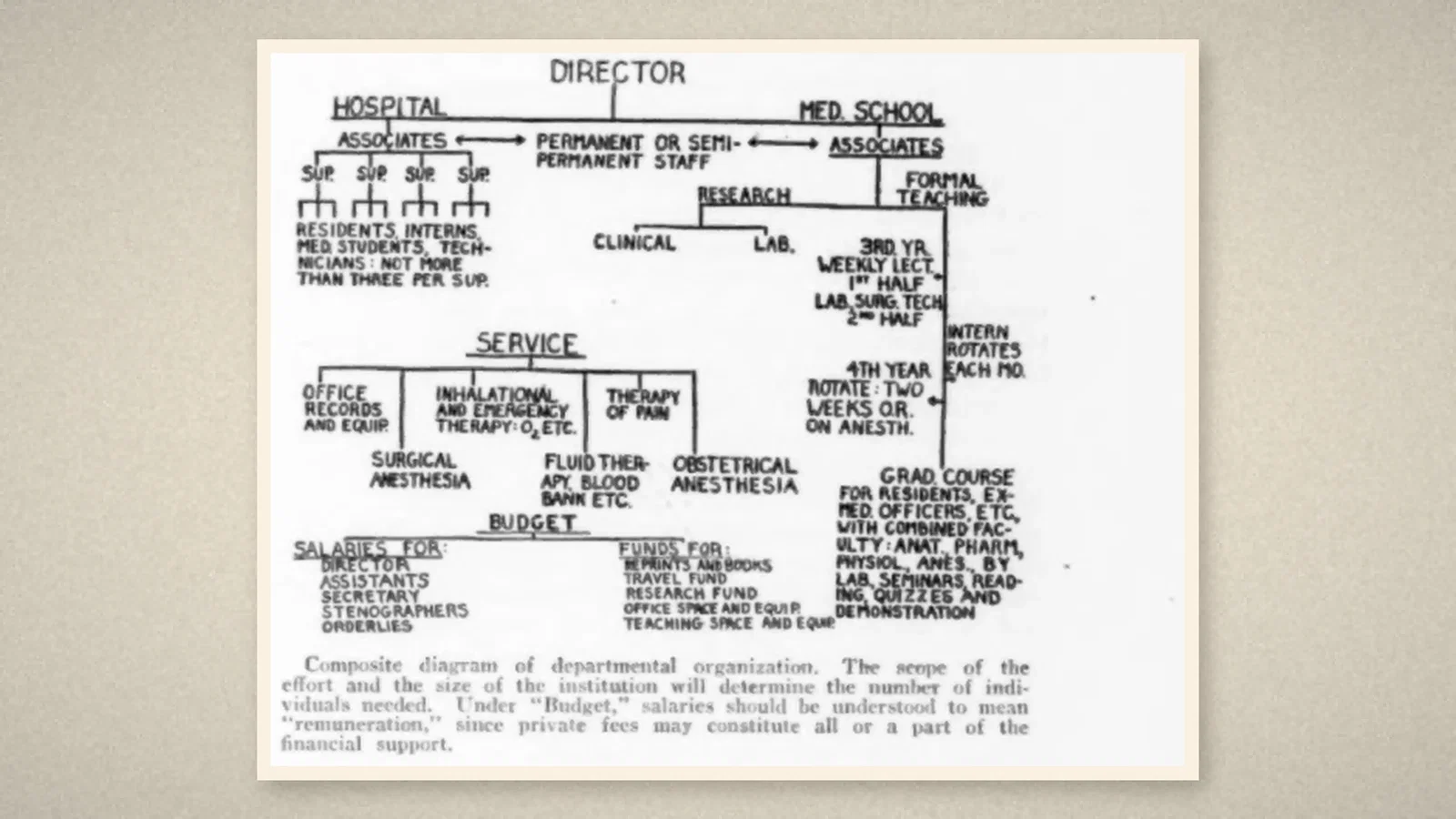
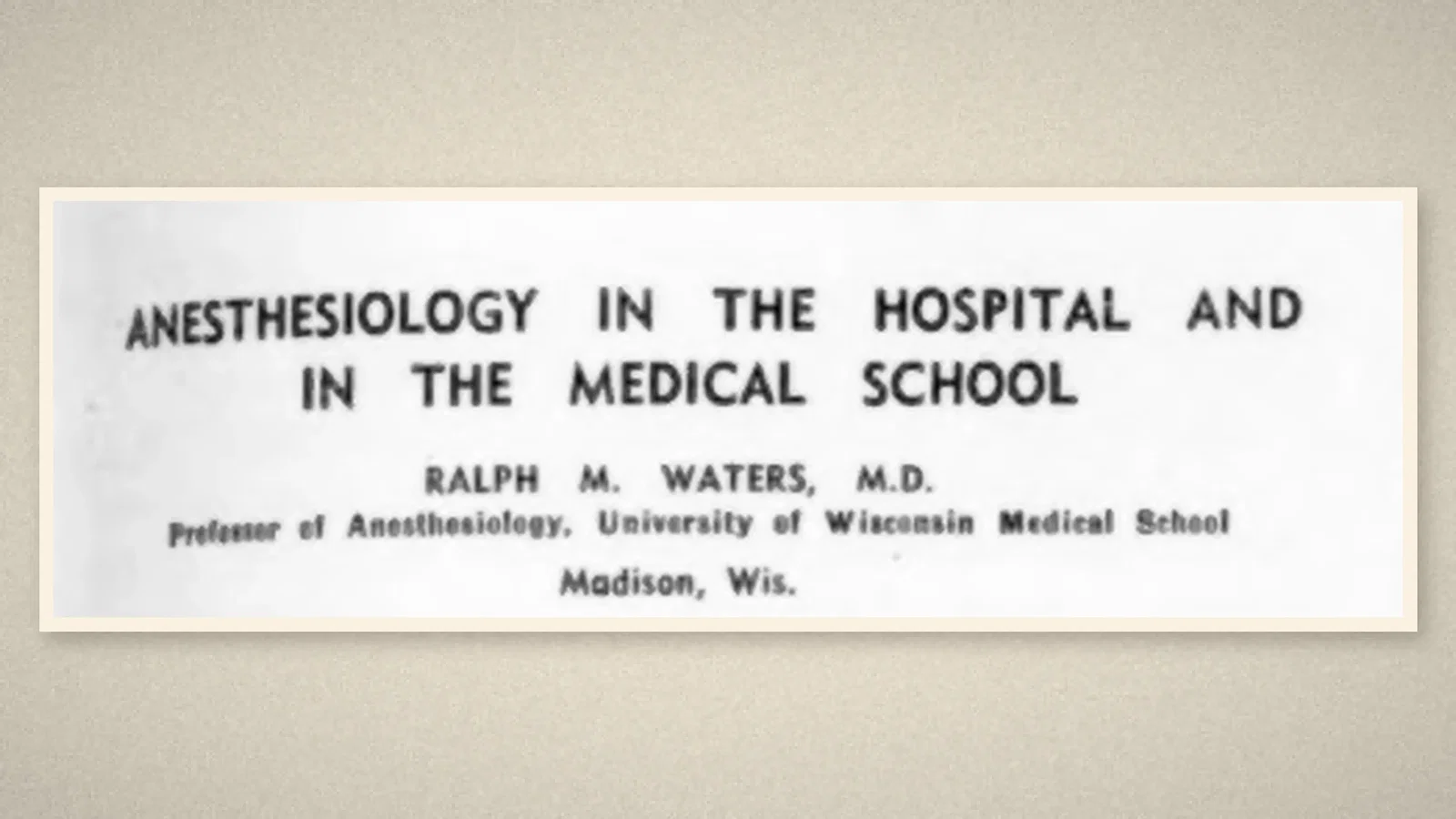
By 1946 Waters, now Professor of Anesthesiology, set out the lessons for others in JAMA. "It's not the tools but the way the tools are used." [2, p. 909] The figures from Wisconsin General Hospital covered 23,296 anaesthetics, with major respiratory complications in 2.67%. [2] A department could not be one person: "a single experienced and capable individual" could not make up a department, and safe practice needed "at least one competent supervisor for each three operating teams". [2, p. 910] "Modern hospitals are medical teaching centers, good or bad, whether they wish it or not." [2, p. 911] Waters's diagram set service, teaching and research side by side under one director, with a budget behind them.
What the record shows
In 1927 a specialist who had learnt anaesthesia by doing it in a Missouri Valley town moved to a medical school in the belief that only there could practice, teaching and research meet. Waters's four objectives put the patient first and research last, and the residency asked for at least three years and some experience of life outside the hospital.
Sources and reading limits
Read: Waters, Postgraduate Medicine 1948, pp. 265–270, and JAMA 1946, pp. 909–912; Waters, J Hist Med 1946, pp. 595–606 (opening pages).
Not covered: Bacon (1996) and the ASA and WLM timelines were not read. The exact month of the move and the department's later history, its records, conferences and the careers of its graduates, are not in what was read and are not told here. All three sources are Waters's own later accounts.
All four illustrations are crops of Waters's 1946 and 1948 papers.
- Waters RM. Pioneering in anesthesiology. Postgrad Med. 1948;4(3):265-70. Internet Archive
- Waters RM. Anesthesiology in the hospital and in the medical school. JAMA. 1946;130(14):909-12. Internet Archive
- Waters RM. The development of anesthesiology in the United States; personal observations 1913-1946. J Hist Med Allied Sci. 1946;1(4):595-606. Internet Archive
Continue exploring
Related reading connects shared questions and contexts; it does not by itself establish historical influence.
- 1923: Waters Keeps the Anesthetic and Removes the Carbon Dioxide
- 1964: Carlos Parsloe and the São Paulo Congress
- 1934: Lundy Uses and Observes Thiopental at the Mayo Clinic
Anesthesia Epochs · The Source Room · About & Editorial Method
Published November 2, 2026. Sources and reading limits are stated above. Illustrations are labelled as original source images or AI-made. Historical accounts are educational; they are not current treatment instructions.