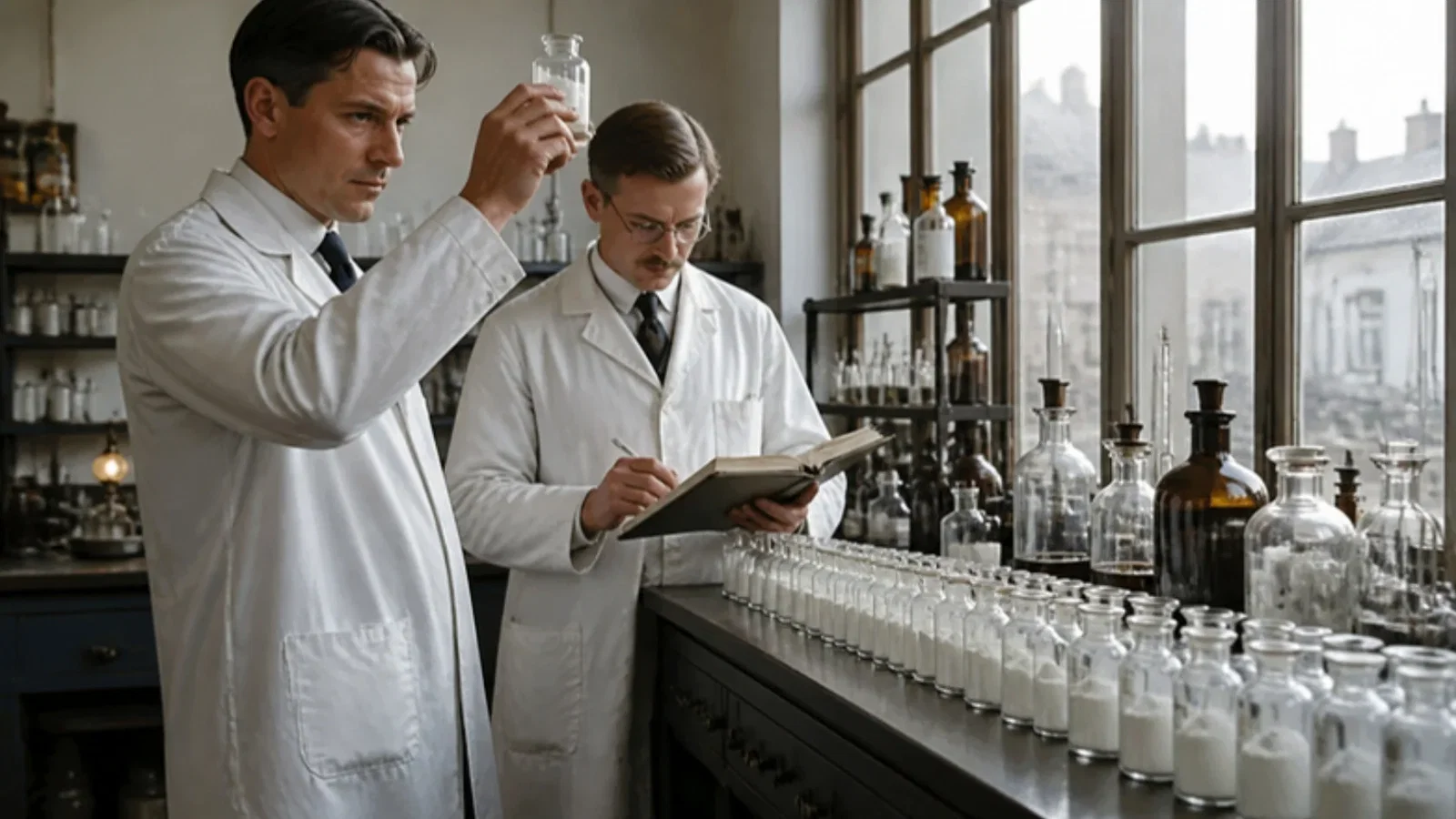
In July 1900 J. Pal of Vienna reported in the Centralblatt für Physiologie that physostigmine was an antidote to curare: in a curarised dog kept alive by artificial respiration, an intravenous injection brought twitching and then spontaneous breathing, and the respirator could be stopped. In 1931 John A. Aeschlimann and Marc Reinert at Hoffmann-La Roche in Basel compared 44 physostigmine-like compounds, most of their own making, and chose one with almost no effect on the heart, sold as Prostigmin; a Heidelberg dissertation of 1932 records its use after nearly all larger operations from June 1931 to restart the bowel, tried in 90 patients. Its study as an antagonist to curare came after curare entered medicine: in 1947 Edith Bülbring and T. C. Chou of Oxford wrote that 'the need for substances which antagonize curare has arisen with the recent introduction of the drug into medicine'.
Reading Library · Anesthesia Epochs · 中文版
Watch the education video (for clinicians)
1931: Prostigmin — Response and Recovery · Anesthesia Epochs Education Series
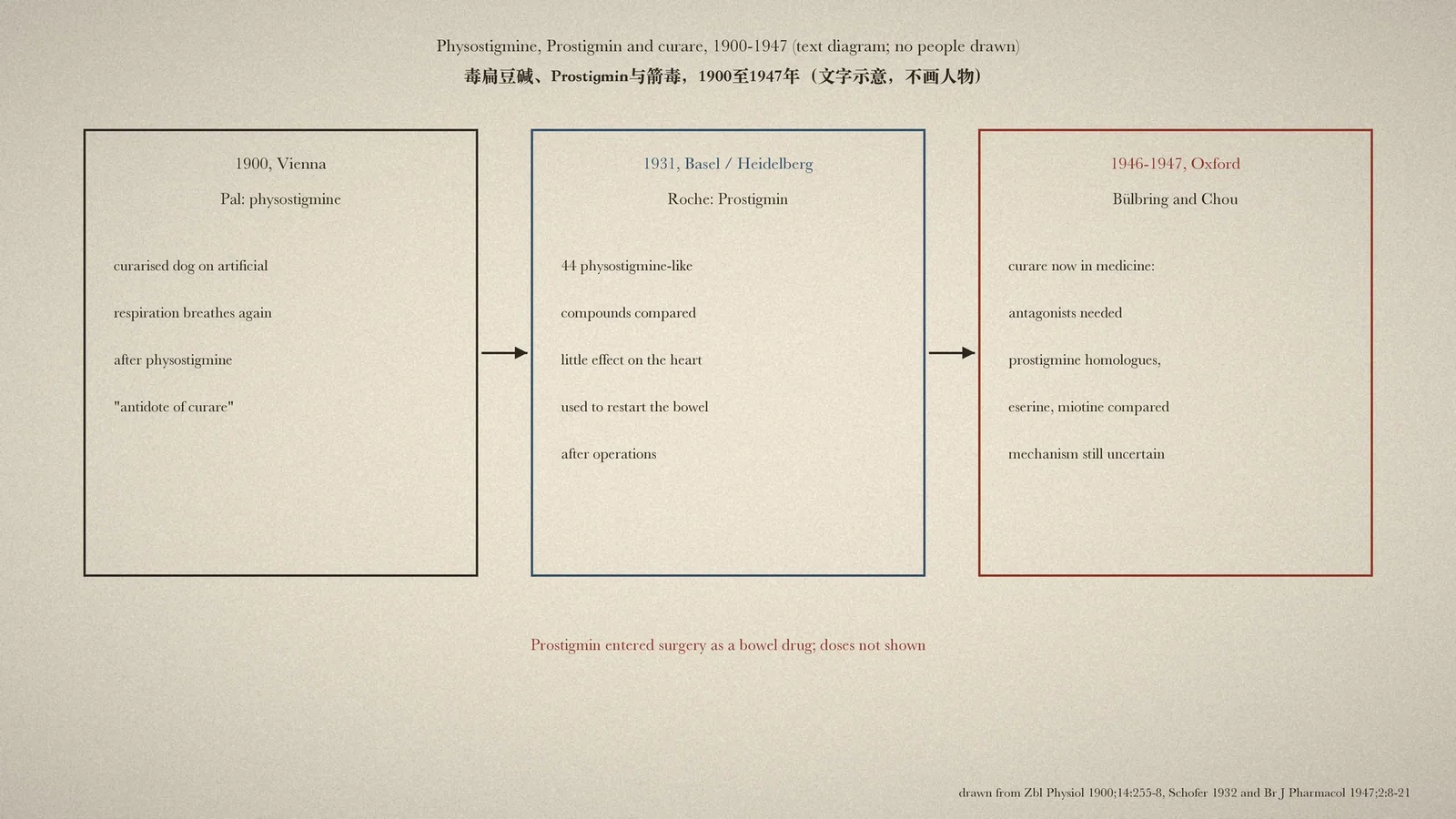
In anaesthesia today neostigmine is mostly known for reversing muscle relaxants. It did not start that way. The three documents in this article show a short note from Vienna that saw the reversal effect with physostigmine in 1900, a drug company that made neostigmine in 1931 to move the bowel after operations, and a pharmacology paper of 1947 that began to study it as a curare antagonist because curare had just come into medicine. [1, p. 255][2, p. 3][3, p. 8]
Vienna, July 1900
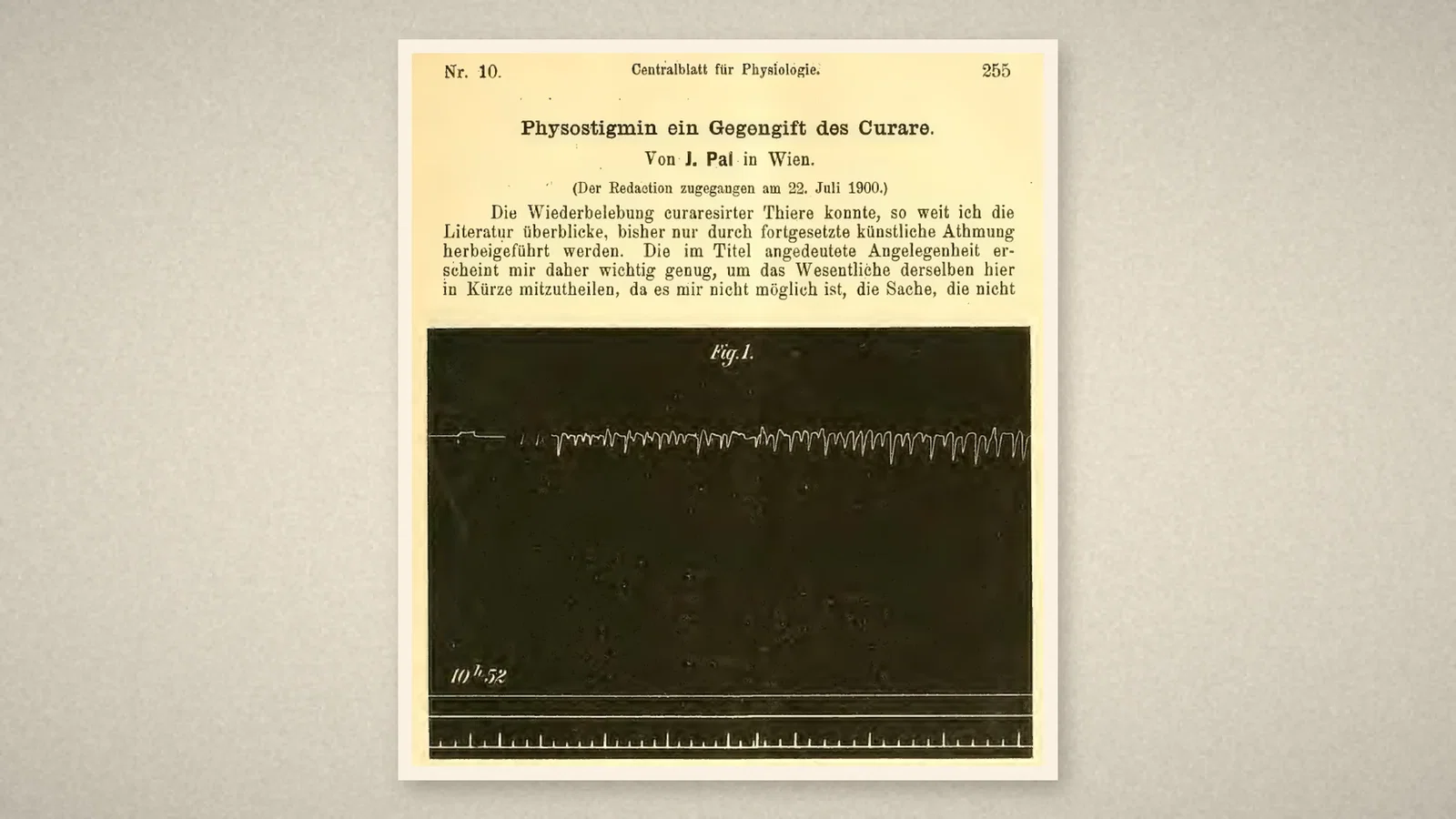
"Physostigmin ein Gegengift des Curare" ("Physostigmine, an antidote of curare") by J. Pal of Vienna reached the Centralblatt für Physiologie on 22 July 1900. As far as Pal could see from the literature, curarised animals had been revived "only by continued artificial respiration". Pal thought the finding important enough to report briefly, and handed its further study to Dr. J. Rothberger. [1, p. 255]
The discovery was a side observation. Pal was studying the nerve supply of the gut and gave physostigmine to curarised animals kept alive by artificial respiration. After an intravenous injection, strong twitching appeared and the animal began to breathe on its own; Pal "could stop the artificial respiration". [1, p. 255][1, p. 256]
To make sure, on 14 July 1900, with Professor Biedl present, Pal paralysed a dog with curare, started artificial respiration and then injected physostigmine. Within minutes there were intense twitches, spontaneous breathing and heavy salivation. The early irregular movements became adequate breaths, and the artificial respiration was stopped. Morphine was given against convulsions. That afternoon the dog was trembling but conscious, with reflexes. Given no further antidote, it died the next day. [1, p. 256][1, p. 257]
Pal concluded that physostigmine could be called an "antidote of curare": it quickly restored breathing that curare had stopped, leaving physostigmine poisoning to be treated; atropine was the usual remedy, and Pal thought adding morphine very useful. Pal noted that the diaphragm was among the earliest muscles to respond, and that Harnack and Witkowski, who had studied the two drugs together, had missed that physostigmine could abolish the curare effect completely. [1, p. 257][1, p. 258]
Basel and Heidelberg, 1931
Thirty years later the interest was the gut. A Heidelberg medical dissertation of 1932 by Richard H. A. Schofer, on Prostigmin for preventing and treating bowel disorders after operations, explains the background. Physostigmine was known to stimulate the bowel strongly, but it was seldom used because of its "undesirable side effects on heart and eye". [2, p. 3]
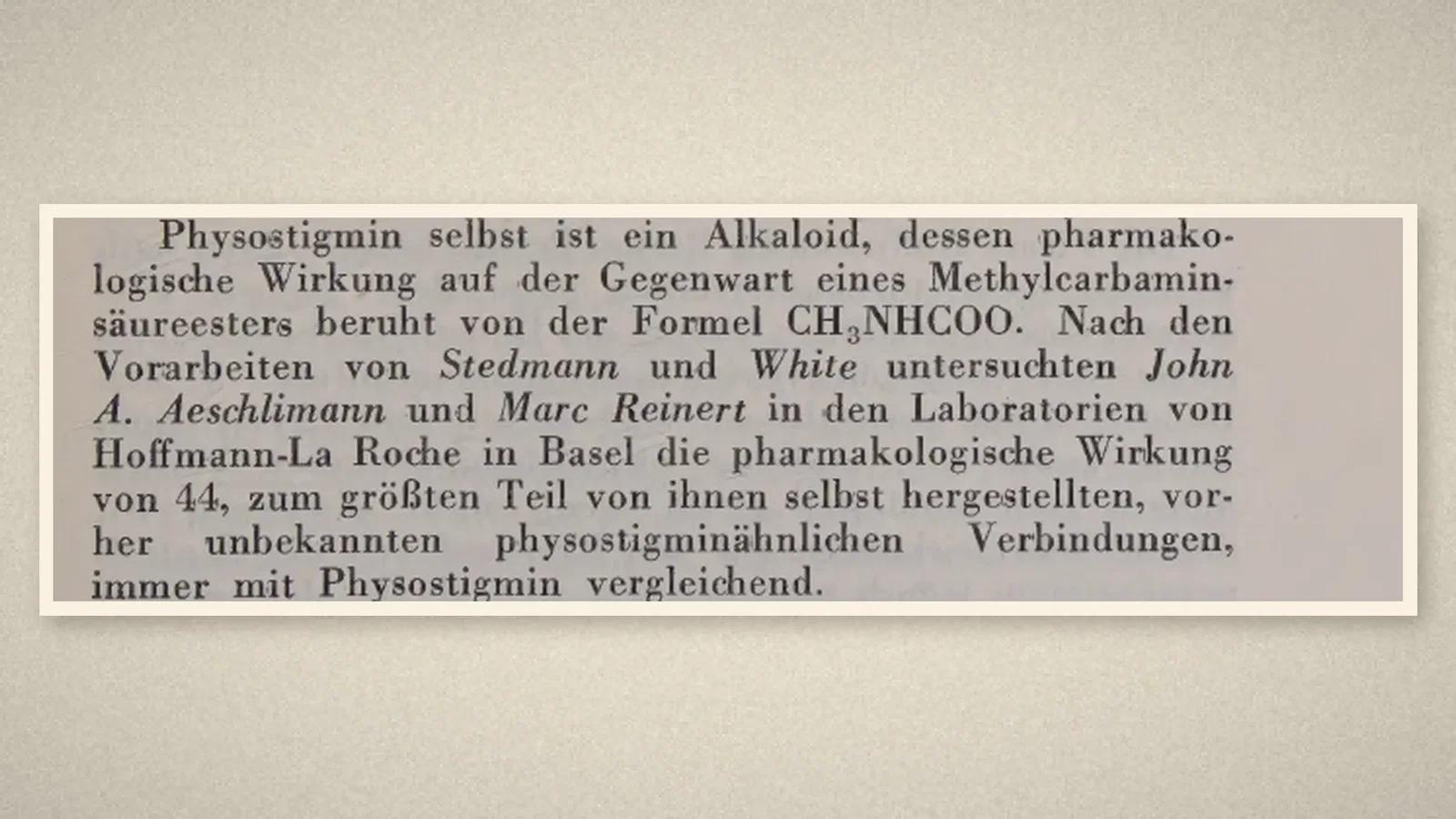
John A. Aeschlimann and Marc Reinert, in the laboratories of Hoffmann-La Roche in Basel, had compared 44 physostigmine-like compounds, most of them made by themselves and previously unknown. One, a dimethylcarbamic ester, had almost no effect on the heart and nearly the bowel action of physostigmine. Hoffmann-La Roche sold it as Prostigmin, with even fewer effects on the circulation and nervous system. [2, p. 3][2, p. 4]
"Since June 1931" the University Women's Clinic in Heidelberg had used Prostigmin after nearly all larger operations, especially laparotomies, and it was tried clinically in 90 patients. It usually acted within ten to thirty minutes, with bowel sounds and wind, and apart from colic in some patients no side effects such as nausea, dizziness or palpitations "were ever observed". It did nothing for weak or absent labour. [2, p. 5][2, p. 6][2, p. 8]
Oxford, 1946-1947
Curare came into anaesthesia, and the old observation found a use. In the British Journal of Pharmacology for 1947, Edith Bülbring and T. C. Chou of the Department of Pharmacology, Oxford, opened their paper on antagonists to tubocurarine with the reason for it: "The need for substances which antagonize curare has arisen with the recent introduction of the drug into medicine." Too much curare causes respiratory failure; artificial respiration is then usually needed, but its length "can be greatly reduced by the injection of a suitable antagonist". [3, p. 8]
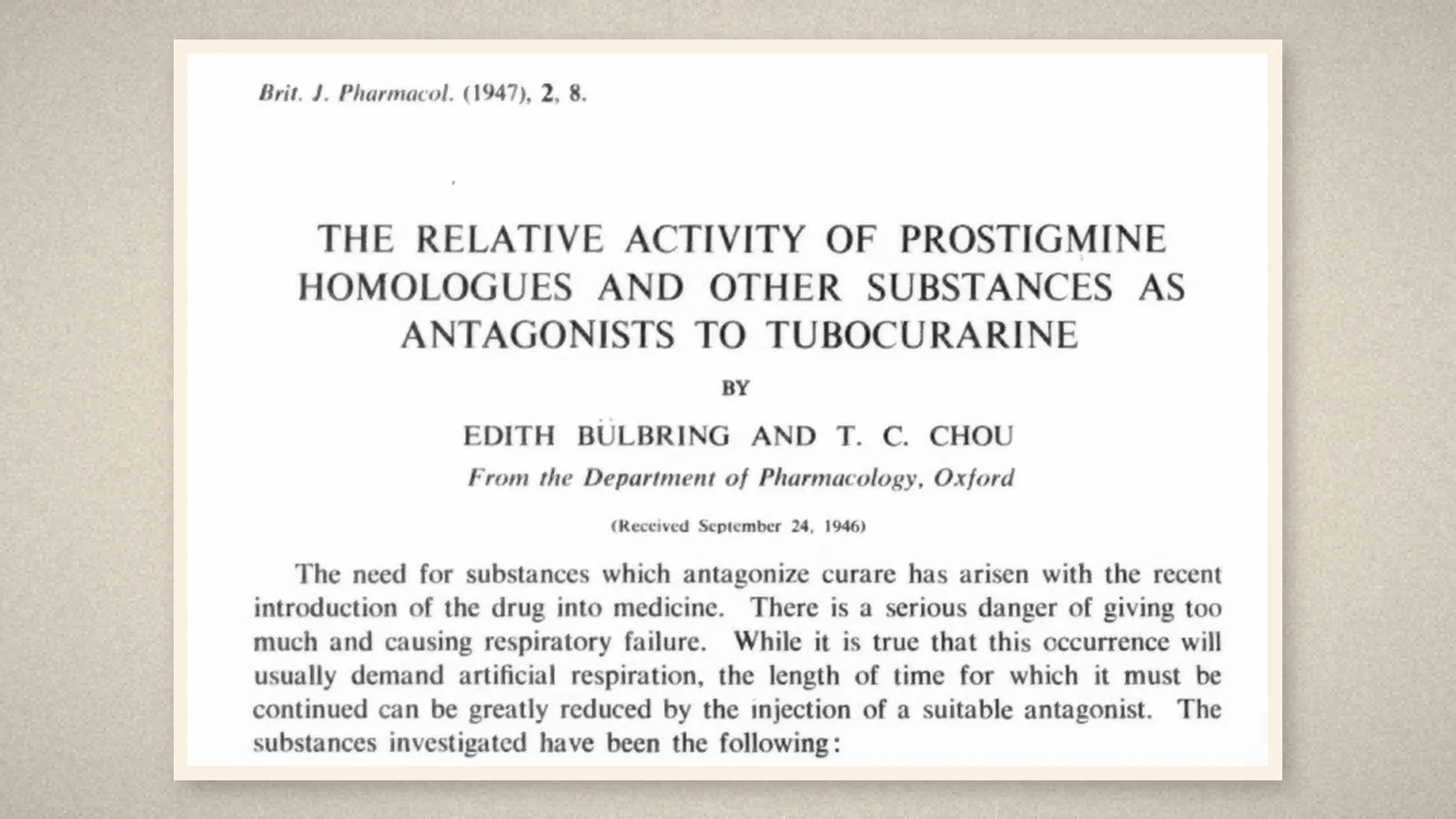
They compared prostigmine and two close relatives with eserine (physostigmine) and miotine, on isolated nerve-muscle preparations and in whole animals. They were careful about the mechanism: "It is not known whether the anti-curare activity of substances which inhibit cholinesterase is solely due to this property." [3, p. 8][3, p. 21]
What the record shows
The reversal of curare was seen in a dog in 1900, as a side observation in a study of the gut. Prostigmin was made in 1931 for a different job, keeping the bowel moving after abdominal surgery. Only when curare itself became an anaesthetic drug did pharmacologists set out to compare antagonists. The steps that later made neostigmine a routine anaesthetic drug are not in these pages.
Sources and reading limits
Read: J. Pal, "Physostigmin ein Gegengift des Curare", Centralblatt für Physiologie 1900;14:255-258, in full; Richard H. A. Schofer, "Über Prostigmin zur Prophylaxe und Behandlung postoperativer Darmstörungen", Heidelberg dissertation 1932, in full; Edith Bülbring and T. C. Chou, "The Relative Activity of Prostigmine Homologues and Other Substances as Antagonists to Tubocurarine", British Journal of Pharmacology 1947;2:8 onwards, the opening, discussion and summary (pp. 8 and 21), the methods and tables skimmed.
Not covered: Aeschlimann and Reinert's own paper in the Journal of Pharmacology and Experimental Therapeutics of November 1931, known here only through the dissertation; the other Prostigmin papers the dissertation cites; Rothberger's follow-up to Pal; the early clinical reports of neostigmine reversing curare in anaesthesia; neostigmine in myasthenia gravis.
Limits: some timelines date the neostigmine event to 1931 and a reversal event to 1900; this article cannot date the clinical reversal of curare in anaesthesia. The account of Aeschlimann and Reinert is second-hand. The dissertation gives patients' names; they are not repeated. Doses, lethal doses and concentrations are not repeated, and the page crops stop before them. Pal's remark that the effect had not been described is Pal's own. German quotations are translated for this article.
Three illustrations are crops of the Centralblatt für Physiologie 1900 (p. 255), Schofer's 1932 dissertation (p. 3) and the British Journal of Pharmacology 1947 (p. 8); one is a text diagram drawn from these, with no people drawn and no doses shown.
- Pal J. Physostigmin ein Gegengift des Curare. Zentralbl Physiol. 1900;14:255-8. Internet Archive
- Schofer RHA. Über Prostigmin zur Prophylaxe und Behandlung postoperativer Darmstörungen [dissertation]. Heidelberg: Universität Heidelberg; 1932. Internet Archive
- Bülbring E, Chou TC. The relative activity of prostigmine homologues and other substances as antagonists to tubocurarine. Br J Pharmacol. 1947;2:8-22. Internet Archive
Continue exploring
Related reading connects shared questions and contexts; it does not by itself establish historical influence.
- 1938: Gill Brings Curare and Curare Plants Back from Ecuador
- 1940–1952: From Curare to Succinylcholine in Convulsive Therapy
- 1914: Dale Divides Acetylcholine's Actions into Muscarine and Nicotine
Anesthesia Epochs · The Source Room · About & Editorial Method
Published November 3, 2026. Sources and reading limits are stated above. Illustrations are labelled as original source images or AI-made. Historical accounts are educational; they are not current treatment instructions.