
A substance found in ergot, intensely active and quickly gone, with as yet no evidence that the body made it.
Reading Library · Anesthesia Epochs · 中文版
Watch the education video (for clinicians)
1914: Dale's Acetylcholine — Muscarine and Nicotine Actions · Anesthesia Epochs Education Series
Anaesthetists use the words "muscarinic" and "nicotinic" every day: atropine opposes muscarinic effects, and muscle relaxants act at nicotinic receptors. One source of that pair of words is a pharmacological paper published in 1914 by Henry Dale of the Wellcome Physiological Research Laboratories at Herne Hill, in south London.
A surprise from ergot
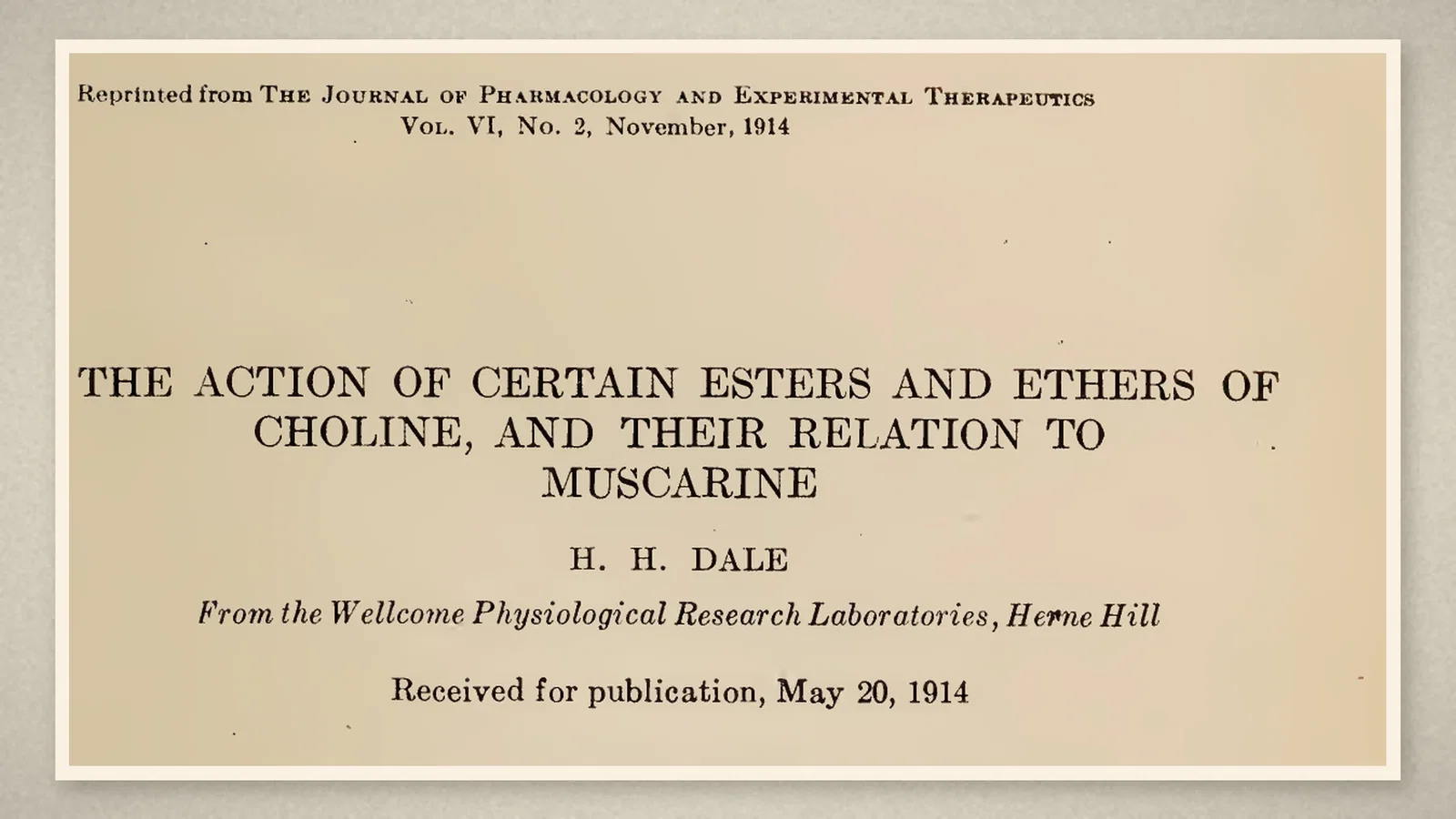
The paper, "The action of certain esters and ethers of choline, and their relation to muscarine", was received on 20 May 1914 and published in the Journal of Pharmacology and Experimental Therapeutics, vol. 6, no. 2, in November 1914. [1, p. 147] Dale explained how it began: certain specimens of ergot and its extracts showed an action "clearly not referable to any of the active principles hitherto described"; it looked like a muscarine-type action, and they started out expecting to find muscarine. [1, p. 147]
Instead, the chemist A. J. Ewins isolated the principle and identified it as acetylcholine, whose intense depressor activity was already known from the work of Hunt and Taveau. [1, p. 147] Dale's paper set out in detail the pharmacology of it and of a series of other choline derivatives.
Intensely active, quickly gone
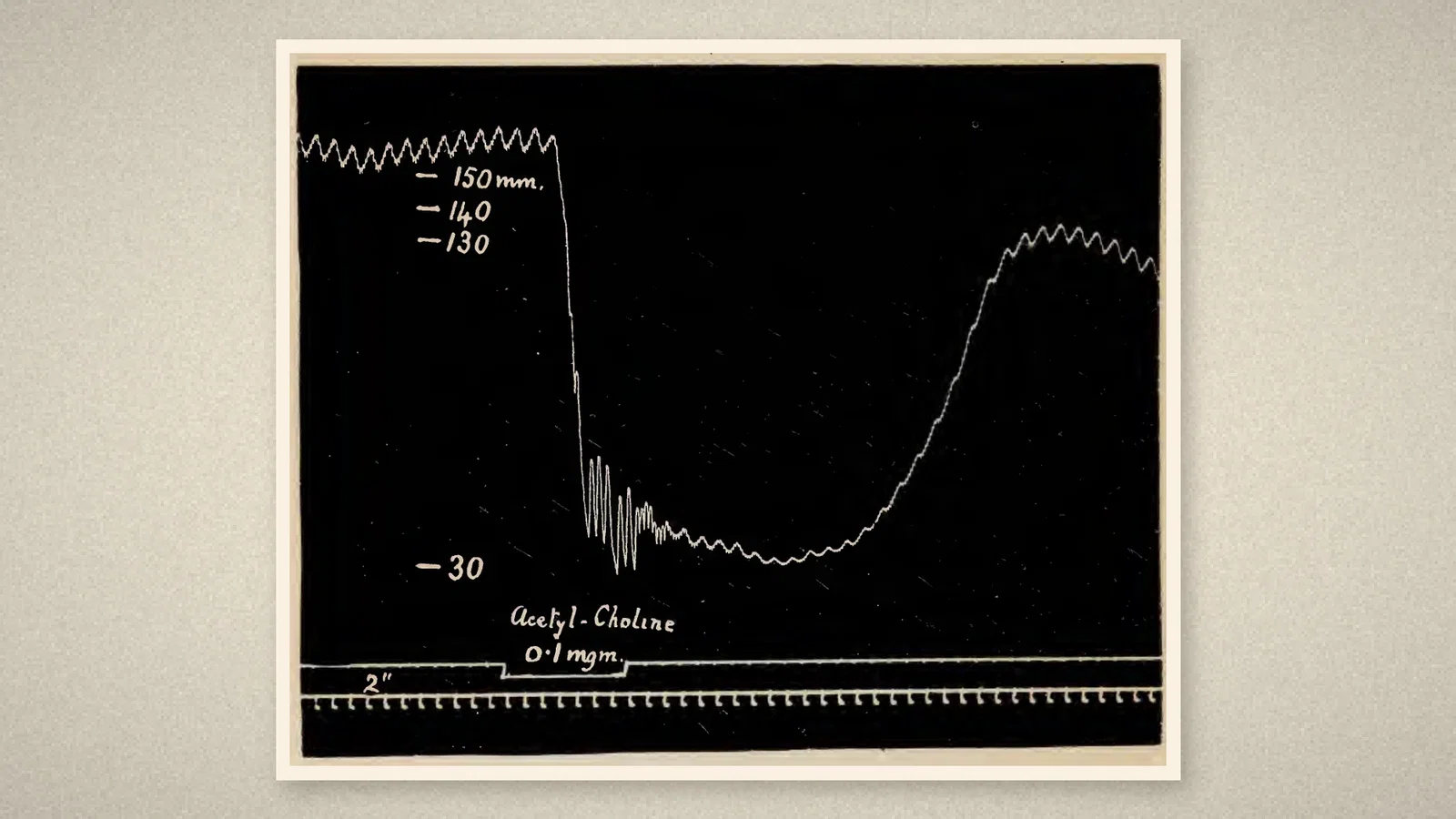
Fig. 5 shows a cat with the brain destroyed under artificial respiration: after 0.1 mgm of acetylcholine intravenously the carotid pressure fell steeply and recovered within a few minutes. [1, p. 154] With a slightly larger dose an intense but brief action on the heart appeared, which, Dale wrote, "bears a remarkable resemblance to that of a brief faradisation of the vagus nerve". [1, p. 153]
The effects came and went quickly and could be reproduced dose after dose. Dale connected this "with some probability" with the ease with which the ester is hydrolysed into its relatively inert constituents, choline and acetic acid, and added that in the blood at body temperature "it seems not improbable that an esterase contributes to the removal of the active ester from the circulation". [1, p. 153–154]
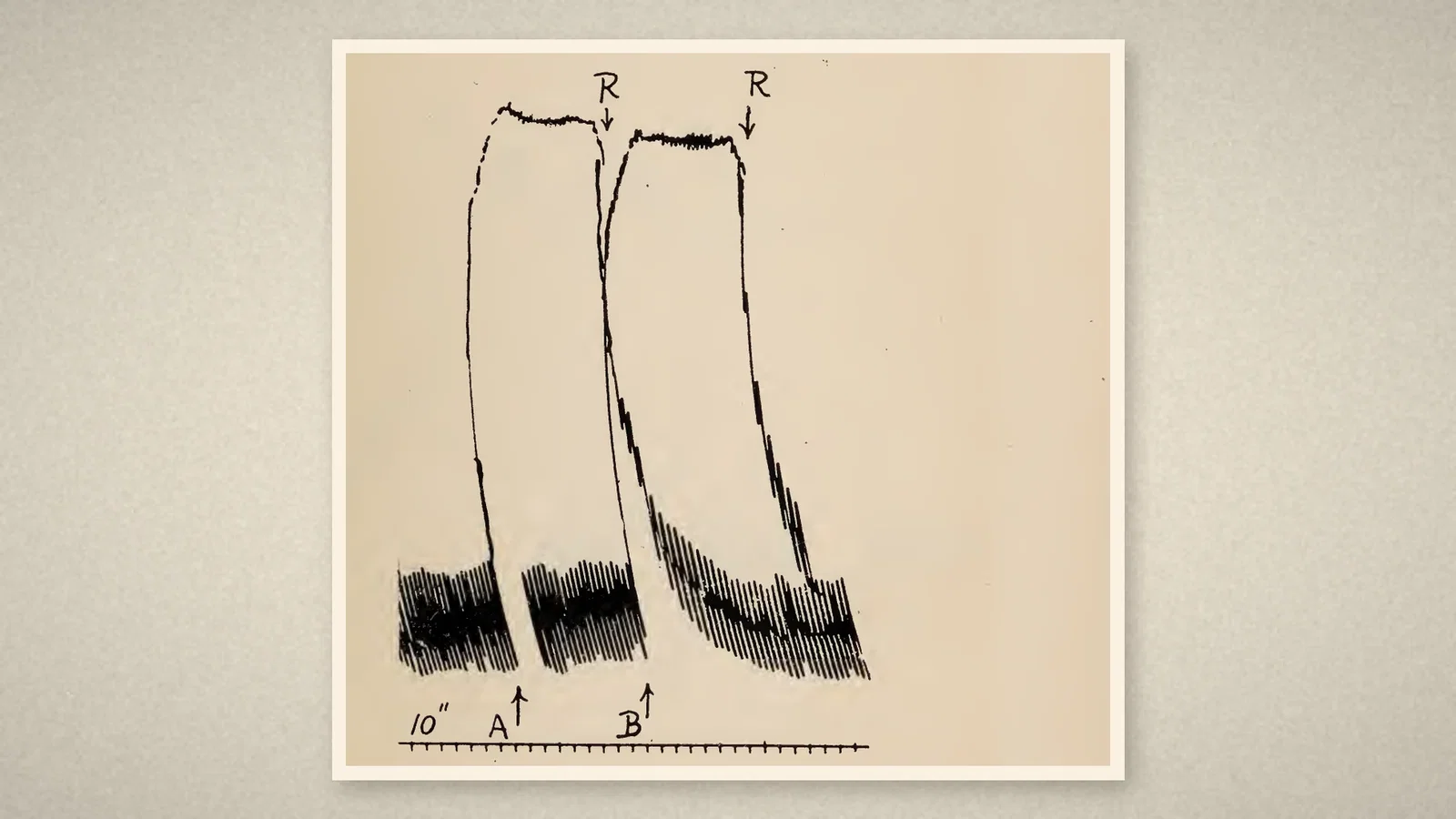
On isolated organs its potency was startling. Fig. 13 shows a loop of rabbit intestine in Tyrode's solution contracting equally to synthetic acetylcholine and to acetylcholine from ergot. [1, p. 167] A sensitive preparation, Dale wrote, showed a definite response when acetylcholine was added to the bath at 1 part in 500 millions. [1, p. 168]
Two kinds of action
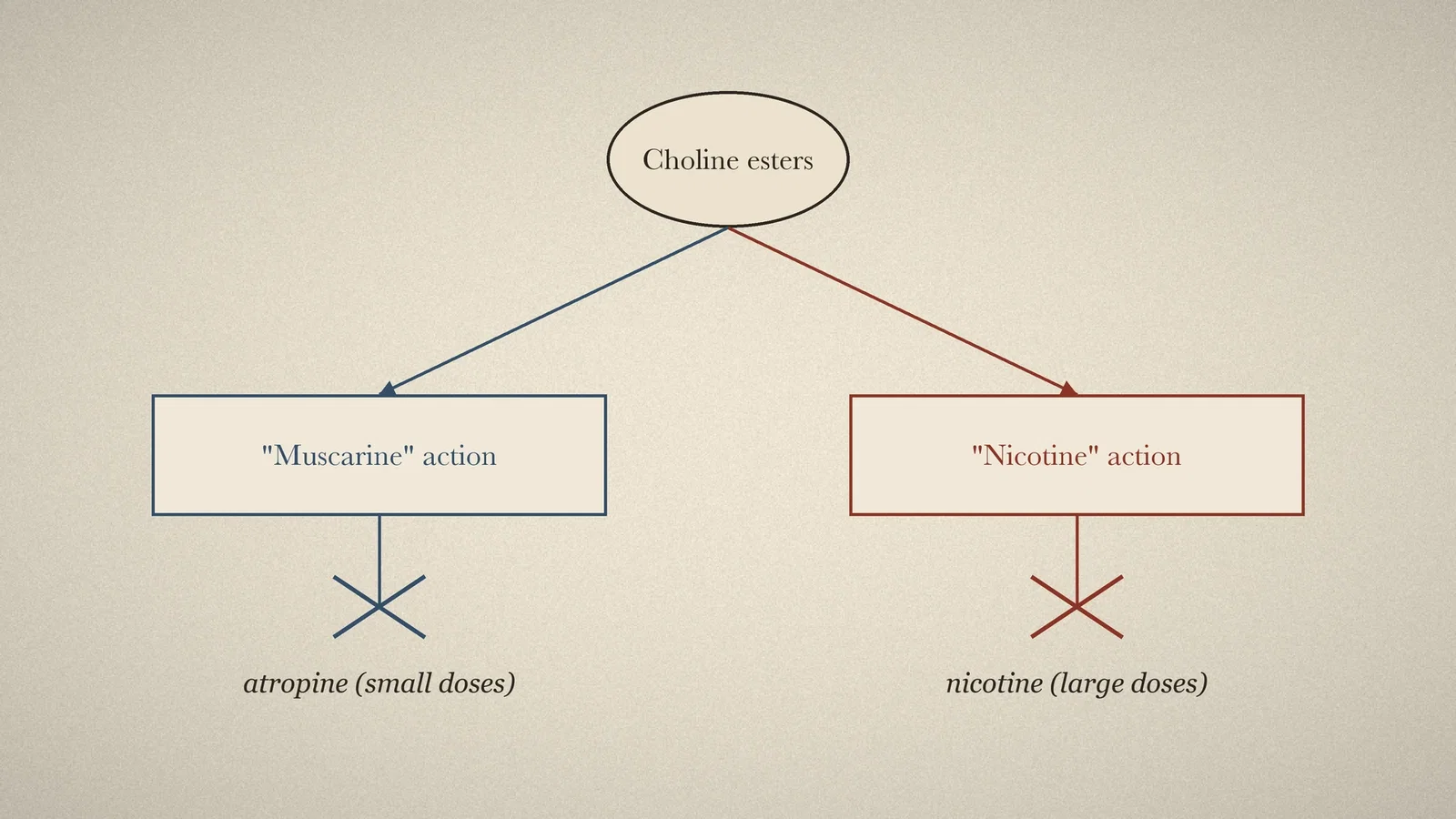
The paper's most important part is its discussion and summary. Choline and its derivatives, Dale pointed out, had two distinct types of action. One Dale called the "muscarine" action: broadly a reproduction of the effects of stimulating the cranial and sacral divisions of the autonomic system, such as constriction of the pupil, salivary secretion, inhibition of the heart, constriction of the bronchioles and contraction of the gut; it was peripheral, unaffected by nicotine in large doses, but "readily abolished by small doses of atropine". [1, p. 183–184] The other "may for brevity be called a 'nicotine-action'", of the curare or nicotine type; it could be seen on its own once the muscarine action was excluded by atropine, and could itself be suppressed by large doses of nicotine. [1, p. 182; 1, p. 185]
About acetylcholine itself Dale was cautious: given intravenously it broke down so fast that "this makes it impossible to form any accurate idea of its 'nicotine' action". [1, p. 186]
Is it in the body?
Read today, what stands out is what Dale did not claim. There was no known store of choline derivatives, Dale wrote, "nor, indeed, any evidence that a substance resembling acetyl-choline exists in the body at all". [1, p. 188] Dale did admit a possibility: acetylcholine, or some similarly active and unstable ester, might arise in the body and be hydrolysed by the tissues so quickly that known methods could not detect it, and the suggestion would become interesting if a way to test it could be found. [1, p. 189] Now that its natural occurrence in ergot was shown, Dale added, it might be found in other fungi and possibly in animal tissues. [1, p. 189]
What the record shows
In 1914 Dale did not yet propose chemical transmission of nerve impulses. The paper split the actions of a potent substance found in ergot into two kinds, said what blocked each, and guessed why it vanished so fast. Atropine against muscarinic effects and acetylcholine broken down by an esterase, ideas that anaesthesia would later depend on, already appear here in tentative form.
Sources and reading limits
Read: H. H. Dale, "The action of certain esters and ethers of choline, and their relation to muscarine", Journal of Pharmacology and Experimental Therapeutics 1914;6(2):147–190 (Wellcome offprint, full text on the Internet Archive).
Not covered: Ewins's paper on isolating acetylcholine from ergot (Biochem J 1914;8:44) and Dale's preliminary note were not read; Ewins's work is described only as Dale reports it. Dale and Ewins did not propose a hypothesis of chemical transmission in the 1914 paper, which says there was no evidence that such a substance existed in the body and only admits the possibility; this article says just that. The Nobel Prize and the later history of muscle relaxants are not documented in what was read, and no dates are given for them here. The article is dated by the paper's receipt, 20 May 1914, not 1913.
Of the four illustrations, three are crops of pages and figures from the 1914 offprint and one is a diagram drawn for this article from the source.
- Dale HH. The action of certain esters and ethers of choline, and their relation to muscarine. J Pharmacol Exp Ther. 1914;6(2):147-90. Internet Archive (Wellcome Collection)
Continue exploring
Related reading connects shared questions and contexts; it does not by itself establish historical influence.
- 1911: Roth's Cricoid Pressure Keeps Air out of the Stomach
- 1911: Hewitt on How Anaesthetics Entered the Medical Curriculum
Anesthesia Epochs · The Source Room · About & Editorial Method
Published November 2, 2026. Sources and reading limits are stated above. Illustrations are labelled as original source images or AI-made. Historical accounts are educational; they are not current treatment instructions.