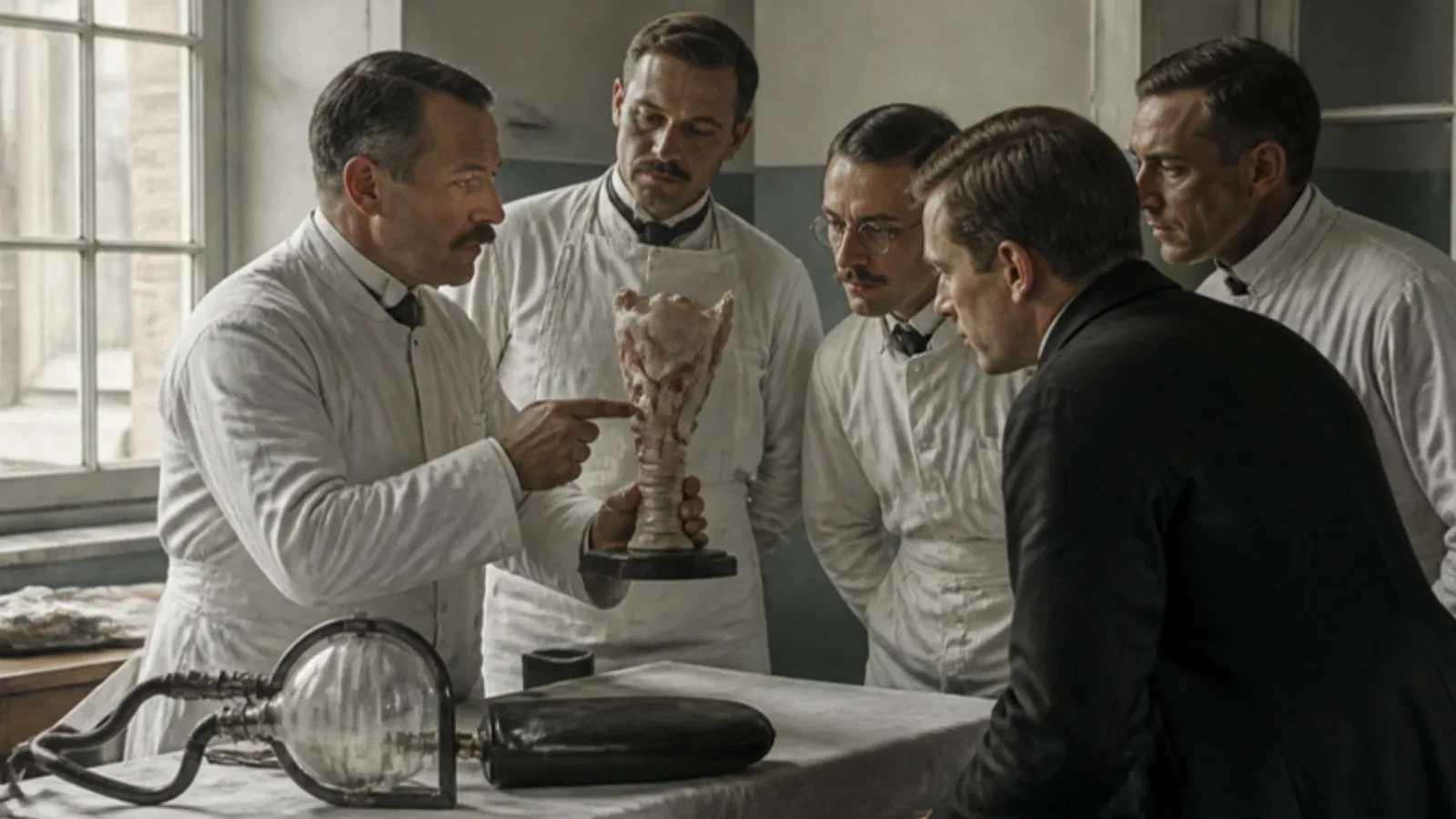
Half a century before Sellick, pressure on the cricoid served a different purpose.
Reading Library · Anesthesia Epochs · 中文版
Watch the education video (for clinicians)
1911: Roth's Cricoid Pressure — Keeping Air out of the Stomach · Anesthesia Epochs Education Series
Every anaesthetist knows cricoid pressure: during induction a finger presses the cricoid cartilage backwards, closing the oesophagus so that stomach contents cannot regurgitate into the airway. It usually carries the name of the British anaesthetist Sellick, who published "Cricoid pressure to control regurgitation of stomach contents during induction of anaesthesia" in the Lancet in 1961. [4]
Half a century earlier, Roth, a surgeon in Lübeck, described almost the same manoeuvre. Reading the 1911 texts, though, shows that what Roth wanted to prevent was something else.
A combination apparatus, 1911
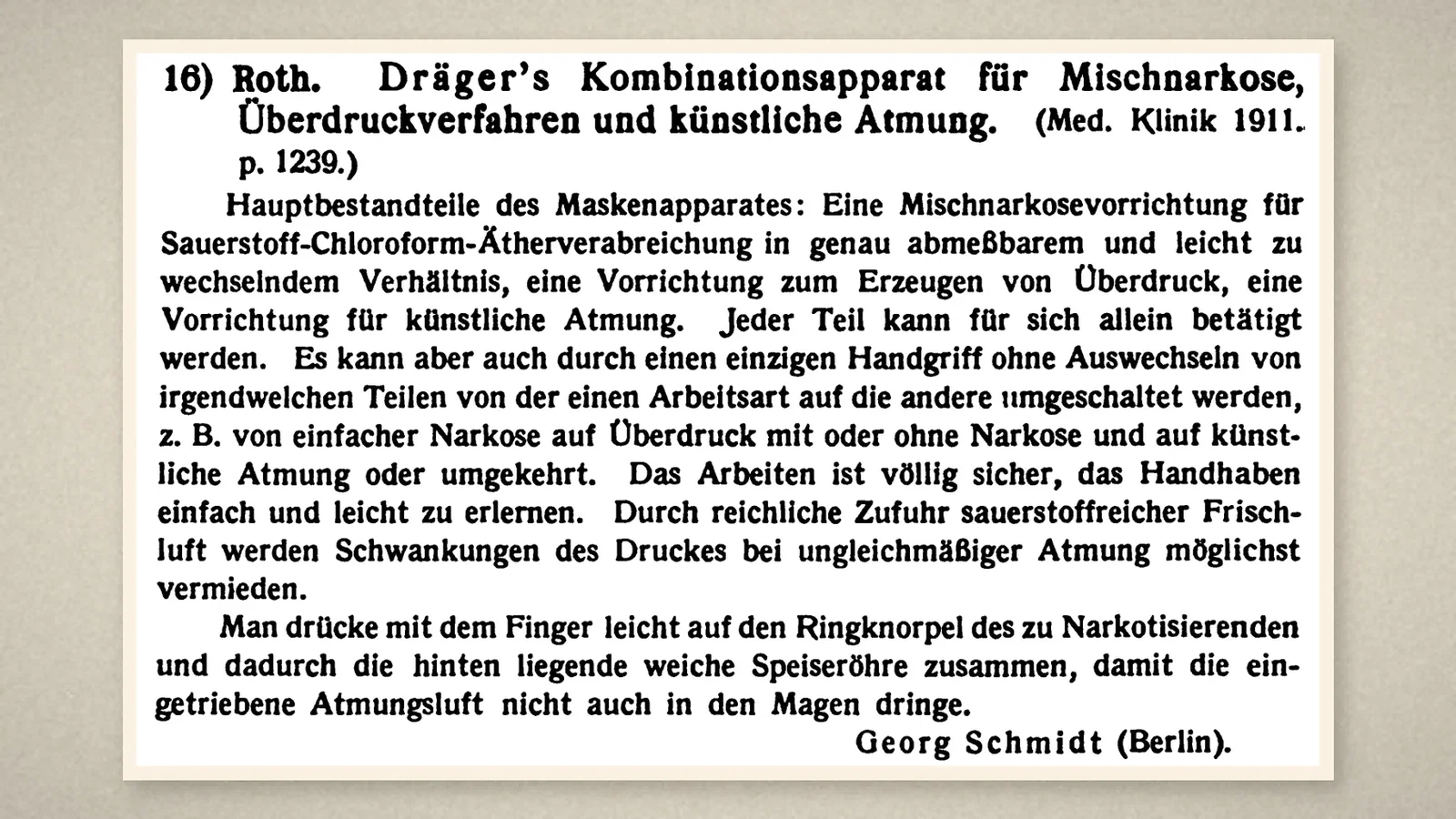
In 1911 Roth described in the Medizinische Klinik a "combination apparatus" made by the Dräger works in Lübeck for mixed anaesthesia, the overpressure method and artificial respiration. The Zentralblatt für Chirurgie, No. 41, printed an abstract by Georg Schmidt. [1, p. 1380] The mask apparatus, it said, had three parts: a device giving oxygen, chloroform and ether in exactly measurable and easily changed proportions, a device for producing overpressure, and a device for artificial respiration; each could be used alone, or the apparatus could be switched from one mode to another "by a single handle, without exchanging any parts". [1, p. 1380]
The abstract's last sentence reads: "One presses lightly with the finger on the cricoid of the person being anaesthetized, and thereby compresses the soft oesophagus lying behind it, so that the air driven in does not also enter the stomach." [1, p. 1380]
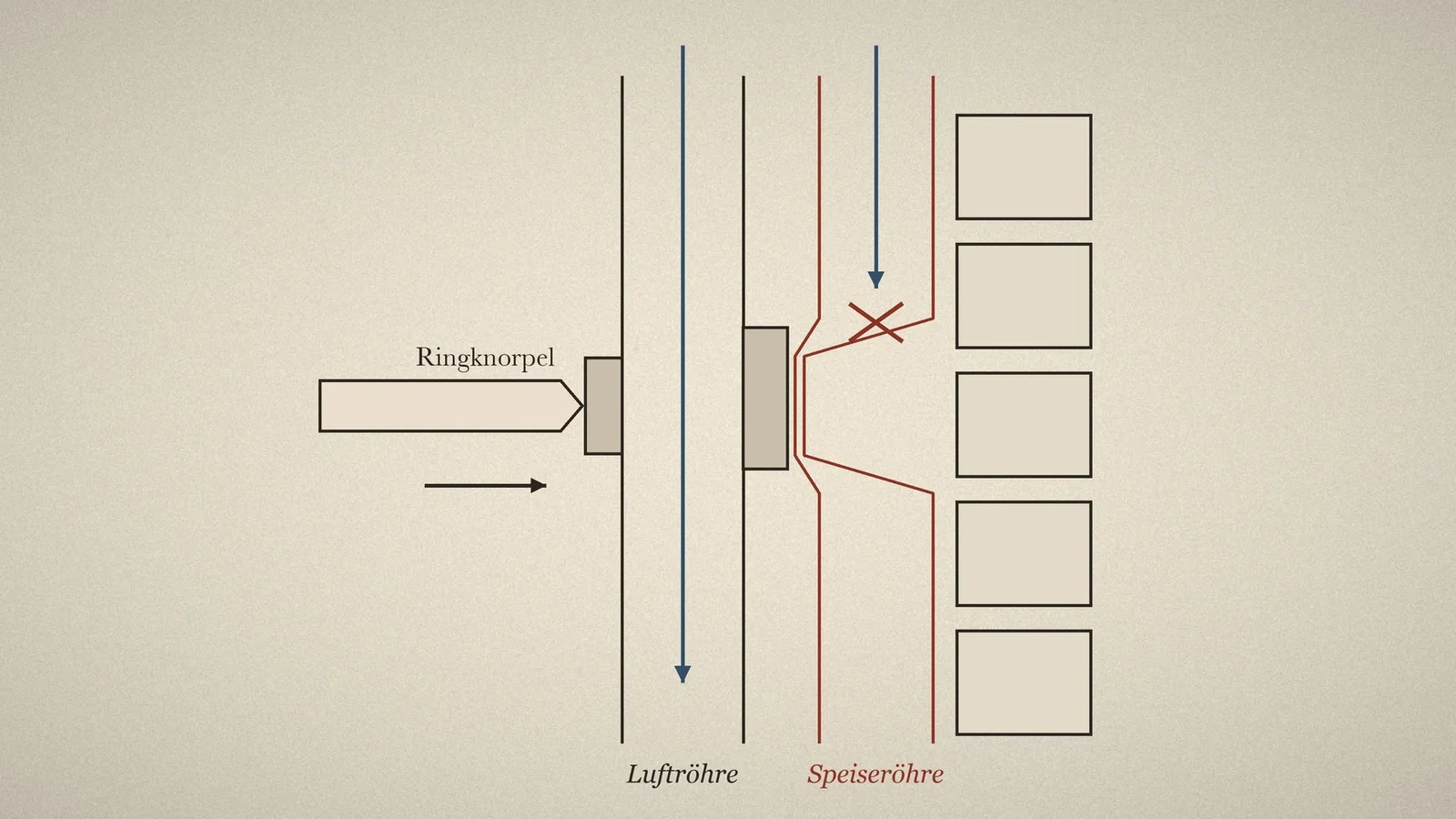
The logic is plain. The machine is blowing gas into the patient, by overpressure or artificial respiration; the gas can go into the lungs or down the oesophagus into the stomach; a finger on the cricoid closes the oesophageal route.
The Pulmotor
The same year Roth described another Dräger machine in the Berliner klinische Wochenschrift, No. 38: the automatic resuscitator called the "Pulmotor". The abstract in the Zentralblatt, No. 49, explains that it expanded the lungs by blowing oxygen into the trachea and lungs and produced expiration automatically by suction; because it adapted to the capacity of the lungs, no harm need be feared; and "by light pressure on the trachea one can compress the oesophagus and so prevent air from entering the stomach in unwanted amounts". [2, p. 1620]
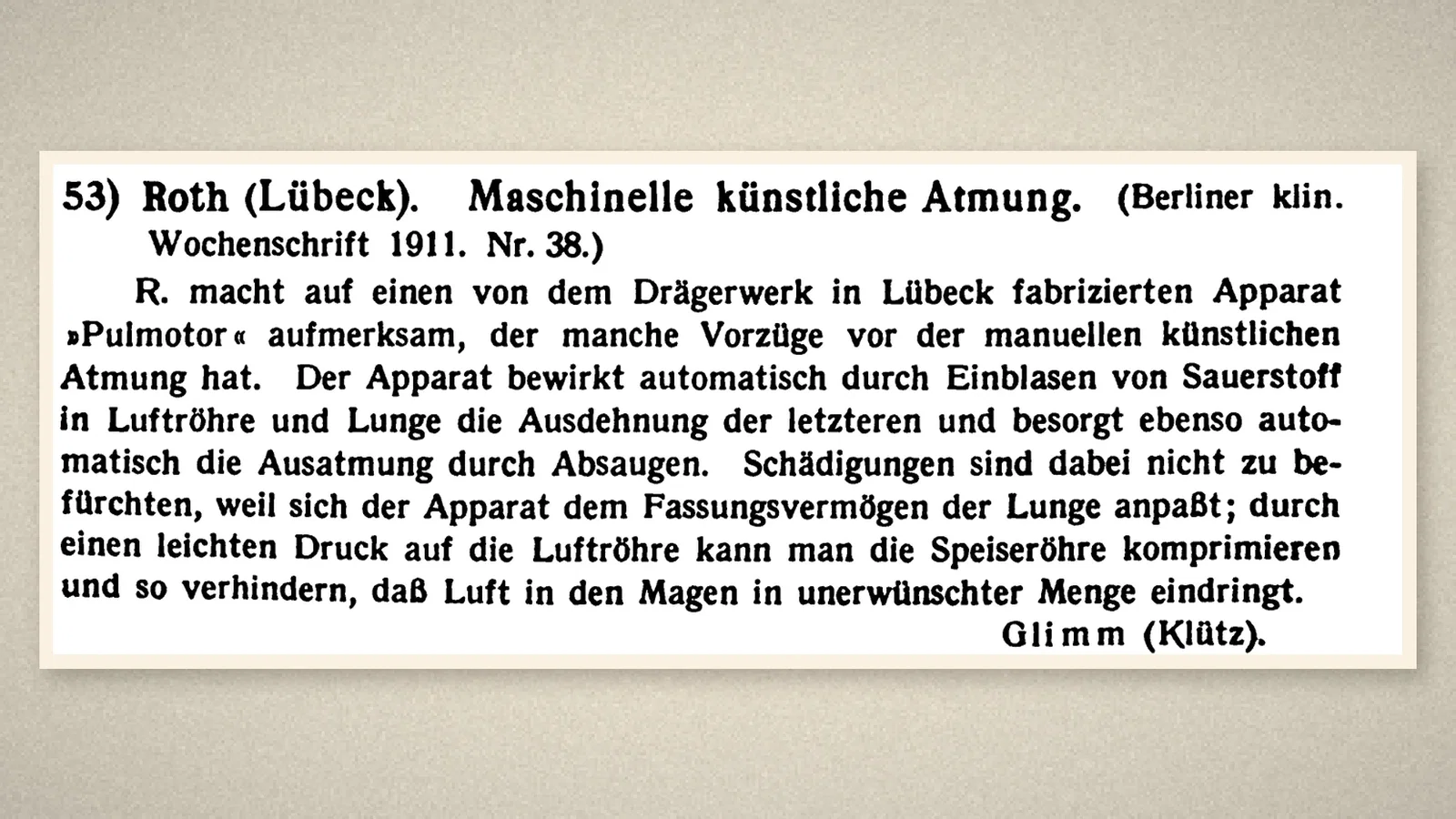
Here the word is "trachea"; No. 41 says "cricoid". The two abstracts were written by different people and evidently describe the same manoeuvre: pressing from the front on the cricoid at the lower end of the larynx to close the oesophagus behind.
Lübeck, 28 October 1911
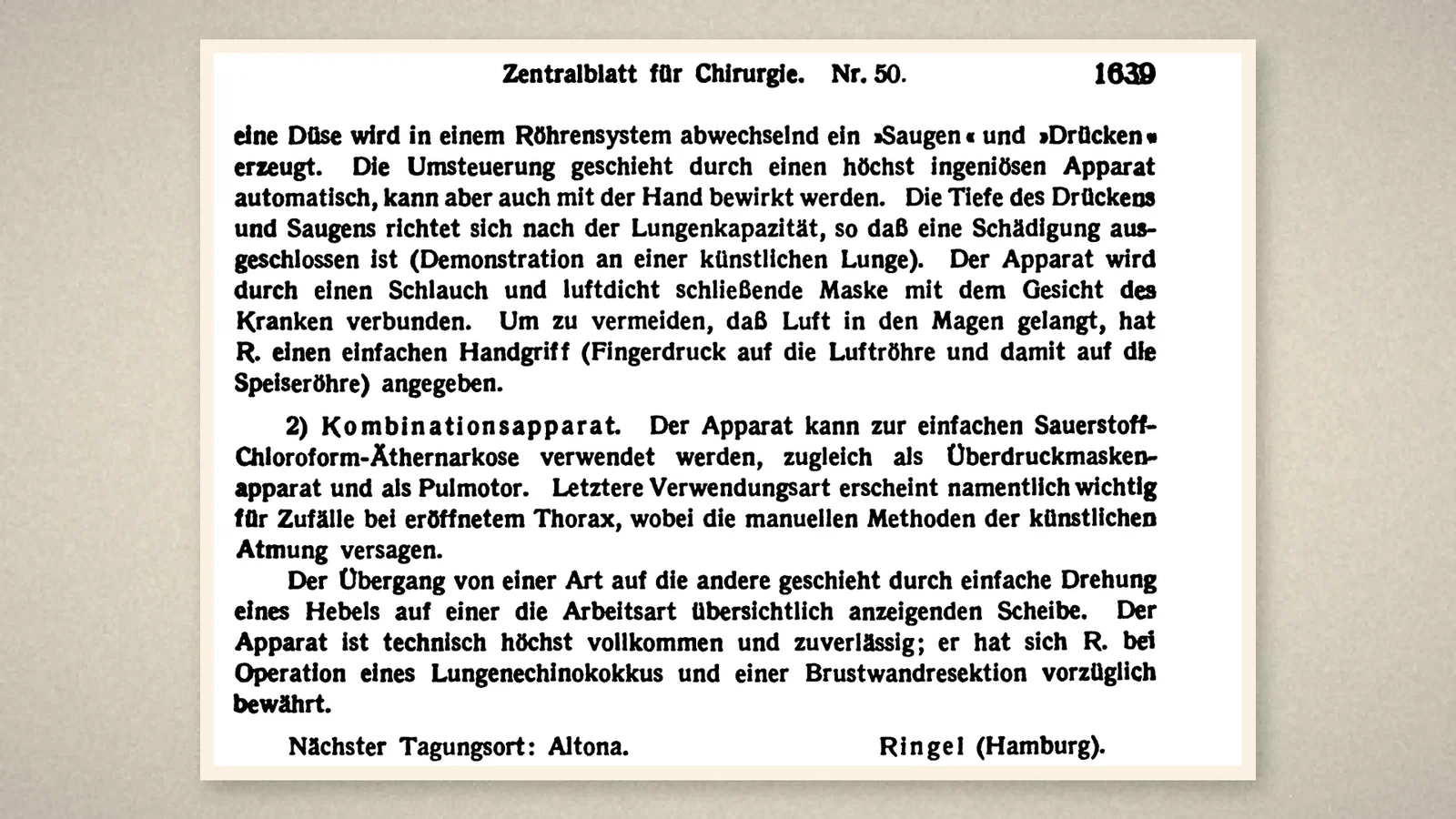
On 28 October 1911 the Association of North-West German Surgeons held its ninth meeting in Lübeck, with Roth in the chair. [3, p. 1628] Roth demonstrated two machines "built by the Lübeck Drägerwerk". [3, p. 1638] The first was the Pulmotor, which the report said even a layman could operate at the scene of an accident; to keep air from entering the stomach, Roth had devised a simple manoeuvre, "finger pressure on the trachea and thus on the oesophagus". [3, p. 1638–1639] The second was the combination apparatus, usable for simple oxygen-chloroform-ether anaesthesia, as an overpressure mask and as a Pulmotor; the last use was especially important in accidents with the chest open, when manual artificial respiration failed. Roth had used it with excellent results in an operation for a hydatid cyst of the lung and in a chest-wall resection. [3, p. 1639]
How it differs from Sellick
Read together, the 1911 texts show Roth pressing on the cricoid so that gas blown in by a machine would not inflate the stomach, as an accompaniment to positive-pressure ventilation and resuscitation. Sellick's title, by contrast, is explicitly about controlling the regurgitation of stomach contents during induction. [4] The manoeuvre is nearly the same; the problem it answers differs, gastric inflation in one case and regurgitation with aspiration in the other.
What the record shows
In Lübeck in 1911, Dräger's machines were bringing positive-pressure ventilation into the operating theatre and to the scene of accidents, and with it a new question: where does the gas go? Roth's answer was a finger on the cricoid. Half a century later the same manoeuvre was given a new purpose.
Sources and reading limits
Read: in the Zentralblatt für Chirurgie 1911, vol. 38, part 2, Georg Schmidt's abstract of Roth's paper in the Medizinische Klinik 1911, p. 1239 (No. 41, p. 1380); Glimm's abstract of Roth's paper in the Berliner klinische Wochenschrift 1911, No. 38 (No. 49, p. 1620); and the report of Roth's demonstration of two Dräger machines at the Lübeck meeting of 28 October 1911 (No. 50, pp. 1628, 1638–1639); Crossref bibliographic data for Sellick's 1961 paper.
Not covered: Roth's original papers in the Medizinische Klinik and the Berliner klinische Wochenschrift were not found; this article relies on the contemporary abstracts and meeting report. The sources read call the surgeon only "Roth (Lübeck)"; the first name "Otto" and the title "chief surgeon of Lübeck General Hospital" were not checked. On the central point, the sources describe pressure on the cricoid (or "trachea") to stop air blown in by the apparatus from entering the stomach, not protection against regurgitation at induction in patients with full stomachs, and they say nothing of "ileus and peritonitis" or the sixth cervical vertebra. Sellick's 1961 paper was not read; only its title and citation are used.
Of the four illustrations, three are crops of the 1911 Zentralblatt pages and one is a diagram drawn for this article from the sources.
- Schmidt G. [Abstract of] Roth. Dräger's Kombinationsapparat für Mischnarkose, Überdruckverfahren und künstliche Atmung. Med Klin 1911:1239. Zentralbl Chir. 1911;38(41):1380. Internet Archive
- Glimm. [Abstract of] Roth. Maschinelle künstliche Atmung. Berl Klin Wochenschr 1911;(38). Zentralbl Chir. 1911;38(49):1620. Internet Archive
- Vereinigung nordwestdeutscher Chirurgen, 9. Tagung, Lübeck, 28 Oct 1911: Roth. Demonstration zweier vom Lübecker Drägerwerk konstruierter Apparate. Zentralbl Chir. 1911;38(50):1628, 1638-9. Internet Archive
- Sellick BA. Cricoid pressure to control regurgitation of stomach contents during induction of anaesthesia. Lancet. 1961;278(7199):404-6. doi:10.1016/S0140-6736(61)92485-0. DOI
Continue exploring
Related reading connects shared questions and contexts; it does not by itself establish historical influence.
Anesthesia Epochs · The Source Room · About & Editorial Method
Published November 2, 2026. Sources and reading limits are stated above. Illustrations are labelled as original source images or AI-made. Historical accounts are educational; they are not current treatment instructions.