The 1956 clinical introduction linked a new drug to the problem of measuring its delivery.
Reading Library · Anesthesia Epochs · 中文版
Watch the companion film
1956: Halothane — What the Apparatus Delivers · Watch on YouTube
Historical anchor: 1956. Date details and source qualifications are explained below.
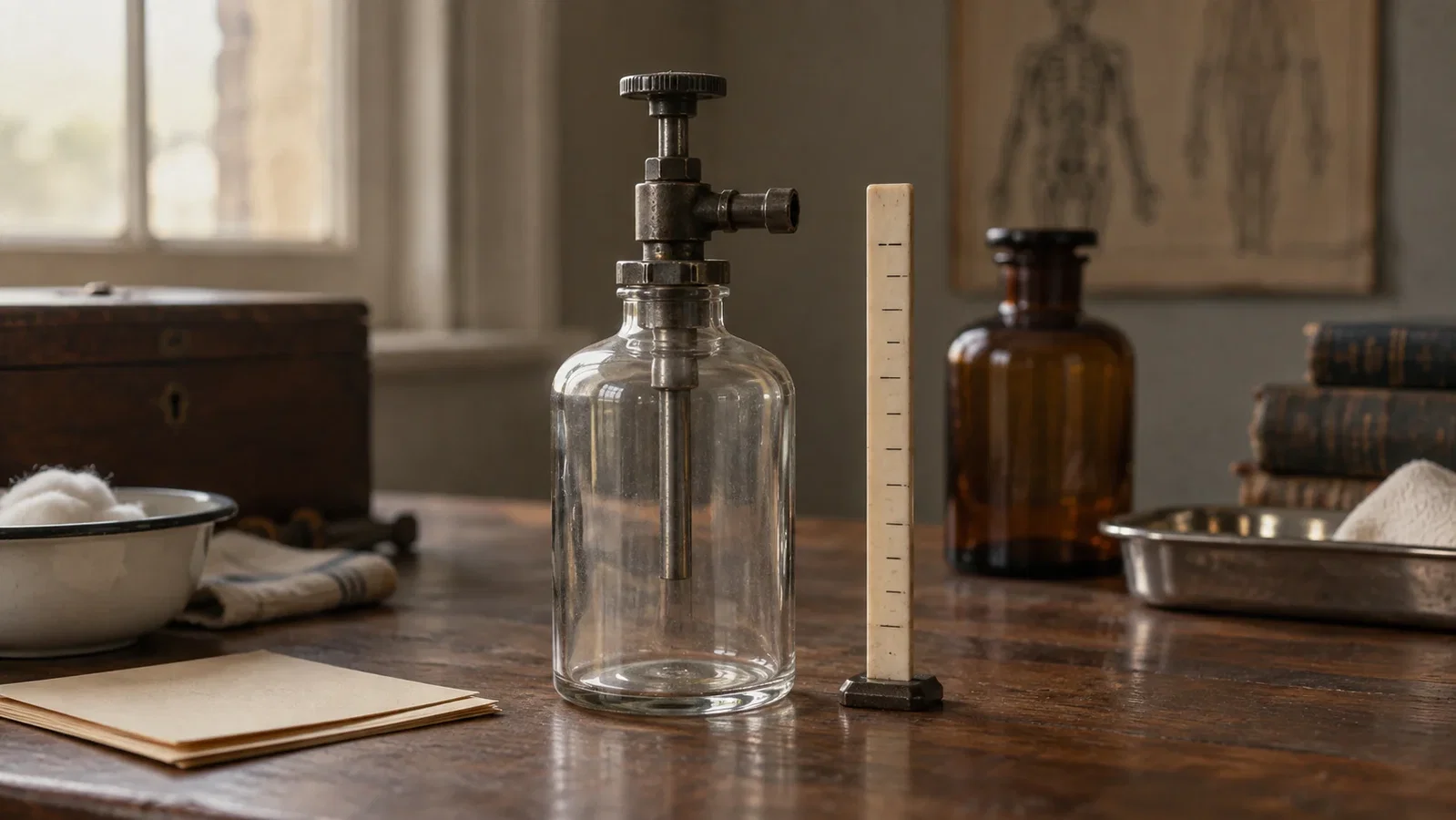
An extra scale beside a vaporizer control is an unassuming place to begin the history of a new anesthetic. Yet it captures a central difficulty in Michael Johnstone’s 1956 report: before explaining a patient’s response, how confidently could the anesthetist know what the apparatus had delivered?
Johnstone used the smaller Trilene bottle of a Boyle apparatus to administer Fluothane, the trade name for halothane. His paper included both a diagram of an extended scale and a photograph of the modified control. He acknowledged that the vapor concentrations remained approximate. The apparatus mattered as much as the label on the bottle.[1]
Two dates, and different kinds of evidence
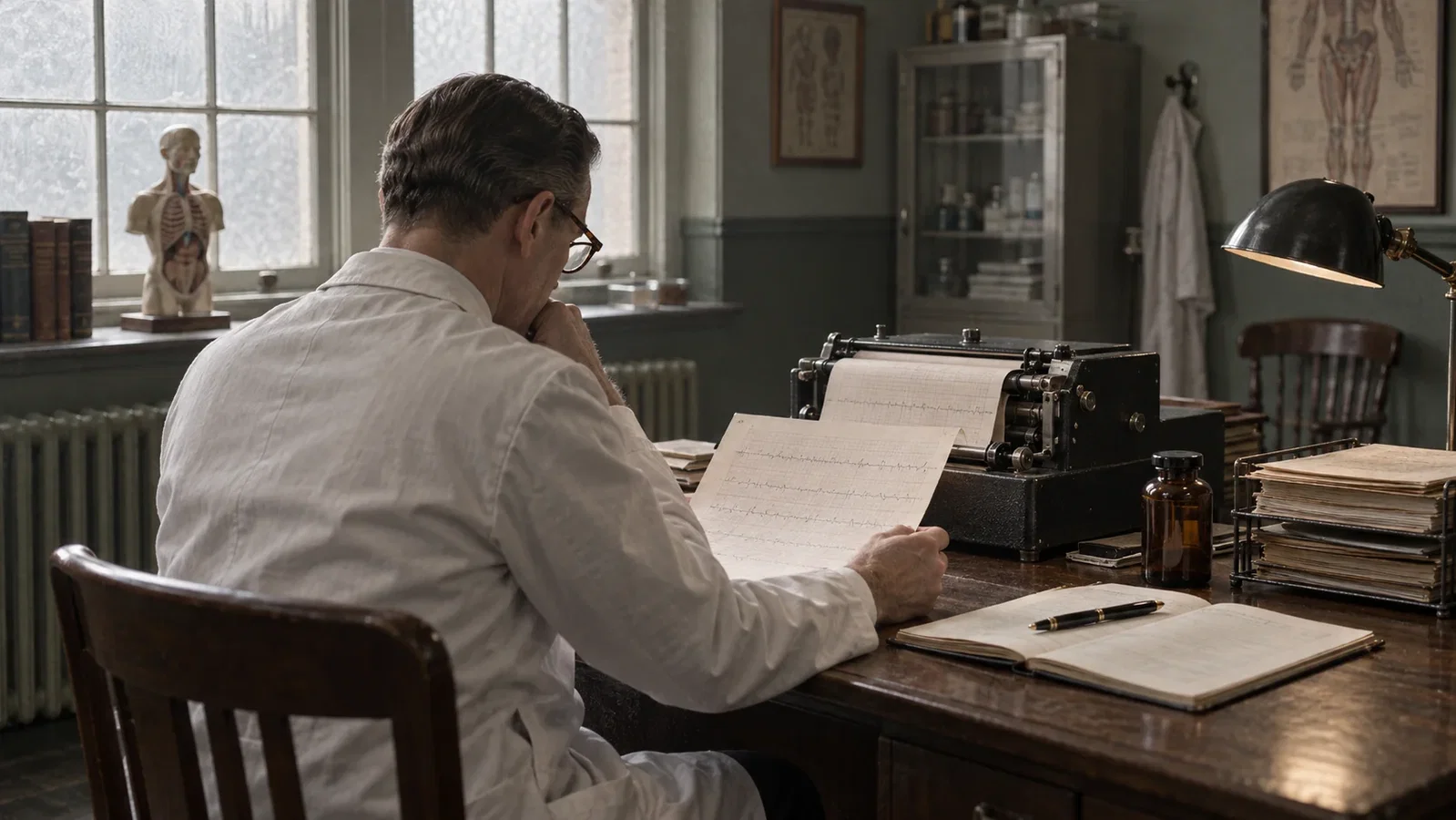
The clinical introduction is dated to 20 January 1956 at Manchester Royal Infirmary. The specific evidence used here is a later account by Diana Leitch, published in the Royal Society of Chemistry Historical Group newsletter in 2018. She quotes an internal ICI report dated that day, recording the first use in humans that morning. The newsletter has been read; the original internal report is not covered.[3]
Johnstone’s own clinical paper appeared in September 1956. Its title, The human cardiovascular response to Fluothane anaesthesia, identifies the investigation’s emphasis. The January event and September publication should remain separate, as should the contemporary paper and the later quotation documenting the exact day.[1,3]
The paper also gives the work a wider cast. It describes research associated with Raventós and Suckling, and thanks Suckling for supplies, Raventós and Paget for assistance, and surgical colleagues at Manchester Royal Infirmary and Crumpsall Hospital. Johnstone was investigating clinical use, not claiming to have synthesized the compound alone. A later RCoA biography describes his earlier interest in electrocardiography and anesthetic effects on the heart; it provides professional context, rather than direct access to his early thesis.[1,4]
Halothane’s nonflammability was an important attraction. It did not make halothane the first fluorinated agent in clinical anesthesia: Johnstone’s opening paragraph explicitly discusses the earlier Fluoromar. Nor could a physical property settle questions about the circulation and ventilation of a person receiving the drug.[1,2]
Read the denominator before reading the promise
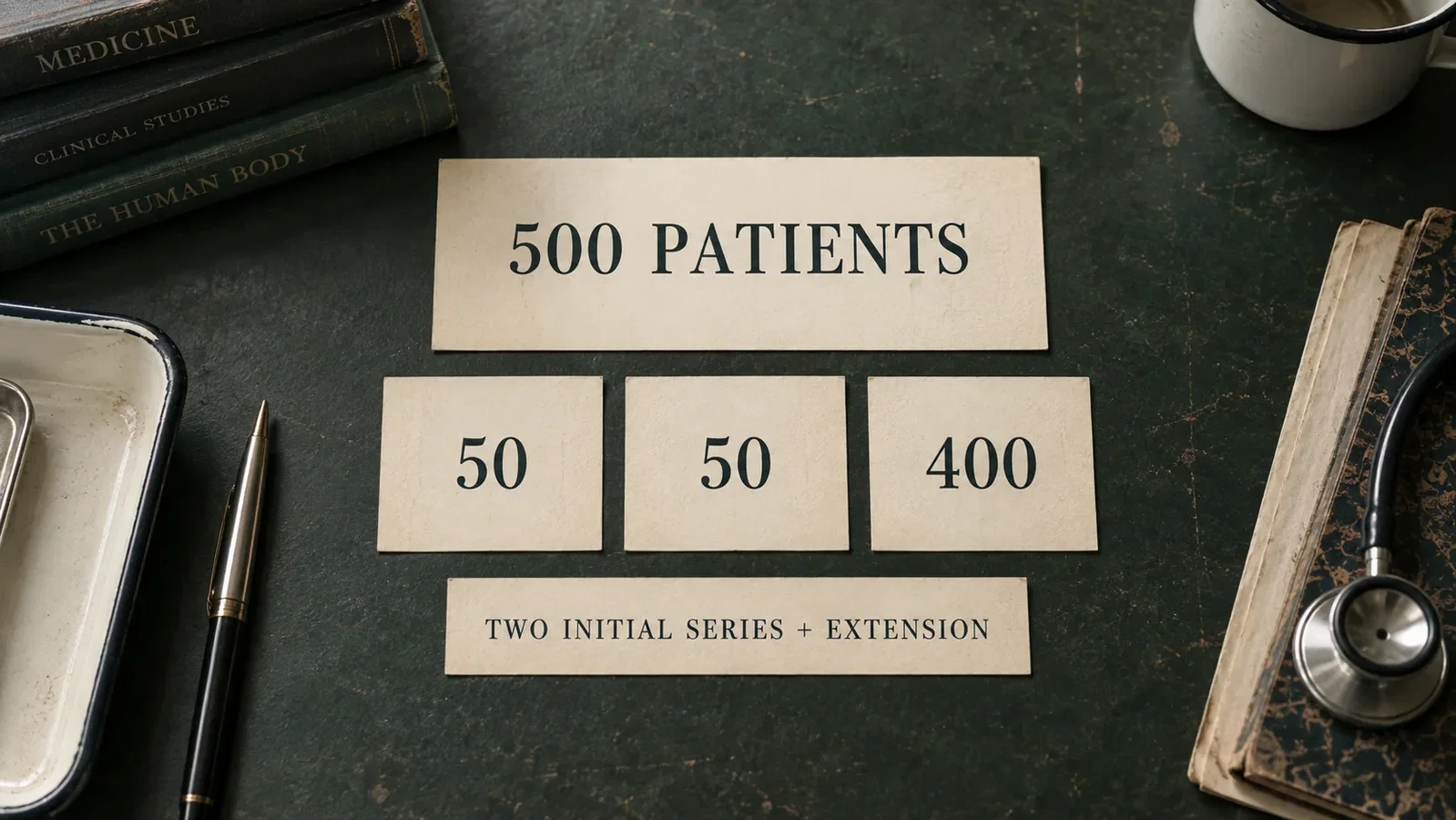
The original report concerns 500 patients. It describes two initial series of 50, followed by 400 additional cases, and repeats the total in its summary. The initial series and the extension must not be added to the stated total a second time.[1:393–397,409]
This was a developing body of clinical experience, not a randomized comparison. The second initial series changed both the vapor concentration and the use of atropine. Differences between those series therefore cannot establish the isolated effect of either change. The extension included patients with substantial disease, but excluded those with obviously diminished blood volume before surgery. A broad case mix was still a selected case mix.[1]
What the apparatus could not resolve
Blood pressure and the radial pulse were checked repeatedly in all cases; continuous electrocardiography was used during most major operations. This is more specific than saying that all 500 patients underwent continuous ECG monitoring. Johnstone documented hypotension, slowing of the pulse and changes in rhythm. Some combinations of a muscle relaxant and controlled respiration were accompanied by severe circulatory reactions.[1:393–400]
The observations generated a practical problem in interpretation. In some patients, the hypotensive effect diminished as anesthesia continued. Did this reflect increasing tolerance, or a declining output from the vaporizer? Johnstone could not decide. His discussion called for more accurately controlled and calibrated vaporizers for an agent of this potency.[1:408]
The uncertainty belongs in the story. A changing blood pressure could not simply be read as a changing response to a known, constant exposure. Delivery and response had to be considered together.
There is also a concrete connection to the earlier Boyle apparatus article. The 1956 paper names and illustrates the later apparatus being adapted to a new agent. That supports a historical relationship between equipment and clinical investigation. It does not identify this bottle as the original 1917 machine or demonstrate that decades of design remained unchanged.
Oxford asked another part of the question
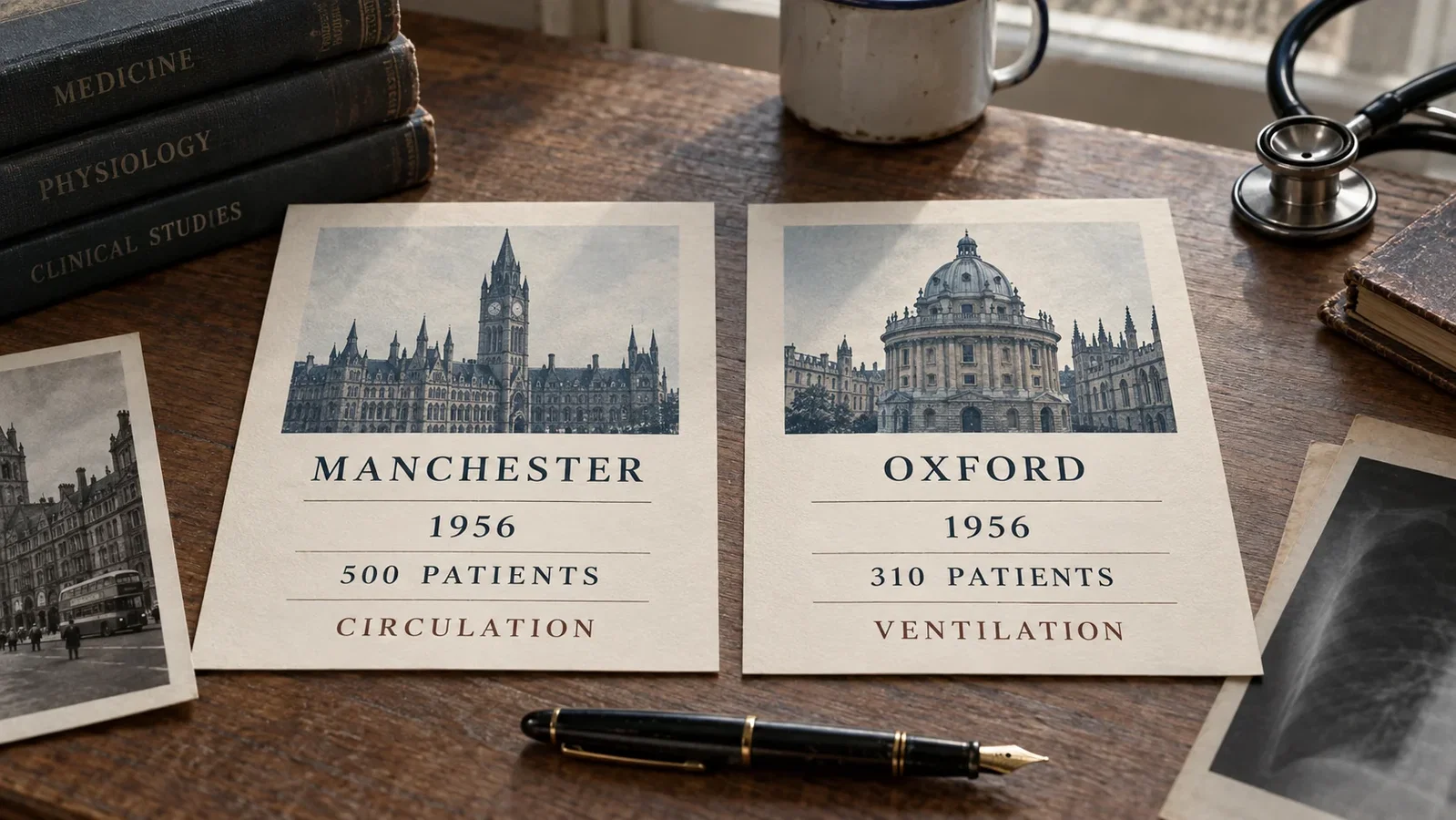
In October 1956, R. Bryce-Smith and H. D. O’Brien published their experience with volunteers and 310 surgical patients. They explicitly distinguished their work from Johnstone’s study of delivery through a Boyle apparatus. Their report examined open-drop administration and an EMO inhaler delivering halothane in air.[2:969]
These were different patients and delivery conditions, not an additional arm of the Manchester series. Combining the denominators would disguise that difference.
The Oxford observations brought ventilation into sharp focus. A respiratory rate that remained steady or increased could coexist with a reduction in the depth of breathing. Measurement of expired gas revealed the extent of respiratory depression more clearly than rate alone. The authors regarded respiratory depression as a major disadvantage and argued for limiting use to skilled anesthetists while knowledge remained incomplete.[2:970,972]
The two papers should not be forced into agreement on every impression. Their apparatus, gas mixtures and accompanying drugs differed. Read together, they show why a favorable description of anesthesia required attention to the conditions under which it had been observed.
The limits were present in the original report
Johnstone reported no deaths during anesthesia, but separately presented six postoperative deaths, including cases whose causes were not established. The section on jaundiced patients also mentions a death that cannot be confidently matched to that list from the text. This account therefore does not calculate an aggregate mortality rate or attribute every death to halothane, or exclude its possible contribution.[1:405,407,410]
His favorable accounts of individual patients with serious disease, proposed autonomic explanations and optimistic discussion of surgical shock remain observations and interpretations within an early report. They cannot establish general organ protection or the elimination of perioperative risk.
The historical change is visible in the work itself: a new agent reached patients, its effects were recorded, the apparatus was modified, and different delivery conditions were investigated. Nonflammability addressed a real problem. It also left anesthetists with problems that required more precise measurement.
Source note. The central evidence is the complete 19-page Johnstone paper and four original scanned pages of the Oxford report. The exact January date is attributed to Leitch’s later quotation of an internal report; the internal original is not covered. The RCoA account supplies retrospective career context. Historical doses, management recommendations and safety assessments are not current clinical instructions.
Image note. All four images are newly generated editorial interpretations. They are not verified portraits, hospital photographs, original case records or working reconstructions of anesthetic equipment. The numerical cards distinguish series; they do not represent an outcome comparison.
Sources and reading limits
- Johnstone M. The human cardiovascular response to Fluothane anaesthesia. Br J Anaesth. 1956;28(9):392–410. Original paper, PMID13364102. All 19 pages of the OUP guest PDF, including figures and references, were read individually. The 1998 reprint was not used as the original issue.
- Bryce-Smith R, O’Brien HD. Fluothane: a non-explosive volatile anaesthetic agent. Br Med J. 1956;2(4999):969–972. Original scans, DOI10.1136/bmj.2.4999.969. All four scanned pages were read through the references in the left column of page 972; adjacent articles are excluded.
- Leitch D. News from Catalyst: Widnes Successes. RSC Historical Group Newsletter, No.73, Winter 2018:5–6. Newsletter PDF. The cover and complete two-page contribution were read, not the entire 34-page newsletter. Its cited 1956 internal report is not covered.
- Chadwick IS. Dr Michael William Johnstone. Royal College of Anaesthetists. Professional biography. The full browser-rendered body was read and archived; this does not imply that every work listed in its bibliography was obtained.
Continue exploring
Related reading connects shared questions and contexts; it does not by itself establish historical influence.
- 1951: Suckling Designs Halothane at ICI
- 1917: The Boyle Machine, Adaptation Behind an Eponym
- 1965: Isoflurane Emerges from a Screening Program
The Source Room · About & Editorial Method
Sources and reading limits are stated above. Illustrations are labelled as original source images or AI-made. Historical accounts are educational; they are not current treatment instructions.