1917–1919: Earlier apparatus, British-cylinder adaptation and multiple configurations.
Reading Library · Anesthesia Epochs · 中文版
Watch the companion film
1917: The Boyle Machine · Watch on YouTube
Historical anchor: 1917. Date details and source qualifications are explained below.
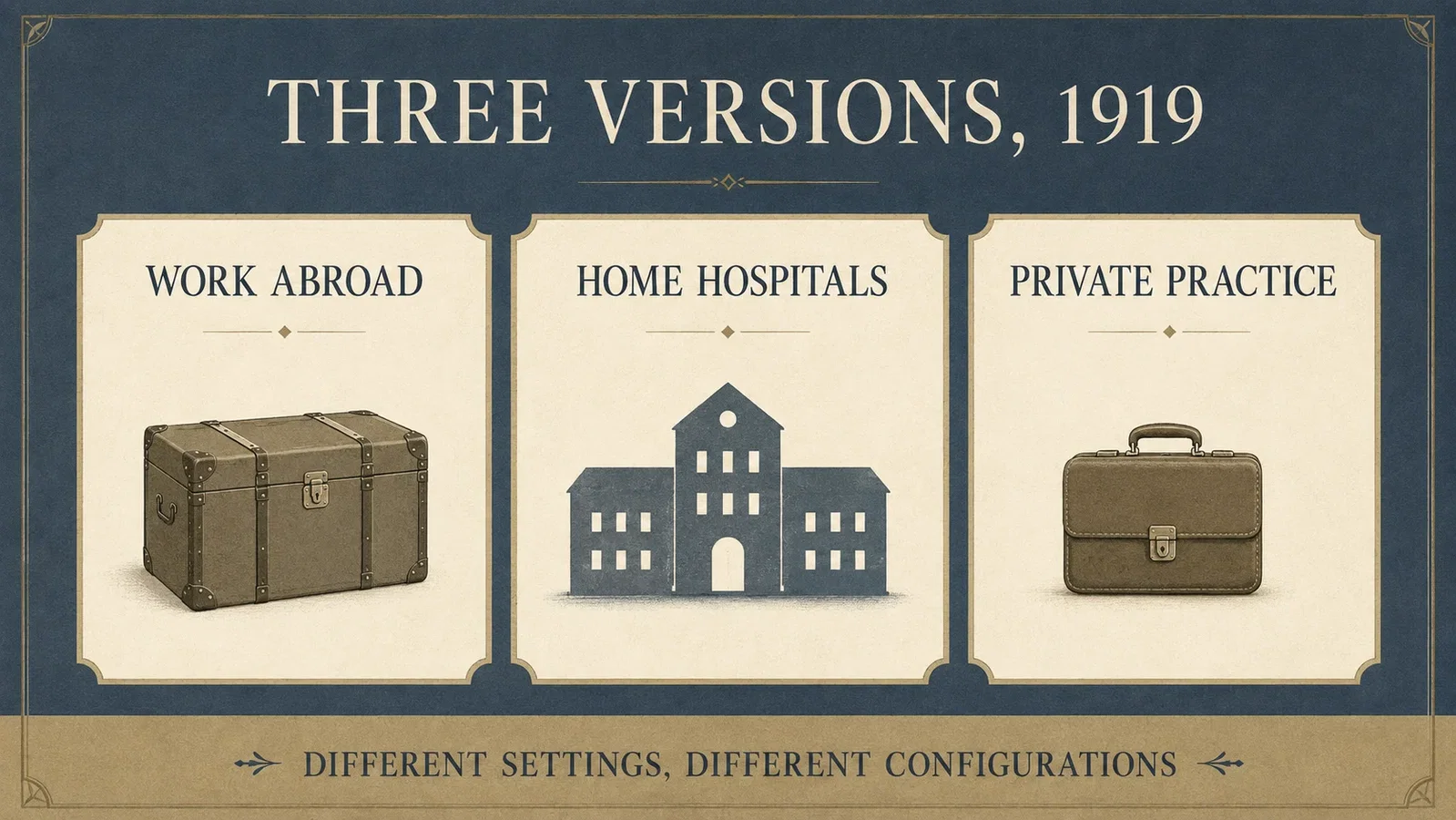
A machine's name can make its history seem more singular than its hardware was. By 1919, the apparatus described by H. Edmund G. Boyle already came in three versions: one for work abroad, one for hospitals at home, and one for private practice. The illustration in his notice showed the home-hospital model—not the smaller outfit that could be packed away.[2]
That is a useful place to begin the story of the Boyle machine. The name endured, but neither its configuration nor the contributions behind it can be reduced to one object.
An engineering problem with practical details
Boyle's notice appeared in The Lancet on 8 February 1919. It described reducing valves with fine adjustment that could fit ordinary English cylinders, a sight-feed arrangement, a pressure gauge on the oxygen cylinder, a rebreathing bag, a mask and an ether bottle. It also mentioned the period practice of warming the nitrous-oxide valve with a small spirit lamp.[2]
These details locate the apparatus in its own time. They are not a current equipment specification, and the notice does not establish that every component originated with Boyle. Adapting an arrangement to available cylinders was a concrete problem in making it usable.
The three sizes addressed different settings. The overseas and home-hospital versions stood on wheels. For private practice, the stand carrying the sight-feed and ether bottles could be taken down and stowed among the cylinders, with a cover and carrying handle. A photograph or drawing of one version therefore cannot stand for all of them.[2]
At the end of the same notice, Boyle thanked Geoffrey Marshall for suggestions about the requirements for using the machine in France. The acknowledgment matters: an enduring product name is compatible with contributions from other clinicians, earlier designs and manufacturers.[2]
The earlier report named Gwathmey's apparatus
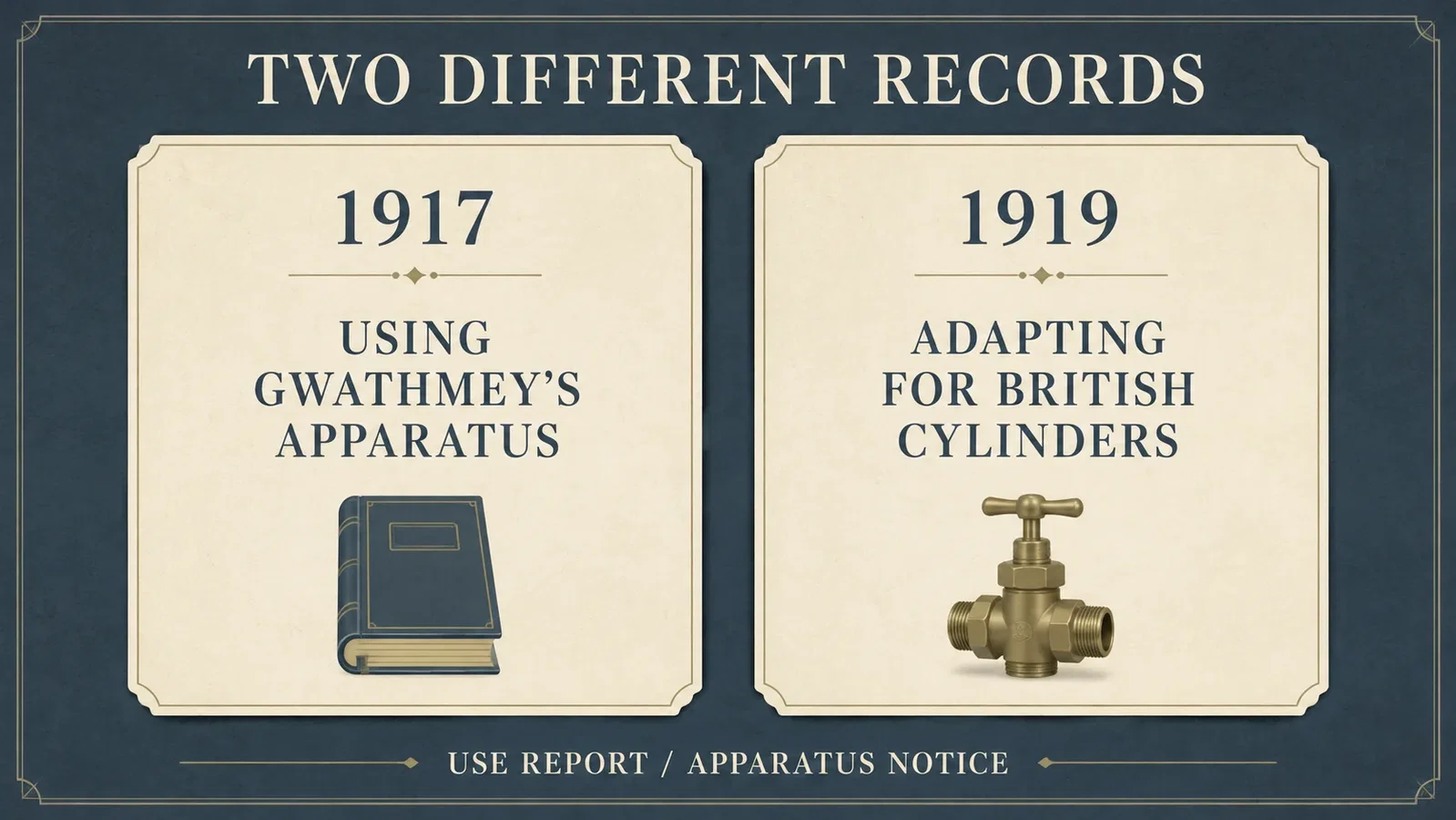
Return to 1917 and the distinction becomes sharper. Boyle's paper, read to the Medical Society of London on 29 October and published on 3 November, explicitly identified the apparatus he was using as Gwathmey's. He credited James T. Gwathmey with stimulating his interest in the method.[1]
The arrangement brought together cylinders of nitrous oxide and oxygen, a glass chamber in which gas passage through water could be observed, an optional volatile-agent bottle, a rebreathing bag and a facepiece. Observation of bubbles was a historical way to judge gas supply. It did not provide the measured inspired oxygen concentration or concentration assurance that a modern reader might assume. Observing gas flow and adding anesthetic vapor were distinct functions; rebreathing was not synonymous with mechanical ventilation.[1]
Much of Boyle's report concerned the work of the anesthetist: conditions during induction, attention to the airway, the patient's responses and the need for additional agents. Its final page described limitations and warned that careless or inexperienced administration could lead to disaster. Hardware did not remove the requirement for skill.[1]
The setting also requires care. Although the title concerned military surgery, Boyle expressly confined his own experience with wounded men to the First London General Hospital and officers' hospitals in London. He said that he had not been to the front. His proposed advantages there were an extrapolation, not his own frontline comparative study.[1]
Thus the 1917 report cannot simply be recaptioned as a launch announcement for a wholly original Boyle machine. It documents his use and advocacy of a method and apparatus whose antecedents he acknowledged.
What the case totals can support
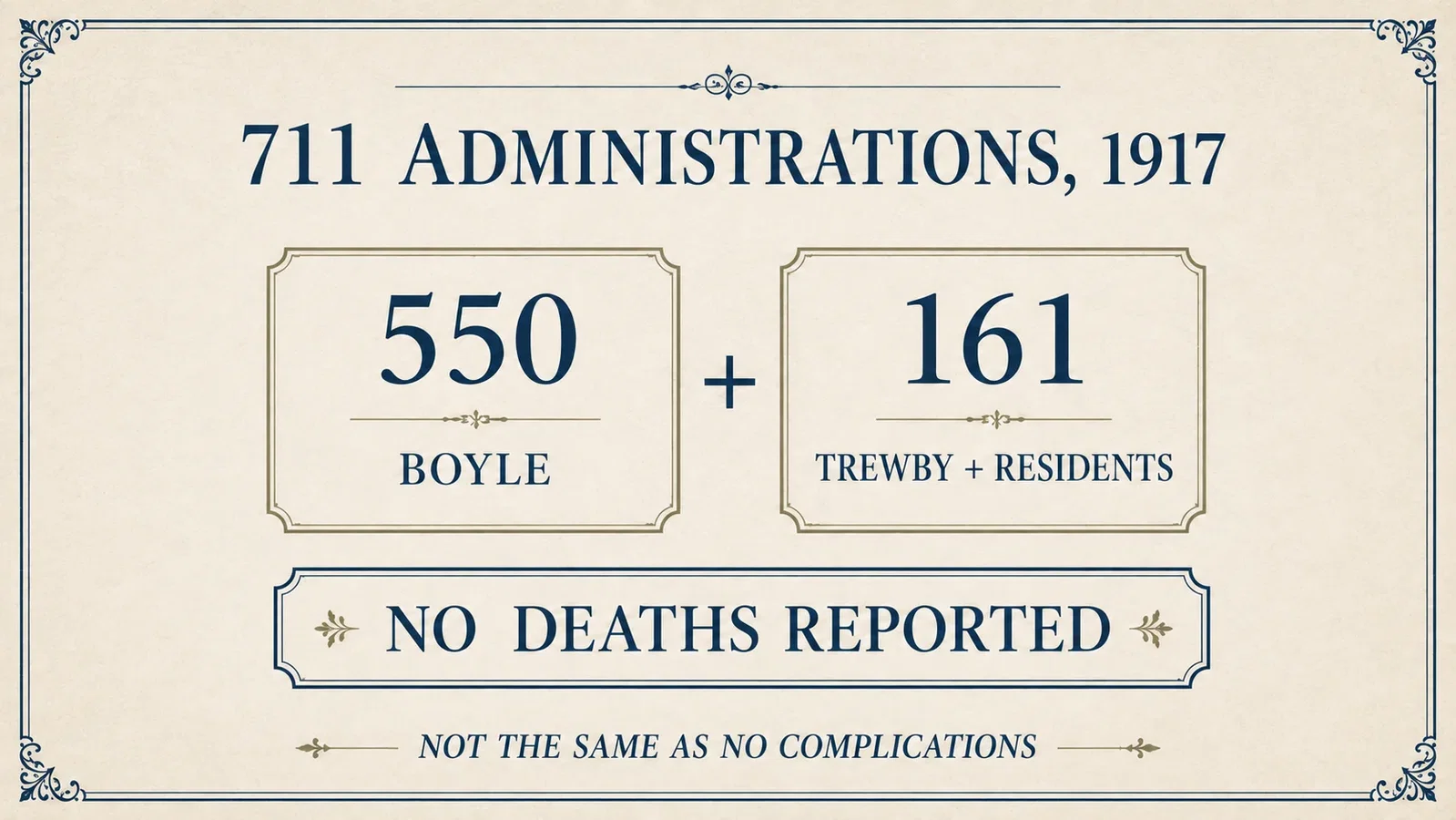
The 1917 summary listed 711 administrations: 550 by Boyle and 161 by J. F. Trewby and residents at the First London General Hospital. A separate analysis concerned 200 consecutive cases. The subset is not an additional cohort to add to 711, and the entire total should not be credited to one operator.[1]
Boyle reported no fatalities, but the same summary recorded five cases of bronchitis, one of which included slight bronchopneumonia. The 200-case analysis included vomiting and reports of pain. “No deaths reported” is therefore not “no complications.” Nor did the paper provide a randomized comparison or a follow-up framework establishing zero risk.[1]
In 1919, Boyle reported more than 2,000 personal administrations and more than 1,600 by Trewby and residents—more than 3,600 in all, with no fatality reported. The notice described experience with the method. It did not document 3,600 controlled tests of one identical machine configuration, and its later totals should not simply be added to the 1917 series.[2]
Those boundaries do not make the observations worthless. They identify what kind of evidence they are: clinicians reporting their practice, alongside preferences, limitations and warnings. They do not isolate the effects of apparatus, drugs, operator experience and patient selection.
Manufacturing, memory and surviving objects
Boyle's 1934 account added a manufacturing story. He recalled that, after the 1917 paper appeared, the War Office requested machines. Coxeter could not meet the demand because much of its staff had been called up; Siebe Gorman then made equipment, and Boyle remembered inspecting it for service at the front.[3]
This is a retrospective first-person source, not a wartime order book independently recovered for this article. It supports an attributed account of supply and production. It does not supply an independently verified first manufacturing day, an exhaustive production total or a settlement of invention priority.[3]
A contemporary observer offers a different perspective. In his 1918 thesis, Adam Brydon described seeing Boyle's new apparatus and anticipated wider use of this form of anesthesia in war surgery. His expectation is evidence of interest at that moment—not a measurement of completed adoption.[6]
Surviving museum objects add another necessary distinction. The Science Museum Group dates its Coxeter-made Boyle-type apparatus A630940 to 1918. The Wood Library-Museum's BOC machine is much later: its introduction suggests 1950–1955, while its catalogue gives a broader approximate 1946–1955 range. Neither object should be presented as a verified 1917 original merely because it carries Boyle's name.[4,5]
For this article, 1917 remains the historical development anchor, while the 1919 notice supplies a specific account of apparatus configuration and adaptation. That is a more defensible story than a single inventor suddenly assembling the modern anesthesia machine.
A short name can conceal a long process: using an existing method, adapting hardware, accommodating different settings, receiving clinical suggestions and securing manufacture. Reading the original papers restores those distinctions without requiring every later development to be traced back to one moment.
Image note: All four images are AI-generated modern editorial illustrations. Bottles, metal components, cases, cards, buildings and symbols are conceptual, not verified reconstructions, portraits, archival facsimiles or photographs of a particular hospital. The images are not operating diagrams or safety certifications. This article is medical history, not guidance on current anesthetic equipment, connections, gas mixtures or doses.
Sources and reading limits
- Boyle HEG. Experiences in the use of nitrous oxide and oxygen with rebreathing in military surgery. Lancet. 1917;2:667–669, 3 November, issue 4914. Original issue scan; publisher record. The complete three-page contribution and issue heading were read, not the entire 38-page issue.
- Boyle HEG. New inventions: Nitrous-oxide-oxygen-ether outfit. Lancet. 1919;1:226, 8 February, issue 4980. Original issue scan. The complete notice, illustration, cross-column continuation and issue heading of the 44-page issue were read. Historical running-volume numbers differ from modern electronic volume labels; year, half-year volume, issue, date and page locate the source here.
- Boyle HEG. Nitrous oxide: history and development. British Medical Journal. 1934;1(3812):153–155. Original paper; PMID 20778037, PMC2444118. All three pages were read through Boyle's acknowledgment at the top left of 155; the adjacent Leeds hospital article is excluded. Manufacturing recollections are attributed to 1934, and older historical assertions in the paper are not treated as independently verified.
- Wood Library-Museum. BOC Boyle Machine, accession 2000-04-03-3. Collection record. Full explanatory text, object catalogue and historical notes read online.
- Science Museum Group. Boyle-type anaesthetic apparatus, London, England, 1918, A630940. Collection record. Object description, date, maker and details read online. General safety wording in the museum narrative is not used as outcome evidence.
- Brydon AG. Anaesthesia in war surgery. Edinburgh MD thesis, 1918, p. 27. University record. All 29 pages were read; p. 27 was re-checked for this article.
Continue exploring
Related reading connects shared questions and contexts; it does not by itself establish historical influence.
- 1914–1918: First World War Anesthesia Beyond the Mask
- 1956: Johnstone's Halothane, a Nonflammable Agent Still Needing Measurement
The Source Room · About & Editorial Method
Sources and reading limits are stated above. Illustrations are labelled as original source images or AI-made. Historical accounts are educational; they are not current treatment instructions.