1914–1918: Coexisting routes, constrained supplies and uneven professional authority.
Reading Library · Anesthesia Epochs · 中文版
Watch the companion film
1917–1918: Anesthesia in World War I · Watch on YouTube
Historical anchor: 1914. Date details and source qualifications are explained below.
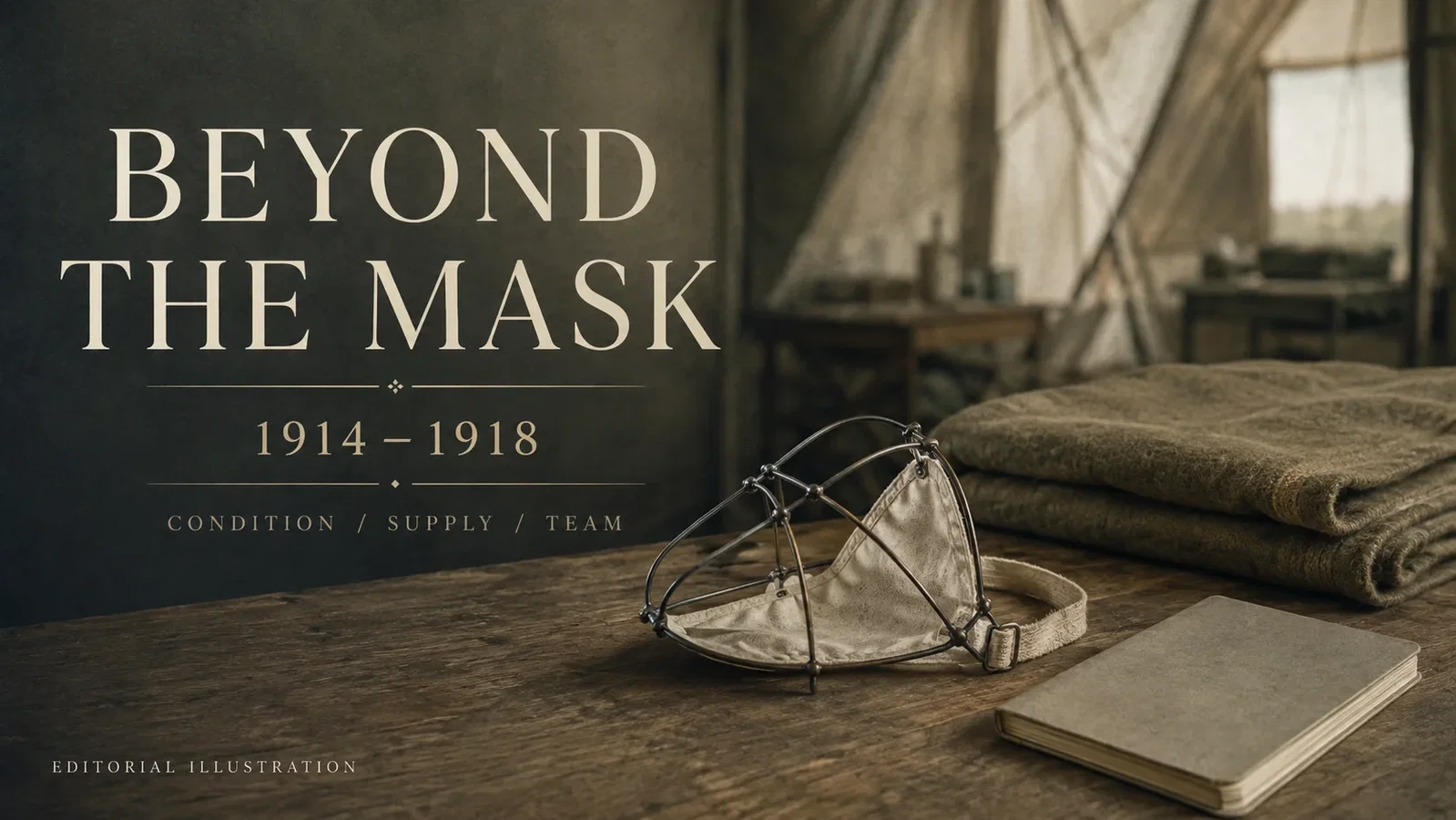
At the end of his 1918 MD thesis, Adam Brydon described a piece of equipment he had recently seen: Boyle's apparatus for nitrous oxide and oxygen, with provision for warmed ether. He expected this form of anesthesia to become more widely used in war surgery.[1]
The future tense matters. An apparatus could impress a clinician without yet being universally available. A technique could be useful without displacing the alternatives. And a person could learn to give anesthesia without being permitted to keep doing so.
Those distinctions make the First World War a more interesting anesthetic story than a simple progression from a mask to a tube. They also limit the claim. The records considered here concern British and Australian practice on the Western Front and in rear hospitals, chiefly in 1917–1918. They do not establish a worldwide adoption rate, or a sudden beginning for modern emergency airway management in 1914.
A change of setting changed the anesthetic problem
Brydon's thesis, submitted to the University of Edinburgh, drew on what he described as approximately 1,100 wartime anesthetics. His experience moved between Brighton, a casualty clearing station in Flanders during the 1917 offensive, and a base hospital. These were not parallel study groups.[1, pp. 1–4]
In Brighton, many patients had already undergone surgery in France and could spend time preparing for a further operation. At the clearing station, recent wounds, severe physiological compromise and fear were part of the anesthetist's immediate problem. A rush of casualties left little certainty about when a man would reach the operating table. Brydon worked with a surgeon as a team, sometimes through demanding shifts.
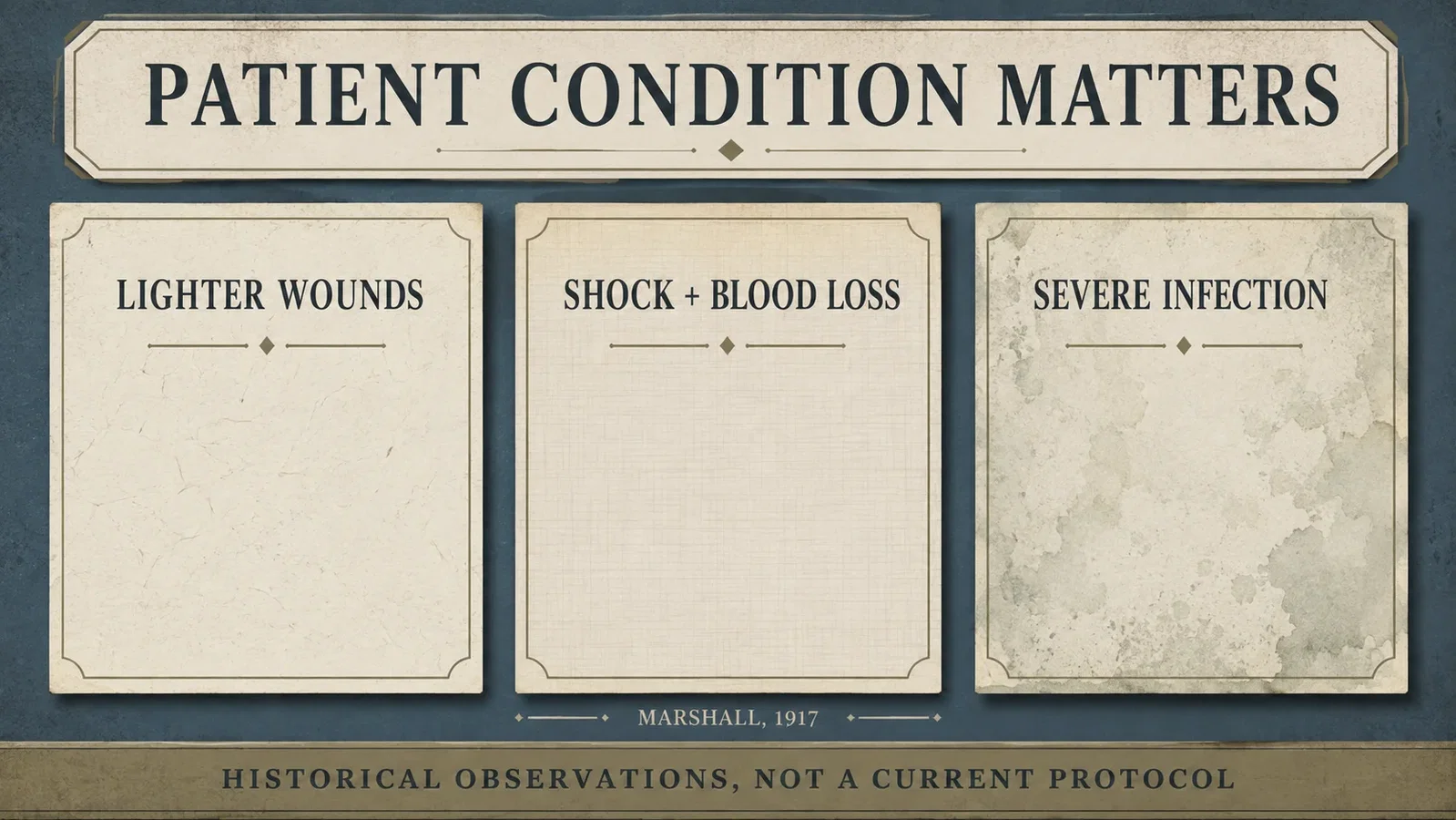
Geoffrey Marshall's 1917 account gave this problem a clinical structure. He distinguished lighter wounds, serious injury with shock or hemorrhage, and severe infection. The site of injury also influenced the choice of anesthetic.[2] These were his period categories, not a present-day trauma classification.
Marshall examined spinal anesthesia in relation to the interval after wounding and evidence of blood dilution. He also followed blood pressure and pulse beyond the operation itself. The records offered reasons to reconsider a method in a particular patient, but they were not randomized comparisons. A tracing from one injured man cannot establish a treatment effect for every wartime casualty.
The important shift in these accounts was therefore not simply a preference for one bottle over another. Preparation, injury, the operation and the subsequent physiological course all entered the anesthetic discussion. Marshall's specific treatment recommendations remain historical statements, not instructions for contemporary practice.
What worked also depended on what arrived
Brydon described attending a lecture and demonstration by Captain Marshall on nitrous oxide and oxygen, including blood-pressure records associated with different anesthetics. He subsequently became enthusiastic about the method through his own clinical experience.[1, p. 16]
His account nevertheless contains a practical obstacle: nitrous oxide was often unobtainable. Ethyl chloride was more portable and readily available. Ether and chloroform remained part of the work, alongside gas and oxygen.[1, pp. 11, 15] Wartime practice did not move neatly through a sequence of complete replacements.
The same was true of equipment. Open masks coexisted with Shipway's apparatus for delivering vapor. Learning to use an apparatus involved more than acquiring it. Brydon warned about incorrectly connected tubing delivering unwanted liquid to the patient and emphasized familiarity with the equipment.[1, pp. 14–15]
This is not a historical setup to reconstruct for use. It is evidence that additional equipment brought additional responsibilities. Availability, correct assembly and an attentive operator were separate requirements; possession of an apparatus did not satisfy all three.
A nasal tube was not automatically a tracheal tube
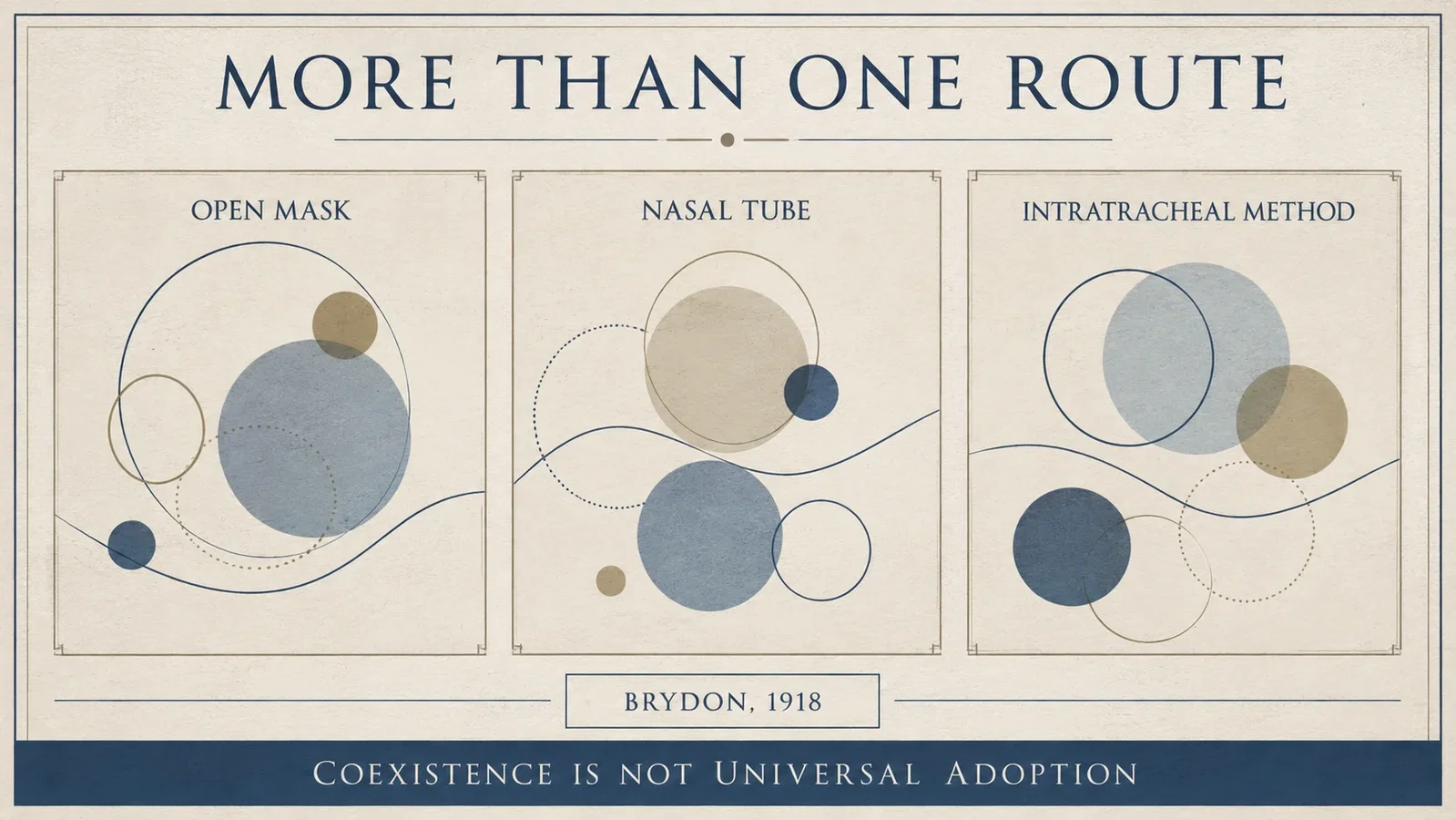
Facial and jaw wounds brought the anesthetic route into the same region as the operation. Brydon described continuing vapor administration through a nasal tube after induction on an open mask. In the same section, he called intratracheal ether useful for this type of case.[1, p. 23]
The distinction between those routes must survive a modern retelling. A nasal tube carrying anesthetic vapor is not, by that description alone, a tube placed in the trachea. The thesis did not supply an intubation denominator, success rate or army-wide airway protocol.
What it documents is coexistence: different routes were available for discussion and use. It does not show that masks disappeared or that a uniform emergency-intubation system had been established. Later laryngoscopes, cuffed tubes and electronic monitors cannot be inserted into a 1914 scene to make that transition look complete.
Read past the impressive recovery from anesthesia
Brydon illustrated his enthusiasm for gas and oxygen with three severely wounded patients. Their immediate condition after operations impressed him. But the examples did not all end with survival.[1, pp. 16–19]
Two subsequently died, their deaths attributed by the author to gas gangrene. Another was evacuated to a base hospital; the thesis did not provide a complete long-term outcome. Operations, saline administration and, in some instances, further operations accompanied the anesthesia. Improvement cannot be assigned to the anesthetic alone.
Neither a three-patient rescue story nor an overall mortality estimate can be made from these selected examples. They showed the writer attempting operations in desperate circumstances and recording what happened afterward. They were not a controlled trial.
Brydon also acknowledged that opportunities to follow patients at the casualty clearing station were limited.[1, p. 25] An encouraging postoperative observation, readiness for another operation, evacuation and eventual survival are different outcomes. The limitations were already present in the account; a historical narrative should not remove them.
Training, practice and permission could diverge
The personnel story was equally uneven.
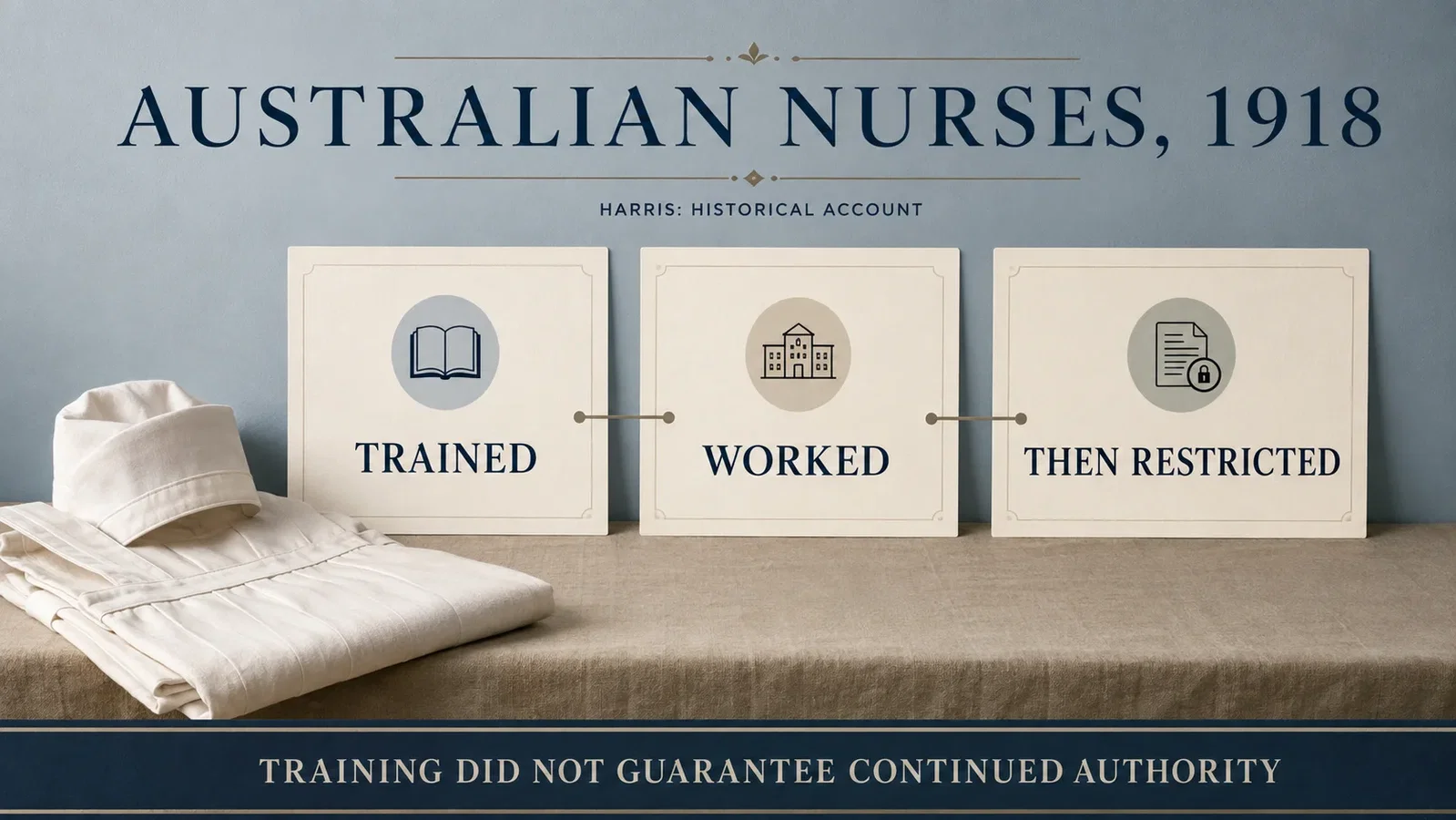
In her historical study, Kirsty Harris described the British Army's three-month nurse-anesthetist course beginning in January 1918. The first two months were spent at selected base hospitals and the last at casualty clearing stations. Training included patient assessment, anesthetic choice and emergencies, as well as administering anesthetics. Nine Australian nurses were selected for the first course; six passed.[3, pp. 45, 47]
The records discussed by Harris show that these nurses did not merely attend classes. They administered anesthesia. Australian authorities subsequently refused to allow that work to continue, while British services continued using trained nurses, including in Australian hospitals.[3, pp. 47–48]
It would therefore be wrong to say that Australian nurses never gave wartime anesthesia. It would be equally wrong to treat the training course as evidence of a permanent, shared settlement across the participating medical services.
Harris examined professional boundaries, gender, staffing needs and changes in the conduct of the war as explanations for the restriction.[3, pp. 48–49] Her discussion is historical interpretation, not a directly established single official motive. The policy divergence is clearer than the exclusive cause.
This account also illustrates why expanded technical competence and expanded professional authority should not be treated as the same development.
An apparatus at the edge of the story
Boyle's apparatus appears on Brydon's final page as something he had personally seen, followed by an expectation of wider use.[1, p. 27] That is a specific connection to this site's Boyle-machine article: contemporary evidence of the apparatus entering a clinician's view.
It is not proof that war alone caused the invention, or that the equipment had already become standard everywhere. Its development requires its own source inquiry.
Taken together, these records place the mask within a larger problem. The wounded man's condition, the supplies available, the route compatible with the operation, the training of the person giving anesthesia and the authority to perform that work all mattered. None advanced at exactly the same pace.
Image note: All four images are AI-generated modern editorial illustrations. Props, people, paper panels and settings are conceptual, not verified artifact reconstructions, portraits, archival facsimiles or photographs of a particular hospital. Their categories and sequences are not current clinical protocols.
This is medical history, not advice on current anesthetic drugs, apparatus connections or airway procedures. The year 1914 marks the opening of the 1914–1918 context, not a claimed invention or universal adoption date.
Sources and reading limits
- Brydon AG. Anaesthesia in war surgery. MD thesis, University of Edinburgh, 1918. University record; complete PDF. All pages read: modern rights leaf, original title and body pp. 1–27. The title gives Adam Brydon; the repository expands this to Adam Gibson Brydon. The original p. 2 reads 650 clearing-station anesthetics, whereas the abstract says 660. No effect estimate depends on that subtotal here.
- Marshall G. The administration of anaesthetics at the front. Text read in the contemporary BMA collection, British medicine in the war, 1914–1917. London: British Medical Association; 1917:47–50. Scanned reprint. Only the title and this four-page contribution were read. Original BMJ publication: 1917;1(2944):722–725; DOI. The reprint describes 50 cases but its reported groups total 44; no missing cases or overall rate have been inferred.
- Harris K. ‘Giving the dope’: Australian Army Nurse Anaesthetists during World War I. Journal of Military and Veterans’ Health. 2013;21(3):45–50. Journal PDF. All six pages read. The PDF identifies itself as a reprint from Australian Military Medicine 12(3):138–143. Diaries and archives cited by Harris were not independently acquired or read for this article.
The Metcalfe 2007 review, PMID 17582245, was identified but its full text is not covered. It carries no exclusive claim in this article.
Continue exploring
Related reading connects shared questions and contexts; it does not by itself establish historical influence.
- 1917: The Boyle Machine, Adaptation Behind an Eponym
- 1919: Charles Robson Becomes a Specialist Anesthetist at SickKids
The Source Room · About & Editorial Method
Sources and reading limits are stated above. Illustrations are labelled as original source images or AI-made. Historical accounts are educational; they are not current treatment instructions.