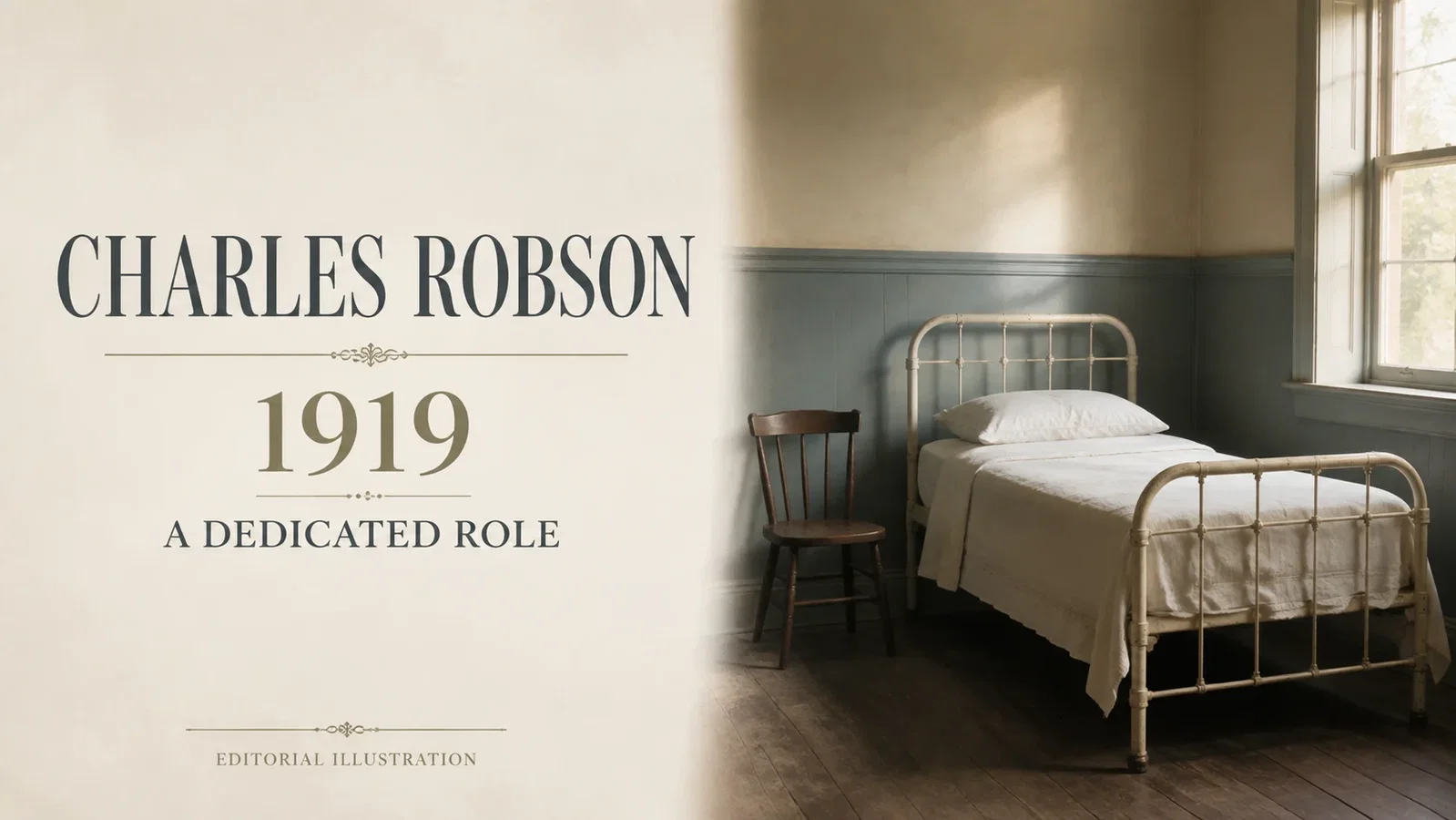
A dedicated post in 1919, with institutional boundaries still changing.
Reading Library · Anesthesia Epochs · 中文版
Watch the companion film
1919: Charles Robson at SickKids · Watch on YouTube
Historical anchor: 1919. Date details and source qualifications are explained below.
The most useful document for the end of Charles Harold Robson's tenure is a short notice, not an obituary. In July 1951, the Canadian Anaesthetists' Society announced that C. I. Junkin had succeeded him as chief at Toronto's Hospital for Sick Children. Robson, the notice added, was becoming an active consultant. It dated his appointment as chief to 1919.[1]
That distinction matters. He left a position of leadership, not necessarily the hospital. It also offers a way to read his earlier career: a job title does not, by itself, describe how an entire service worked.
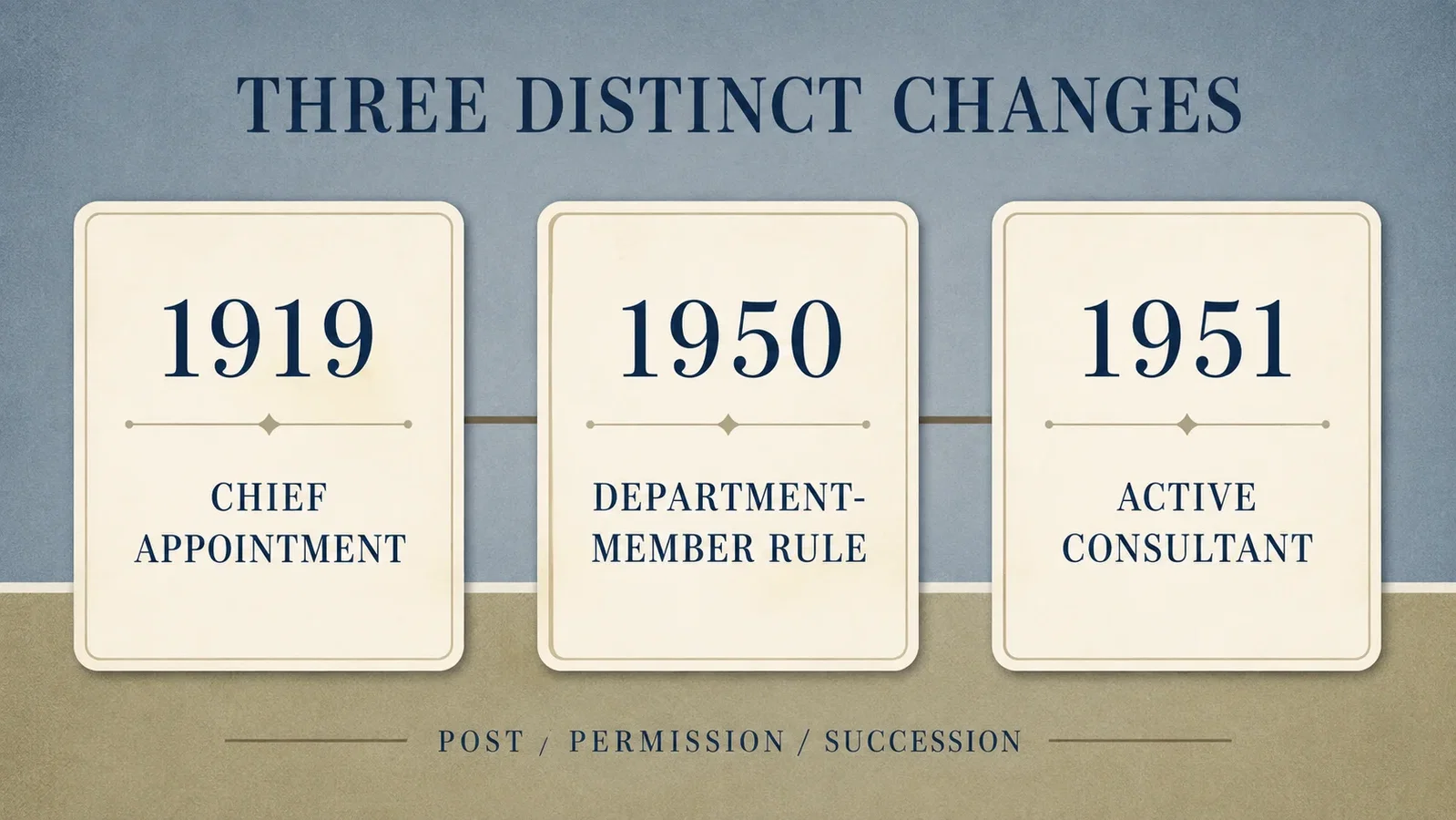
A post, a staffing rule and a succession
A. W. Conn's biography describes Robson as the hospital's sole full-time anesthetist while other doctors could still anesthetize their own private, fee-paying patients. Only in 1950, Conn reported, was administration restricted to members of the anesthesia department.[2]
Three dates therefore describe three different events. Robson became chief in 1919; a restriction on who could administer anesthesia followed in 1950; another chief succeeded him in 1951. The later arrangements should not be projected back onto the year of his appointment.[1,2]
The contemporary notice is valuable corroboration of that appointment's starting year. It is not the original 1919 appointment letter, however, and supplies neither an exact starting day nor evidence of international priority.[1]

What “full-time” leaves out
Conn also recorded work at other hospitals and difficulties with remuneration. Robson's professional commitment to anesthesia did not mean exclusive employment at SickKids, nor does the description establish that he personally administered every anesthetic there.[2]
The question of priority needs similar care. David Steward's 2012 vignette called him Toronto's first full-time pediatric anesthetist but treated Canadian priority as a possibility. Steward's 2015 historical summary used the more modest description of an early dedicated practitioner in Canada.[3,4]
These accounts justify attention to Robson without turning him into the world's first person to anesthetize a child. They also illustrate why several citations should not automatically be counted as several independent confirmations: Steward's vignette cites Conn, and the two Steward publications share an author.
An earlier paper seen through a later one
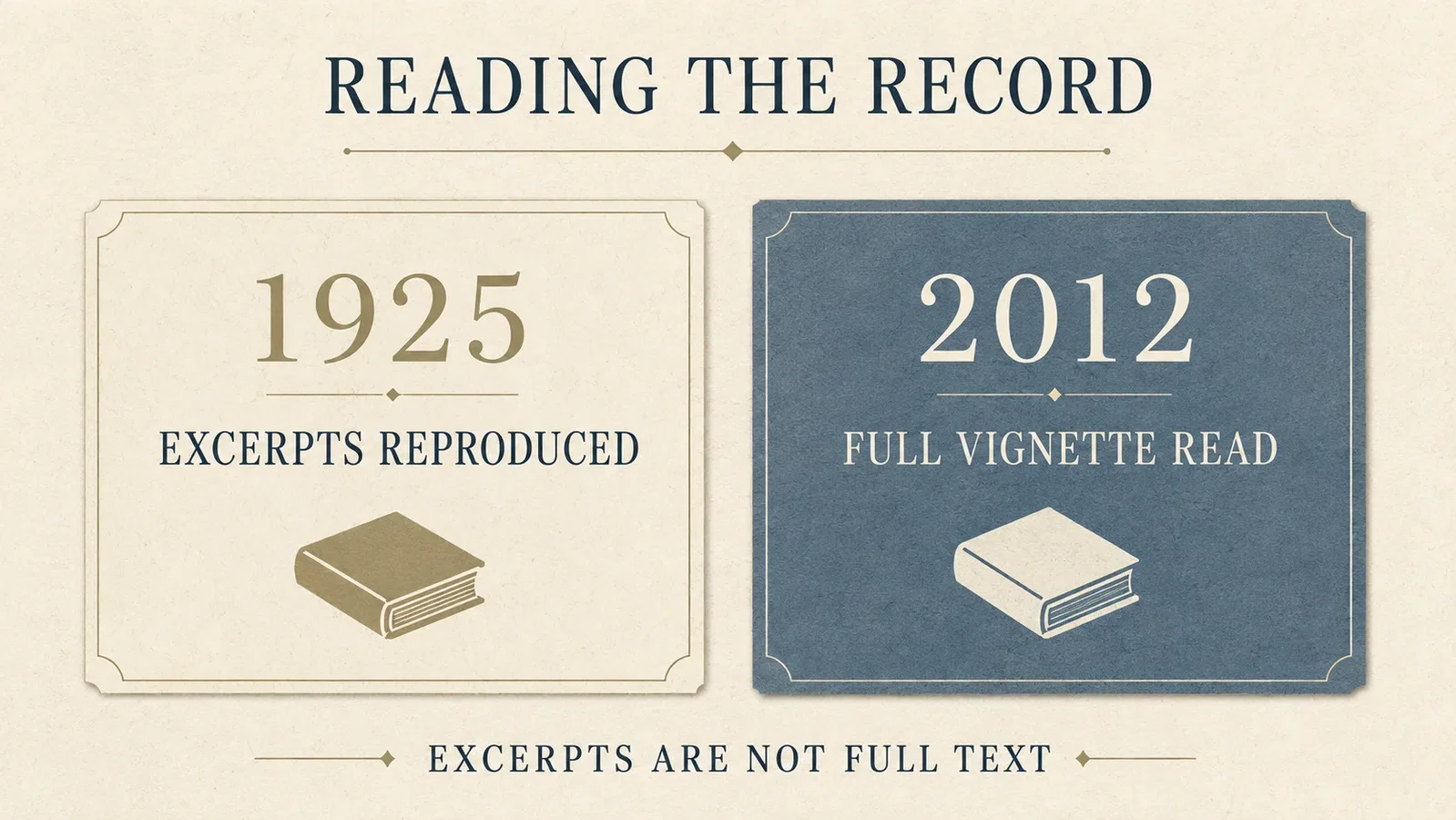
The 2012 vignette reproduces the opening of a 1925 paper and quotes Robson's opposition to operating on conscious newborns without anesthesia. It also discusses his concern for the airway and his use of fingers to guide an intratracheal catheter.[3]
These are attributed descriptions from a later, fully read source. Steward's complete three-page vignette was obtained and read for this article, not the complete six-page 1925 paper. Its reproduced opening and quotations do not replace examination of the entire earlier contribution.
Nor does an insightful observation validate everything around it. Steward's account includes obsolete practices and beliefs alongside Robson's attention to children. Those details are not current instructions. In particular, “digital” catheter insertion meant guidance by touch, not electronic equipment.[3]
Training was not the same as authorization
There is a specific comparison with this site's World War I article. Conn records Robson's role in establishing military anesthesia training in Britain. Harris's historical study describes a different pathway: Australian nurses trained and worked as anesthetists, yet encountered restrictions on continuing that work.[2,5]
At SickKids, the contrast ran in another direction. A dedicated specialist existed before anesthesia provision was restricted to departmental members.[2] Together, the records distinguish acquiring a skill, occupying a specialized post and receiving institutional permission to provide care.
This is an editorial comparison, not evidence that Robson trained those nurses, that the institutions shared a policy, or that war necessarily caused his appointment. The site's link between the two articles is therefore undirected, not a claim of transmission or causation.
Reading a source does not remove its defects
Conn's opening paragraph places Robson's Toronto work before World War I, although the same page later describes his arrival in 1919. It also calls a 1936 contribution his only known paper; Steward reproduces an opening from 1925.[2,3] Neither problematic statement is adopted here, and the printed war number has not been silently changed.
Robson's career is significant without those embellishments. The institutional story is one of a sustained specialist role developing within a service whose boundaries were still changing. Steward's later summary places him among a wider group of dedicated pediatric practitioners, alongside continued participation by general practitioners.[4] These historical accounts and appointment records do not quantify a survival benefit attributable to his post.
Image note: All four images are AI-generated modern editorial illustrations or graphics. Ward interiors, furniture, cards and symbols are not authenticated hospital reconstructions, artifacts, archival facsimiles or patient photographs. No image demonstrates a clinical procedure. This is medical history, not present-day pediatric anesthesia, fasting or airway guidance.
Sources and reading limits
- Canadian Anaesthetists' Society. News Letter. July 1951;1(4):10. Original newsletter. Eleven-page issue; cover and appointment notice on page 10 read. This is a 1951 report of the earlier tenure, not the 1919 appointment letter.
- Conn AW. History of Canadian Anaesthesia: Dr. C. H. Robson (1884–1969). Canadian Journal of Anaesthesia. 1990;37(5):579. Publisher PDF. Complete single page and scan read; chronology and publication-list problems are discussed above.
- Steward DJ. Historical vignette: Dr Charles Robson; Pioneer Canadian Pediatric Anesthetist. Pediatric Anesthesia. 2012;22:275–277. DOI:10.1111/j.1460-9592.2011.03724.x; PMID:22023512. Three-page journal PDF mirror. Entire article, figures, captions and references read; publisher access failed. The 1925 paper is known here only through reproduced extracts, not a separately read full text.
- Steward DJ. The history of pediatric anesthesia in Canada (a summary). Anesthesia News. 2015;30(3):15. Society newsletter. Complete one-page history read in an archived 19-page issue, not the entire issue. Same author as source 3.
- Harris K. ‘Giving the dope’: Australian Army Nurse Anaesthetists during World War I. Journal of Military and Veterans' Health. 2013;21(3):45–50. Journal reprint. All six pages previously read for the WWI article; pages 45–46 read for this comparison.
Continue exploring
Related reading connects shared questions and contexts; it does not by itself establish historical influence.
The Source Room · About & Editorial Method
Sources and reading limits are stated above. Illustrations are labelled as original source images or AI-made. Historical accounts are educational; they are not current treatment instructions.