Terrell, Speers Croix and the constraints of anesthetic development.
Reading Library · Anesthesia Epochs · 中文版
Watch the companion film
1965: Isoflurane — From Synthesis to Screening · Watch on YouTube
Historical anchor: 1965. Approximate placement; see the essay for the date range and evidence.
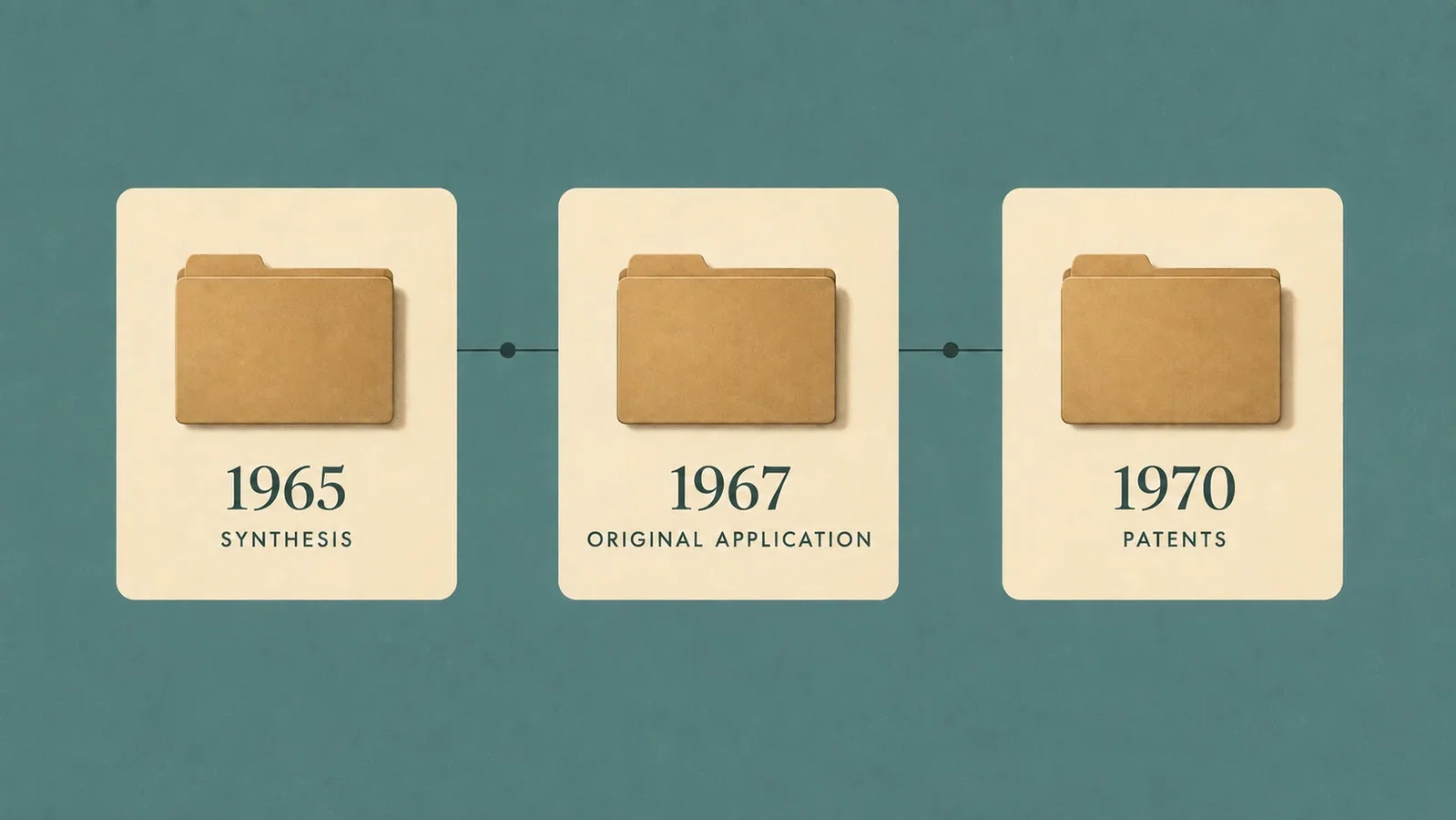
The two patents make a useful starting point. Both were dated October 20, 1970, named Ross C. Terrell, and described the compound associated with isoflurane. Their application histories reach back to December 15, 1967.[4,5] Neither date should silently replace 1965 on a history of synthesis. They document different stages of the work.

The 1965 dating comes from historical accounts. Ball and Westhorpe, writing from the Geoffrey Kaye Museum, place isoflurane’s synthesis in that year. The anesthesia timeline maintained by Hamamatsu University School of Medicine gives the same year.[2,3] These records support a year-level milestone; they do not supply a dated laboratory notebook or establish a day of clinical introduction.
To understand the research behind that milestone, we can turn to Terrell’s own retrospective. He recalls a project begun around 1960 at Ohio Medical Products, intended to produce a volatile anesthetic that could at least match halothane. The company assigned two senior chemists: Louise Speers Croix and Terrell.[1] Her contribution belongs in the account. Speers also appears among the authors of the 1971 chemistry paper, whose publication record was checked for this article.[6]
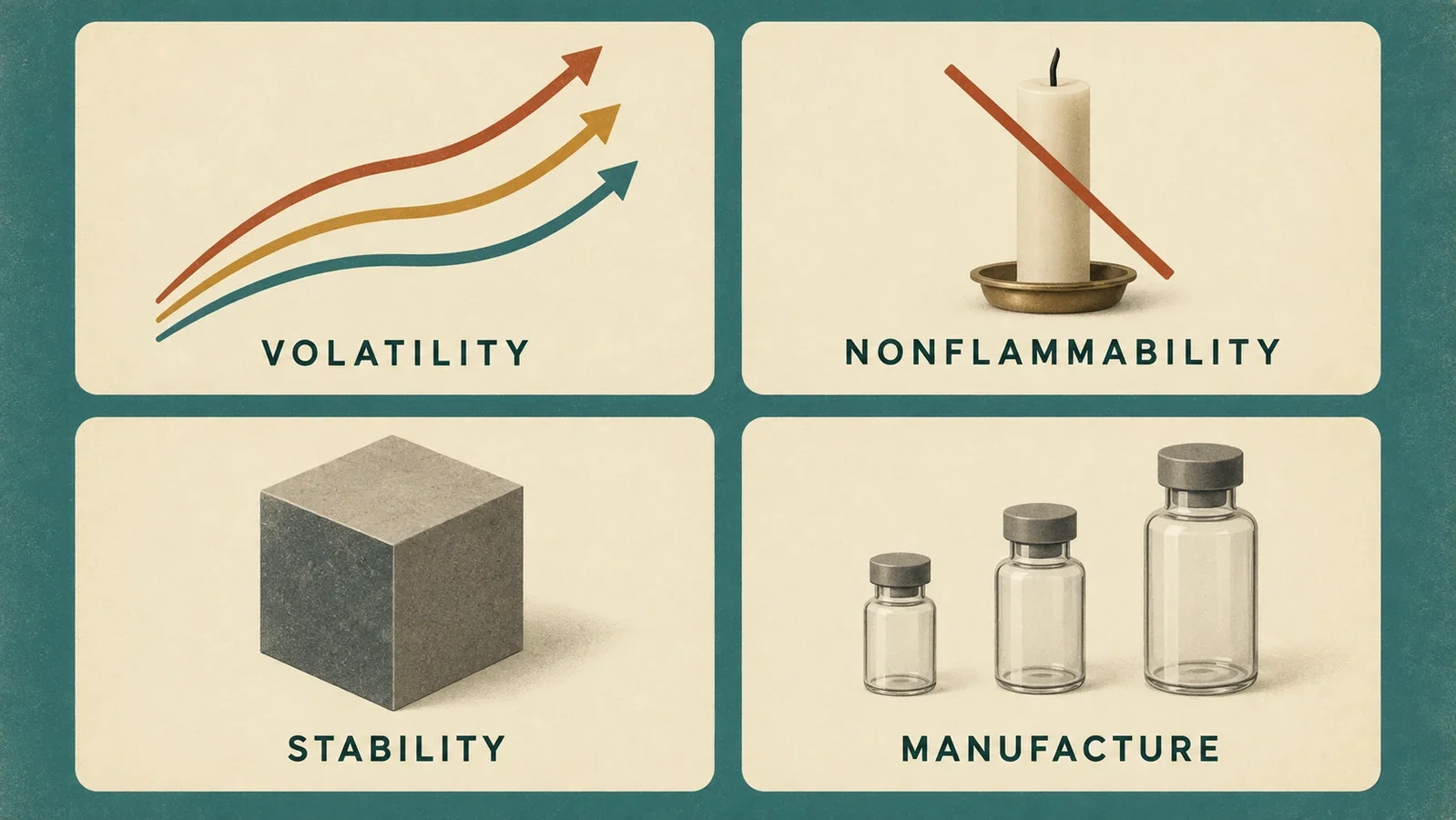
Terrell describes four practical constraints: volatility, nonflammability, stability (particularly with soda lime), and production in substantial quantities at an acceptable cost.[1] Meeting one requirement did not remove the others. Nor could a promising structural formula settle the pharmacology. In his account, structure–activity patterns offered clues but could not reliably identify a good anesthetic in advance. Screening remained essential.
Halothane supplies a concrete connection to another article in this history. Johnstone’s 1956 clinical paper begins by discussing its nonflammability, while Terrell later names the drug as the benchmark for the new project.[1,7] Reading the two accounts together connects an agent already entering clinical practice with the aims of subsequent chemical research. It does not show that Johnstone personally directed the isoflurane program, or establish a comparative safety advantage for either drug.
The patents add a contemporary documentary layer. They identify the compound and discuss its anesthetic use; the later filing also includes a human surgical case alongside animal observations.[4,5] Those are meaningful records of investigation. They are not equivalent to a controlled clinical evaluation, and the applicant’s favorable descriptions should not become an unqualified safety claim in a modern history.
This distinction also limits what can be said about 1965. Synthesis, animal testing, a human case, a patent application and wider clinical use are separate events. A source documenting one cannot automatically date all the others. The article therefore follows isoflurane’s emergence as a research candidate, without making 1965 stand for clinical approval or routine use.

Keeping the collaboration and the stages visible changes the story. Isoflurane becomes the result of sustained chemical selection under demanding practical conditions. Its place on the timeline marks a candidate worth carrying forward, with the work of clinical evaluation still requiring its own evidence.
Source and image note: Terrell’s complete retrospective was read in publisher HTML, together with the extracted historical note, the relevant university timeline entry, and selected original patent pages including their corrections. The original 1971 chemistry paper is not covered; it is cited only for verified metadata. Chemical procedures, anesthetic doses and questionable numerical properties in the patents are not reproduced. All four images are modern editorial interpretations, not archival scenes or operating instructions.
Sources and reading limits
- Terrell RC. The invention and development of enflurane, isoflurane, sevoflurane, and desflurane. Anesthesiology. 2008;108(3):531–533. DOI/full text. Participant retrospective; full publisher HTML read, including 14 references. David S. Warner is the section editor.
- Ball C, Westhorpe RN. Isoflurane. Anaesthesia and Intensive Care. 2007;35(4):467. Historical cover note. Full extracted text read; raw PDF not covered. Used for the 1965 historical dating, not as an original laboratory record.
- Hamamatsu University School of Medicine, Department of Anesthesiology and Resuscitology. Anesthesia virtual museum: historical timeline. The 1965 row lists isoflurane synthesis and R. C. Terrell. Institutional historical catalog, accessed September 15, 2026.
- Terrell RC. US3535388: 1-chloro-2,2,2-trifluoroethyl difluoromethyl ether. Patent dated October 20, 1970; original application December 15, 1967. PDF pp. 1, 3 and 4 read, including the June 22, 1971 certificate of correction; not a clinical trial report.
- Terrell RC. US3535425: 1-chloro-2,2,2-trifluoroethyl difluoromethyl ether as an anesthetic agent. Patent dated October 20, 1970; continuation-in-part filed December 18, 1969. PDF pp. 1, 3, 4 and 5 read, including the June 1, 1971 correction. Contains animal observations and one human surgical case; neither is a comparative safety trial.
- Terrell RC, Speers L, Szur AJ, Treadwell J, Ucciardi TR. General anesthetics. 1. Halogenated methyl ethyl ethers as anesthetic agents. Journal of Medicinal Chemistry. 1971;14(6):517–519. DOI; PubMed 5091966. Metadata checked; original full text not covered. The abstract reprinted with reference 1 is not a new 2008 experiment.
- Johnstone M. The human cardiovascular response to Fluothane anaesthesia. British Journal of Anaesthesia. 1956;28:392–410. DOI. First page (392) of an archived copy read; the remaining 18 pages were not read.
Continue exploring
Related reading connects shared questions and contexts; it does not by itself establish historical influence.
- 1956: Johnstone's Halothane, a Nonflammable Agent Still Needing Measurement
- 1972: Enflurane's FDA Approval and an Unfinished Clinical Story
- 1990: Sevoflurane Moves from Approval to Launch in Japan
- 1992: Desflurane Enters the US Approval Record
The Source Room · About & Editorial Method
Sources and reading limits are stated above. Illustrations are labelled as original source images or AI-made. Historical accounts are educational; they are not current treatment instructions.