NDA 020118: development history and a dated regulatory archive.
Reading Library · Anesthesia Epochs · 中文版
Watch the companion film
1992: Desflurane — FDA Approval of Suprane · Watch on YouTube
Historical anchor: 1992. Date details and source qualifications are explained below.
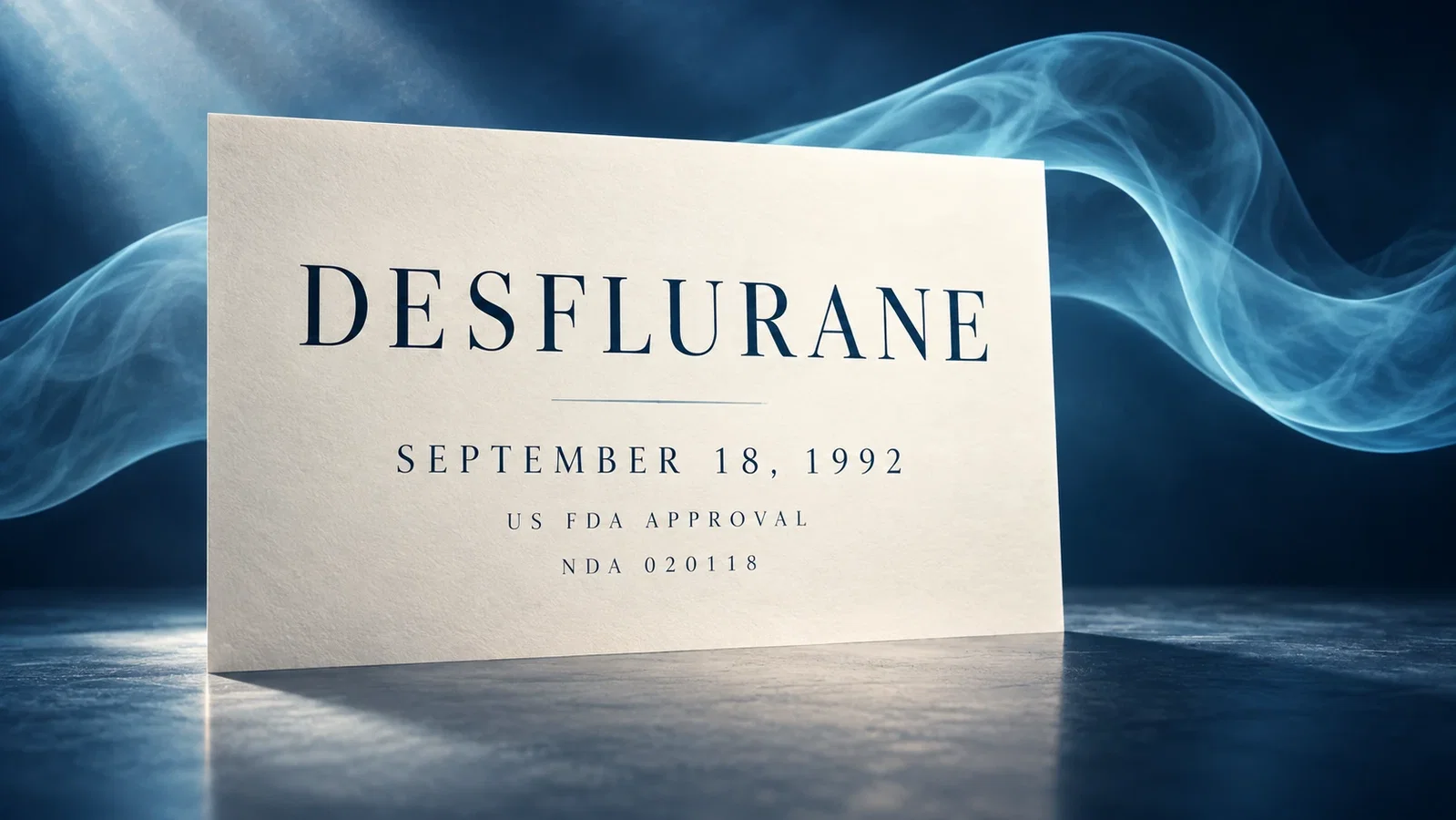
On September 18, 1992, the FDA approved Suprane, whose active ingredient is desflurane. Drugs@FDA lists the action as the original approval of NDA 020118 and classifies it as a new molecular entity.[1, Original Approvals] The date anchors a US regulatory decision. It does not date the compound’s synthesis or replace an account of its development.
In his 2008 retrospective, chemist Ross C. Terrell placed desflurane within the Ohio Medical Products research program. Around 1960, he and Louise Speers Croix began searching for new inhaled anesthetics. Over the next ten to fifteen years, the team synthesized several hundred fluorinated compounds. Enflurane, isoflurane, sevoflurane and desflurane appear in that shared account.[2, project origins and candidates] This is a participant’s later recollection, rather than a contemporary laboratory record.

Terrell described four requirements: volatility, nonflammability, stability, particularly with soda lime, and economical manufacture at scale.[2, four development requirements] An anesthetic candidate therefore faced practical tests beyond producing anesthesia. The shared program supports this article’s relationship with the isoflurane synthesis article; it does not establish that isoflurane directly caused the 1992 approval.
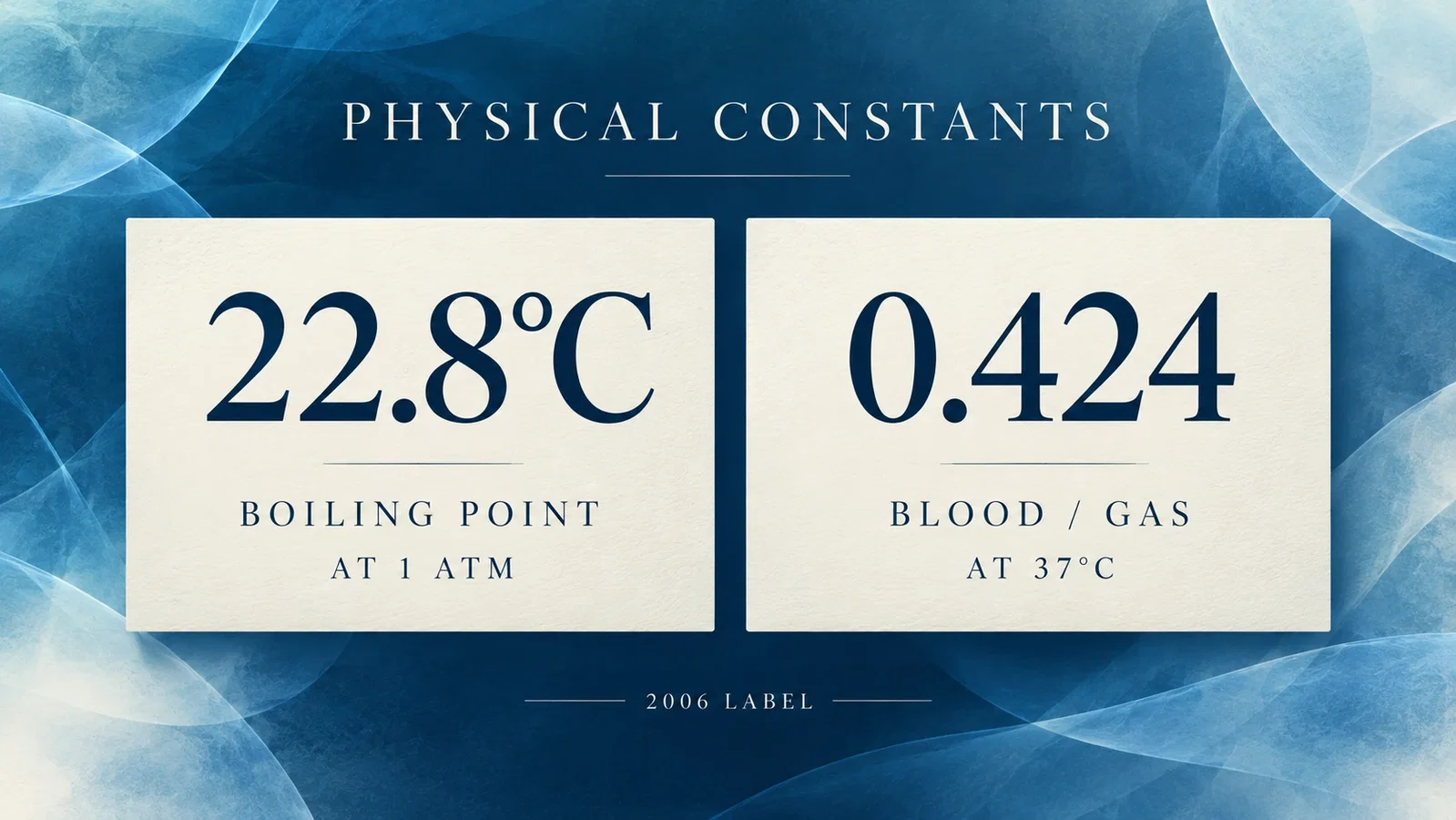
The FDA’s archived 2006 S010 label gives a boiling point of 22.8°C at one atmosphere and a blood/gas partition coefficient of 0.424 at 37°C. It also specifies a vaporizer designed and designated for desflurane.[3, printed pp 3, 15] Physical properties and delivery equipment both mattered. These statements belong to a later label, not an original 1992 document acquired for this account.
Recovery outcomes need separate reading. The 2006 label distinguishes eye opening, stating one’s name and fitness for discharge. Some early recovery measures differed in its summarized comparisons, while fitness for discharge did not show a statistically significant difference.[3, printed pp 6–7] That does not establish earlier discharge for every patient. The underlying trial reports are not covered here.
Stability also has conditions. Alongside its discussion of chemical stability, the label warns that desflurane can react with dried carbon dioxide absorbents to produce carbon monoxide.[3, printed pp 4, 16] A development criterion cannot be extended into a guarantee of nonreactivity under every circuit condition or of overall safety.
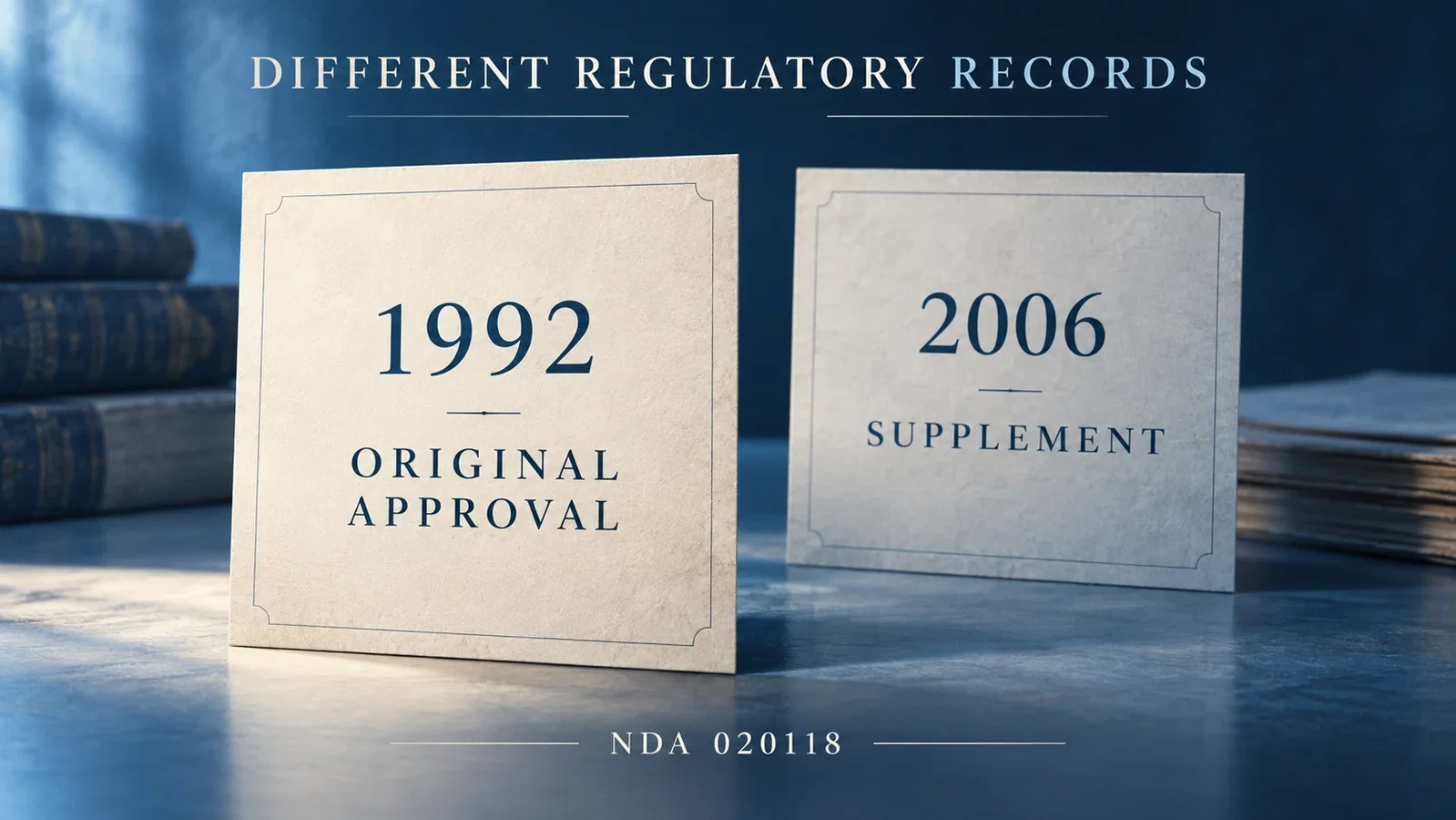
The regulatory record continued after initial approval. The S012 supplement letter signed on December 15, 2006 concerned the inclusion of data in children aged 2–16 in response to a pediatric written request.[4, pp 1, 3] It documents a later update, not the original 1992 indications. The database category “new patient population” alone does not establish approval for every pediatric anesthetic use.
The November 2022 label’s first page still identifies 1992 as the year of initial US approval.[5, p 1] That agrees with the registry year, but the documents serve different purposes: the registry dates an action, a label presents a particular version of product information, and a supplement letter records a specified change. The original 1992 label and signed approval letter remain outside the acquired source set.
This article therefore rests on a verifiable approval date and two historical strands: the shared development of fluorinated anesthetics and an evolving regulatory archive.[1–5] The first describes the candidate’s origins; the second records specific decisions and revisions. The 1992 entry supplies a firm chronological anchor, while later evidence must still be read on its own terms.
Images are modern editorial concepts, not original packaging, signed documents or clinical equipment photographs.
Sources and reading limits
- FDA. Drugs@FDA: NDA 020118, Suprane. Official approval history, ORIG-1, September 18, 1992. Full visible registry page read. Original 1992 label not available on the page; no original 1992 signed letter acquired.
- Terrell RC. The Invention and Development of Enflurane, Isoflurane, Sevoflurane, and Desflurane. Anesthesiology. 2008;108(3):531–533. PMID 18292690. Full archived publisher-visible text reread; participant retrospective, not a contemporaneous laboratory notebook. David S. Warner is the section editor.
- FDA. Suprane S010 label, archived with the May 8, 2006 action. Twelve selected pages read: printed pp 3, 4, 6, 7, 12, 13, 14, 15, 16, 19, 21, 23. Clinical comparisons are label summaries; underlying trial articles not read.
- FDA. NDA 20-118/S012 supplementary approval letter. Electronically signed December 15, 2006. All three pages read. Its referenced label enclosure is not identified here as the earlier S010 label.
- FDA. Suprane S026 label. Revised November 2022. Only the first page read from the acquired 36-page PDF; used to cross-check the initial approval year.
Source limits: the FDA registry, labels and supplement letter share a regulatory lineage and are not independent clinical validations. This account reconstructs no original bottle label, approval ceremony or vaporizer mechanism, and supplies no dosing instructions. Historical labeling is interpreted by version, rather than used as current clinical guidance.
Continue exploring
Related reading connects shared questions and contexts; it does not by itself establish historical influence.
The Source Room · About & Editorial Method
Sources and reading limits are stated above. Illustrations are labelled as original source images or AI-made. Historical accounts are educational; they are not current treatment instructions.