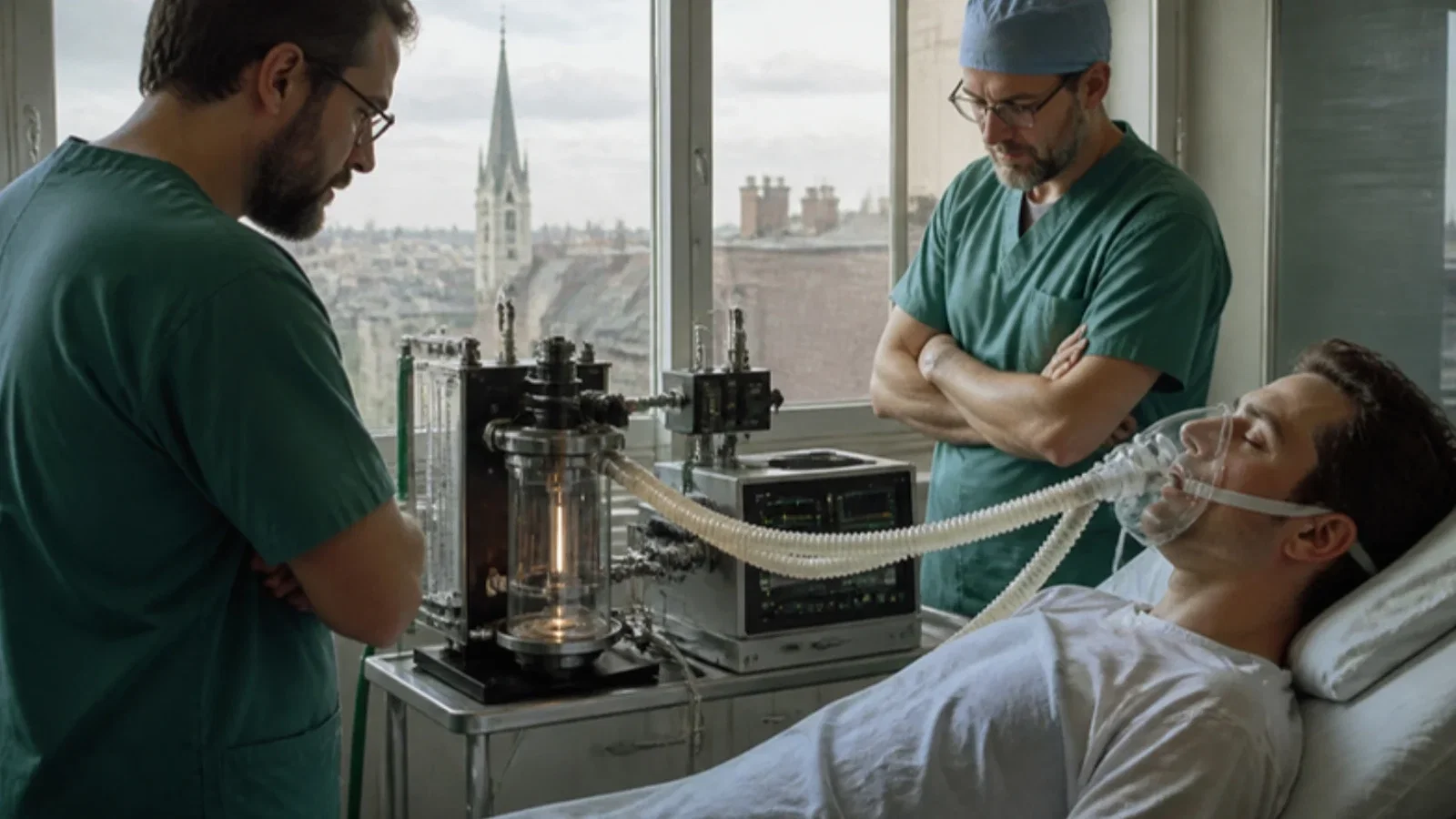
The British Journal of Anaesthesia for January 1990 (vol. 64) printed a paper by R. M. Jones, J. N. Cashman and T. G. K. Mant of the Department of Anaesthetics, Guy's Hospital, London, accepted on 19 June 1989. Desflurane (I-653), a fluorinated methyl ethyl ether, had exceptionally low solubility and appeared non-toxic in animals. 'In the first study in man', the authors wrote, ten healthy unpremedicated young male volunteers breathed sub-anaesthetic or anaesthetic concentrations: there was no coughing, breath-holding, salivation or other untoward respiratory response; minute volume and alveolar ventilation fell and rate rose; arterial pressure fell while heart rate stayed the same; the volunteers found the odour neither irritating nor unpleasant; and recovery after about 90 minutes was rapid and clear-headed. Heijke and Smith's editorial in the same issue called it 'an account of the first administration to humans' of I-653 or desflurane, noted its relatively brief gestation between laboratory and clinic, praised its very rapid induction and emergence, and warned that its high volatility and expense made closed circuits and special vaporisers essential.
Reading Library · Anesthesia Epochs · 中文版
Watch the education video (for clinicians)
1990: Desflurane (I-653) in Volunteers — Guy's Hospital, London · Anesthesia Epochs Education Series
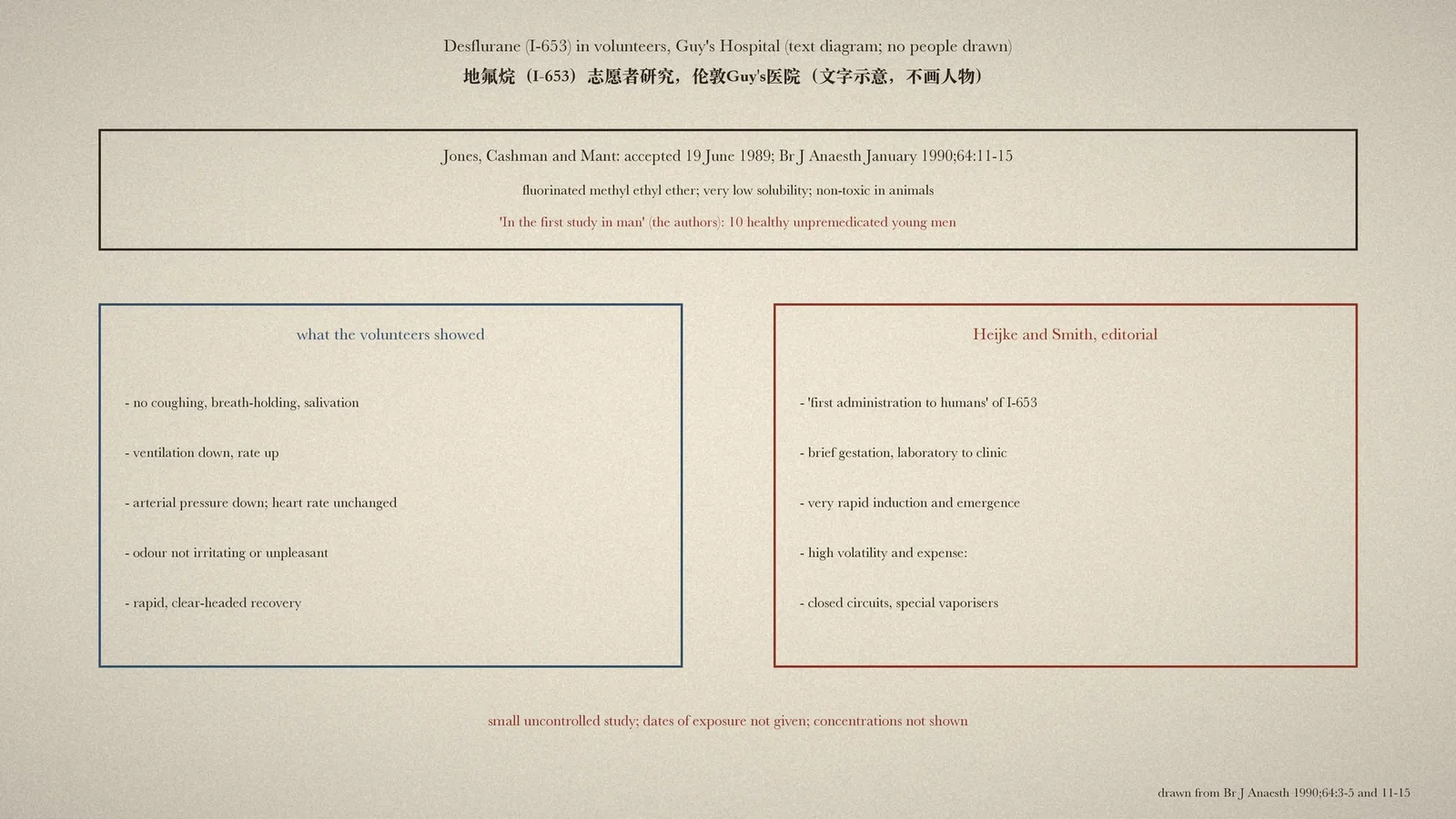
A new inhaled anaesthetic is first judged by how it feels to breathe and how quickly people wake from it. In January 1990 the British Journal of Anaesthesia printed a report on ten young men at Guy's Hospital in London who breathed a compound still called I-653. The same issue carried an editorial that weighed its promise against its cost. [1, p. 11][1, p. 3]
The editorial
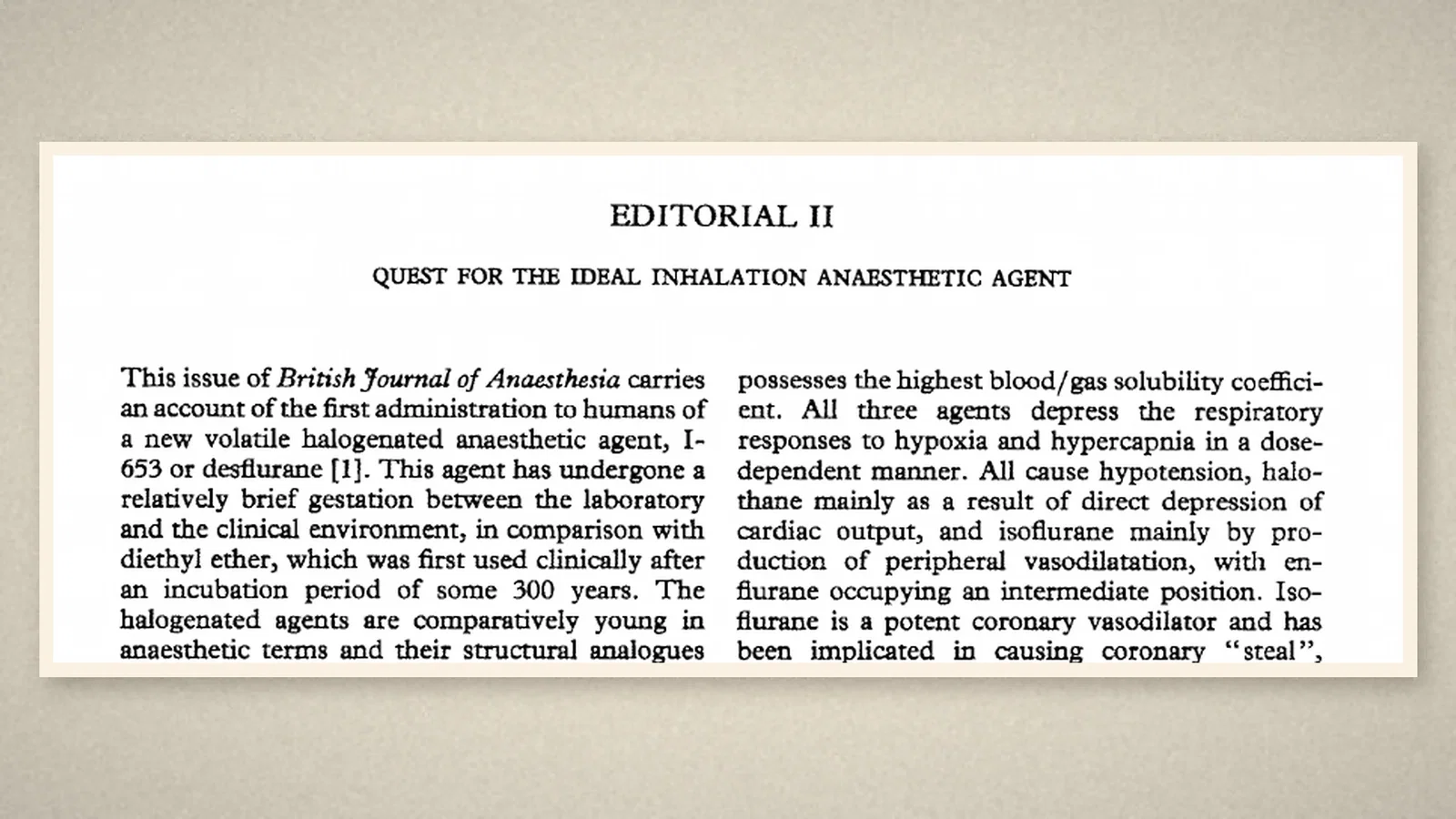
The editorial, by S. Heijke and G. Smith, was titled "Quest for the ideal inhalation anaesthetic agent". It opened by saying that "this issue of British Journal of Anaesthesia carries an account of the first administration to humans" of a new volatile halogenated agent, "I-653 or desflurane". The agent had undergone "a relatively brief gestation between the laboratory and the clinical environment". By contrast, diethyl ether "was first used clinically after an incubation period of some 300 years". [1, p. 3]
The editorial went on to list the properties an ideal agent should have. It should be cheap to make and stable, non-flammable, potent and poorly soluble in blood, pleasant to inhale, and free of important effects on the heart, lungs and organs. It then set out where halothane, enflurane, isoflurane and the newer sevoflurane each fell short. [1, p. 3]
The volunteers
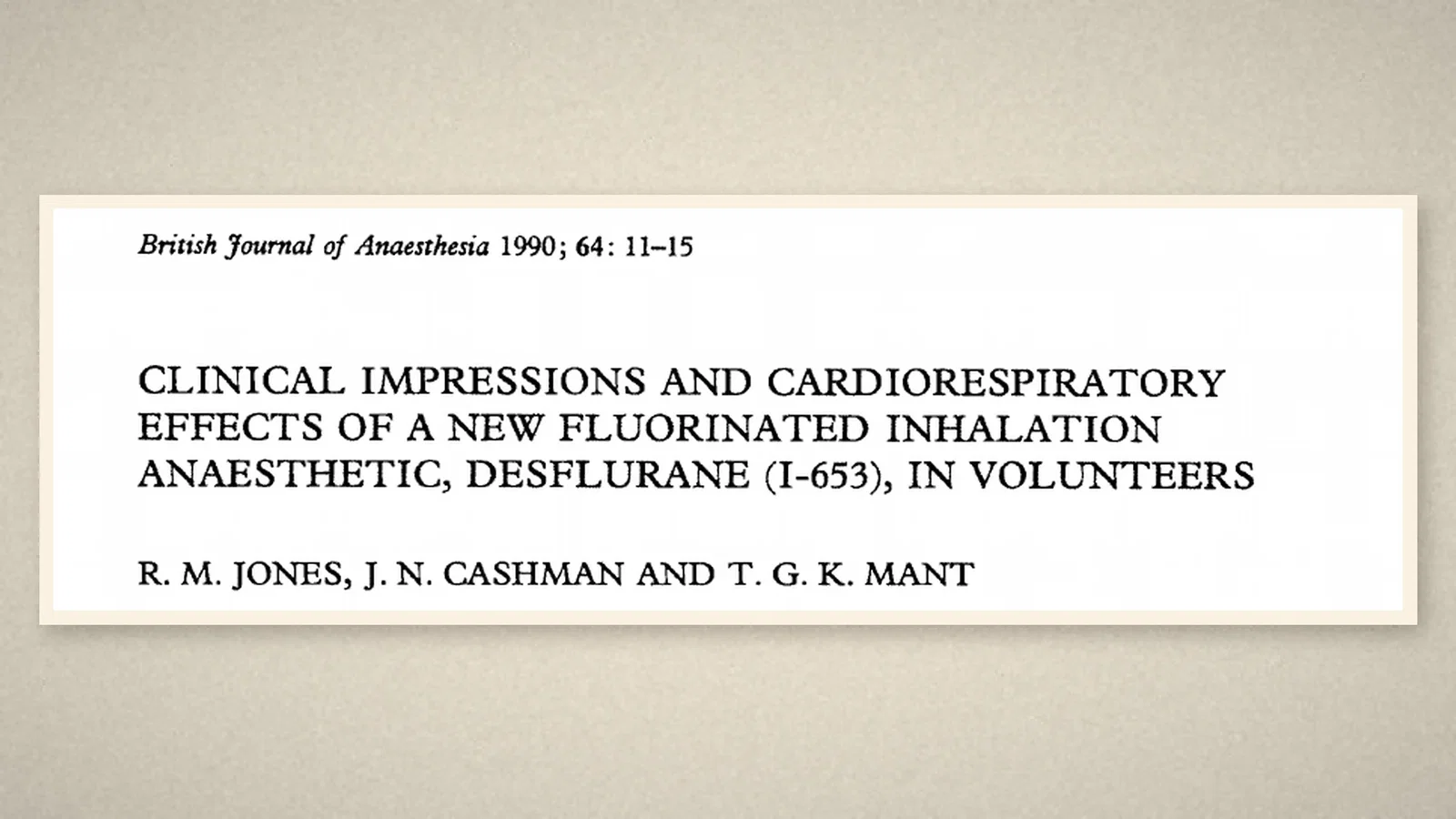
The paper, by R. M. Jones, J. N. Cashman and T. G. K. Mant of the Department of Anaesthetics at Guy's Hospital, was accepted on 19 June 1989. [1, p. 11] Desflurane, they wrote, "is a fluorinated methyl ethyl ether". Its very low solubility and its stability suggested it might be useful and safe, and studies in animals indicated that "the compound is non-toxic". [1, p. 11]
"In the first study in man, we have exposed volunteers to desflurane", the authors wrote, to examine its effects on the heart and breathing and how acceptable it was to inhale. The gas was "administered to 10 healthy, unpremedicated young male volunteers". Each volunteer was screened in detail and admitted to Guy's the day before. Half began at a sub-anaesthetic level and half at an anaesthetic level, and the level was changed after 30 minutes. [1, p. 11][1, p. 12]
All the volunteers completed the trial. The first half hour "was tolerated well by all subjects and there was no breath-holding, coughing" or other problem. [1, p. 12] Over the whole exposure, breathing volume fell and rate rose. Arterial pressure fell, more for diastolic than for systolic pressure, while heart rate stayed the same. The rhythm did not change except for one extra beat in one volunteer. The men "stated that the odour of desflurane was not irritating or unpleasant". After about an hour and a half, recovery was "rapid and clear-headed". [1, p. 11]
Promise and cost
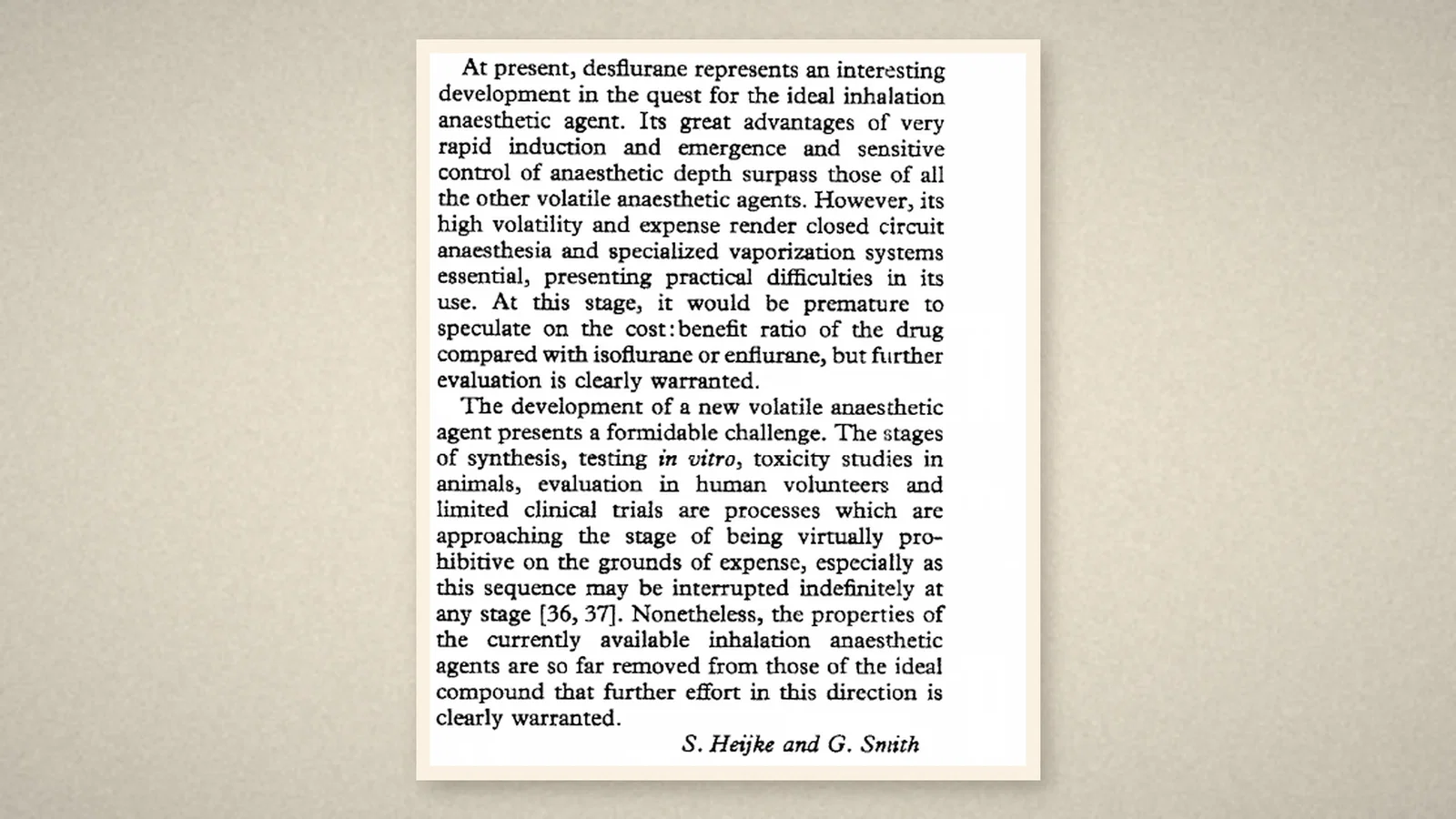
The editorial ended on balance. Desflurane was "an interesting development in the quest for the ideal inhalation anaesthetic agent". Its "great advantages of very rapid induction and emergence and sensitive control of anaesthetic depth" surpassed those of all other volatile agents. But its "high volatility and expense render closed circuit anaesthesia and specialized vaporization systems essential". It was too early to judge the cost against isoflurane or enflurane, though further evaluation was "clearly warranted". [1, p. 5]
The editorial's authors also noted the growing cost of the path itself. Synthesis, laboratory testing, animal toxicity, volunteer studies and limited trials were "approaching the stage of being virtually prohibitive on the grounds of expense". [1, p. 5]
What the record shows
The human data on desflurane read here came from ten healthy men breathing it through a mask. They did not cough, their hearts did not race, and they woke quickly and clearly. The same issue already named the difficulty that would follow the drug: a vapour so volatile that it needed its own kind of vaporiser.
Sources and reading limits
Read: British Journal of Anaesthesia 1990;64, no. 1. This covered Heijke and Smith's editorial (pp. 3-5) and Jones, Cashman and Mant (pp. 11-15): the summary, introduction, methods and results were read and the discussion skimmed.
Not covered: the chemistry and animal studies of I-653; the companion papers on desflurane in the same issue; any record of the first trials, which some timelines date to 1987; and approval records.
Limits: some timelines date the first clinical trials to 1987. The paper read here was accepted in June 1989 and does not give the dates of the exposures. "First study in man" is the authors' phrase, and "first administration to humans" is the editorial's. The study is small and uncontrolled. Concentrations, potency values and physiological figures are not repeated, and page crops stop before them. Volunteers are not identified.
Three illustrations are crops of the 1990 issue (pp. 3, 11 and 5). One is a text diagram drawn from it, with no people drawn and no concentrations shown.
- Heijke S, Smith G. Quest for the ideal inhalation anaesthetic agent. Br J Anaesth. 1990;64:3-6; Jones RM, Cashman JN, Mant TGK. Clinical impressions and cardiorespiratory effects of a new fluorinated inhalation anaesthetic, desflurane (I-653), in volunteers. Br J Anaesth. 1990;64:11-5. Internet Archive
Continue exploring
Related reading connects shared questions and contexts; it does not by itself establish historical influence.
- 1960: The Cleveland Clinic Reports Methoxyflurane in 206 Patients
- 1951: Suckling Designs Halothane at ICI
- 1992: Desflurane Enters the US Approval Record
Anesthesia Epochs · The Source Room · About & Editorial Method
Published November 3, 2026. Sources and reading limits are stated above. Illustrations are labelled as original source images or AI-made. Historical accounts are educational; they are not current treatment instructions.