In the Proceedings of the Society for Experimental Biology and Medicine for November 1930, Chauncey D. Leake and Mei-Yu Chen of the Pharmacological Laboratory, University of California Medical School, reasoned that compounds combining the chemistry of diethyl ether and ethylene should be interesting general anaesthetics, and that the lower members of a series of unsaturated ethers should be better than the higher. With small samples from Vienna and Princeton, tested in mice, only divinyl ether anaesthetised and let the animals recover faster than ether, without irritation. In JAMA of 6 January 1934 Leake recalled that pure divinyl oxide did not exist when the prediction was made, that Major and Ruigh at Merck later made it, that Gelfan and Bell at Alberta showed its safety for man, and that it was used in surgery at the University of California Hospital with Dorothy Wood as anaesthetist; it was not ideal, being explosive, costly and unstable. In the same issue Goldschmidt and colleagues at Pennsylvania reported 461 patients, with satisfactory results, and liver necrosis in dogs.
Reading Library · Anesthesia Epochs · 中文版
Watch the education video (for clinicians)
1930: Divinyl Ether — Prediction Is a Beginning · Anesthesia Epochs Education Series
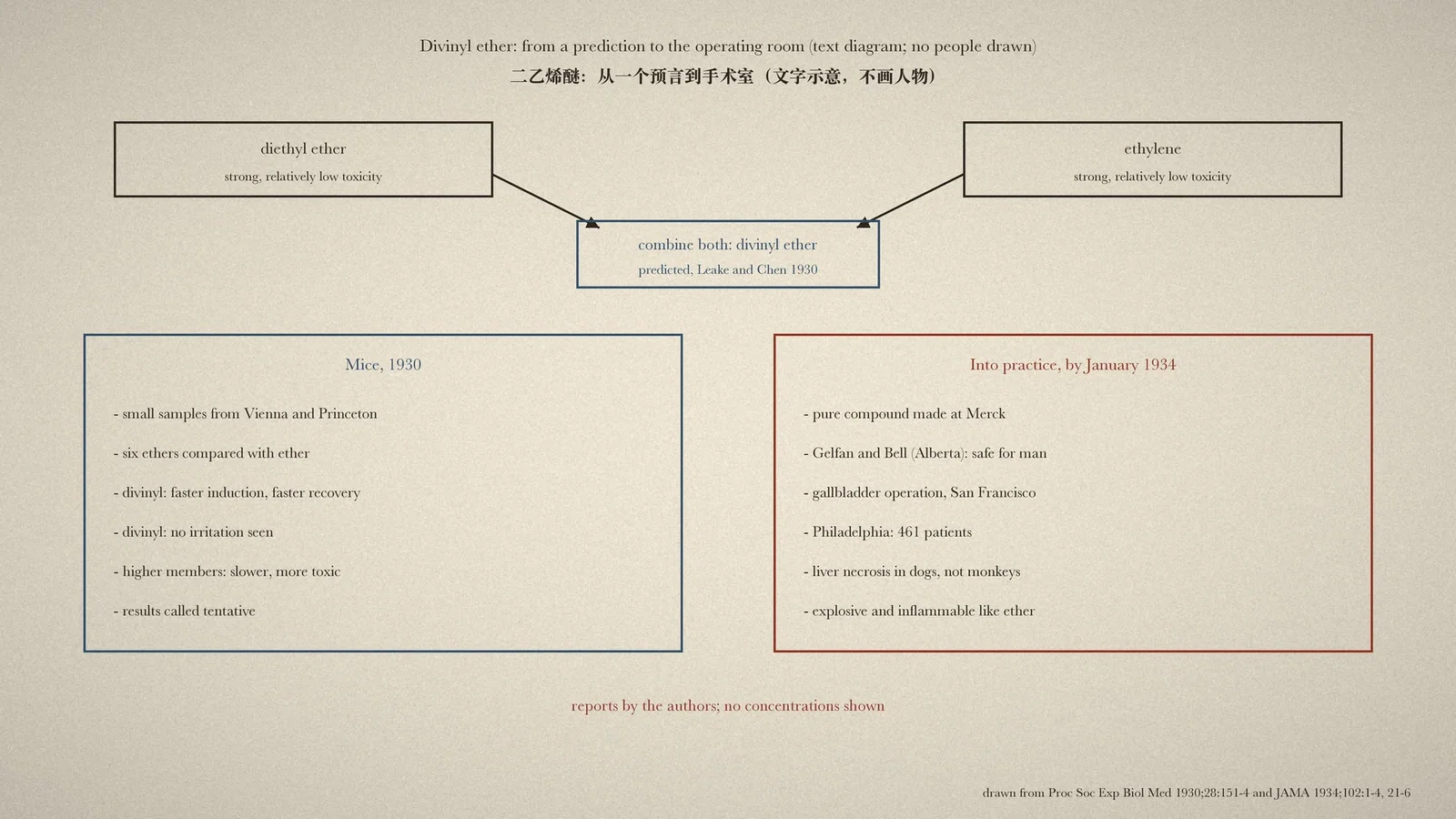
Divinyl ether was reasoned out on paper before anyone had a pure sample of it. A four-page paper of 1930 argued from the structure of two known anaesthetics to a third compound that hardly existed yet, tested the idea in mice with whatever small samples could be had, and invited others to carry on. Within a little over three years the compound was being given to hundreds of patients. [1, p. 151][1, p. 154][3, p. 21]
A prediction
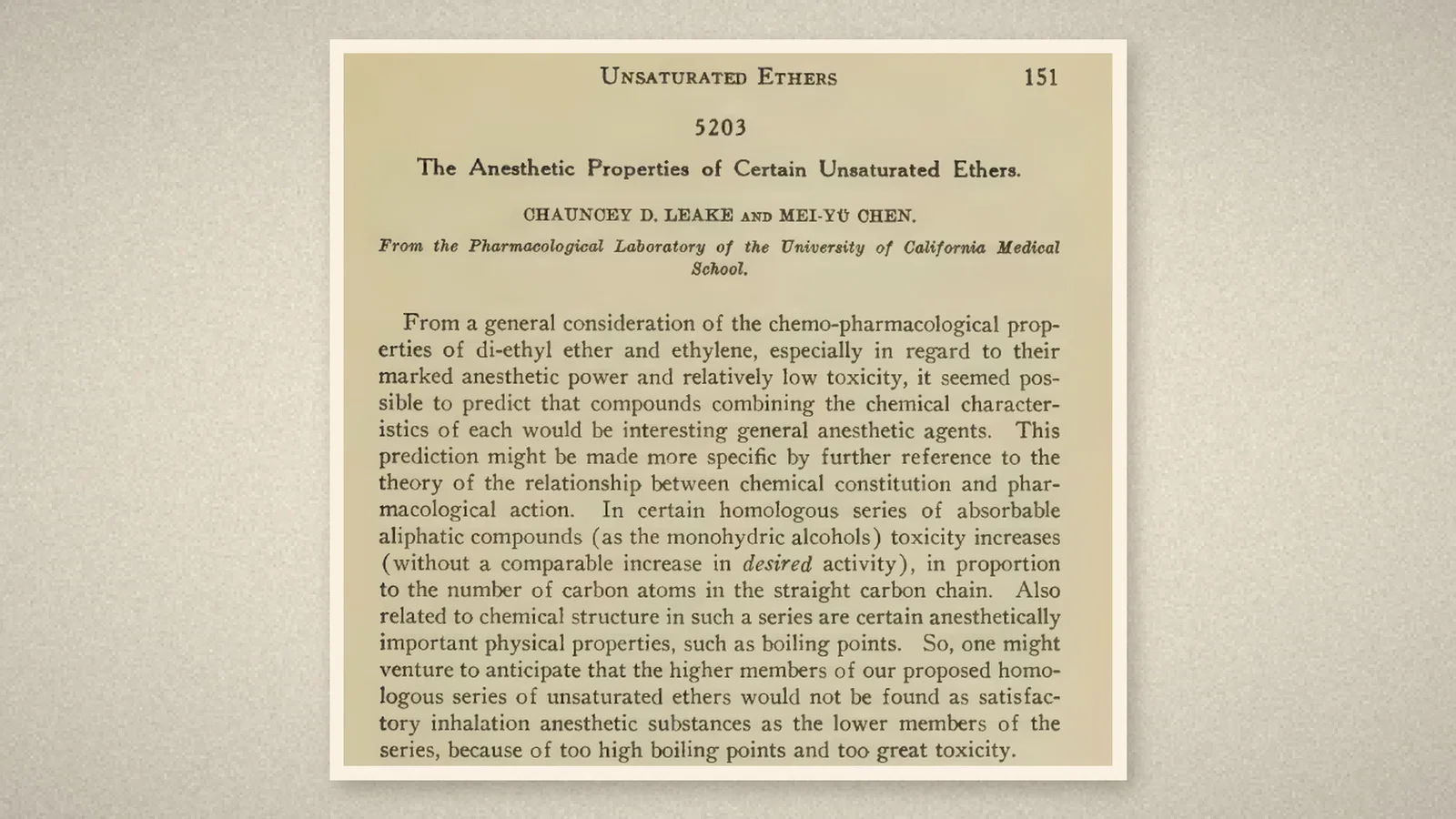
"The Anesthetic Properties of Certain Unsaturated Ethers" by Chauncey D. Leake and Mei-Yu Chen, of the Pharmacological Laboratory of the University of California Medical School, appeared in the Proceedings of the Society for Experimental Biology and Medicine for November 1930. It opens with an argument rather than an experiment. Diethyl ether and ethylene were both strong anaesthetics with relatively low toxicity, so "compounds combining the chemical characteristics of each would be interesting general anesthetic agents". And since, in such chemical series, toxicity and boiling point rise as the carbon chain grows, the smaller members of a series of unsaturated ethers should make better inhalation agents than the larger. [1, p. 151]
A few samples and some mice
The compounds were hard to get. Leake and Chen obtained some from Professor Sigmund Fraenkel in Vienna and others, divinyl ether among them, from Doctor Randolph Major through Professor Lauder Jones of Princeton. Only small quantities came, so only tentative measurements were possible. The estimated oil-water partition coefficients suggested that divinyl ether "might be predicted to be the best" of the series. [1, p. 151][1, p. 152]
The authors then used mice "for economy of material", with ordinary ether as the standard at equal molecular concentrations. [1, p. 152]
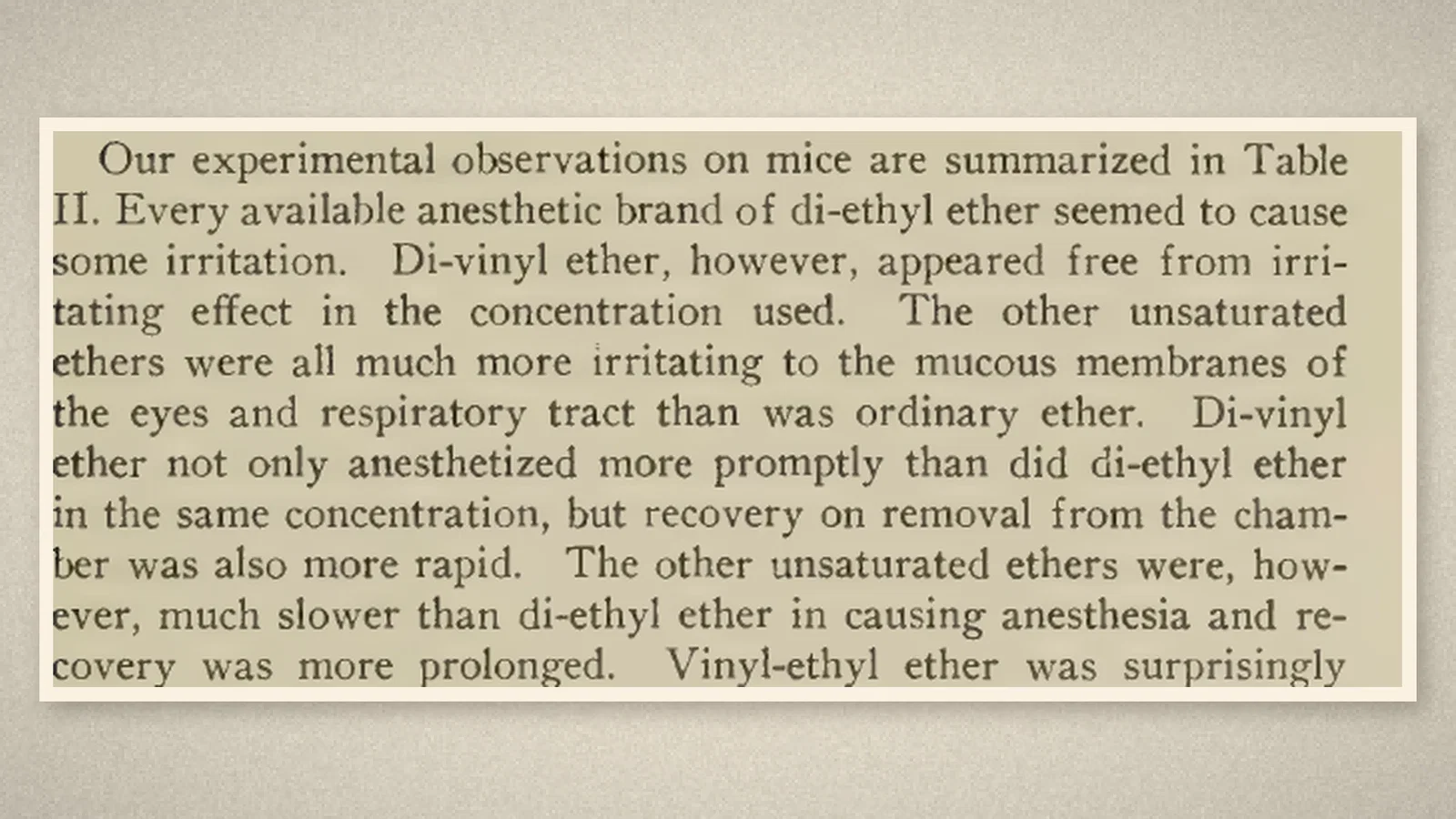
Every brand of anaesthetic ether caused some irritation. Divinyl ether "appeared free from irritating effect"; it put the mice to sleep more promptly than diethyl ether, and they recovered more quickly. The other unsaturated ethers were slower and more irritating, and the larger ones showed the greater toxicity the authors had expected. Apart from one compound that behaved oddly, the results matched the prediction, and further study "is justified and is cordially invited". [1, p. 153][1, p. 154]
From an impure sample to a pure compound
Three years later, in JAMA of 6 January 1934, Leake looked back in "The Role of Pharmacology in the Development of Ideal Anesthesia". When the prediction was made, divinyl oxide, "although theoretically known to chemists, did not exist". The sample from Princeton was impure but showed the predicted properties. Major and Ruigh, by then at the Laboratory of Pure Research of Merck & Co., made the pure compound and supplied enough for pharmacological study and then for clinical trial. [2, p. 2]
Pure divinyl oxide, Leake wrote, was explosive like ether and ethylene but more powerful and faster, less irritating, and recovery from it was quicker. Gelfan and Bell of the University of Alberta showed its safety in anaesthetic concentrations for man. Then, in Leake's words, came its "first surgical use", with Dr. Dorothy Wood as anaesthetist at the University of California Hospital, San Francisco: the removal of a gallbladder from an obese patient, where its practical advantages "were clearly evident". [2, p. 2]
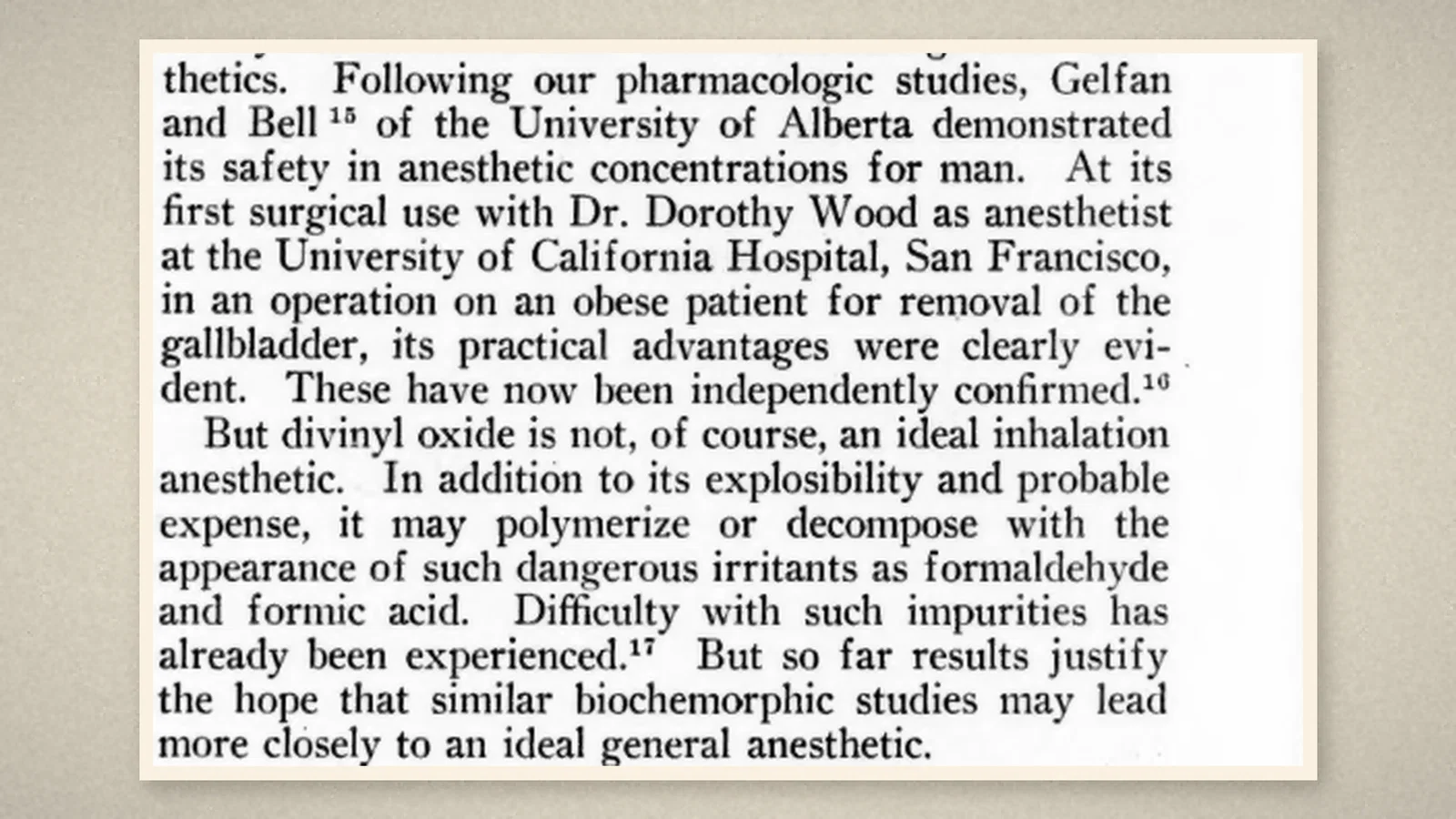
Leake did not oversell it. Divinyl oxide was "not, of course, an ideal inhalation anesthetic": it was explosive and probably costly, and it could polymerise or decompose into irritants such as formaldehyde and formic acid. Trouble with impurities had already occurred. [2, p. 2]
Four hundred and sixty-one patients
The same issue carried "Divinyl Ether: Experimental and Clinical Studies" by Samuel Goldschmidt, I. S. Ravdin and colleagues at the University of Pennsylvania, read in June 1933. The authors noted that it was "as explosive and inflammable as diethyl ether", and they gave it to no patient until their laboratory studies were complete. In all 461 patients were anaesthetised at the Hospital of the University of Pennsylvania, the first fifty by one of the authors and the rest by the hospital's nurse anaesthetists. [3, p. 21]
They summed up that induction, maintenance and recovery were "satisfactory". In dogs, under some conditions, divinyl ether could cause liver necrosis; in monkeys it did not. In people they saw no harm to liver or kidney, but they had kept it away from patients with biliary disease, and its place among the general anaesthetics would "have to await a more extensive clinical experience". [3, p. 25][3, p. 26]
What the record shows
An anaesthetic designed on paper before it was made in a flask. The 1930 argument is short and modest; the mouse data are tentative. Three years on, the compound had passed through a drug company, two university laboratories and hundreds of operations, and its own advocates were listing what was wrong with it: fire, decomposition and a liver question that the animal work had raised.
Sources and reading limits
Read: Chauncey D. Leake and Mei-Yu Chen, "The Anesthetic Properties of Certain Unsaturated Ethers", Proc Soc Exp Biol Med 1930;28:151-154, in full; C. D. Leake, "The Role of Pharmacology in the Development of Ideal Anesthesia", JAMA 6 January 1934, pp. 1-4, the section on divinyl oxide (p. 2) closely and the rest skimmed; Samuel Goldschmidt, I. S. Ravdin and colleagues, "Divinyl Ether: Experimental and Clinical Studies", same issue pp. 21-26, the opening and clinical method (p. 21) and the summary (pp. 25-26) closely, the animal and liver sections skimmed.
Not covered: Gelfan and Bell's own paper on divinyl oxide in man; the animal paper by Leake, Knoefel and Guedel; Ruigh and Major on the preparation of pure divinyl ether; any record of the clinical case that some histories link to Mary Botsford; a CSA history article beyond its title; the later use and decline of divinyl ether.
Limits: some histories link Mary Botsford to a clinical case in 1932, while the pages read name Dorothy Wood as anaesthetist at the surgical use Leake describes, without a date; neither a date nor a first is asserted here, and "first surgical use" is Leake's phrase. The mouse work used very small samples and the authors called it tentative. Concentrations, partition coefficients and boiling points are not repeated, and the page crops leave out the table and the figures. Patients are not identified.
Three illustrations are crops of the Proceedings of the Society for Experimental Biology and Medicine, November 1930 (pp. 151 and 153), and JAMA, 6 January 1934 (p. 2); one is a text diagram drawn from these papers, with no people drawn and no concentrations shown.
- Leake CD, Chen MY. The anesthetic properties of certain unsaturated ethers. Proc Soc Exp Biol Med. 1930;28:151-4. Internet Archive
- Leake CD. The role of pharmacology in the development of ideal anesthesia. JAMA. 1934;102(1):1-4. Internet Archive
- Goldschmidt S, Ravdin IS, Lucke B, Muller GP, Johnston CG, Ruigh WL. Divinyl ether: experimental and clinical studies. JAMA. 1934;102(1):21-6. Internet Archive
Continue exploring
Related reading connects shared questions and contexts; it does not by itself establish historical influence.
- 1923: Luckhardt and Carter Breathe Ethylene and Oxygen Themselves
- 1903: McCardie Presents Ethyl Chloride as a General Anaesthetic
- 1881–1882: Cyclopropane Enters the Record in Freund's Reports
Anesthesia Epochs · The Source Room · About & Editorial Method
Published November 3, 2026. Sources and reading limits are stated above. Illustrations are labelled as original source images or AI-made. Historical accounts are educational; they are not current treatment instructions.