
In the Lancet of April 1903 W. J. McCardie of Birmingham presented ethyl chloride, given from an Ormsby inhaler, as a quick and safe general anaesthetic for short operations, calling it a perfect anaesthetic for children's small operations.
Reading Library · Anesthesia Epochs · 中文版
Watch the education video (for clinicians)
1903: Ethyl Chloride — Convenient, but How Safe? · Anesthesia Epochs Education Series
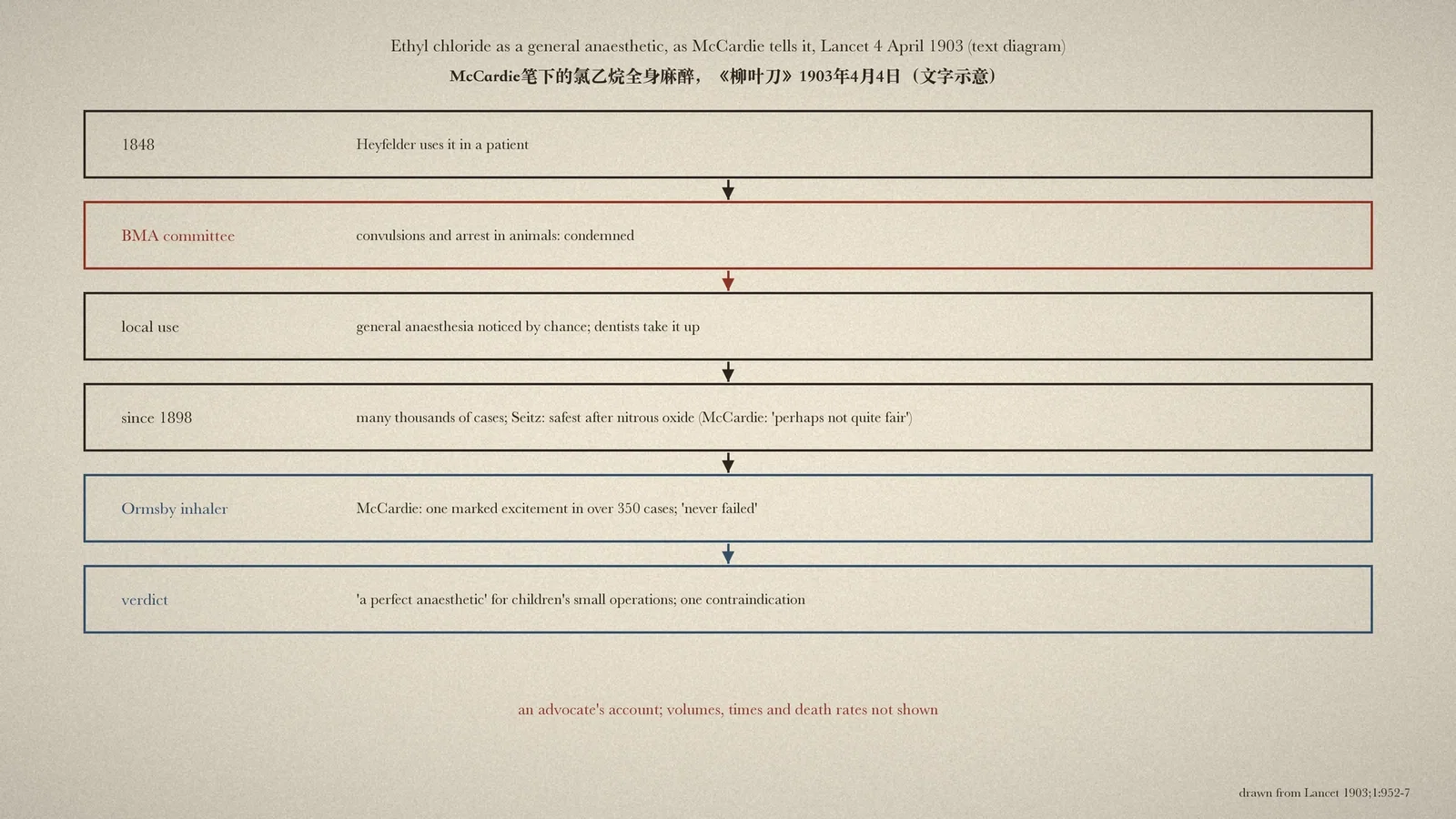
A drug condemned once by a committee came back by accident, through dentists, and by 1903 an English anaesthetist was calling it perfect for children. This paper records ethyl chloride at the height of its welcome, written by one of its advocates. [1, p. 952][1, p. 956]
The paper
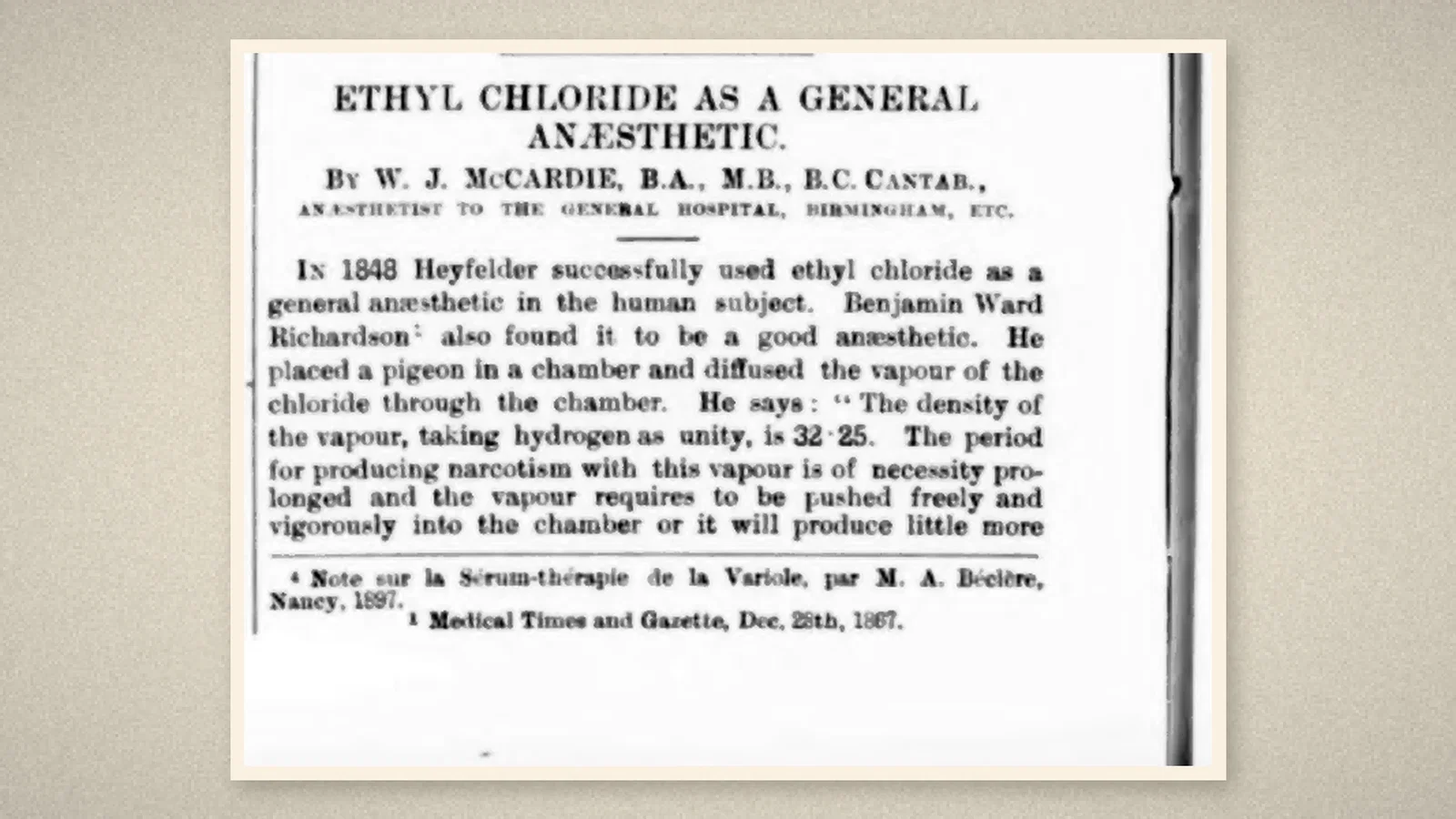
The Lancet of 4 April 1903, pp. 952-957, carried "Ethyl chloride as a general anaesthetic" by W. J. McCardie, "anaesthetist to the General Hospital, Birmingham". [1, p. 952]
A history, as McCardie tells it
"In 1848 Heyfelder successfully used ethyl chloride as a general anaesthetic in the human subject," McCardie began, and Benjamin Ward Richardson also found it good. But a committee of the British Medical Association, testing it on animals, found that it "quickly caused convulsions and stoppage of respiration", and its use was condemned. [1, p. 952][1, p. 953]
Little more was heard of it until Carlson and Thiesing noticed that local use of the drug sometimes produced general anaesthesia; Thiesing tried it in self-experiment and on others. Then Billeter and other dentists took it up as a general anaesthetic in dental work, and Lotheisen of Innsbruck tried it after reading that Soulier of Lyons had done so, although, McCardie notes, Soulier had actually used a different drug, ethylidene chloride. "Since 1898 ethyl chloride has been employed in many thousands of cases." [1, p. 953]
Seitz of Konstanz, for whom McCardie had collected the English cases, compared death rates and concluded that ethyl chloride was the safest anaesthetic "with the exception of nitrous oxide". McCardie added a caution of the author's own: it was "perhaps not quite fair" to compare a drug used some tens of thousands of times with drugs given hundreds of thousands of times. On the Continent, where nitrous oxide was little used and chloroform was the common anaesthetic, surgeons were always looking for a quickly acting drug whose effect passed off fast, "for short operations". [1, p. 953]
Why it seemed safe
Ethyl chloride is a colourless, aromatic, very volatile liquid that burns with a green flame. Because it is absorbed very quickly and eliminated almost as quickly, McCardie wrote, "this is a great point in favour of safety". The paper summarises the observations of others on breathing and blood pressure. Children, as a rule, took it well. [1, p. 953]
The inhaler
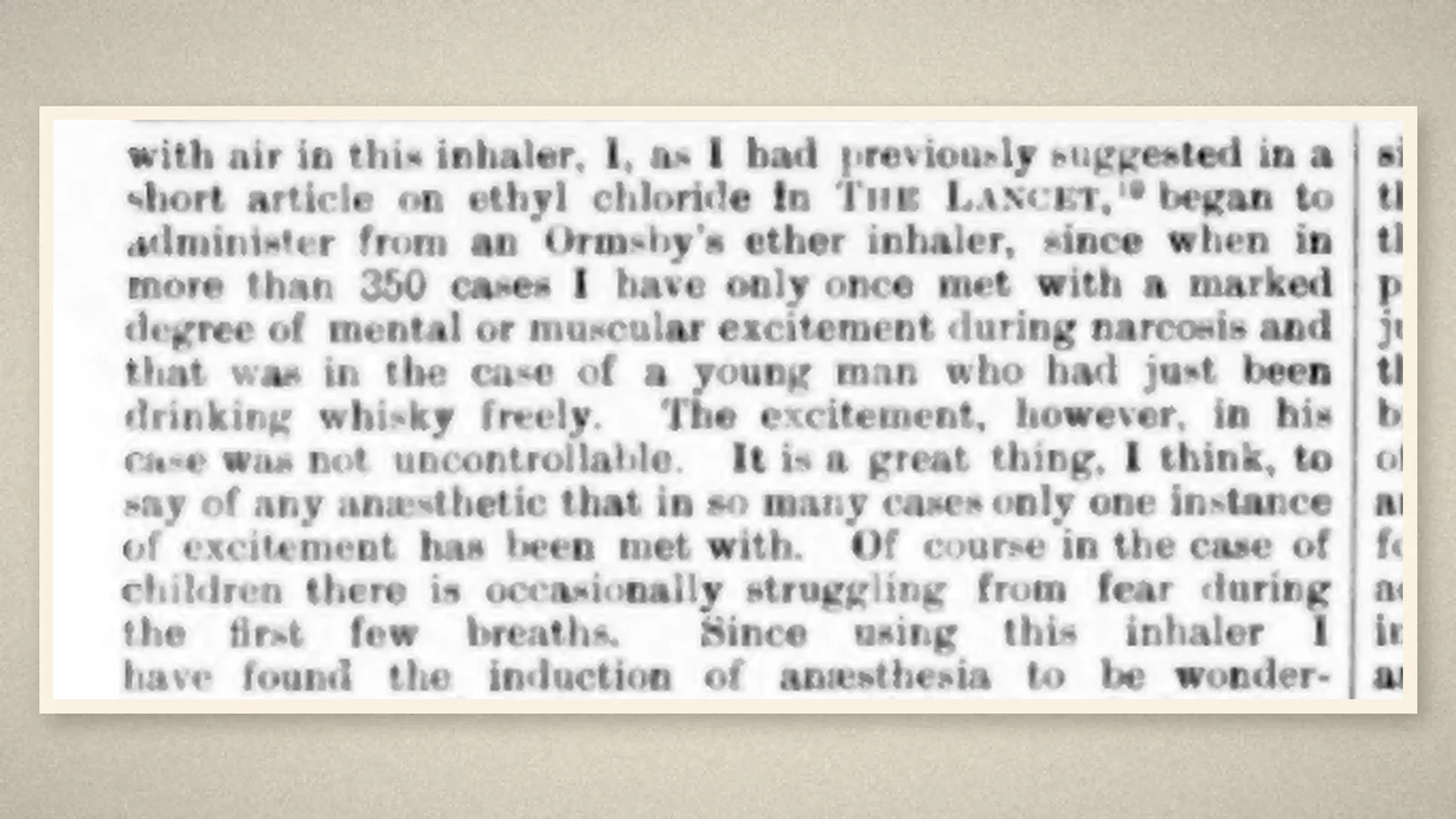
Excitement, McCardie found, depended on how completely air was shut out. After some excitement and a failure or two in early cases, McCardie changed to Ormsby's ether inhaler, and "in more than 350 cases I have only once met with a marked degree of mental or muscular excitement". "Since I have used Ormsby's inhaler I have never failed" to induce anaesthesia. Most of McCardie's cases were removals of adenoids and tonsils, and teeth; tables compared the times with those of nitrous oxide. [1, p. 954]
Several cases showed the drug's use where gas had failed or would be hazardous: a patient whom nitrous oxide could not keep under; a patient with a dental abscess and a narrowed airway; a patient with a blocked nose. In each, ethyl chloride gave a short, deep anaesthetic and a quick recovery. [1, p. 956]
One contraindication
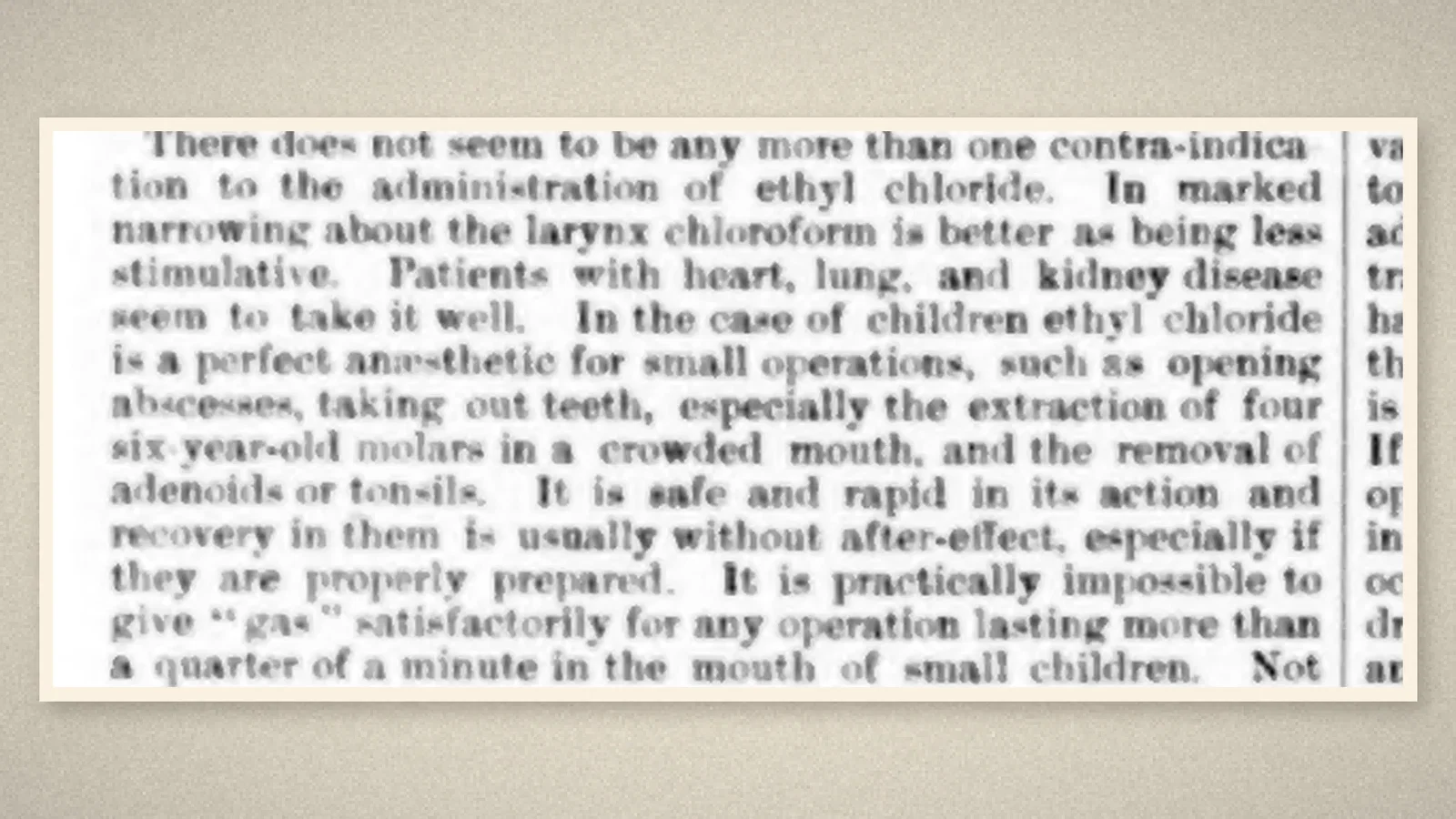
"There does not seem to be any more than one contra-indication": in marked narrowing about the larynx, chloroform was better because it was less stimulating. Patients with heart, lung and kidney disease seemed to take it well, and "in the case of children ethyl chloride is a perfect anaesthetic for small operations", such as opening abscesses, extracting teeth and removing adenoids or tonsils. If more time was needed, ether could be added to the same inhaler. The paper ends that ethyl chloride from an Ormsby inhaler was "an ideal anaesthetic for short operations in country practice". [1, p. 956][1, p. 957]
What the record shows
The rise of a drug in its own advocate's words. Its appeal is plain: it was fast, simple, portable and pleasant for children. So is the evidence: one anaesthetist's case counts, another's mortality statistics, and a warning in the author's own hand that the comparison was not quite fair. The later decline of ethyl chloride is not in these pages.
Sources and reading limits
Read: W. J. McCardie, "Ethyl chloride as a general anaesthetic", The Lancet, 4 April 1903, pp. 952–957.
Not covered: Heyfelder's report of 1848; Seitz's statistics; Lotheisen's papers; the British Medical Association committee's report; later reports of deaths under ethyl chloride and its decline. This is an advocate's account, and it shows only the rise of the drug; the history and safety statistics are as McCardie reports them, McCardie doubted the fairness of Seitz's comparison, and McCardie's own cases are counted without controls. Patients are not identified. Volumes, mortality ratios, times and doses are not repeated.
- McCardie WJ. Ethyl chloride as a general anaesthetic. Lancet. 1903;1(4153):952-7. Internet Archive
Continue exploring
Related reading connects shared questions and contexts; it does not by itself establish historical influence.
- 1904: Reclus Says Stovaine Will Replace Cocaine
- 1901: Takamine Reports Adrenalin, the Suprarenal Active Principle
- 1901: Rolland Mixes Three Halides into Somnoform
Anesthesia Epochs · The Source Room · About & Editorial Method
Published November 3, 2026. Sources and reading limits are stated above. Illustrations are labelled as original source images or AI-made. Historical accounts are educational; they are not current treatment instructions.