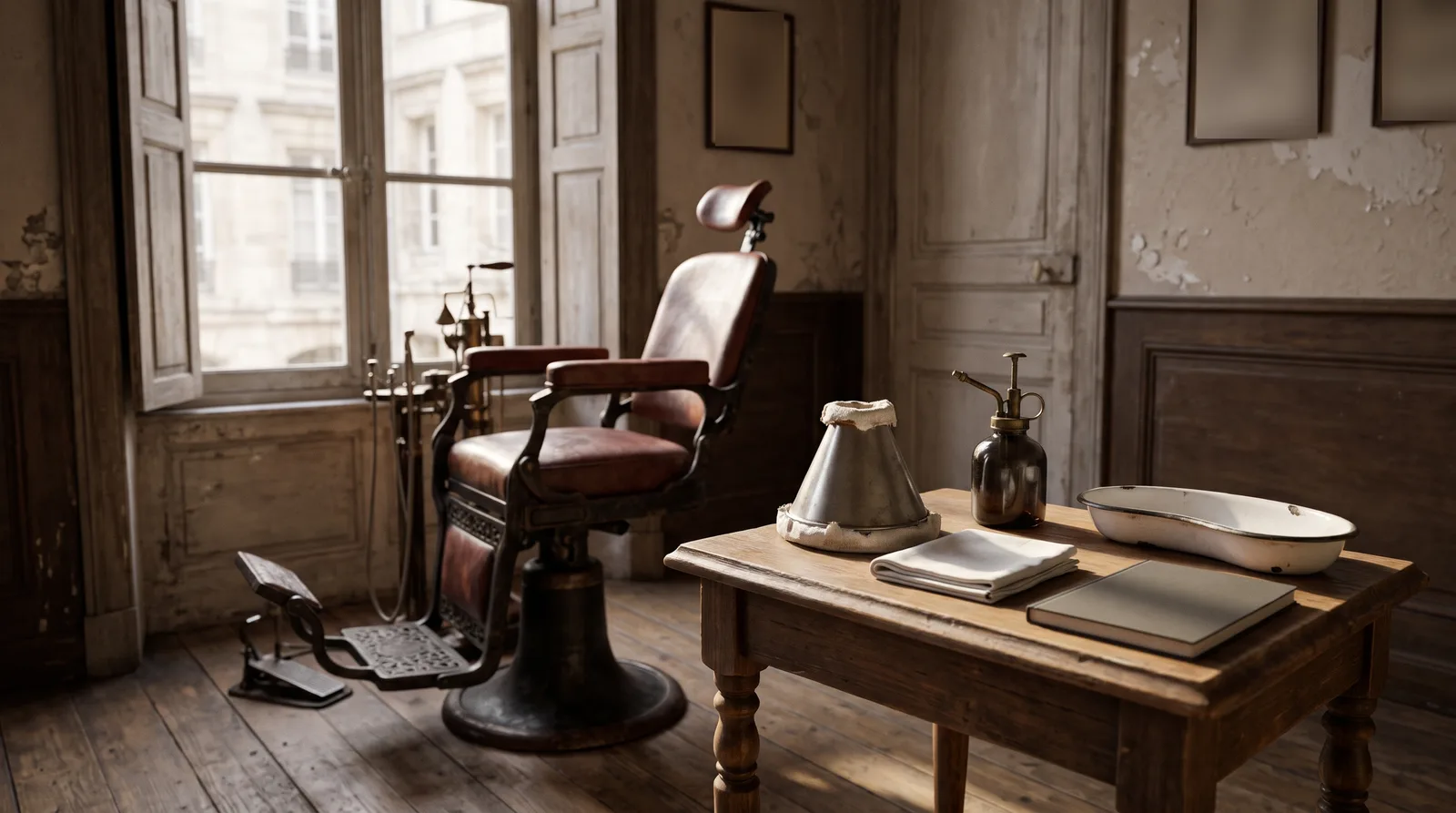
In 1901 Georges Rolland of the Bordeaux Dental School reported somnoform, an inhaled mixture of ethyl chloride, methyl chloride and ethyl bromide for short dental operations; in London in 1903 W. Foster Cross reported suffocation, struggling and unreliable relaxation, and found it to have few, if any, advantages over the ordinary anaesthetics.
Reading Library · Anesthesia Epochs · 中文版
Watch the education video (for clinicians)
1901: Somnoform — Composition, Delivery and a Safety Claim · Anesthesia Epochs Education Series
For short dental operations, one proposed alternative to nitrous oxide and chloroform, briefly fashionable in Europe and as far as Australia, was "somnoform", a mixture introduced by Georges Rolland of the Bordeaux Dental School. The Geoffrey Kaye Museum dates it to 1901 and holds an inhaler made for it by George Parrett, a dental graduate of the University of Melbourne. The main sources here are Rolland’s own ten-year report, published in 1910, and the discussion of somnoform at the Society of Anaesthetists in London in April 1903. [1][2][3]
The mixture
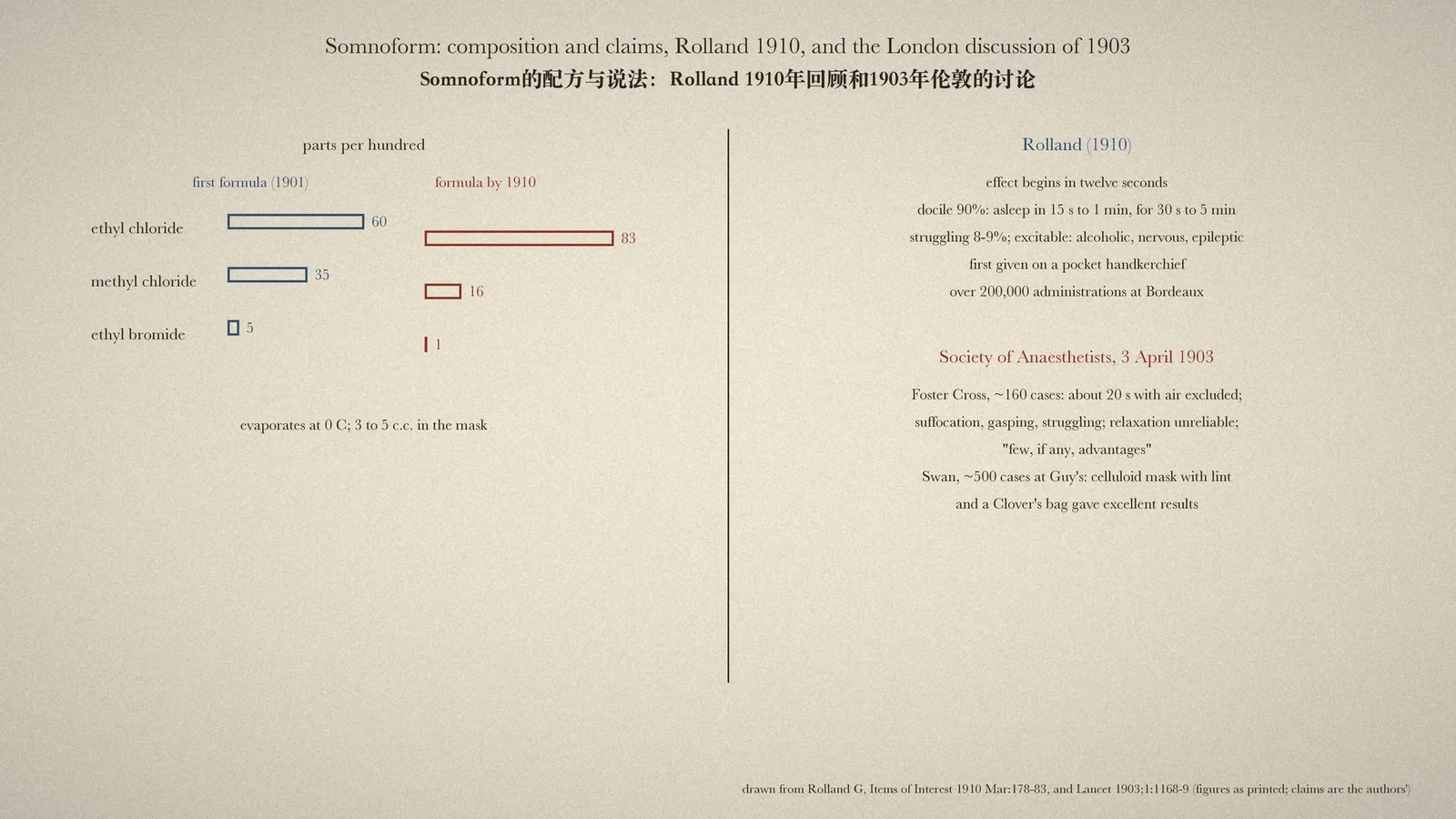
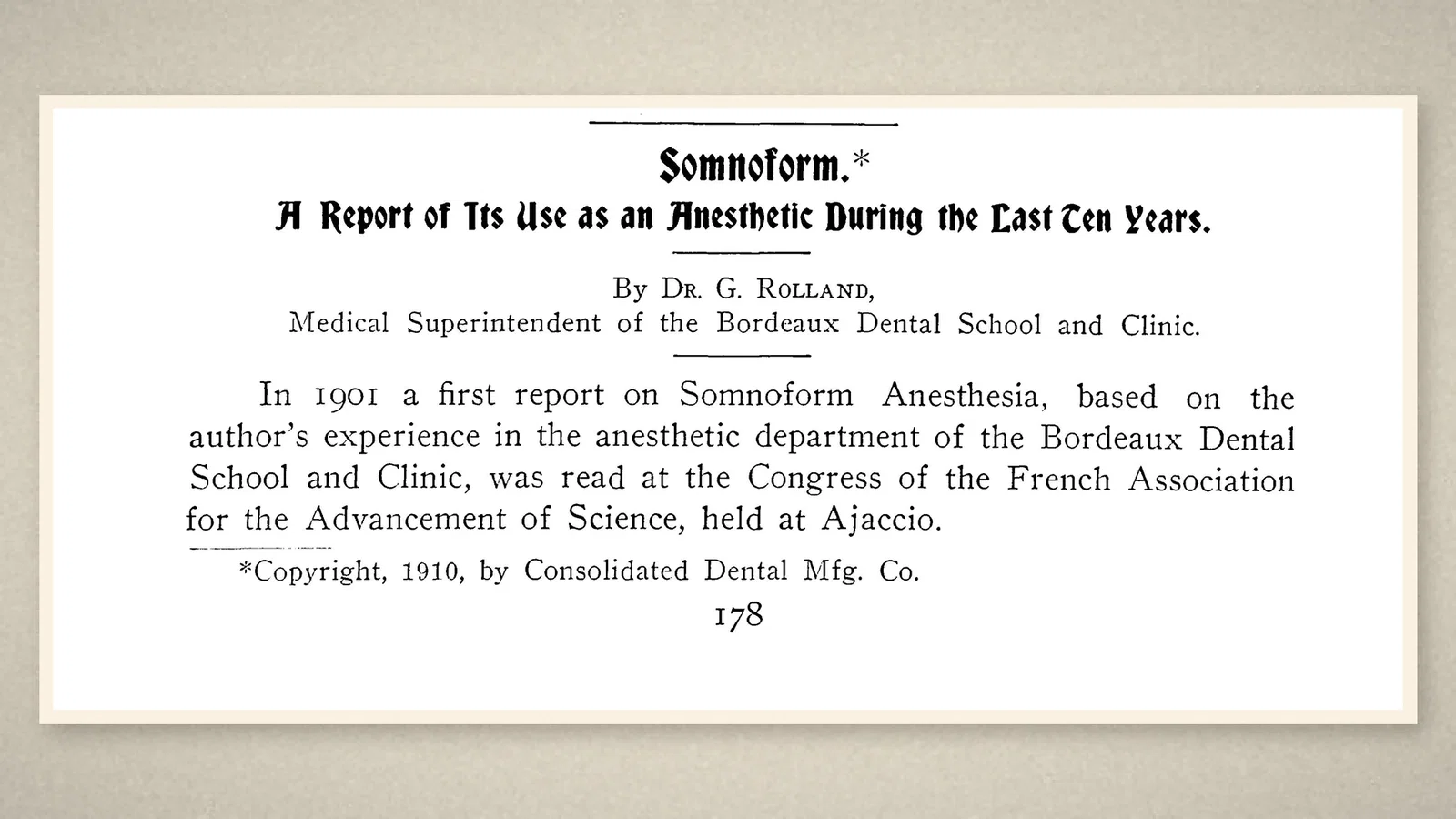
Rolland, "Medical Superintendent of the Bordeaux Dental School and Clinic", wrote in 1910 that "in 1901 a first report on Somnoform Anesthesia, based on the author's experience in the anesthetic department of the Bordeaux Dental School and Clinic, was read at the Congress of the French Association for the Advancement of Science, held at Ajaccio". Somnoform "at that time was composed of 60 parts of ethyl chlorid, 35 parts of methyl chlorid, and 5 parts of ethyl bromid". It evaporated at 0 °C, which Rolland considered necessary for rapid uptake from the alveoli, and "its anesthetic effect commences in twelve seconds". [1]
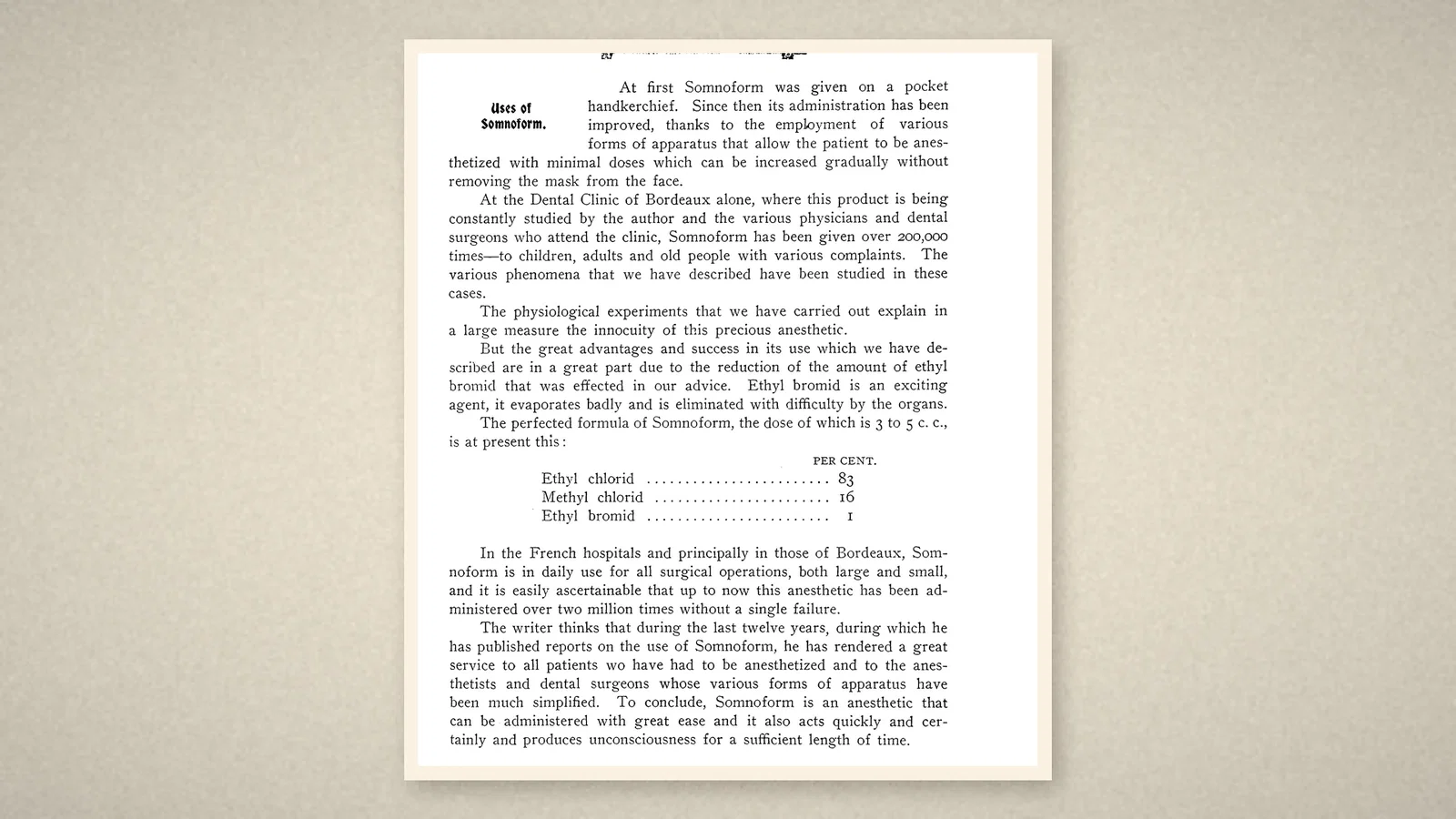
Rolland described three kinds of patient. The "docile", about 90 per cent, breathed quietly from a mask containing 3 to 5 c.c., lost consciousness in fifteen seconds to a minute, and stayed unconscious for thirty seconds to five minutes. The "struggling", 8 to 9 per cent, pulled at the mask, held their breath, stiffened and sometimes became cyanosed. The "excitable" (nervous, alcoholic, epileptic patients and smokers) were slow to go under and slow to recover. At first somnoform "was given on a pocket handkerchief"; later various forms of apparatus allowed small doses to be increased without lifting the mask. [1]
By 1910 Rolland claimed that somnoform had been given more than 200,000 times at the Bordeaux clinic alone, and attributed its success largely to cutting the ethyl bromide, "an exciting agent" that "evaporates badly and is eliminated with difficulty". The "perfected formula" was 83 per cent ethyl chloride, 16 per cent methyl chloride and 1 per cent ethyl bromide. [1]
The London discussion, 1903
The view from London was cooler. At the Society of Anaesthetists on 3 April 1903, W. Foster Cross opened a discussion on somnoform, which, Cross said, had been introduced to the public about a year earlier: in May 1902 Rolland and F. Field Robinson had described it to the British Dental Congress at Shrewsbury. Its claimed advantages were that no bulky apparatus was needed, only a flask of about 50 c.c. and a cone-shaped face-piece; rapid onset and recovery; no untoward effects; and "absolute safety". [2]
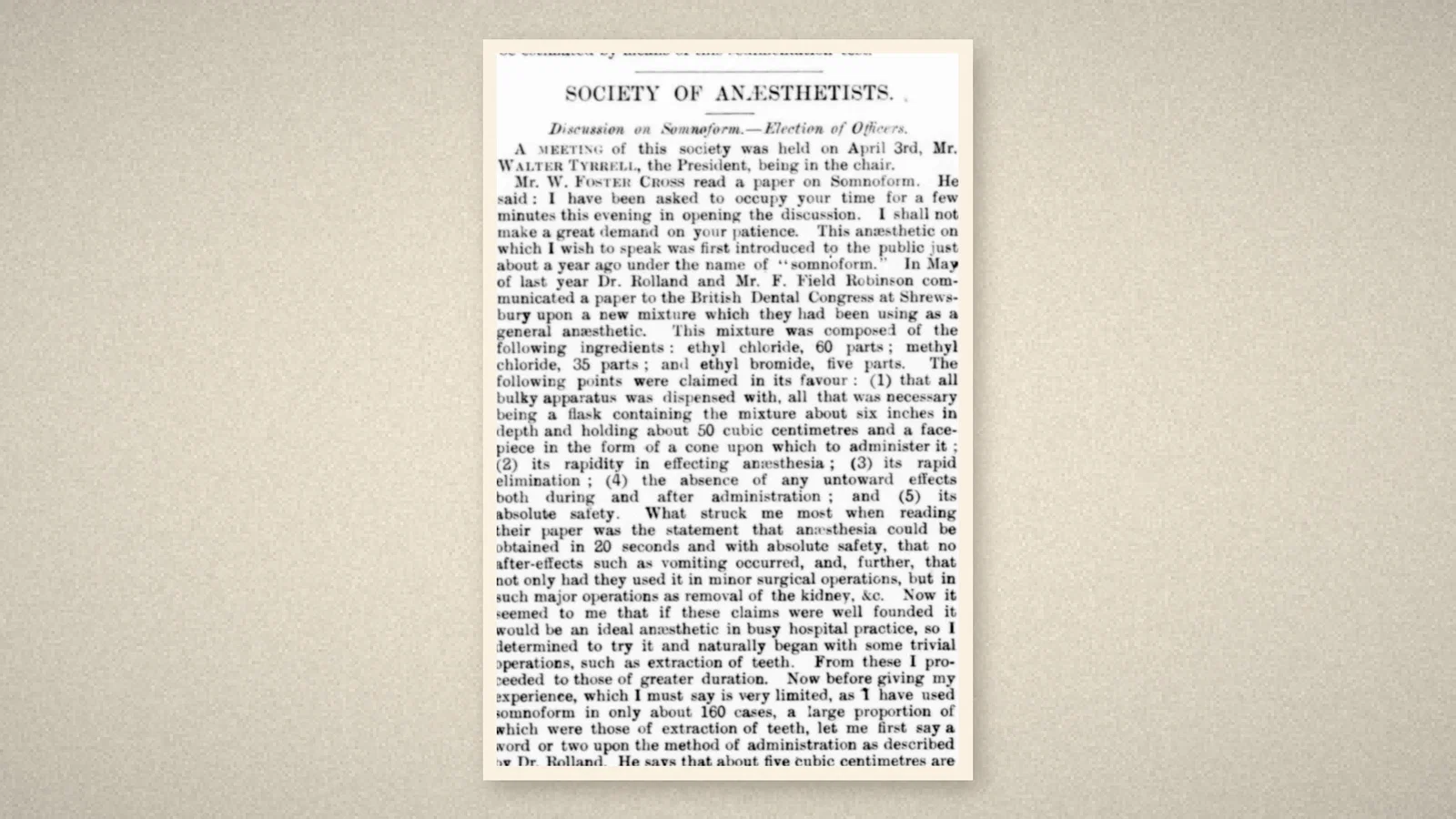
Cross had given it in about 160 cases, mostly dental extractions, following Rolland's method of spraying about 5 c.c. inside the mask and applying it so as to exclude air. With air excluded, anaesthesia came in about 20 seconds, but "the evident feeling of suffocation and the consequent gasping for breath were much more marked than in any other anaesthetic", and patients tried to pull the mask away. With air admitted, induction took about 50 seconds or produced only analgesia. Muscular relaxation was unreliable: a boy having a finger amputated kept moving the fingers of that hand throughout. Cross concluded that somnoform "possesses few, if any, advantages over the ordinary anaesthetics in daily use". R. H. J. Swan, who had used it in about 500 patients in the dental department at Guy's, found the cone mask unsatisfactory too, but obtained excellent results with a celluloid mask, lint inside to partly close the holes, and a Clover's bag; two cubic centimetres were enough. [2]
What the record shows
Somnoform belongs to a short chapter in which very volatile halogenated hydrocarbons were tried as rapid, portable anaesthetics for brief procedures. The documents show the pattern that recurs with new agents: confident claims of speed and safety from the originator, writing years later in a manufacturer's journal; and, from independent users, reports of suffocation, struggling and poor relaxation when the mixture was given without air, with better results once the apparatus was improved. The lesson Swan drew, that the delivery system mattered as much as the drug, is the same one that runs through the history of inhalers.
Sources and reading limits
Read: Rolland’s report in Items of Interest, March 1910, pp. 178–183; the Lancet report of the Society of Anaesthetists meeting of 3 April 1903, 25 April 1903, pp. 1168–1170; the Geoffrey Kaye Museum page.
Not covered: Rolland’s 1901 Ajaccio report; the Shrewsbury paper of 1902; Parrett’s inhaler and any publication by Parrett, mentioned only as the museum describes it; Rolland’s animal experiments. Rolland’s figures (over 200,000 administrations at Bordeaux and, by Rolland’s account, over two million without a single failure) and safety claims are Rolland’s own, in an article copyrighted by a dental manufacturer. The Lancet item is catalogued under 18 April 1903 but the pages are headed 25 April 1903. Doses are given as printed, not as guidance.
- Rolland G. Somnoform: a report of its use as an anesthetic during the last ten years. Items of Interest. 1910 Mar:178-83. Internet Archive
- Society of Anaesthetists: discussion on somnoform [Foster Cross W, Swan RHJ, et al.]. Lancet. 1903;1:1168-70. Internet Archive
- Geoffrey Kaye Museum of Anaesthetic History. Australia and New Zealand. GKM
Continue exploring
Related reading connects shared questions and contexts; it does not by itself establish historical influence.
- 1903: McCardie Presents Ethyl Chloride as a General Anaesthetic
- 1868: Clover Gives Nitrous Oxide Through a Sheet-Lead Face-Piece
Anesthesia Epochs · The Source Room · About & Editorial Method
Published November 2, 2026. Sources and reading limits are stated above. Illustrations are labelled as original source images or AI-made. Historical accounts are educational; they are not current treatment instructions.