In November 1901 Jokichi Takamine announced in the American Journal of Pharmacy that the active principle of the suprarenal glands had been isolated in a pure, stable, crystalline form, named it Adrenalin, and listed among its uses bloodless operations and the prevention of collapse in anesthesia.
Reading Library · Anesthesia Epochs · 中文版
Watch the education video (for clinicians)
1901: Adrenalin — From Crystalline Substance to Clinical Claim · Anesthesia Epochs Education Series
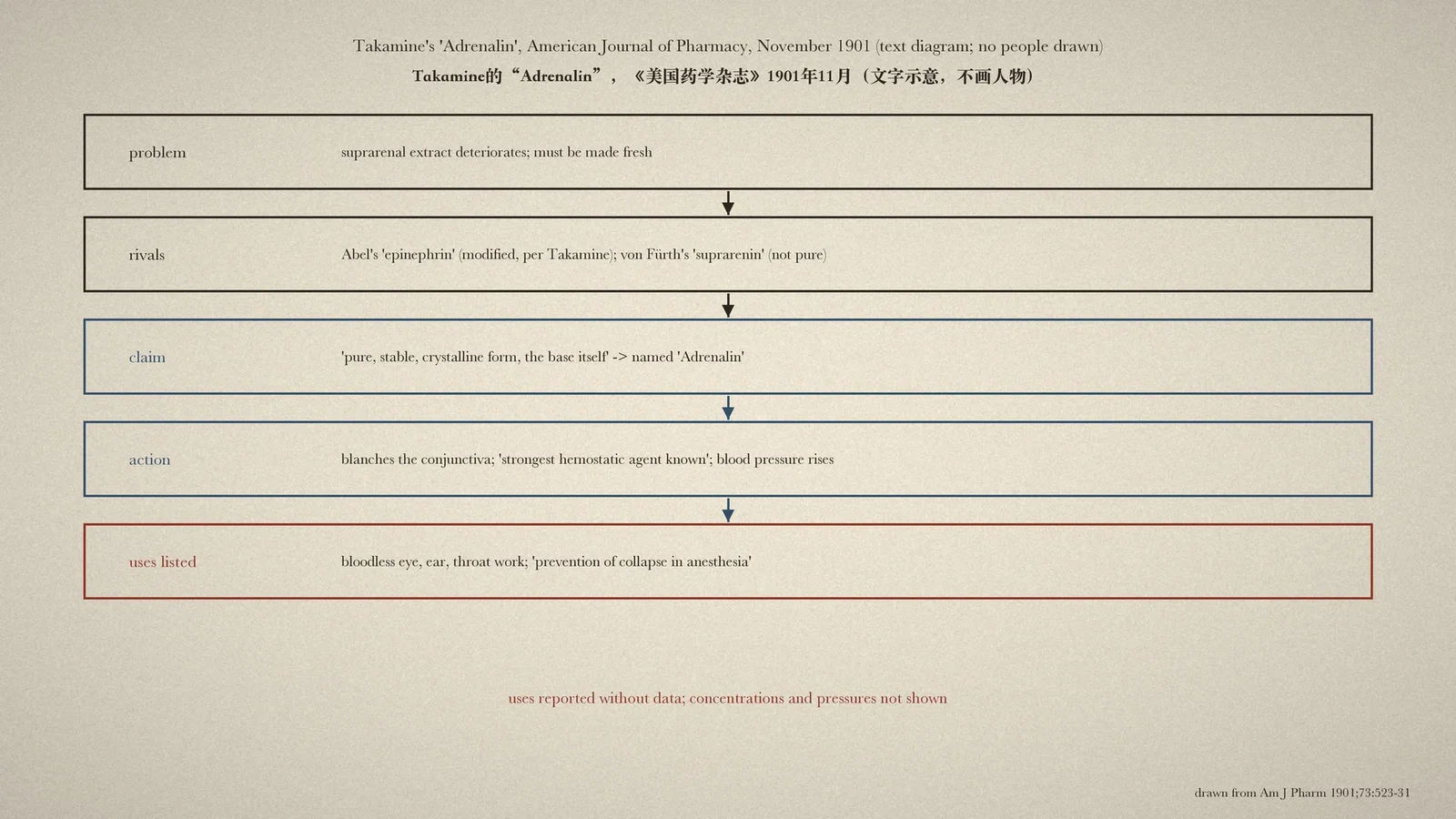
Every anaesthetist knows the drug, by one name or the other. In 1901 Dr Jokichi Takamine of New York told a room of pharmacists that the active principle of the adrenal glands had been caught in a bottle at last: white, crystalline and stable. The paper gave it a new name, a list of chemical tests and a list of uses. One of those uses was the prevention of collapse under anaesthesia. [1, p. 523][1, p. 525][1, p. 530]
The paper
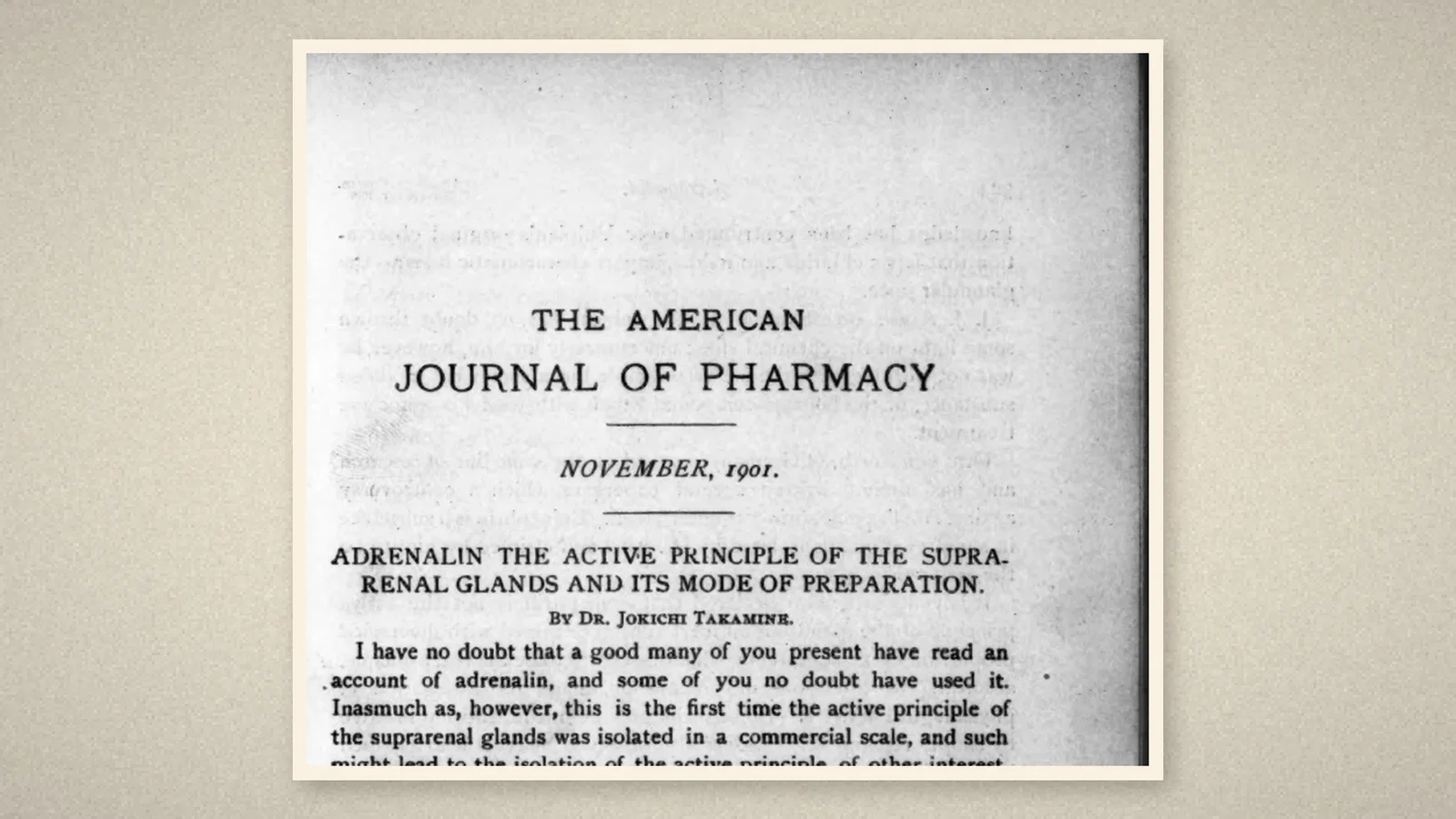
The American Journal of Pharmacy for November 1901, vol. 73, pp. 523-531, printed "Adrenalin the active principle of the suprarenal glands and its mode of preparation" by Dr Jokichi Takamine. The meeting report in the same issue adds that Takamine, "of New York City", read it at a pharmaceutical meeting of the Philadelphia College of Pharmacy. [1, p. 523][1, p. 572]
Takamine opened with a claim: "this is the first time the active principle of the suprarenal glands was isolated in a commercial scale", which might lead to the isolation of the active principles of other glands. [1, p. 523]
The problem
Treatment with suprarenal extract, Takamine wrote, had spread through many branches of medicine. But the extract was "prone to deteriorate very rapidly" and had to be made fresh each time, so physicians wanted the active ingredient in pure form. [1, p. 523]
Chemists had tried. In Takamine's account, J. J. Abel "was not working with the active principle but a somewhat modified substance", a benzoyl compound that survived the autoclave. Otto von Fürth had written several papers attacking Abel's "epinephrin" and claiming that von Fürth's own "suprarenin" was the true principle, yet could not get it in pure, stable, definite form. [1, p. 524]
A crystal and a name
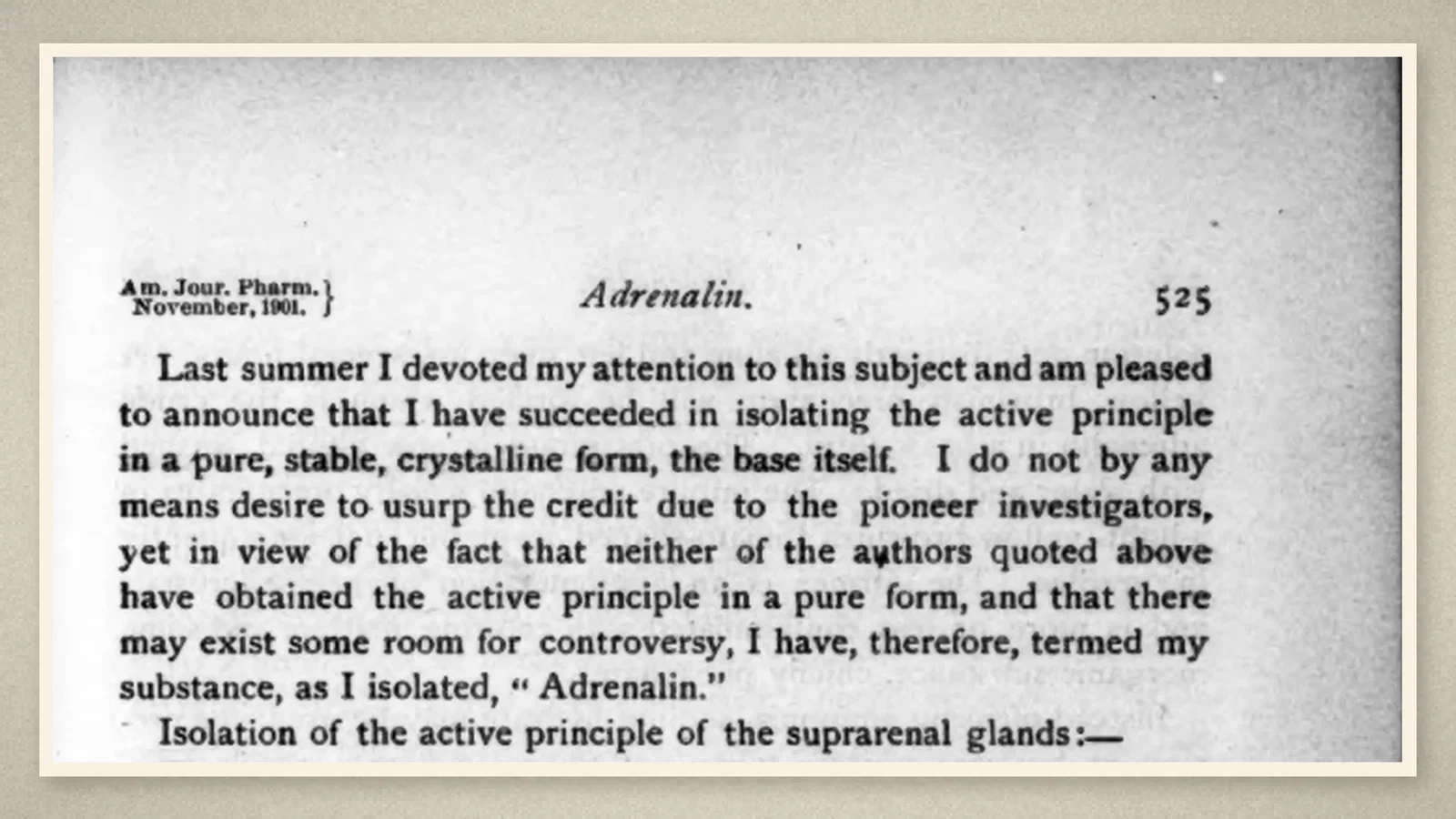
"Last summer I devoted my attention to this subject," Takamine wrote, and "I have succeeded in isolating the active principle in a pure, stable, crystalline form, the base itself." Takamine did not "desire to usurp the credit due to the pioneer investigators", but since neither of them had obtained the principle pure and there might be room for controversy, the new substance got a new name: "Adrenalin". [1, p. 525]
The method followed. The glands are broken up and steeped in warm water, heated to set the albumen, kept from the air under a layer of fat or carbonic acid gas, pressed, concentrated in a vacuum, cleared with alcohol, and made alkaline with ammonia, which throws down crude adrenalin; repeated purification gives white crystals. The substance was slightly bitter and left "a numb feeling on the tongue". Dry, it was perfectly stable; in solution it took oxygen from the air and turned pink, then red, then brown. [1, p. 525][1, p. 526]
Takamine set the formulas proposed by Fürth, Abel and Aldrich beside Takamine’s own, and noted that T. B. Aldrich of Detroit had also isolated a crystalline principle and shown it to be identical with Adrenalin. [1, p. 528]
What it did
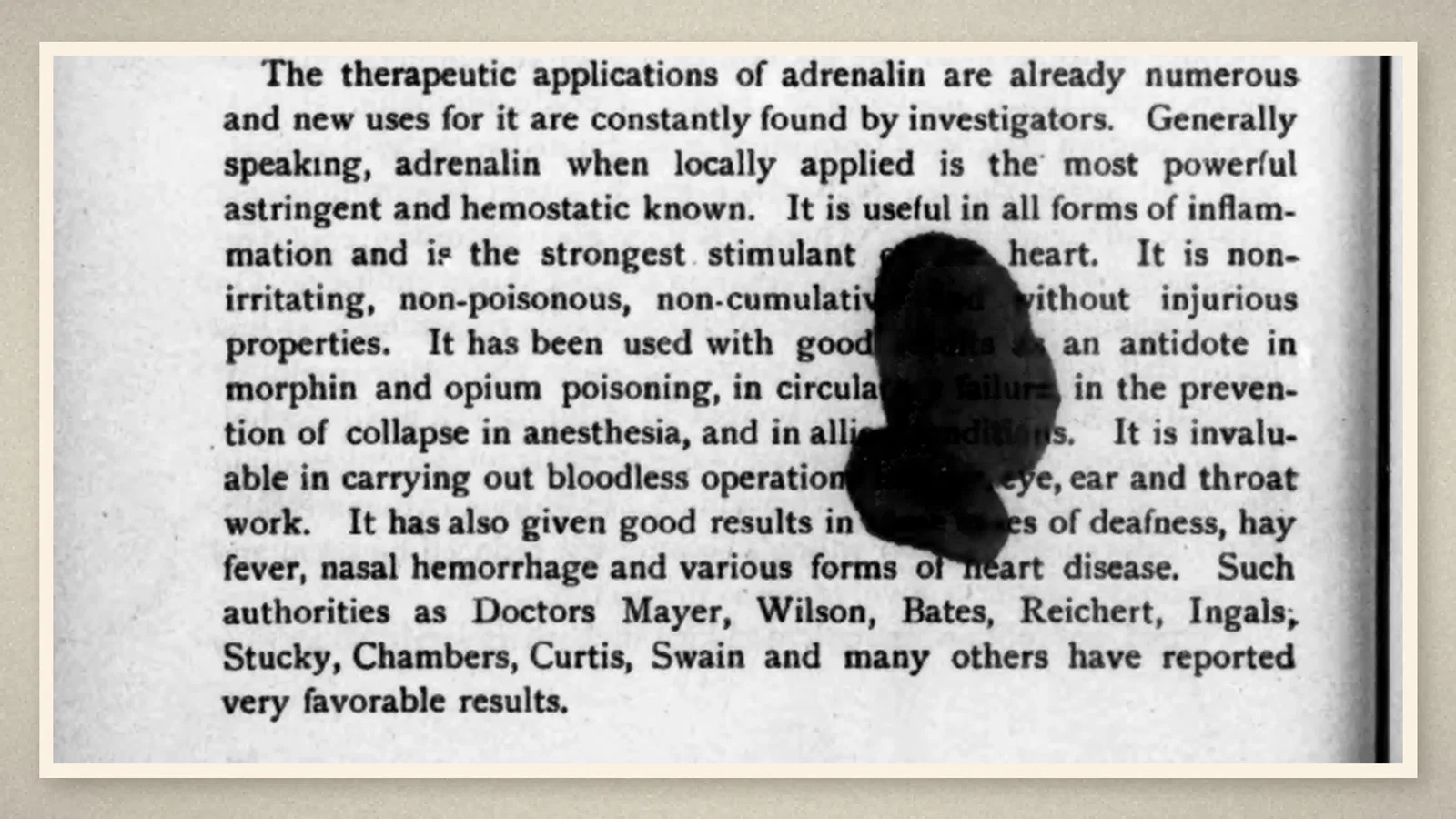
The physiological activity, Takamine wrote, "is astoundingly strong". A fraction of a drop of a very dilute solution "blanches the normal conjunctiva within one minute. It is the strongest hemostatic agent known." Injected into a vein, it acted powerfully on the muscle of the blood vessels and of the heart, "resulting in an enormous rise of blood pressure". [1, p. 530]
Then came the uses. Applied locally, adrenalin was the most powerful astringent and haemostatic known. It had been used against morphine and opium poisoning, in circulatory failure, "in the prevention of collapse in anesthesia", and was invaluable "in carrying out bloodless operations" on the eye, ear and throat. Many physicians had reported favourable results. Takamine thanked Dr E. M. Houghton of Detroit for the physiological tests and gave a large share of the credit to an associate, Wooyenaka. [1, p. 530][1, p. 531]
What the record shows
The moment a hormone became a reagent in a bottle. Before this, surgeons had used an extract that soon went bad. After it, they had a stable white crystal with a name, sold as a solution. The paper's own list already joined it to anaesthesia: to keep the field bloodless and to hold up a failing circulation.
Sources and reading limits
Read: Takamine’s paper in the American Journal of Pharmacy, November 1901, pp. 523–531, and the report of the meeting at which it was read, pp. 572–573.
Not covered: Abel’s papers on epinephrin; von Fürth’s papers on suprarenin; Aldrich’s own paper; Takamine’s other publications that year; the later dispute over the names adrenaline and epinephrine; the synthesis of adrenaline. “The first time … isolated in a commercial scale” is Takamine’s own claim, as are the judgements on Abel and von Fürth. The uses, including “the prevention of collapse in anesthesia”, are listed without data and credited to other physicians. The meeting report prints a date that does not fit the November issue, so no meeting date is given. Concentrations, doses and pressure figures are not repeated.
- Takamine J. Adrenalin the active principle of the suprarenal glands and its mode of preparation. Am J Pharm. 1901;73:523-31. Internet Archive
Continue exploring
Related reading connects shared questions and contexts; it does not by itself establish historical influence.
- 1882: Anrep Injects Cocaine into Anrep's Own Arm
- 1884: Koller Brings Cocaine to the Surface of the Eye
- 1898: Dreser Presents Heroin as a Respiratory Sedative
Anesthesia Epochs · The Source Room · About & Editorial Method
Published November 3, 2026. Sources and reading limits are stated above. Illustrations are labelled as original source images or AI-made. Historical accounts are educational; they are not current treatment instructions.