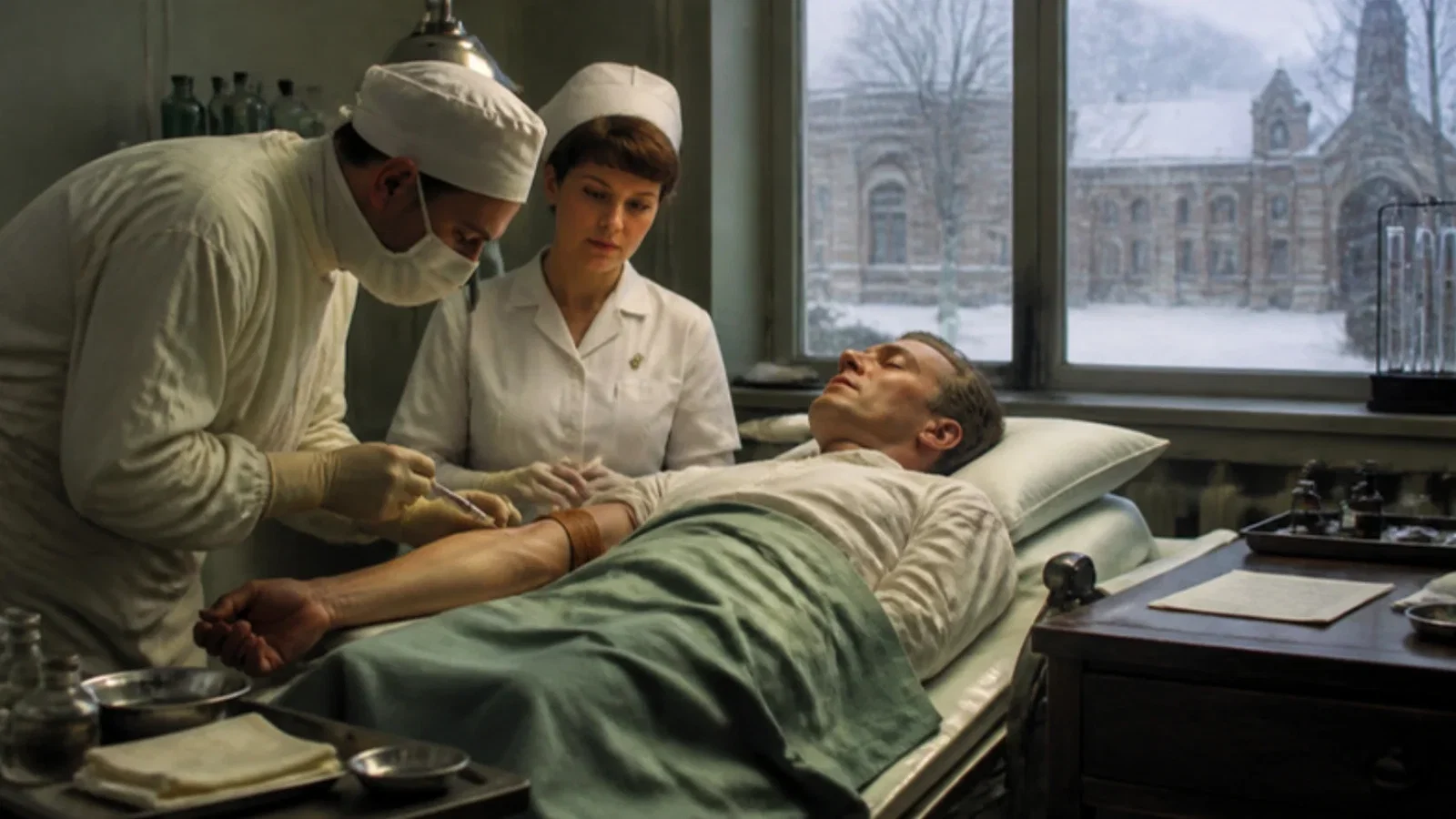
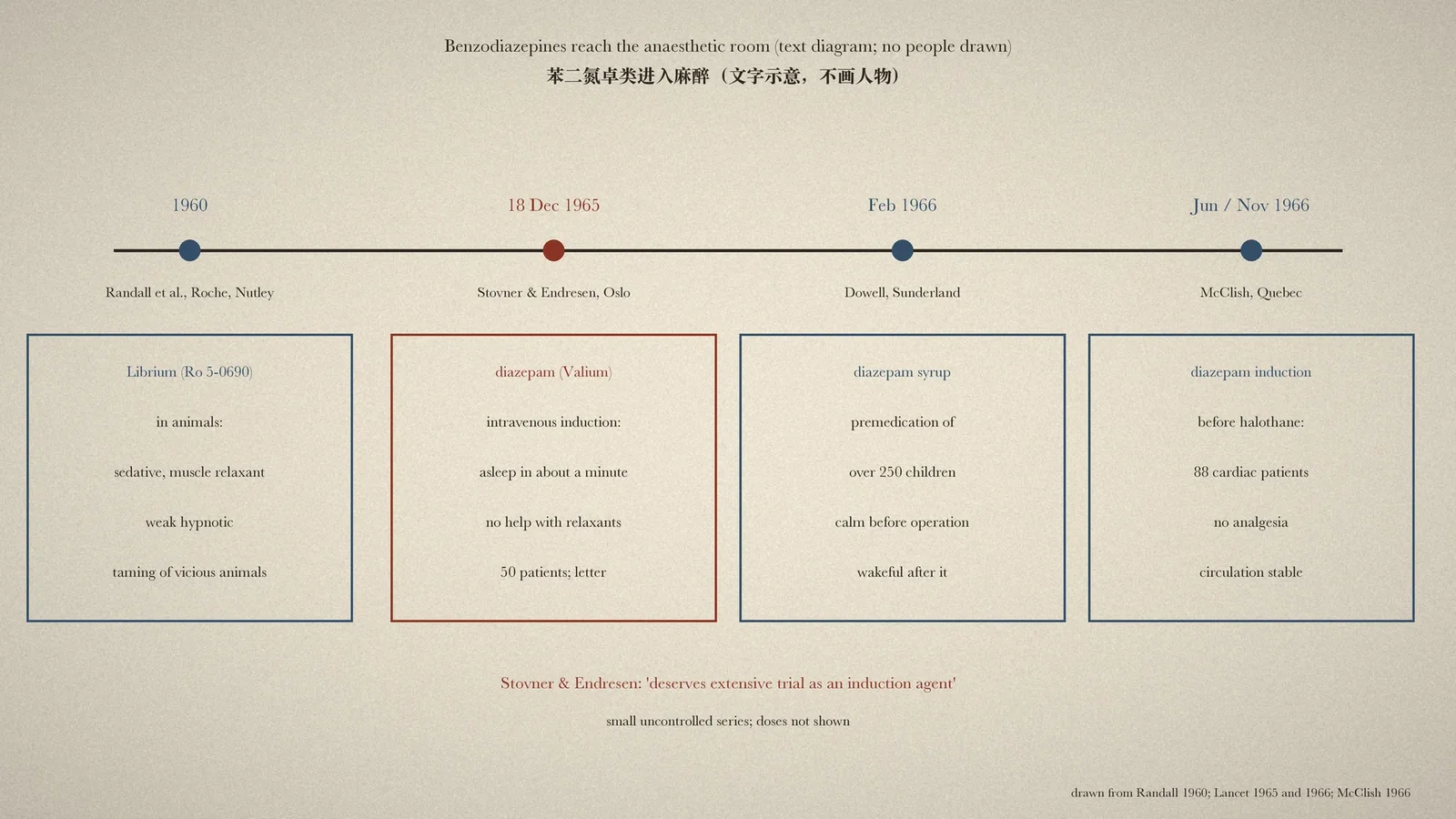
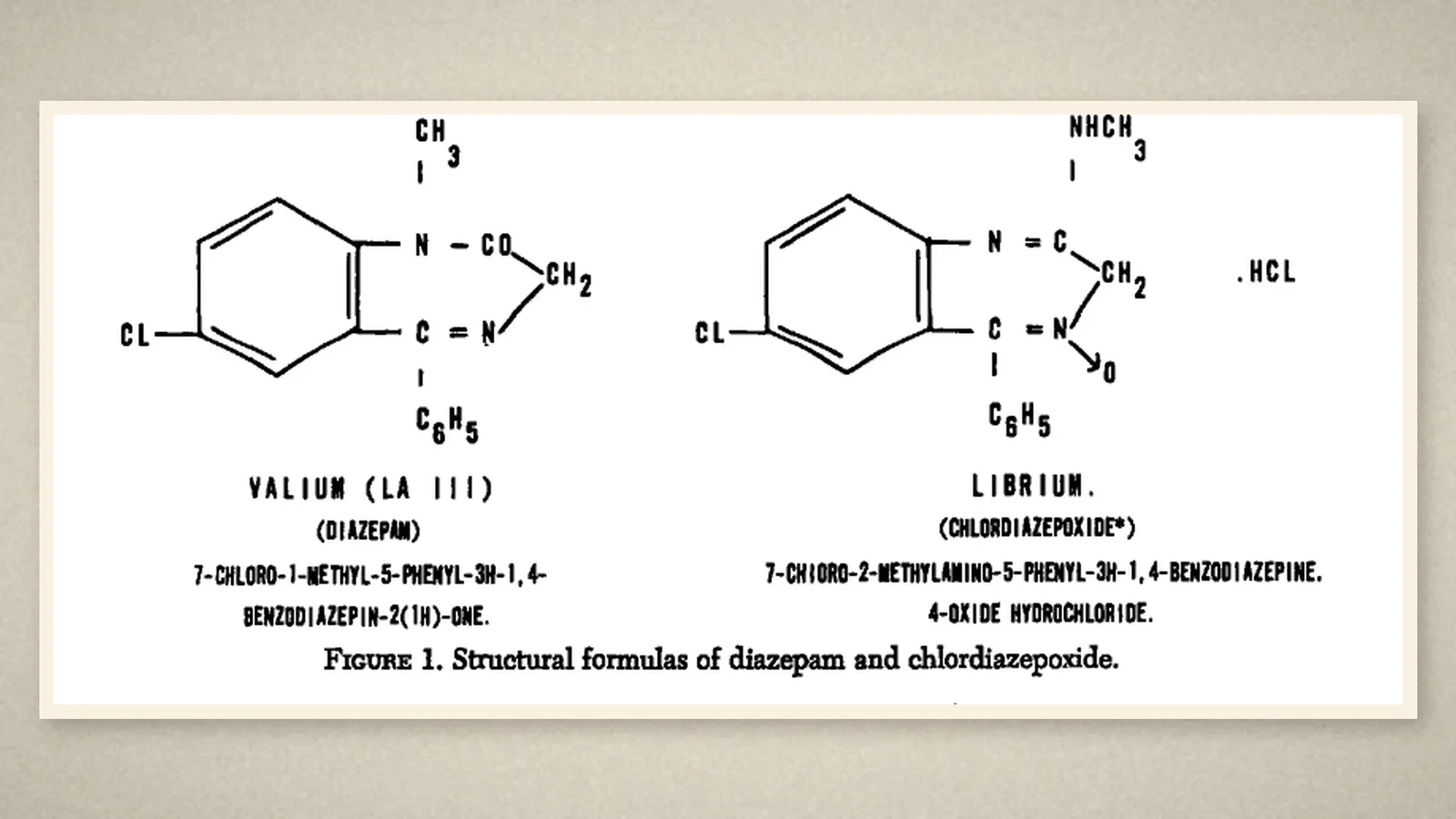
In 1960 Randall and colleagues of the Hoffmann-La Roche pharmacology department in Nutley, New Jersey, described methaminodiazepoxide (Librium, Ro 5-0690) in animals: sedative and muscle-relaxant, only weakly hypnotic, with a marked taming effect on vicious animals; the compound had been synthesized by Sternbach and Reeder. Five years later J. Stovner and R. Endresen of the Department of Anaesthesia, Norwegian Radium Hospital, Oslo, wrote to The Lancet of 18 December 1965: prompted by diazepam's rapid muscle relaxation in tetanus, they tried it in anaesthesia and found that it did not potentiate relaxants but put patients to sleep in about a minute with little change in respiration or circulation; they had used it for induction in 50 patients and thought it deserved extensive trial. In February 1966 Dowell of Sunderland described oral diazepam premedication in children, and in June and November 1966 McClish of Laval Hospital, Quebec, reported intravenous diazepam induction for halothane anaesthesia in 88 cardiovascular patients.
Reading Library · Anesthesia Epochs · 中文版
Watch the education video (for clinicians)
1965: Diazepam — Sleep Is Not Analgesia · Anesthesia Epochs Education Series
Benzodiazepines are now part of almost every anaesthetic day: they calm patients before surgery, put them to sleep at induction, and often leave them with little memory of what happened. Yet the class was not made for anaesthesia. It began as a "psychosedative" in the animal laboratory, and only some years later did anaesthetists try it in the operating theatre. A short letter in The Lancet of 18 December 1965 is the clearest record of that step among the sources read here. [1, p. 1298][2, p. 163]
A taming drug in the laboratory
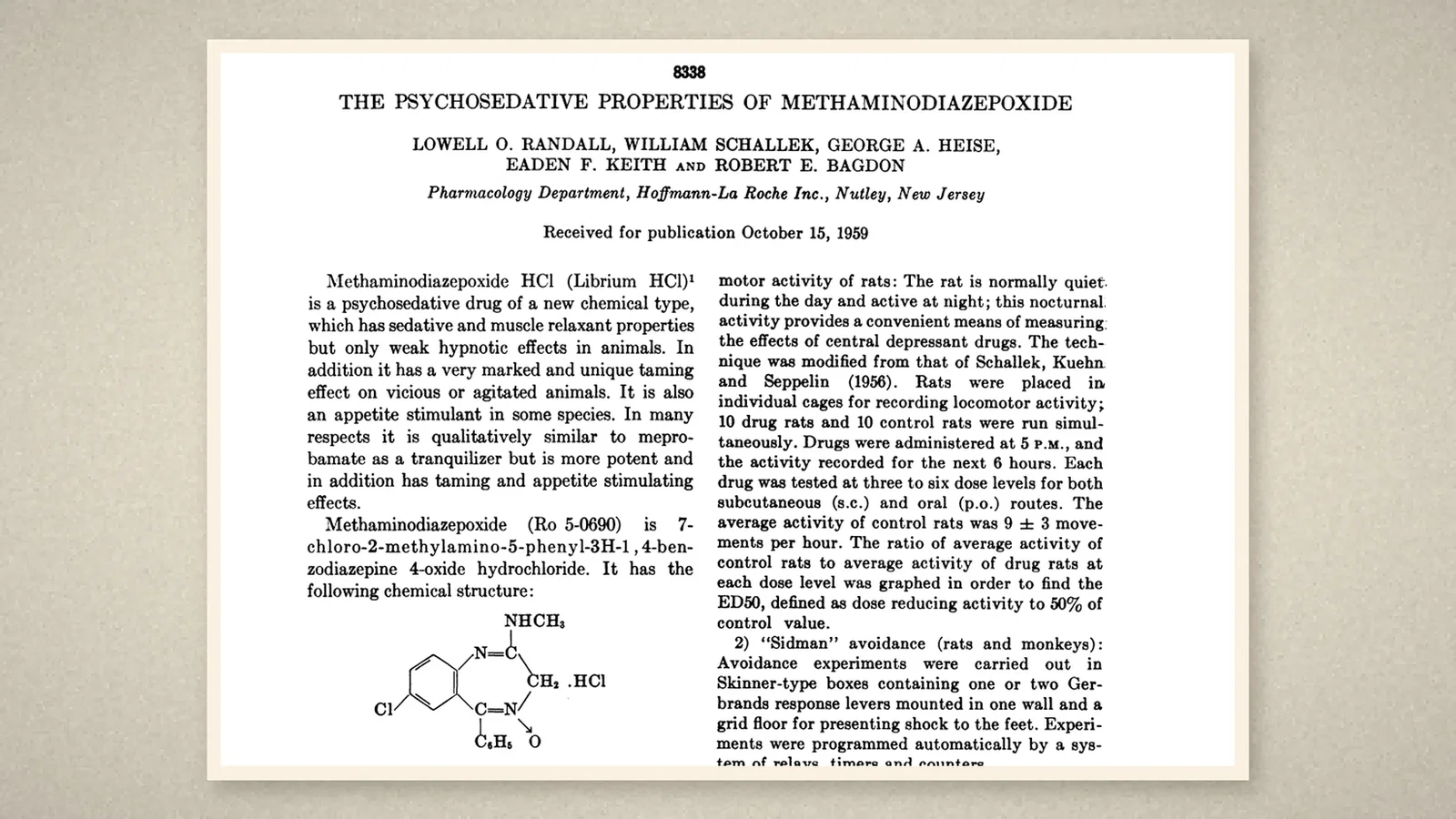
In 1960 the Journal of Pharmacology and Experimental Therapeutics printed a paper by Lowell O. Randall and four colleagues of the Pharmacology Department, Hoffmann-La Roche Inc., Nutley, New Jersey, received on 15 October 1959. Methaminodiazepoxide hydrochloride, sold as Librium and coded Ro 5-0690, was described as "a psychosedative drug of a new chemical type". In animals it had sedative and muscle-relaxant properties but only weak hypnotic effects, and it had "a very marked and unique taming effect on vicious or agitated animals". The compound had been synthesized by Sternbach and Reeder. [2, p. 163]
The paper ended by noting that, in initial trials in human subjects, the drug showed promise of being particularly effective in reducing anxiety. At this stage it was a drug for psychiatry and general medicine, and the paper did not mention anaesthesia. [2, p. 171]
A letter from Oslo
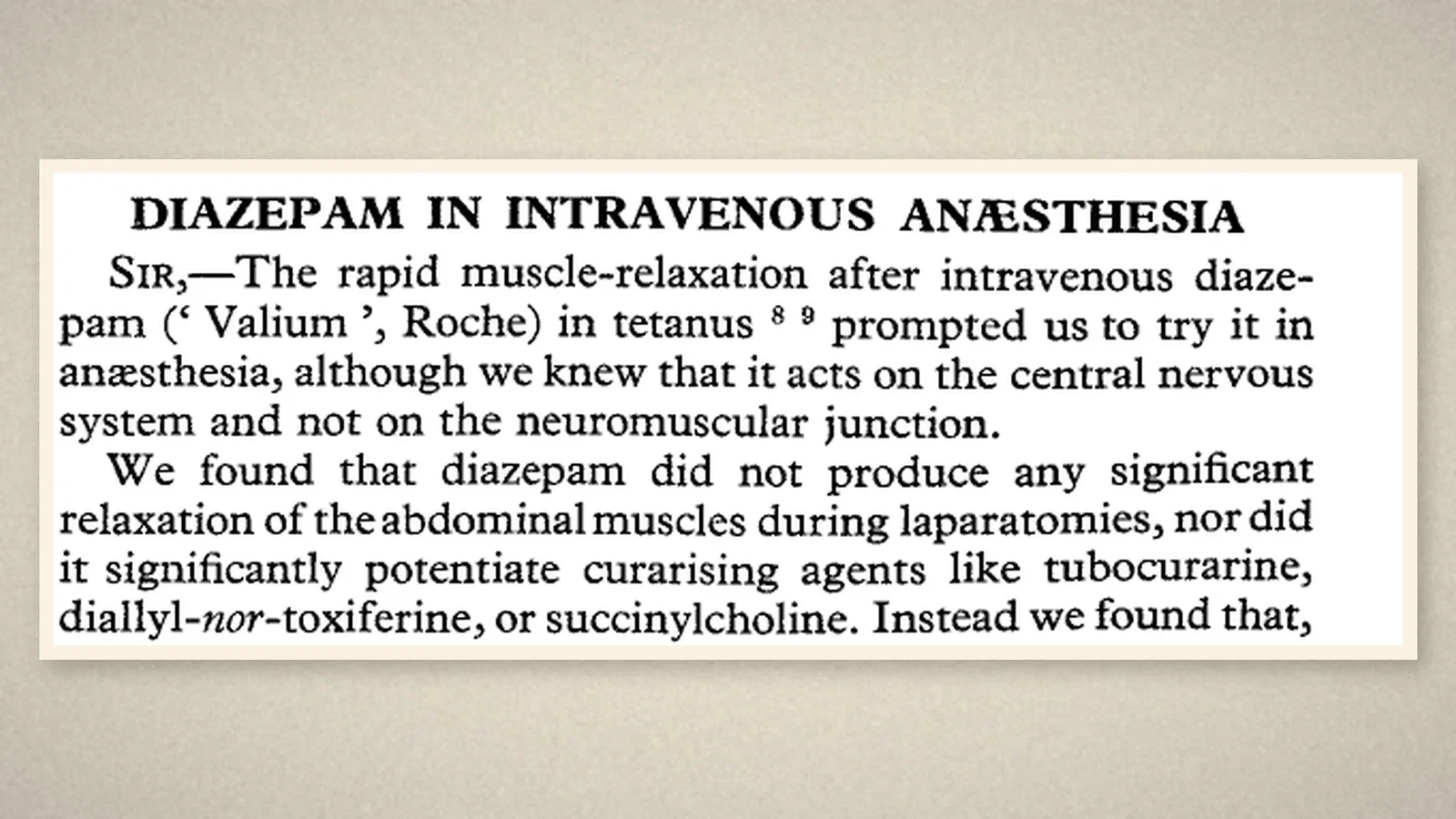
The same company later introduced a close chemical relative, diazepam, sold as Valium. J. Stovner and R. Endresen of the Department of Anaesthesia at the Norwegian Radium Hospital, Oslo, had seen that intravenous diazepam relaxed muscles quickly in tetanus. That prompted them to try it in anaesthesia, "although we knew that it acts on the central nervous system and not on the neuromuscular junction". [1, p. 1298]
The result was not what they expected. At laparotomy diazepam did not produce any significant relaxation of the abdominal muscles, nor did it significantly potentiate tubocurarine, diallyl-nor-toxiferine or succinylcholine. But they found something else: premedicated adult patients "fell asleep in about a minute" after intravenous injection. The undiluted preparation caused pain in the arm, so it was diluted. Anaesthesia lasted from half an hour to an hour, "during which time neither respiration nor circulation changed substantially". The lower jaw relaxed and patients usually tolerated an oropharyngeal airway without laryngeal spasm, but relaxation was not sufficient for smooth tracheal intubation, for which succinylcholine had to be given. Anaesthesia was continued with nitrous oxide and oxygen. [1, p. 1298]
The two had used diazepam for induction in 50 patients having thyroidectomies, radical mastectomies, hysterectomies and large-bowel resections. Their conclusion was that diazepam "deserves extensive trial as an induction agent in anaesthesia". In their experience it produced less respiratory and circulatory depression "than the time-honoured short-acting barbiturates". [1, p. 1299]
Replies and follow-up
In February 1966 The Lancet printed a letter from T. Dowell of the General Hospital, Sunderland, under the same title. Dowell had followed the discussion and had been using the paediatric syrup to premedicate children for elective surgery. In a preliminary trial of over 250 unselected children, most having adenotonsillectomy, two features stood out: quiet alertness before operation, with indifference to intravenous induction, and "the restful but wakeful state" afterwards, with many children reading or drawing within an hour or so of the end of the list. [3, p. 369][3, p. 370]
On 9 June 1966, at the annual meeting of the Canadian Anaesthetists' Society in Banff, André McClish of the Institute of Cardiology, Laval Hospital, Quebec, presented a series that was published in November. Eighty-eight consecutive, unselected patients for cardiovascular surgery or cardioversion were induced with a single intravenous dose of diazepam, followed by halothane. "Unconsciousness supervenes in less than two minutes", without coughing, laryngospasm or hiccup. McClish stressed that diazepam produced sedation, hypnosis and slight muscle relaxation "but no analgesia", so analgesics and relaxants were still needed. [4, p. 562][4, pp. 566-567]
There were problems too. Twenty patients complained of a painful burning sensation on injection, and there were several cases of venous thrombosis and thrombophlebitis at injection sites, though those veins were also used for blood sampling and other drugs. Emergence, "though not instantaneous, was rapid". McClish judged the stability of the circulation to be "an undisputed advantage of diazepam over barbiturates", above all in cardiac patients. [4, pp. 569-570][4, p. 572]
What the record shows
Benzodiazepines entered anaesthesia almost by accident. Two doctors in Oslo were looking for muscle relaxation and found an induction agent instead. They had only 50 patients and a letter, but they had already named the features that would be argued over afterwards: quick sleep, steady breathing and circulation, no analgesia, and pain on injection.
Sources and reading limits
Read: Randall, Schallek, Heise, Keith and Bagdon, J Pharmacol Exp Ther 1960;129:163-71 (opening, methods headings, discussion and summary; tables skimmed); Stovner and Endresen, Lancet 18 December 1965, pp. 1298-9 (the whole letter); Dowell, Lancet February 1966, pp. 369-70 (the whole letter); McClish, Can Anaesth Soc J 1966;13:562-75 (introduction, material and method, results on the nervous system, side effects and discussion; tables skimmed). All four are publisher PDFs of the published articles, obtained through institutional access.
Not covered: Sternbach and Reeder's chemistry papers and Sternbach's own account; the launch dates of Librium and Valium; the tetanus reports that prompted the Oslo trial; Stovner and Endresen's fuller paper in Acta Anaesthesiologica Scandinavica; Campan's French reports. The ASA timeline entries were not used as evidence.
Limits: the wider story spans 1955 to 1969. This article anchors on the letter of 18 December 1965 because it is the earliest report of anaesthetic induction among the sources read, but earlier unpublished or non-English use cannot be excluded. Stovner and Endresen's series is 50 patients, published as a letter without controls. McClish's 88 patients were all cardiac cases who had also been premedicated with diazepam and other drugs. Doses and concentrations are not repeated, and page crops stop before them. Patients are not identified.
Three illustrations are crops of the 1960 J Pharmacol Exp Ther paper, the 1965 Lancet letter and McClish's 1966 paper. One is a text timeline drawn from these sources, with no people drawn and no doses shown.
- Stovner J, Endresen R. Diazepam in intravenous anaesthesia. Lancet. 1965;2(7425):1298-9. DOI
- Randall LO, Schallek W, Heise GA, Keith EF, Bagdon RE. The psychosedative properties of methaminodiazepoxide. J Pharmacol Exp Ther. 1960;129:163-71. DOI
- Dowell T. Diazepam in intravenous anaesthesia. Lancet. 1966;1:369-70. DOI
- McClish A. Diazepam as an intravenous induction agent for general anaesthesia. Can Anaesth Soc J. 1966;13:562-75. DOI
Continue exploring
Related reading connects shared questions and contexts; it does not by itself establish historical influence.
- 1974: Roche Patents the Compounds That Include Midazolam
- 1972: Munich Alternates Etomidate and Propanidid for Induction
- 1961: Janssen Files the Patent That Contains Fentanyl
Anesthesia Epochs · The Source Room · About & Editorial Method
Published November 3, 2026. Sources and reading limits are stated above. Illustrations are labelled as original source images or AI-made. Historical accounts are educational; they are not current treatment instructions.