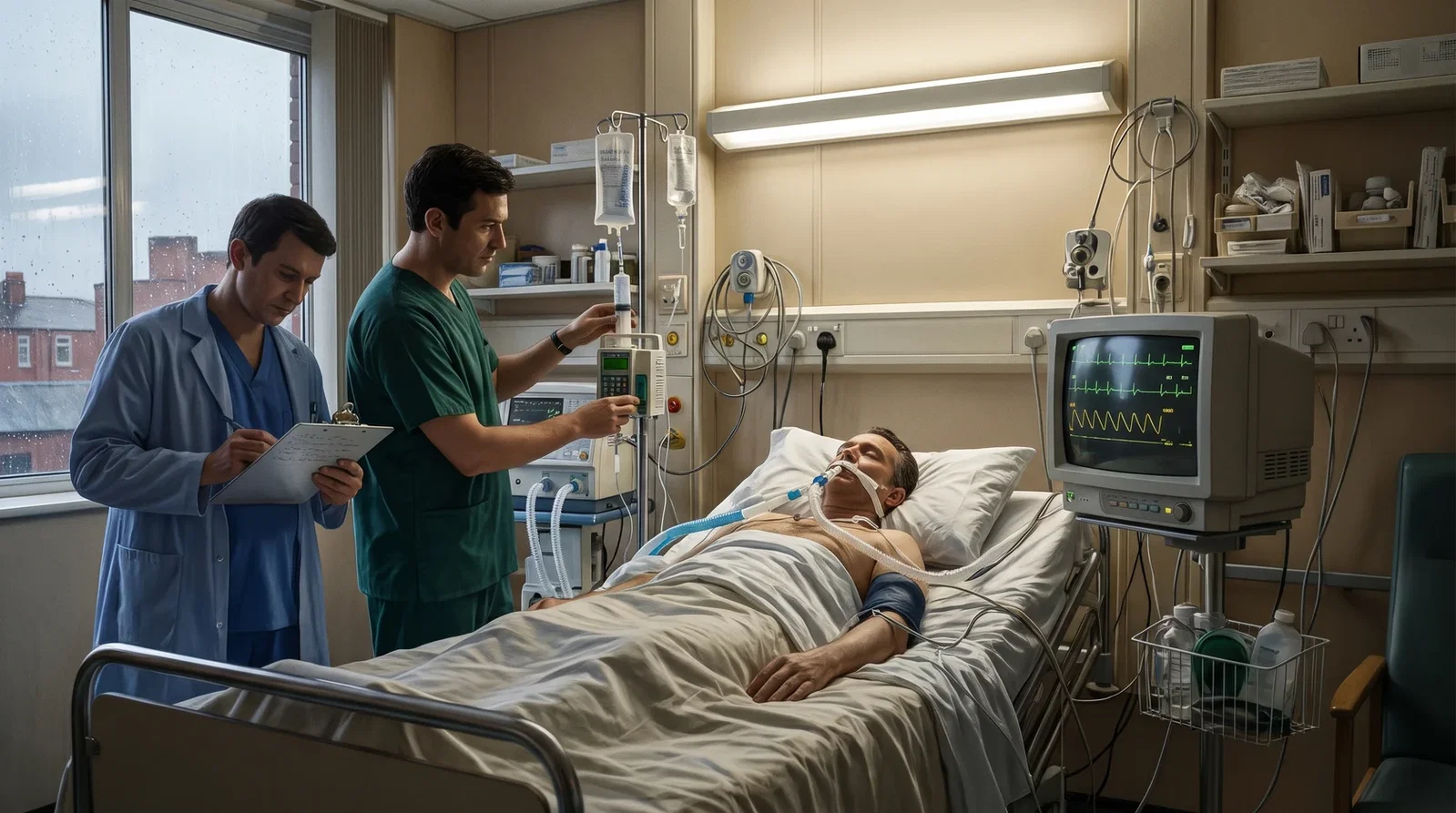
In March and May 1996 the British Journal of Anaesthesia (vol. 76) printed two clinical studies of cisatracurium (51W89, NIMBEX). At the Royal Liverpool University Hospital, Boyd, Eastwood, Parker and Hunter randomly compared infusions of cis-atracurium and atracurium in twelve critically ill patients on mechanical ventilation; atracurium, they explained, was a mixture of 10 geometric isomers, and the 1R cis-1'R cis isomer, designated 51W89 and given the generic name cis-atracurium, was about three times as potent and released less histamine. Neither drug caused apparent haemodynamic or allergic responses, recovery after stopping was similar, and laudanosine was lower with cis-atracurium. At the University of Pittsburgh, De Wolf and colleagues, with Glaxo Wellcome scientists, gave single doses to fourteen patients with end-stage liver disease undergoing liver transplantation and eleven controls, found only minor differences without clinical significance, and suggested cisatracurium might be preferred in liver disease. Wellcome funded or supplied both studies.
Reading Library · Anesthesia Epochs · 中文版
Watch the education video (for clinicians)
1996: Cisatracurium (51W89) — The Single Isomer from Atracurium · Anesthesia Epochs Education Series
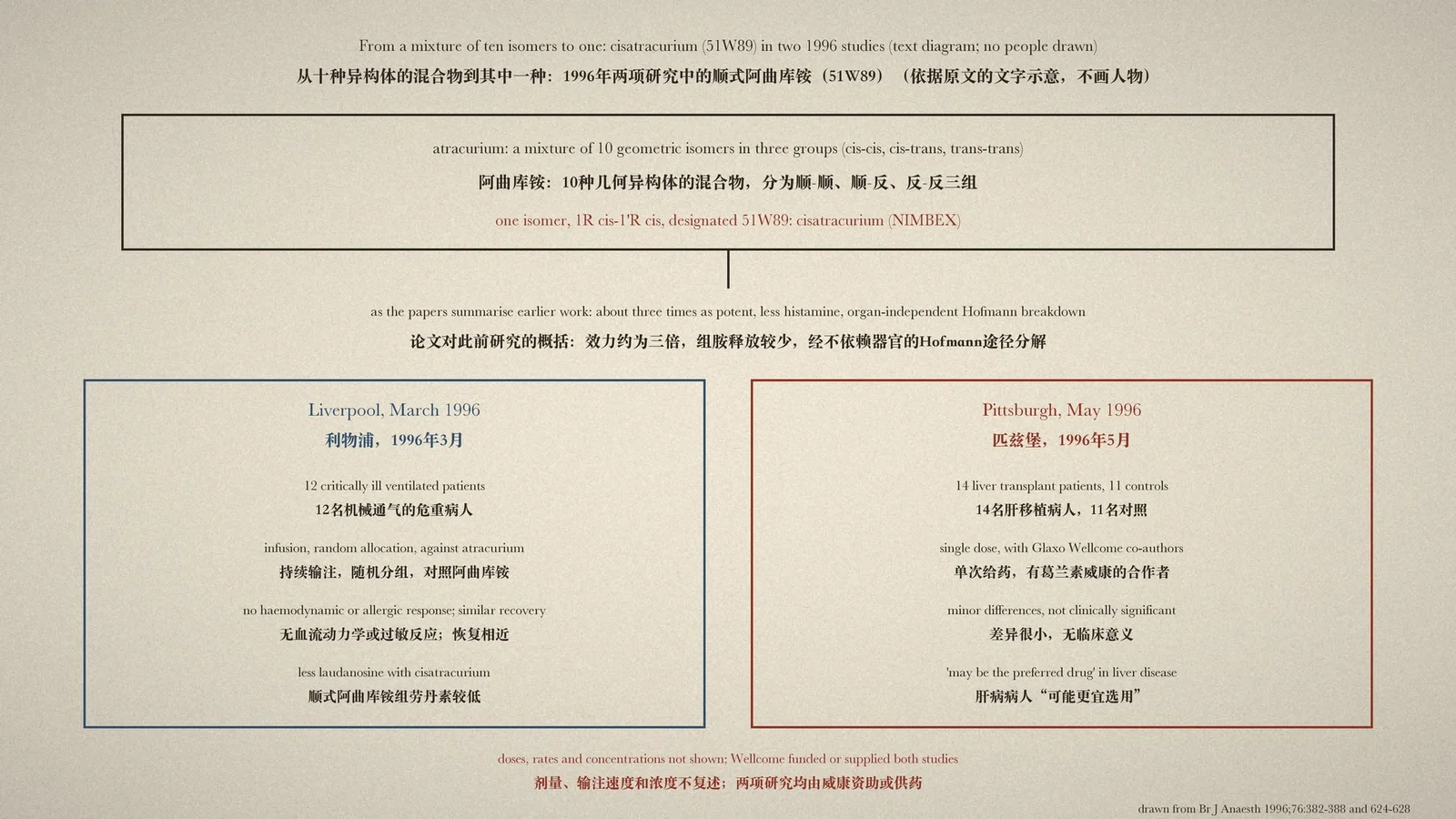
An ampoule of atracurium looks like one drug, but it is a mixture of ten molecules. In 1996 the British Journal of Anaesthesia (vol. 76) printed two papers on one molecule taken from that mixture: the isomer numbered 51W89, generic name cisatracurium, sold as NIMBEX. One came from Liverpool and compared it with atracurium in an intensive care unit; the other came from Pittsburgh and tested it in patients undergoing liver transplantation. This article reads those two clinical studies. [1, p. 382][2, p. 624]
One isomer out of ten
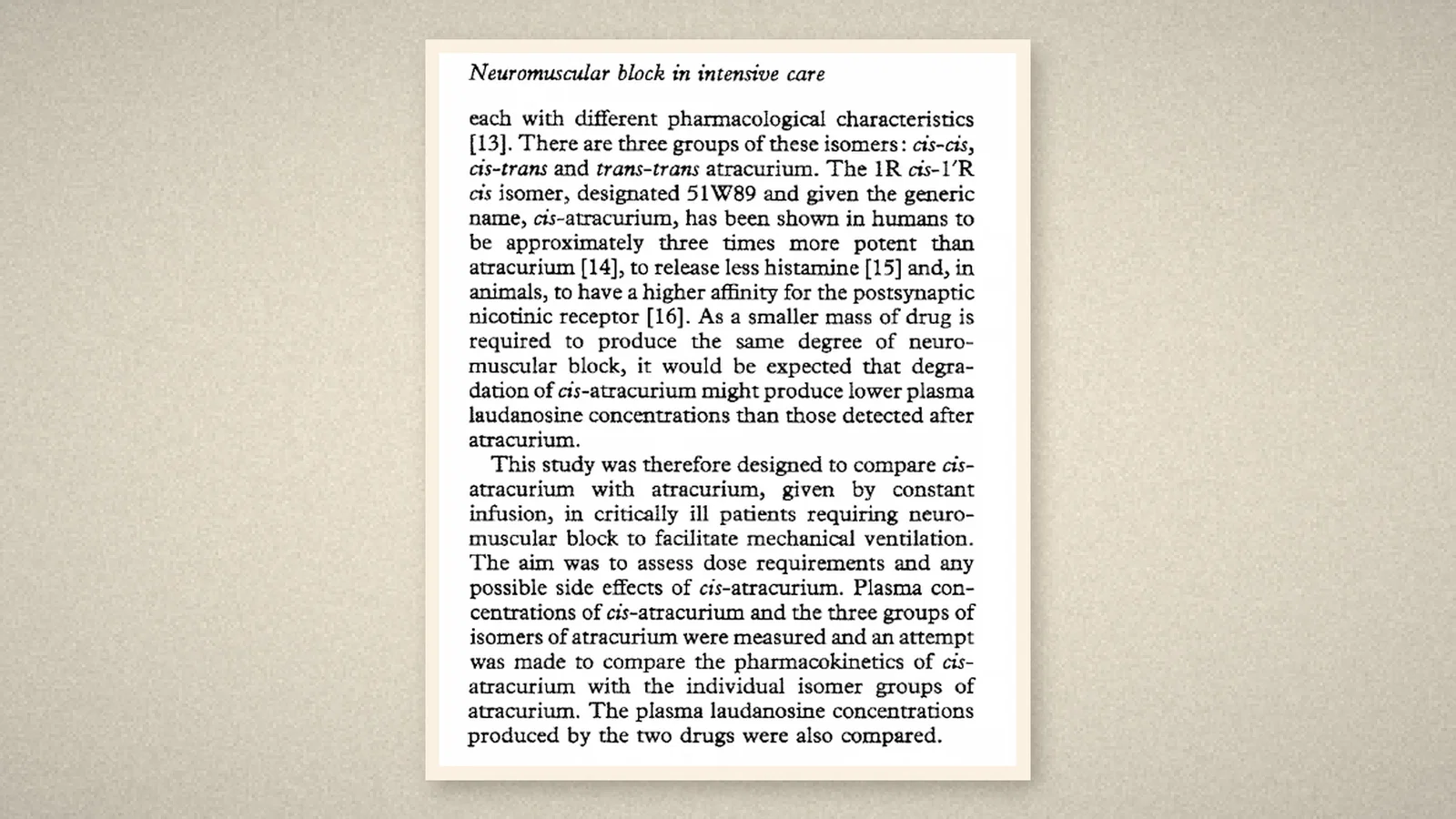
The Liverpool authors set out the background. Atracurium by infusion had proved useful in the critically ill: it breaks down spontaneously in plasma, by what is called Hofmann elimination, and by ester hydrolysis, so its clearance is partly independent of kidney and liver, which suits patients with multiple organ failure; but its breakdown product laudanosine is excreted partly by the kidney and the liver. Atracurium "is a mixture of 10 geometric isomers", in three groups, cis-cis, cis-trans and trans-trans. The 1R cis-1'R cis isomer was "designated 51W89 and given the generic name" cis-atracurium; citing earlier studies, the authors wrote that in humans it was about three times as potent as atracurium and released less histamine, and in animals had a higher affinity for the postsynaptic nicotinic receptor. Because a smaller mass of drug was needed for the same block, they expected its breakdown to produce less laudanosine. [1, p. 382][1, p. 383]
Liverpool: twelve patients in intensive care
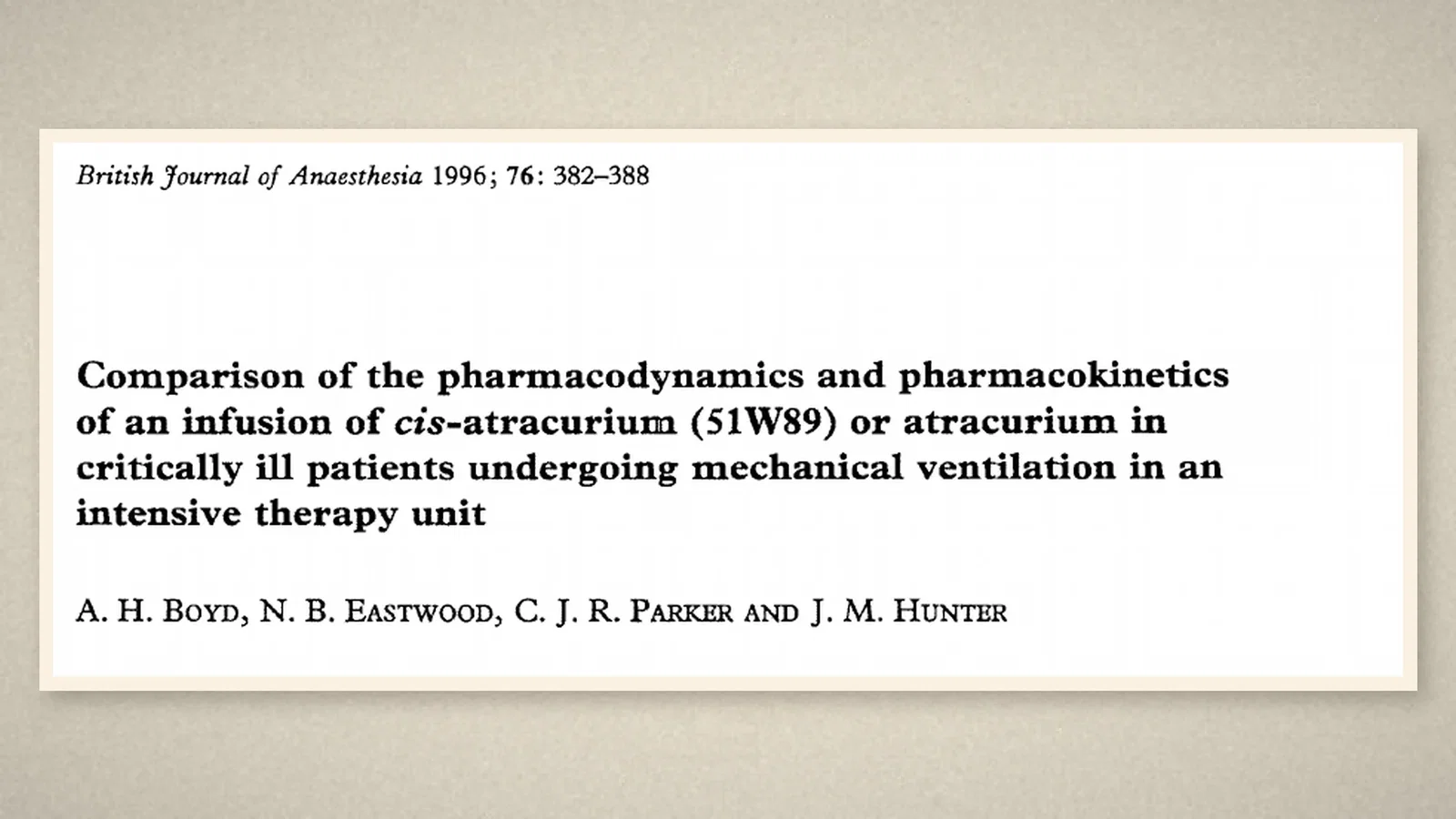
A. H. Boyd, N. B. Eastwood, C. J. R. Parker and J. M. Hunter of the University Department of Anaesthesia at the Royal Liverpool University Hospital studied twelve critically ill patients who needed a neuromuscular blocking drug to assist mechanical ventilation. The study had ethics approval, the Committee on Safety of Medicines issued a clinical trial exemption certificate for cis-atracurium, and consent was obtained from the next of kin of all patients. Following a predetermined random sequence, six received cis-atracurium and six atracurium, with the infusion adjusted by acceleromyographic train-of-four monitoring. The paper was accepted on 17 October 1995 and printed in March 1996. [1, p. 382][1, p. 383]
Neither drug caused an apparent haemodynamic or allergic response; after the infusion stopped, recovery of neuromuscular function took a similar time in the two groups; and plasma laudanosine was lower with cis-atracurium. As with "previous clinical studies of this new drug", the discussion noted, no adverse cardiovascular or allergic effects were seen; rapid recovery seemed achievable after cis-atracurium had been given for many hours to critically ill patients; and there was no evidence of tolerance in either group, evidence for tolerance in the critically ill being, the authors noted, "mainly anecdotal". It was "reassuring" that clearance of cis-atracurium was unchanged in these patients, further evidence of spontaneous breakdown "irrespective of the residing body compartment". The Wellcome Foundation provided a grant and both drugs. [1, p. 382][1, p. 387][1, p. 388]
Pittsburgh: end-stage liver disease
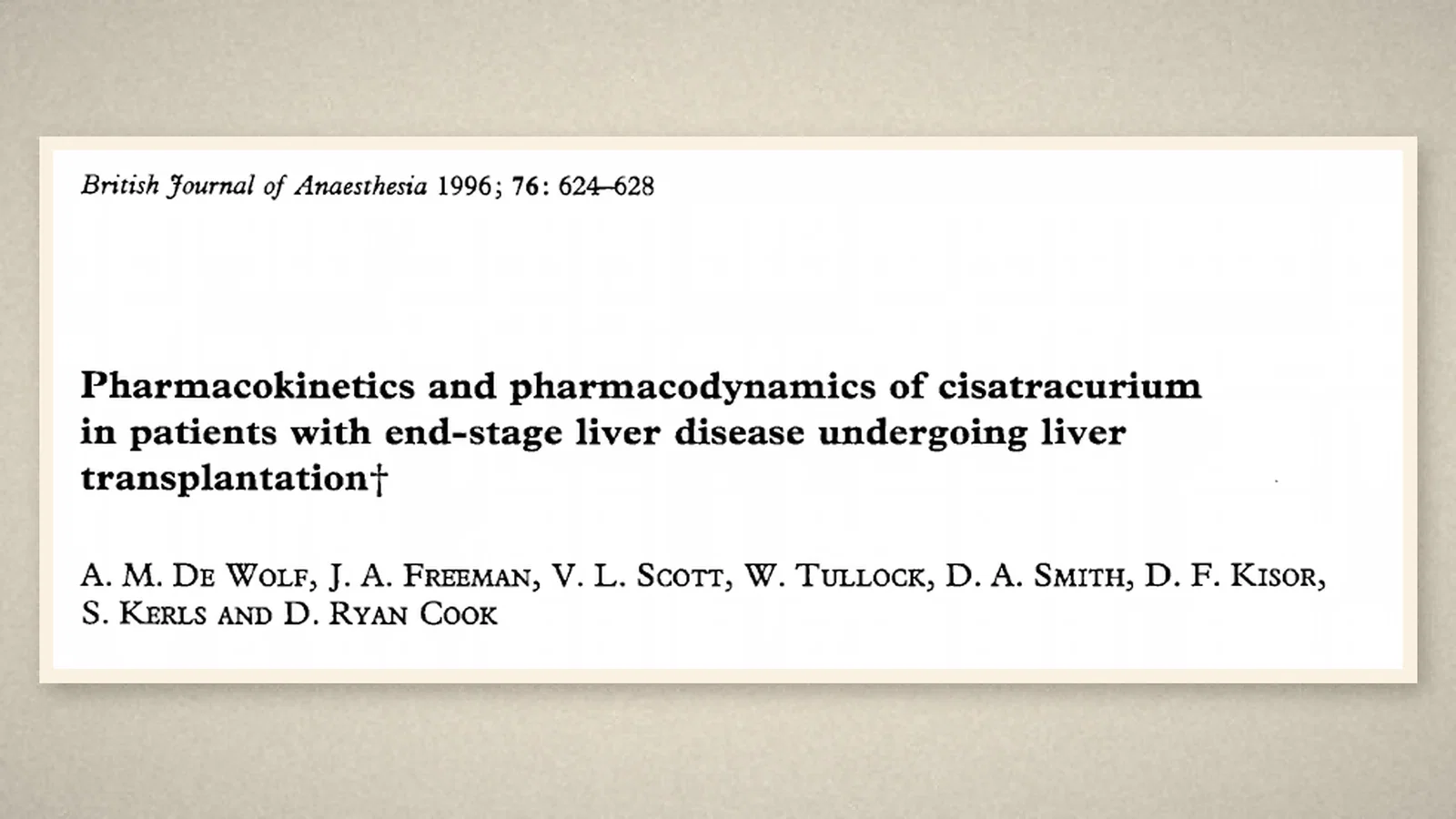
Two months later the same volume (pp. 624-628) printed a paper by A. M. De Wolf, J. A. Freeman, V. L. Scott, W. Tullock and D. Ryan Cook of the Department of Anesthesiology and Critical Care Medicine, University of Pittsburgh, with D. A. Smith, D. F. Kisor and S. Kerls of Glaxo Wellcome at Research Triangle Park, North Carolina. It was accepted on 14 December 1995 and had been presented in part at the American Society of Anesthesiologists meeting in San Francisco on 19 October 1994. "Cisatracurium besylate (51W89; NIMBEX)", the introduction began, was one of the 10 isomers of atracurium, with a slightly slower onset, less propensity to release histamine, and degradation at physiological pH and temperature "by organ-independent Hofmann elimination". [2, p. 624]
The question was whether liver disease changed the drug's behaviour. Fourteen patients with end-stage liver disease undergoing liver transplantation and eleven control patients with normal liver and kidney function having elective surgery each received a single intravenous dose, followed by blood sampling for the drug and its metabolites and electromyographic recording of block at the adductor pollicis. Minor differences in pharmacokinetics and pharmacodynamics "were not associated with any clinically significant differences" in recovery, and there were no clinically significant changes in arterial pressure, heart rate or airway pressure. Because plasma concentrations of laudanosine and another metabolite were significantly lower after equipotent doses, cisatracurium "may be the preferred drug" in patients with liver disease. Glaxo Wellcome provided the drug and supported the study financially. [2, p. 624][2, p. 627][2, p. 628]
What the record shows
These papers are not the birth record of cisatracurium; they record it being taken into the intensive care unit and the liver transplant theatre to be tested. Both turn on one idea: pick a single isomer out of a mixture, reach the same block with less drug, and leave less breakdown product behind.
Sources and reading limits
Read: the Liverpool paper by Boyd, Eastwood, Parker and Hunter, Br J Anaesth 1996;76:382-8, and the Pittsburgh paper by De Wolf and colleagues, Br J Anaesth 1996;76:624-8 (both papers in full, including tables, figures, discussion, acknowledgements and references, from the open Internet Archive scan of the volume; page images checked), with the PubMed records of both papers.
Not covered: the society timeline entries giving 1989 and 1995; any original record of how 51W89 was isolated and named; the earlier human studies the papers cite, including Belmont and colleagues and Lien and colleagues in Anesthesiology in 1995 and Boyd and colleagues in Br J Anaesth 1995;74; any regulatory approval record for NIMBEX.
Limits: the 1989 and 1995 dates in some timelines were not verified; the article is dated to the March 1996 publication of the Liverpool paper. Both papers study a drug already named and in clinical trial, not the story of its development, and the statements on potency, histamine and Hofmann elimination are the authors' summaries of earlier work. Wellcome (later Glaxo Wellcome) funded or supplied both studies, and three of the Pittsburgh authors were company employees. Doses, infusion rates, plasma concentrations, potency ratios and pharmacokinetic values are not repeated, and page crops stop before them. Patients are not identified. The Liverpool authors' statement that theirs was the first study of the pharmacokinetics of atracurium's isomer groups in the critically ill is their own claim.
Three illustrations are crops of the British Journal of Anaesthesia 1996, vol. 76, pp. 382, 383 and 624 (the Liverpool title, the introduction on the isomers, and the Pittsburgh title). One is a text diagram drawn from the papers, with no people drawn and no doses.
- Boyd AH, Eastwood NB, Parker CJR, Hunter JM. Comparison of the pharmacodynamics and pharmacokinetics of an infusion of cis-atracurium (51W89) or atracurium in critically ill patients undergoing mechanical ventilation in an intensive therapy unit. Br J Anaesth. 1996;76(3):382-8. DOI
- De Wolf AM, Freeman JA, Scott VL, Tullock W, Smith DA, Kisor DF, Kerls S, Cook DR. Pharmacokinetics and pharmacodynamics of cisatracurium in patients with end-stage liver disease undergoing liver transplantation. Br J Anaesth. 1996;76(5):624-8. DOI
Continue exploring
Related reading connects shared questions and contexts; it does not by itself establish historical influence.
Anesthesia Epochs · The Source Room · About & Editorial Method
Published November 3, 2026. Sources and reading limits are stated above. Illustrations are labelled as original source images or AI-made. Historical accounts are educational; they are not current treatment instructions.