US Patent 4,179,507 names John B. Stenlake of Glasgow and four colleagues as inventors; its UK priority dates are 10 December 1975 and 29 October 1976, the US application was filed on 9 December 1976, and it was granted on 18 December 1979. Tubocurarine, pancuronium and gallamine, it says, give paralysis of fairly long duration with invariably slow recovery and affect autonomic mechanisms; the new isoquinolinium compounds produce non-depolarising paralysis of relatively short duration with minimal cardiovascular and autonomic effects. Example 1(d) is the N,N'-dimethyl-N,N'-4,10-dioxa-3,11-dioxotridecylene-1,13-bis-tetrahydropapaverinium dibesylate. Anesthesia and Analgesia of September 1982 printed Basta and colleagues' study of atracurium (BW 33A) in 70 patients at the Massachusetts General Hospital, with Katz and colleagues' study; Basta's Figure 1 draws BW 33A with the structure of Example 1(d). The drug, they wrote, was synthesised and developed by Stenlake and studied in Britain by Hughes and Chapple in animals and by Payne and Hughes in patients; it showed no cardiovascular effects in the usual dose range and no cumulation, and might decompose spontaneously at physiological pH by Hofmann elimination. Miller's editorial called the two papers 'the first American clinical trials' with atracurium.
Reading Library · Anesthesia Epochs · 中文版
Watch the education video (for clinicians)
1975: Atracurium — Observation and Prediction · Anesthesia Epochs Education Series
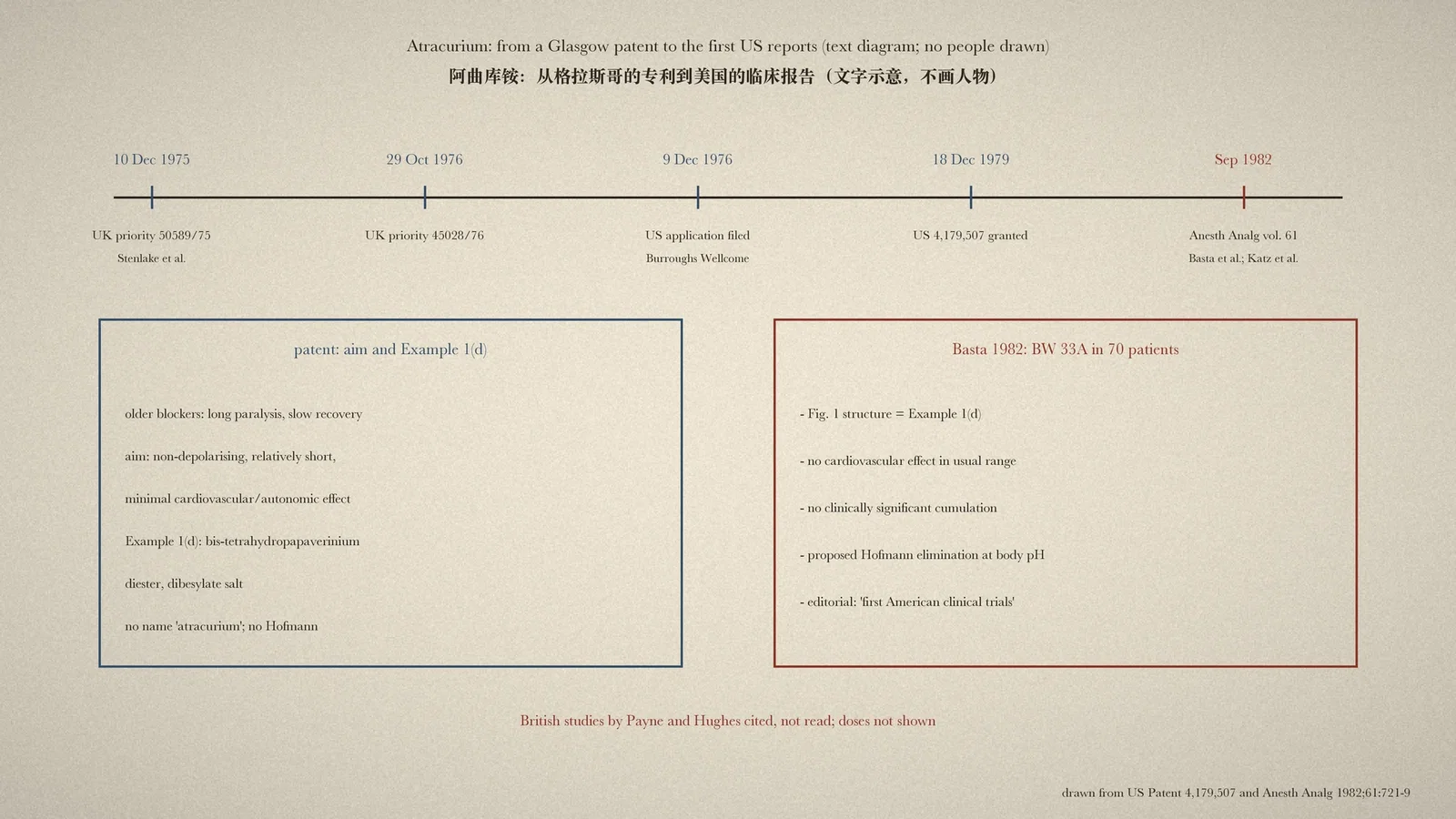
The non-depolarising relaxants of the time lasted a long time, wore off slowly and disturbed the circulation. A patent with priority from Glasgow in December 1975 set out to change that. Six years later, an American journal printed clinical reports from the United States, which its editorial called the first American trials. Those reports added an idea that the patent never mentions: the molecule might break itself down at the pH of the body. [1, PDF p. 2][2, p. 723]
The patent
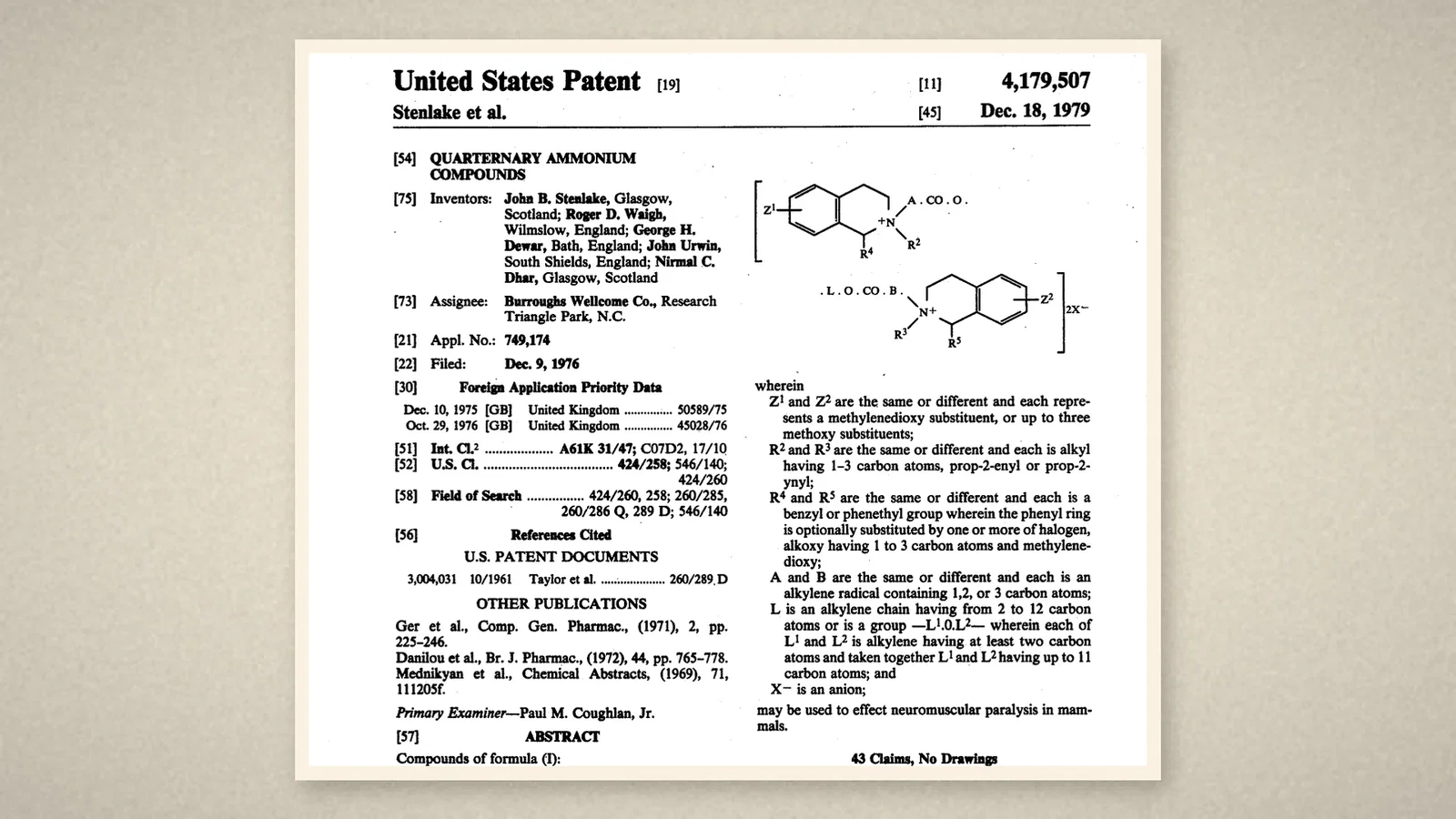
US Patent 4,179,507, "Quaternary ammonium compounds", names five inventors: John B. Stenlake of Glasgow, Roger D. Waigh of Wilmslow, George H. Dewar of Bath, John Urwin of South Shields and Nirmal C. Dhar of Glasgow. Its UK priority applications are dated 10 December 1975 and 29 October 1976. The US application was filed on 9 December 1976, and the patent was granted on 18 December 1979. [1, front page]
The patent first describes the problem. Tubocurarine, pancuronium and gallamine "give rise to paralysis of fairly long duration and the rate of recovery is invariably slow". They also act on autonomic mechanisms. The new isoquinolinium compounds, in contrast, "produce neuromuscular paralysis, by a non-depolarising mechanism of a relatively short duration with a minimal effect upon cardiovascular and autonomic mechanisms". [1, PDF p. 2]
The examples build these compounds from tetrahydropapaverine and pentamethylene diacrylate. Example 1(d) is N,N'-dimethyl-N,N'-4,10-dioxa-3,11-dioxotridecylene-1,13-bis-tetrahydropapaverinium dibesylate. The patent does not use the name atracurium, and nowhere does it mention breakdown in the body. [1, PDF p. 6]
The American trials
The issue of Anesthesia and Analgesia for September 1982, vol. 61, no. 9, printed two studies of the drug. One was "Clinical pharmacology of atracurium besylate (BW 33A)" by Salvatore J. Basta and seven colleagues from the Massachusetts General Hospital, Harvard Medical School and Burroughs Wellcome. The other was a study by Katz and colleagues. [2, p. 723]
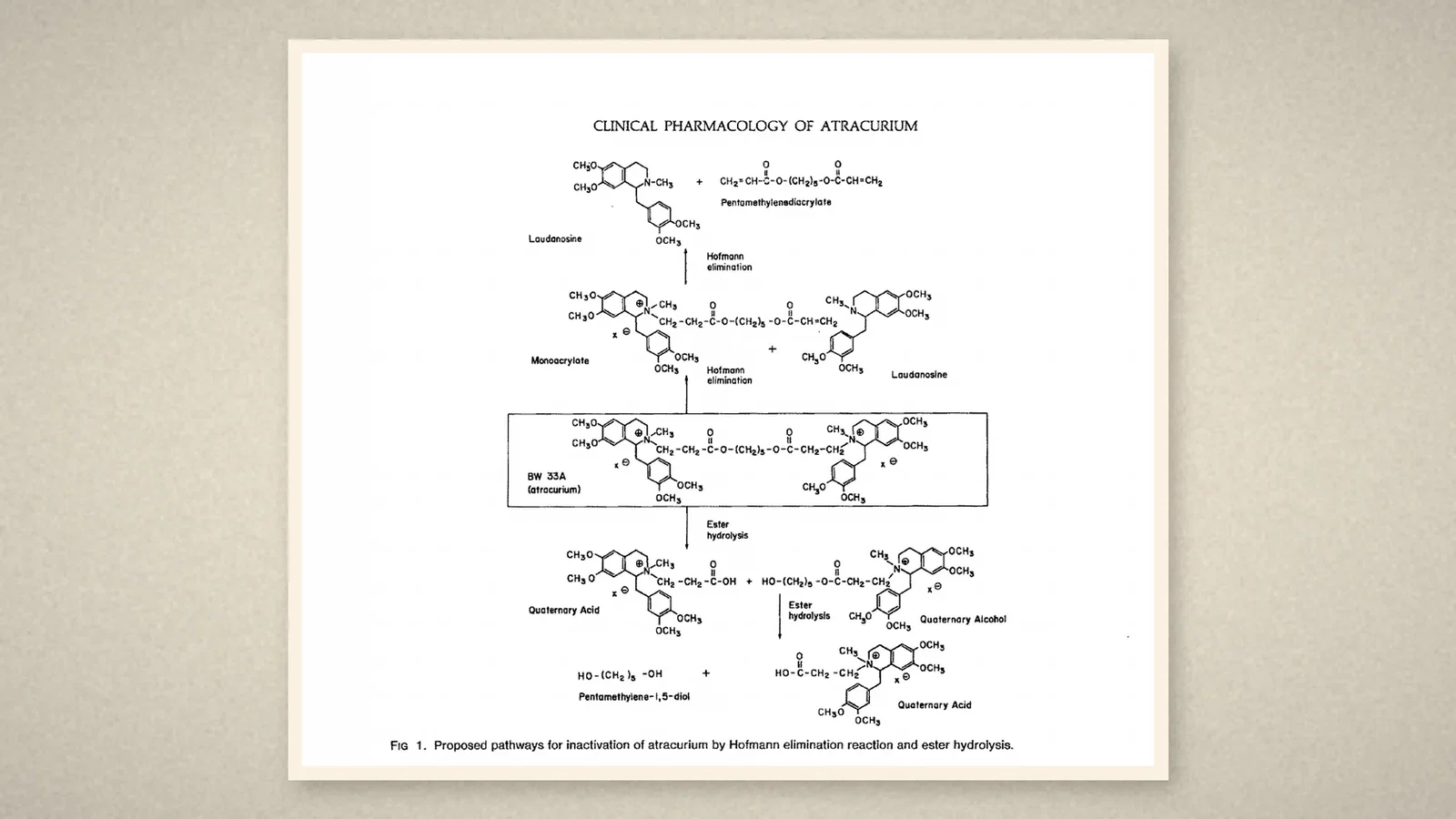
Basta's introduction says that atracurium was "synthesized and developed by Stenlake". In Britain it had been shown "first in animals by Hughes and Chapple and subsequently in anesthetized patients by Payne and Hughes" to be a potent non-depolarising relaxant. Initial studies suggested it might break down at physiological pH in two ways: spontaneously by Hofmann elimination, and by ester hydrolysis that did not depend on plasma cholinesterase. The drug was "currently available for clinical trials in this country". [2, p. 723] Figure 1 draws BW 33A (atracurium) between these two pathways. Its structure, two tetrahydropapaverinium heads joined by a diester chain, is that of the patent's Example 1(d). [2, p. 724]
The study included 70 patients anaesthetised with fentanyl, thiopental and nitrous oxide. "No cardiovascular effects were observed in this dosage range". Larger doses lowered arterial pressure a little and raised heart rate a little. Sixteen patients received at least four successive doses, and "no clinically significant cumulative effect could be shown". The authors concluded that the drug offered several clinical advantages and "should undergo more extensive clinical trials". [2, p. 723]
The editorial
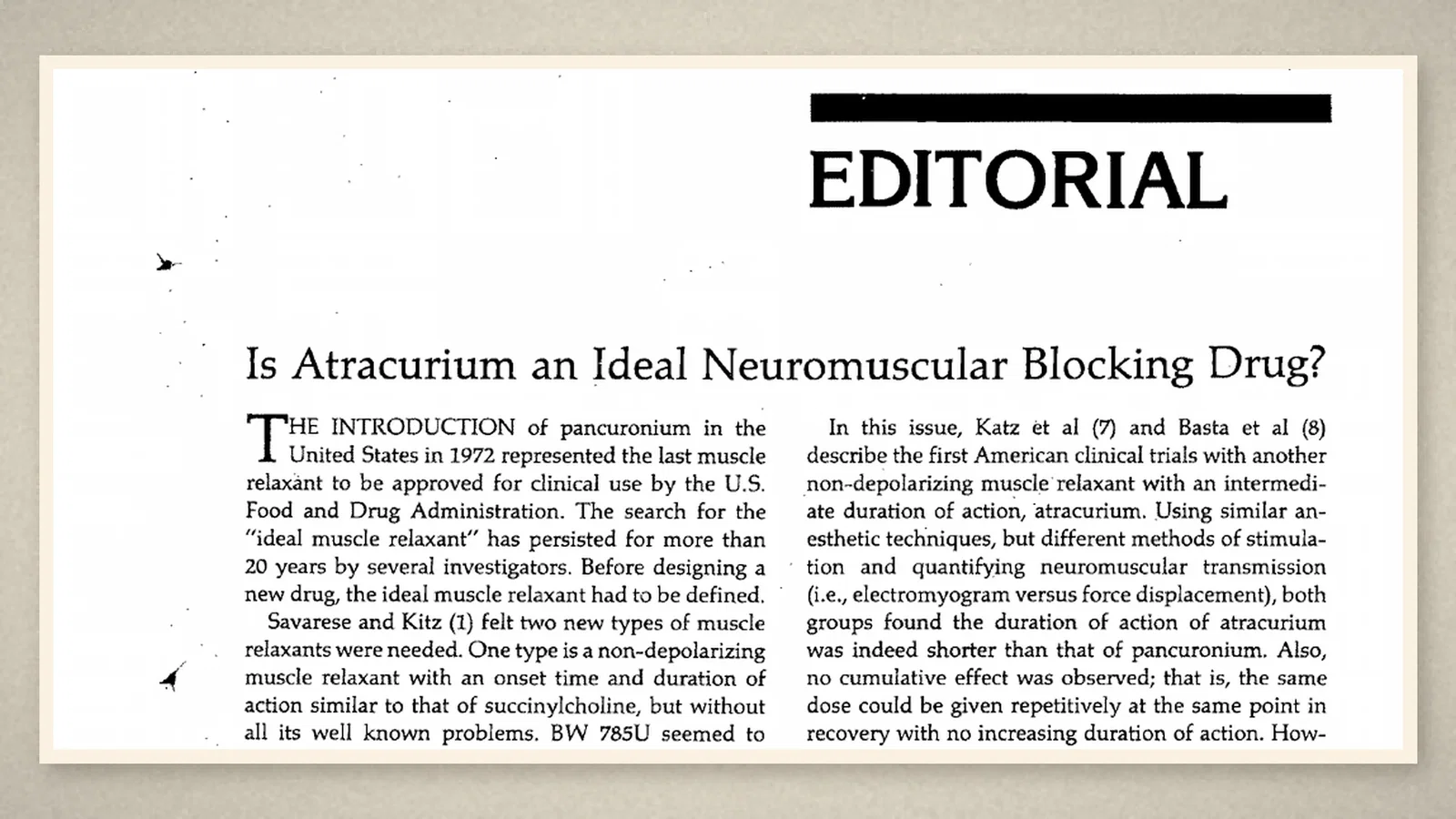
An editorial by Ronald D. Miller of the University of California, San Francisco, opened the issue's discussion. Pancuronium, introduced in the United States in 1972, had been the last relaxant approved by the Food and Drug Administration. Katz and Basta, Miller wrote, "describe the first American clinical trials with another non-depolarizing muscle relaxant", one with an intermediate duration of action. Both groups found it shorter-acting than pancuronium, and in both "no cumulative effect was observed". [2, p. 721]
Miller also marked what was still unknown. The prediction that atracurium did not depend on the kidney or liver for its elimination "remains to be tested in patients". The editorial concluded that atracurium and vecuronium both "represent a significant increase in our flexibility". [2, p. 721][2, p. 722]
What the record shows
The patent's aim was a relaxant that wore off sooner and left the circulation alone. By 1982 a second idea had joined it: a drug that might dismantle itself without the kidney or liver. The American reports supported the first aim. The second was still a proposal, which the editorial said had yet to be tested in patients.
Sources and reading limits
Read: US Patent 4,179,507. This covered the front page, background and statement of the invention (PDF p. 2), and Example 1 including 1(d) (PDF p. 6); the claims were skimmed. Also read from Anesthesia and Analgesia, vol. 61, no. 9 (September 1982): Miller's editorial (pp. 721-722) and Basta and colleagues (pp. 723-729); Katz and colleagues (pp. 730-734) was skimmed. These come from the Internet Archive scan of the volume, with page images checked.
Not covered: Payne and Hughes's British study of 1981; Hughes and Chapple's animal work; Stenlake's chemistry papers; the UK priority applications; and approval records.
Limits: some timelines place this topic at 1980-1981, with Payne and Hughes's human studies, which are not covered and are reported here only as cited. The editorial's reference gives Payne and Hughes's volume as 55, which may be a misprint; this was not checked. The patent does not name atracurium or mention Hofmann elimination. The identification rests on the matching structure in Basta's figure and on the statement that Stenlake synthesised and developed the drug. "First American clinical trials" is Miller's phrase. Doses, onset and recovery times are not repeated, and page crops stop before doses. Patients are not identified.
Three illustrations are crops of the patent's front page and of Anesthesia and Analgesia 1982 (pp. 724 and 721). One is a text diagram drawn from both, with no people drawn and no doses shown.
- Stenlake JB, Waigh RD, Dewar GH, Urwin J, Dhar NC, inventors; Burroughs Wellcome Co., assignee. Quarternary ammonium compounds. US patent 4,179,507. Filed 1976 Dec 9; granted 1979 Dec 18. Google Patents
- Miller RD. Is atracurium an ideal neuromuscular blocking drug? Anesth Analg. 1982;61:721-2; Basta SJ, Ali HH, Savarese JJ, Sunder N, Gionfriddo M, Cloutier G, Lineberry C, Cato AE. Clinical pharmacology of atracurium besylate (BW 33A): a new non-depolarizing muscle relaxant. Anesth Analg. 1982;61:723-9. Internet Archive
Continue exploring
Related reading connects shared questions and contexts; it does not by itself establish historical influence.
- 1951: Thesleff Brings Succinylcholine into the Operating Room
- 1974: Roche Patents the Compounds That Include Midazolam
- 1972: Munich Alternates Etomidate and Propanidid for Induction
Anesthesia Epochs · The Source Room · About & Editorial Method
Published November 3, 2026. Sources and reading limits are stated above. Illustrations are labelled as original source images or AI-made. Historical accounts are educational; they are not current treatment instructions.