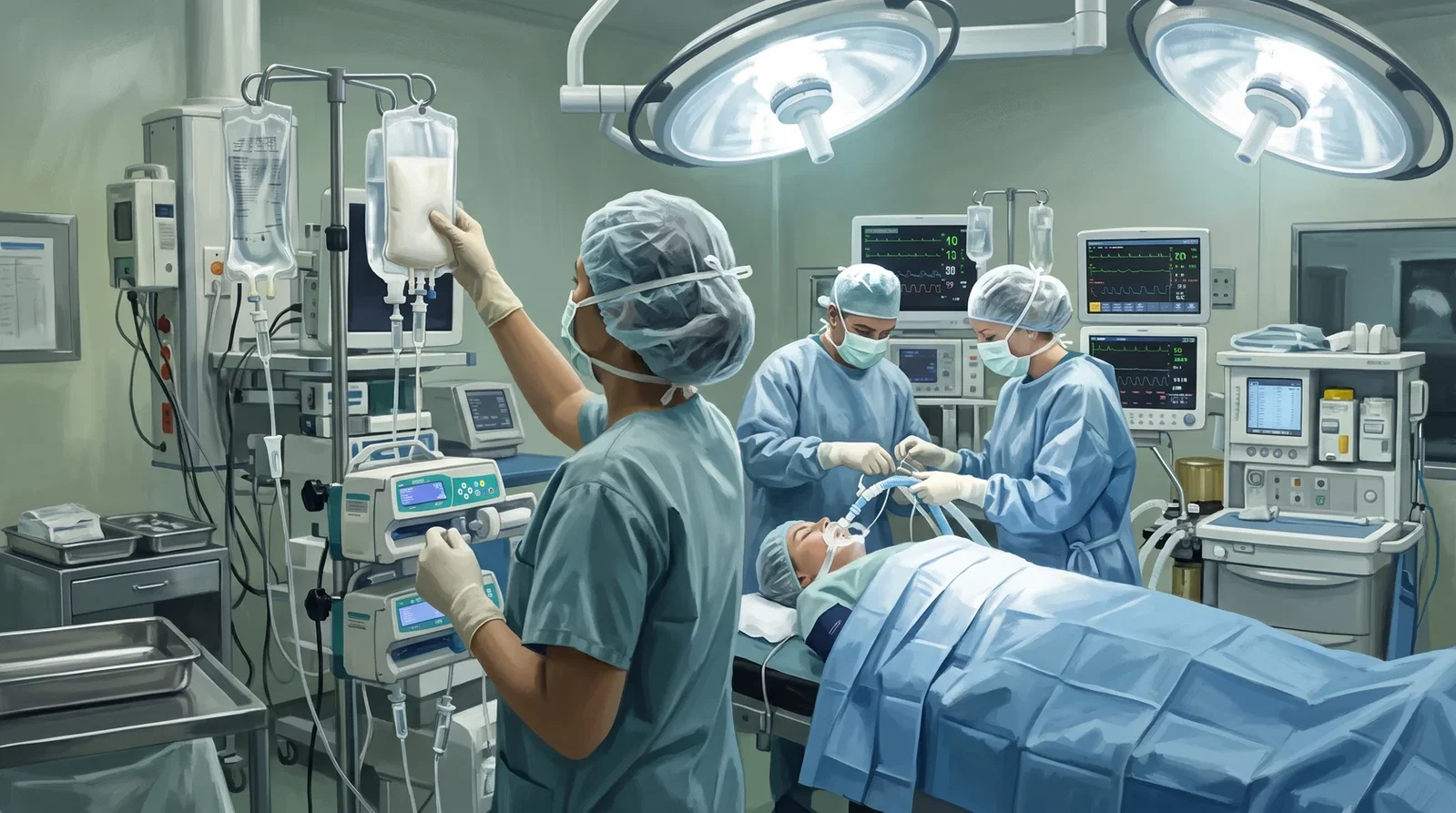
In 1998 Guy Weinberg and colleagues confirmed in rats a chance observation that a lipid infusion raises the dose of bupivacaine needed to stop the heart; in 2006 Rosenblatt's team reported using a lipid emulsion to resuscitate a patient after a presumed bupivacaine-related cardiac arrest.
Reading Library · Anesthesia Epochs · 中文版
Watch the education video (for clinicians)
1998 and 2006: Lipid Emulsion — The Accident That Became an Antidote · Anesthesia Epochs Education Series
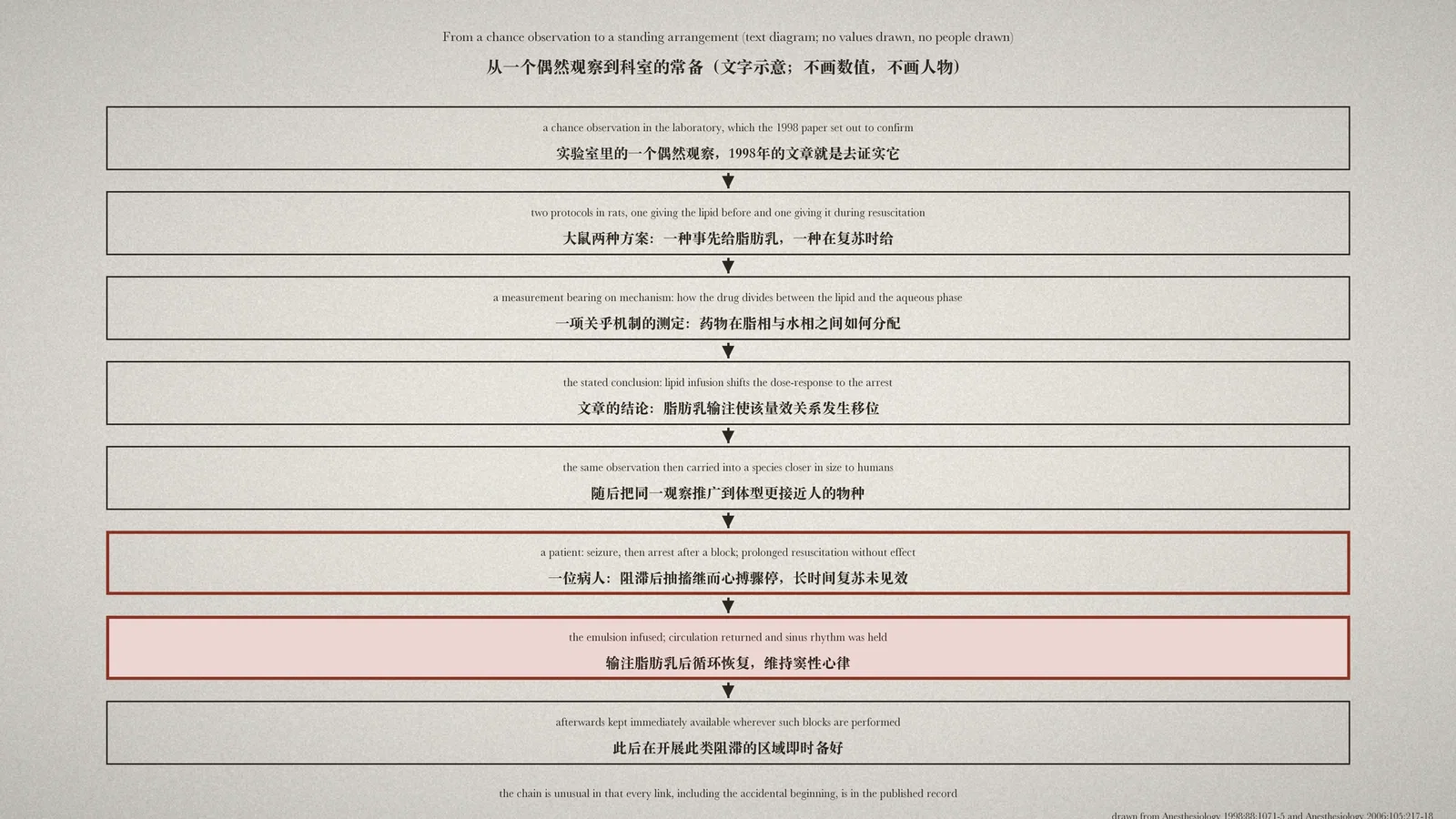
Cardiac arrest after a local anaesthetic reaches the circulation is among the most feared complications of regional anaesthesia: the heart stops, and ordinary resuscitation may go on for a long time without effect. In April 1998 Anesthesiology, vol. 88, pp. 1071-5, published an animal study by Guy L. Weinberg and colleagues; eight years later the same journal published the course of one patient's resuscitation. This article reads both papers. [1, p. 1071][2, p. 217]
First, something noticed by chance
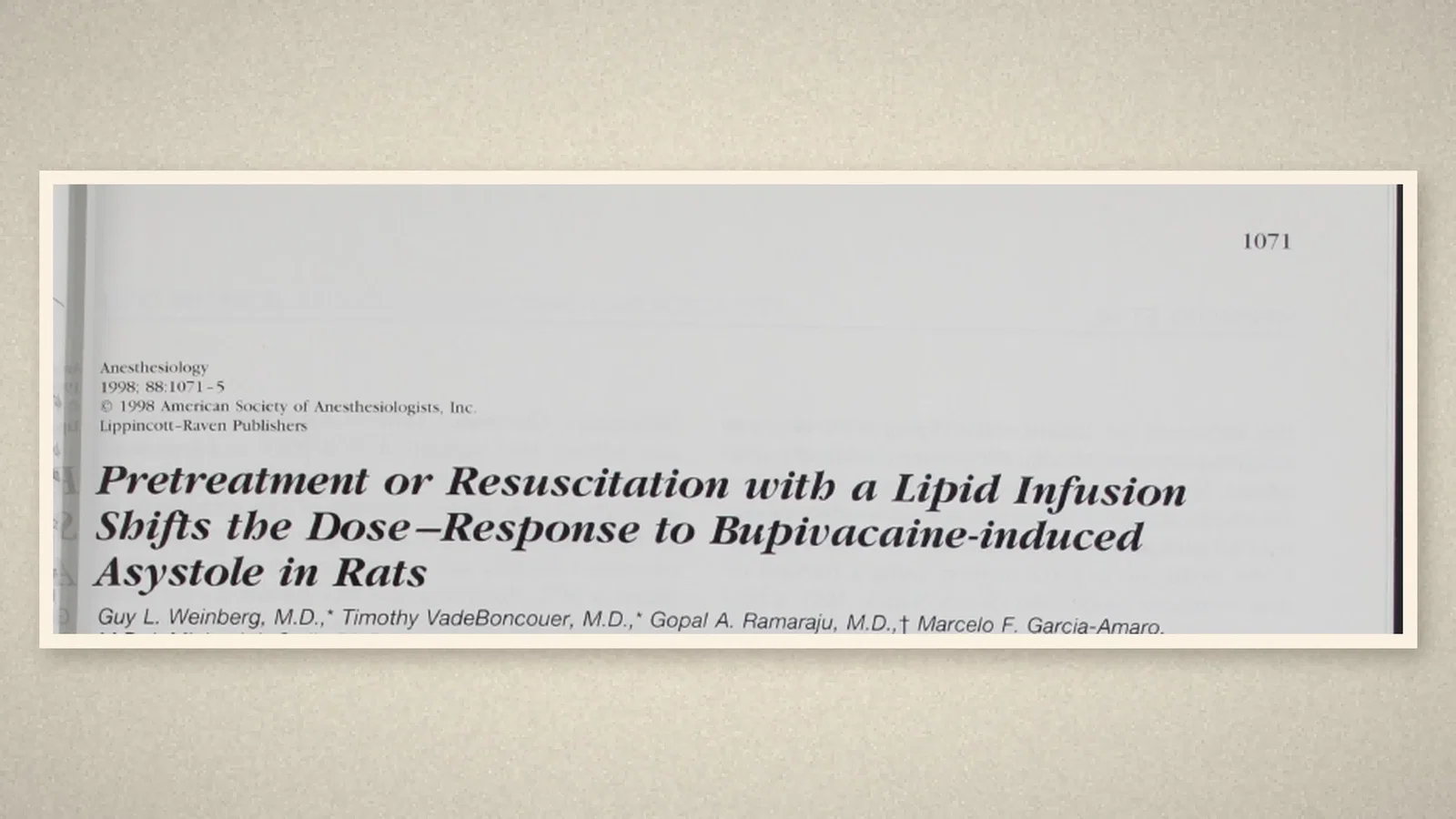
The background of the 1998 paper is put plainly: the authors sought to confirm a chance observation that intravenous lipid treatment increases the dose of bupivacaine required to produce asystole in rats. The starting point, in other words, was not a theory but something met with in the course of other work. [1, p. 1071]
To test it they used two protocols, one of pretreatment, in which the lipid or a control was given before the local anaesthetic, and one of resuscitation, in which the lipid or a control was given after the crisis had been produced. [1, p. 1071]
They also made a measurement bearing on mechanism: using radiolabelled bupivacaine, they determined how the drug partitions between the lipid and aqueous phases of a plasma and lipid emulsion mixture. That puts a simple idea on the table, that the emulsion may act as a lipid compartment drawing a fat-soluble local anaesthetic out of the aqueous phase. [1, p. 1071]
The conclusion is stated soberly: lipid infusion shifts the dose-response to bupivacaine-induced asystole. [1, p. 1071]
A patient, eight years later
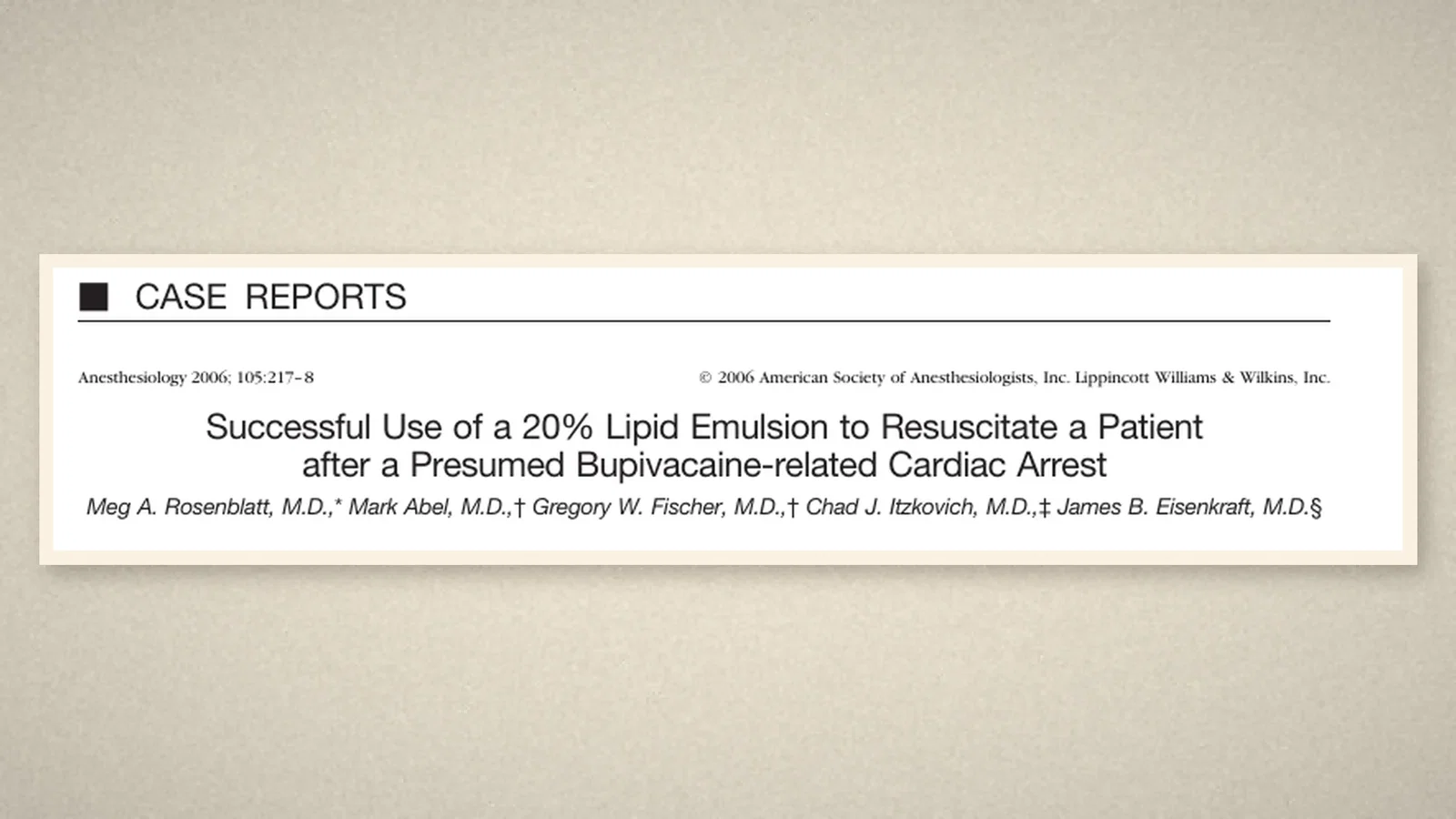
In July 2006 Anesthesiology, vol. 105, pp. 217-18, published a case report from Meg A. Rosenblatt and colleagues in the Department of Anesthesiology at the Mount Sinai School of Medicine, New York. It opens with the background: the infusion of a lipid emulsion had been shown to increase the survival of both rats and dogs resuscitated after an overdose of bupivacaine. [2, p. 217]
The course, as the report gives it: immediately after an interscalene block containing bupivacaine and mepivacaine the patient seized; the seizure was stopped and spontaneous respiration returned, but seizing resumed shortly afterwards, the electrocardiogram then showed asystole, and no pulse or blood pressure was detectable. Advanced cardiac life support was begun at once, the trachea was intubated, tube position was confirmed, and chest compressions were started. [2, p. 217]
After a prolonged resuscitation an infusion of lipid emulsion was begun. Circulation returned, the patient remained in sinus rhythm, was later weaned from mechanical ventilation, had no neurological sequelae and was discharged home. [2, pp. 217-18]
How the authors describe it
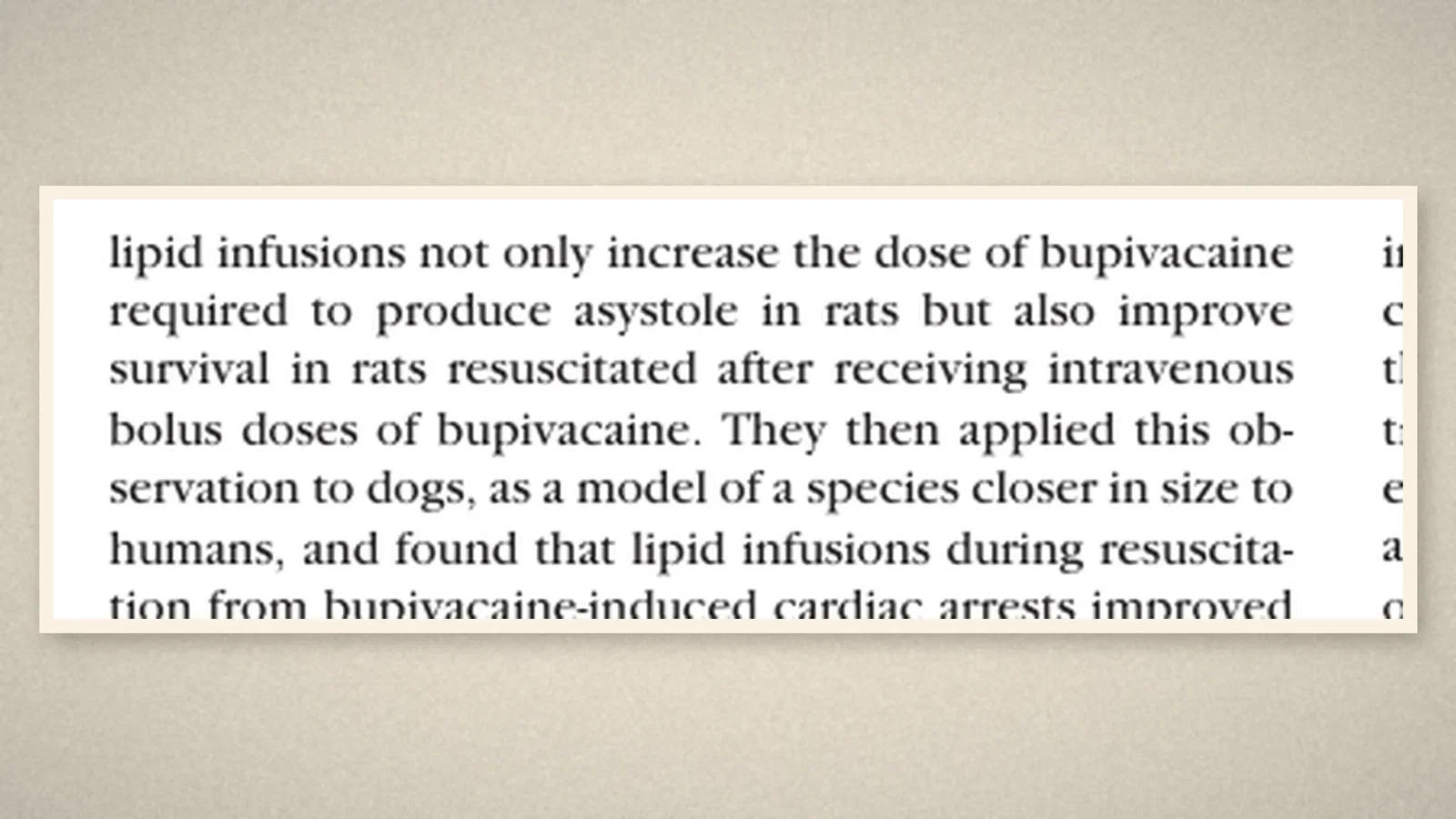
The report states in its opening that this was the first successful use of a lipid infusion to resuscitate a patient from a prolonged cardiac arrest of this kind. That is the authors' own wording, reported here as they put it. [2, p. 217]
The discussion joins the chain together: Weinberg and colleagues had shown that lipid infusions not only increase the dose of bupivacaine required to produce asystole in rats but also improve survival in rats resuscitated after intravenous bupivacaine; they then applied the observation to dogs, a species closer in size to humans, and found lipid infusion during resuscitation effective there too. This case was an attempt built on that animal evidence, made when the usual measures had gone on without success. [2, p. 218]
The report also records a concrete change in practice: after this event, a bag of the emulsion was kept immediately available in the areas where peripheral nerve blocks were performed. [2, p. 218]
What the record shows
Together the two papers trace an unusually complete chain: an observation nobody set out to make, an experiment designed to confirm it with a measurement bearing on why it might work, wider confirmation in a second species, a use at the bedside when the ordinary measures were failing, and then a standing arrangement in the department. Every link is in the published record, including the authors' own admission that the beginning was an accident.
Sources and reading limits
Read: Weinberg GL, VadeBoncouer T, Ramaraju GA, Garcia-Amaro MF, Cwik MJ, "Pretreatment or resuscitation with a lipid infusion shifts the dose-response to bupivacaine-induced asystole in rats", Anesthesiology, April 1998, vol. 88, no. 4, pp. 1071-5, in full; and Rosenblatt MA, Abel M, Fischer GW, Itzkovich CJ, Eisenkraft JB, "Successful use of a 20% lipid emulsion to resuscitate a patient after a presumed bupivacaine-related cardiac arrest", in the same journal, July 2006, vol. 105, no. 1, pp. 217-18, in full. The page images of the first page of each were checked.
Not covered: the dog experiments cited in the 2006 report, and the original source of the chance observation the 1998 paper set out to confirm.
Limits: no doses, concentrations, infusion rates or laboratory values from either paper are reproduced here; the animal results are given in direction only, the clinical course in outline, and no personal details of the patient are given. The 2006 report's description of itself as a first is reported as its own wording.
Three illustrations are taken from the two papers (1998, p. 1071; 2006, pp. 217 and 218). One is a diagram drawn from the texts, with no people drawn and no numerical values shown.
- Weinberg GL, VadeBoncouer T, Ramaraju GA, Garcia-Amaro MF, Cwik MJ. Pretreatment or resuscitation with a lipid infusion shifts the dose-response to bupivacaine-induced asystole in rats. Anesthesiology. 1998;88(4):1071-5. doi:10.1097/00000542-199804000-00028
- Rosenblatt MA, Abel M, Fischer GW, Itzkovich CJ, Eisenkraft JB. Successful use of a 20% lipid emulsion to resuscitate a patient after a presumed bupivacaine-related cardiac arrest. Anesthesiology. 2006;105(1):217-8. doi:10.1097/00000542-200607000-00033
Continue exploring
Related reading connects shared questions and contexts; it does not by itself establish historical influence.
Anesthesia Epochs · The Source Room · About & Editorial Method
Published November 5, 2026. Sources and reading limits are stated above. Illustrations are labelled as original source images or AI-made. Historical accounts are educational; they are not current treatment instructions.