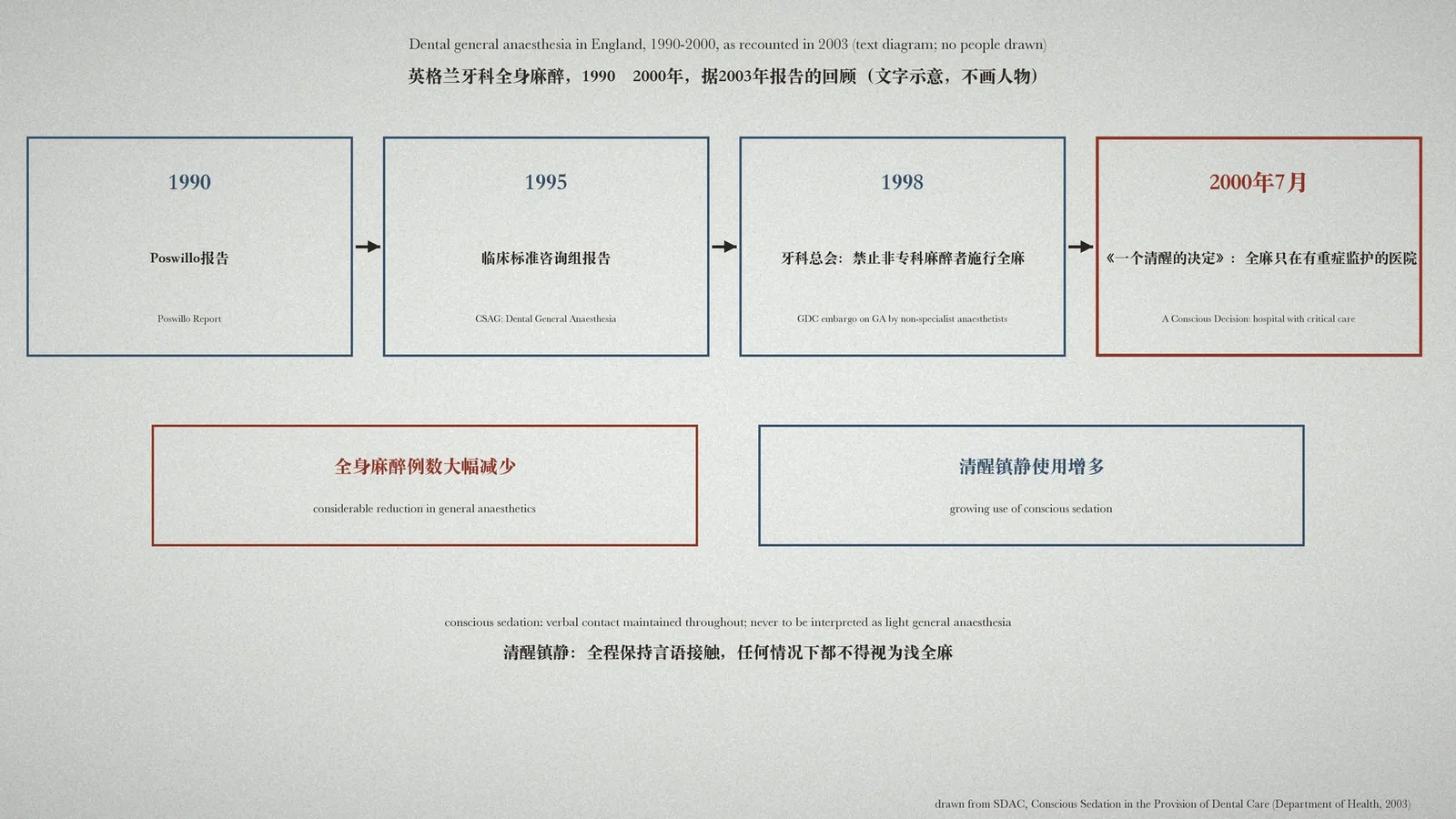
The 2003 Standing Dental Advisory Committee report Conscious Sedation in the Provision of Dental Care, commissioned by the Department of Health, recounts the path: the 1990 Poswillo Report heralded change in dental general anaesthesia, sedation and resuscitation; the 1995 Clinical Standards Advisory Group report set standards for care, facilities and training; in 1998 the General Dental Council placed an immediate embargo on general anaesthesia by non-specialist anaesthetists; and in July 2000 the expert report A Conscious Decision, chaired by the Chief Medical and Chief Dental Officers, confined dental general anaesthesia to hospitals with immediate critical care and endorsed conscious sedation by a trained operator-sedationist with a trained assistant, after which general anaesthetics fell sharply; the Australian Society of Anaesthetists' timeline records a UK-wide ban in dental surgeries in 2001 because of unacceptable morbidity and mortality.
Reading Library · Anesthesia Epochs · 中文版
Watch the education video (for clinicians)
2000: A Conscious Decision — Dental Anaesthesia Moves to Hospital · Anesthesia Epochs Education Series
Should a tooth extraction be done under general anaesthesia? In Britain, for a long time, general anaesthesia given in the dental surgery was common practice. Around 2000 it left the surgery, and dental general anaesthesia was confined to hospitals with critical care. The key document was the Department of Health's 2000 expert report A Conscious Decision. That report itself is not covered in this article; it reads instead the expert-group report Conscious Sedation in the Provision of Dental Care, commissioned by the Department and published in 2003, whose foreword and background tell the story. [1, p. 1][1, p. 7]
A report of 2003
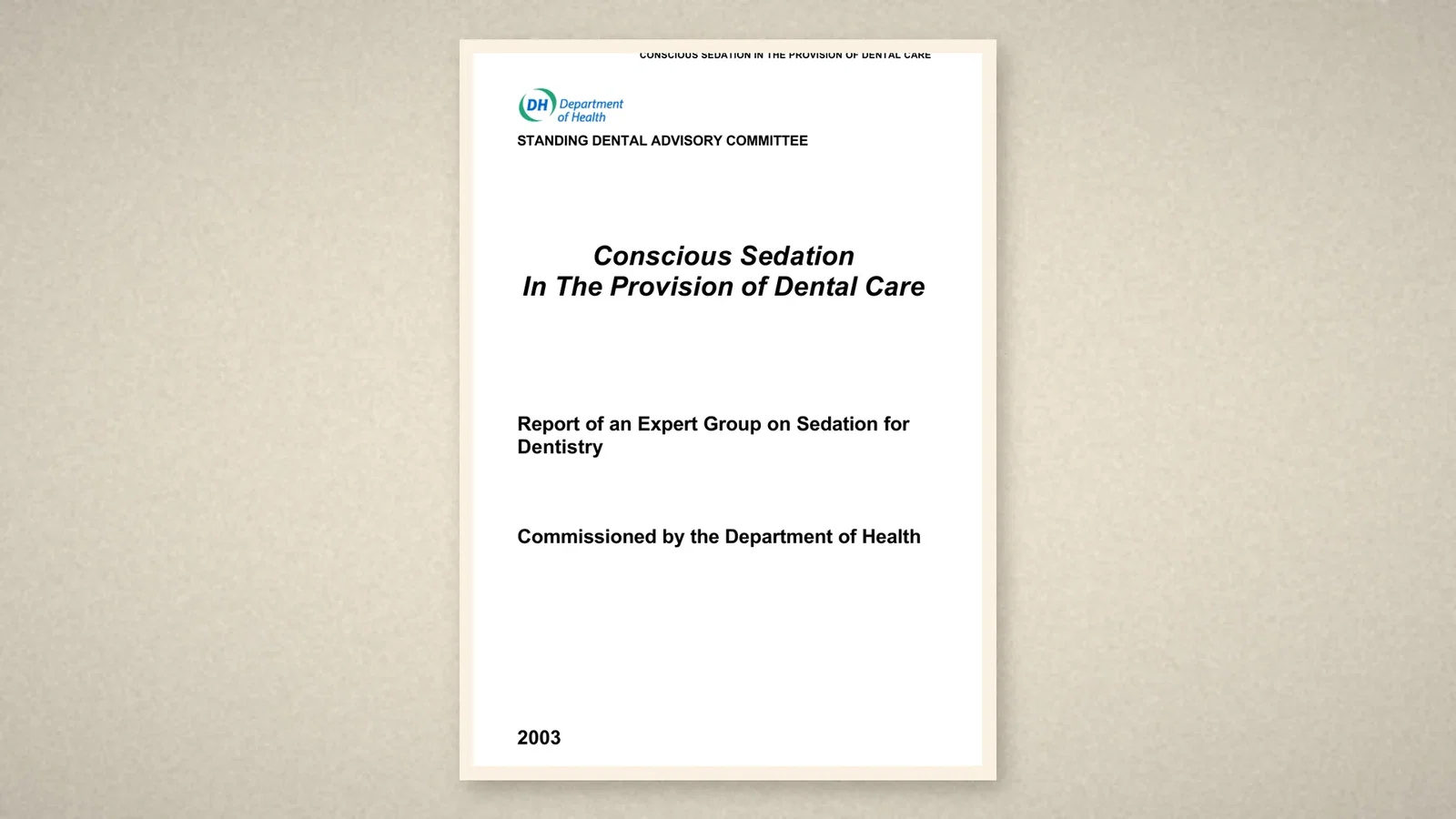
The report was issued by the Department of Health's Standing Dental Advisory Committee as the report of an Expert Group on Sedation for Dentistry, "commissioned by the Department of Health". Its foreword explains that A Conscious Decision, the report of an expert group chaired by the Chief Medical Officer and the previous Chief Dental Officer, was published in 2000. It built on earlier working groups that had stressed that general anaesthesia for dental treatment should be used only when no other method of pain and anxiety management was appropriate for the patient, and it recommended that, when a general anaesthetic was considered necessary, it be provided in the safest possible way. This led to general anaesthesia for dentistry being confined to a hospital setting with the immediate availability of a critical care facility. [1, p. 1][1, p. 7]
The change, the foreword continues, brought a considerable reduction in the number of general anaesthetics and a growing use of conscious sedation in primary care and hospitals, and so a need for clarity about the standards conscious sedation should meet, which was the task of the 2003 report. [1, p. 7]
Step by step
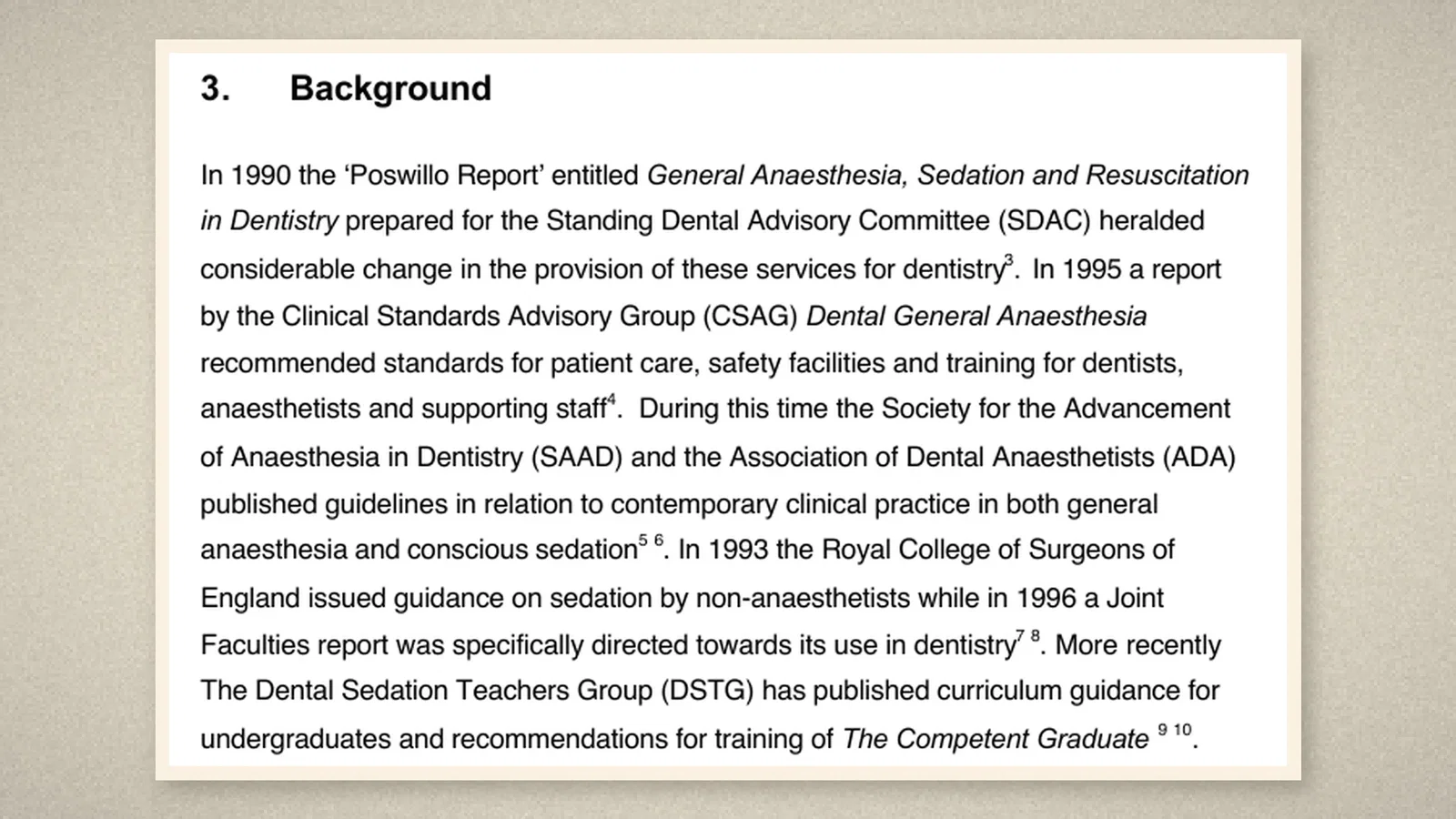
The background section sets out the earlier steps. In 1990 the Poswillo Report, General Anaesthesia, Sedation and Resuscitation in Dentistry, prepared for the Standing Dental Advisory Committee, heralded considerable change in these services. In 1995 the Clinical Standards Advisory Group report Dental General Anaesthesia recommended standards for patient care, safety facilities and the training of dentists, anaesthetists and supporting staff. In the same period the Society for the Advancement of Anaesthesia in Dentistry and the Association of Dental Anaesthetists published practice guidelines, and the Royal College of Surgeons of England issued guidance on sedation by non-anaesthetists. [1, p. 14]
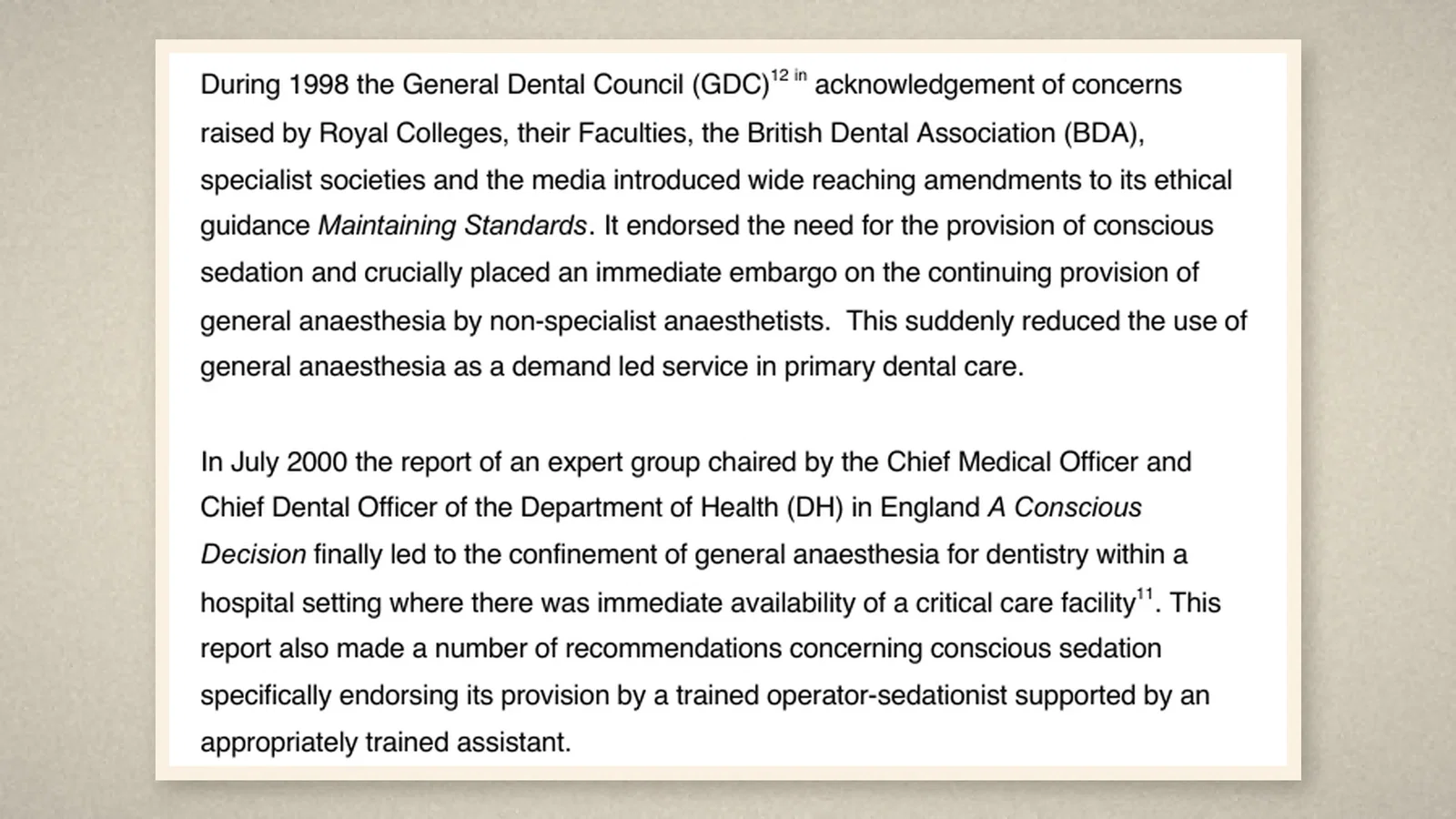
In 1998 the General Dental Council, acknowledging concerns raised by the Royal Colleges, the British Dental Association, specialist societies and the media, made wide-reaching amendments to its ethical guidance Maintaining Standards: it endorsed the provision of conscious sedation and, crucially, placed an immediate embargo on general anaesthesia given by non-specialist anaesthetists, which, the report says, suddenly reduced demand-led general anaesthesia in primary dental care. In July 2000 the expert report chaired by the Chief Medical Officer and Chief Dental Officer, A Conscious Decision, finally confined general anaesthesia for dentistry to hospitals with immediate availability of a critical care facility; it also made recommendations on conscious sedation, specifically endorsing its provision by a trained operator-sedationist supported by an appropriately trained assistant. [1, p. 15]
Conscious sedation is not light anaesthesia
The 2003 report defines conscious sedation as a technique in which drugs depress the central nervous system enough for treatment to be carried out, but during which verbal contact with the patient is maintained throughout; the drugs and techniques should carry a margin of safety wide enough to make loss of consciousness unlikely. In bold type it insists that the level of sedation must leave the patient conscious and able to understand and respond to verbal commands, and that conscious sedation must under no circumstances be interpreted as light general anaesthesia. [1, pp. 14-15]
Another record
The Australian Society of Anaesthetists' history timeline records, under 2001, that general anaesthesia was banned in dental surgeries throughout the United Kingdom, "due to unacceptable morbidity and mortality". [2, p. 87]
What the record shows
The change in British dental anaesthesia was not a ban overnight but the result of reports and professional rules tightening between 1990 and 2000: first standards, then limits on who could give general anaesthesia, and finally limits on where. It also shows that the safety of an anaesthetic practice often depends on the setting in which it is given.
Sources and reading limits
Read: Standing Dental Advisory Committee, Conscious Sedation in the Provision of Dental Care: Report of an Expert Group on Sedation for Dentistry (commissioned by the Department of Health, 2003), the foreword, background, definition of conscious sedation and references (pp. 1-15 and the reference list), the clinical recommendations skimmed. The copy read is hosted by the Dental Fear Central website and carries the Department of Health and Committee title page. Page images of pp. 1, 7, 14 and 15 checked. The 2001 entry of the Australian Society of Anaesthetists' 2024 history timeline, p. 87.
Not covered: A Conscious Decision (Department of Health, July 2000) itself; the Poswillo Report (1990) and the CSAG report (1995); the General Dental Council's Maintaining Standards.
Limits: everything said about the 2000 report rests on the 2003 report's account; the ASA timeline dates the UK-wide ban to 2001, while this article is dated by the July 2000 report. Sedative drugs and doses are not repeated.
Three illustrations are taken from the 2003 report (title page, p. 14, p. 15). One is a text diagram drawn from the report, with no people drawn.
- Standing Dental Advisory Committee. Conscious Sedation in the Provision of Dental Care: Report of an Expert Group on Sedation for Dentistry. Commissioned by the Department of Health. London: Department of Health; 2003. PDF
- Australian Society of Anaesthetists. Anaesthesia History Timeline. 2024. PDF
Continue exploring
Related reading connects shared questions and contexts; it does not by itself establish historical influence.
Anesthesia Epochs · The Source Room · About & Editorial Method
Published November 4, 2026. Sources and reading limits are stated above. Illustrations are labelled as original source images or AI-made. Historical accounts are educational; they are not current treatment instructions.