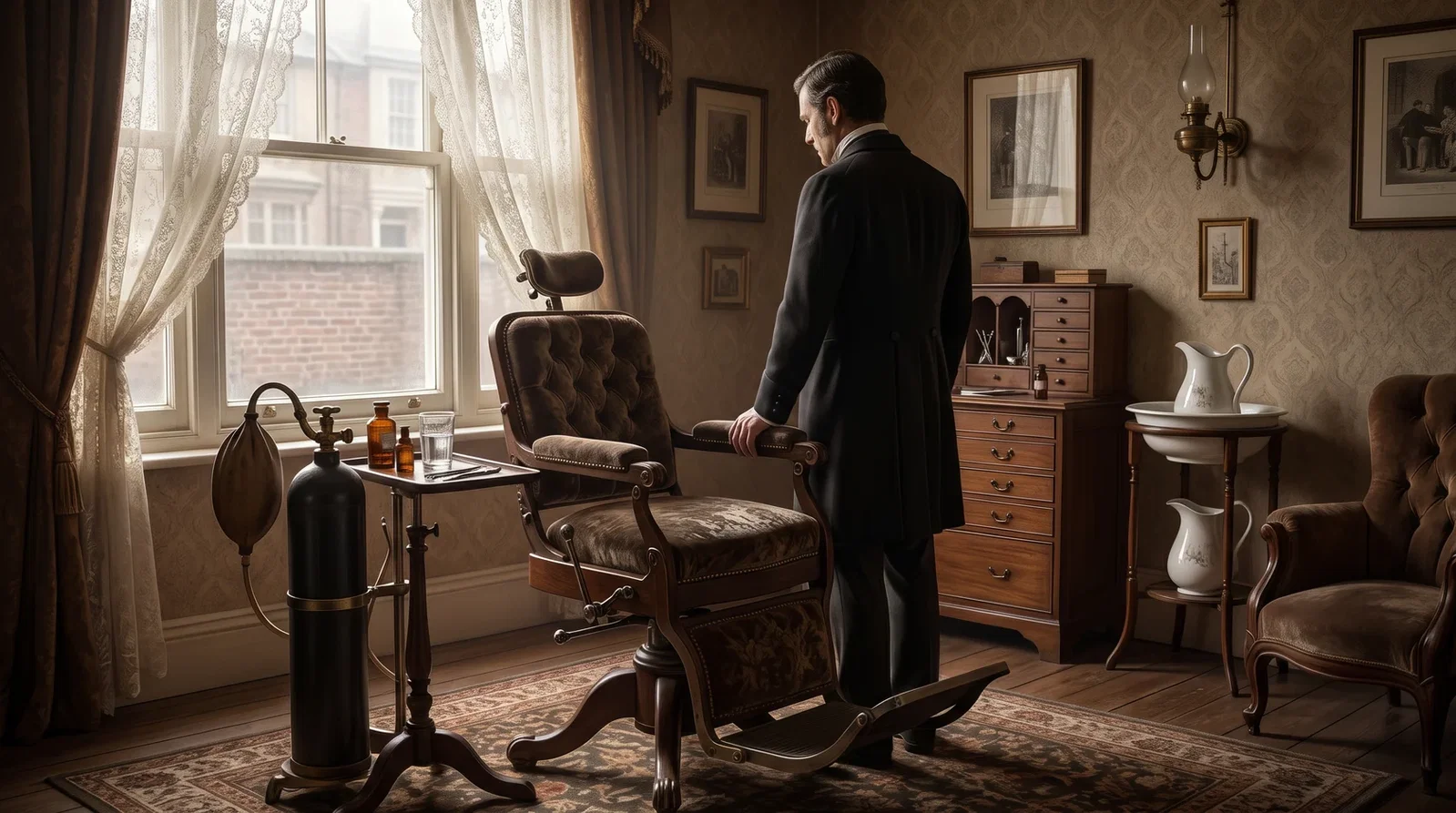
Reporting a death after a tooth extraction, The Lancet argued that the gas buys brief insensibility by suspending respiration rather than acting as a true anaesthetic.
Reading Library · Anesthesia Epochs · 中文版
Watch the education video (for clinicians)
1873: The Exeter Nitrous Oxide Death — An Interval of Partial Death · Anesthesia Epochs Education Series
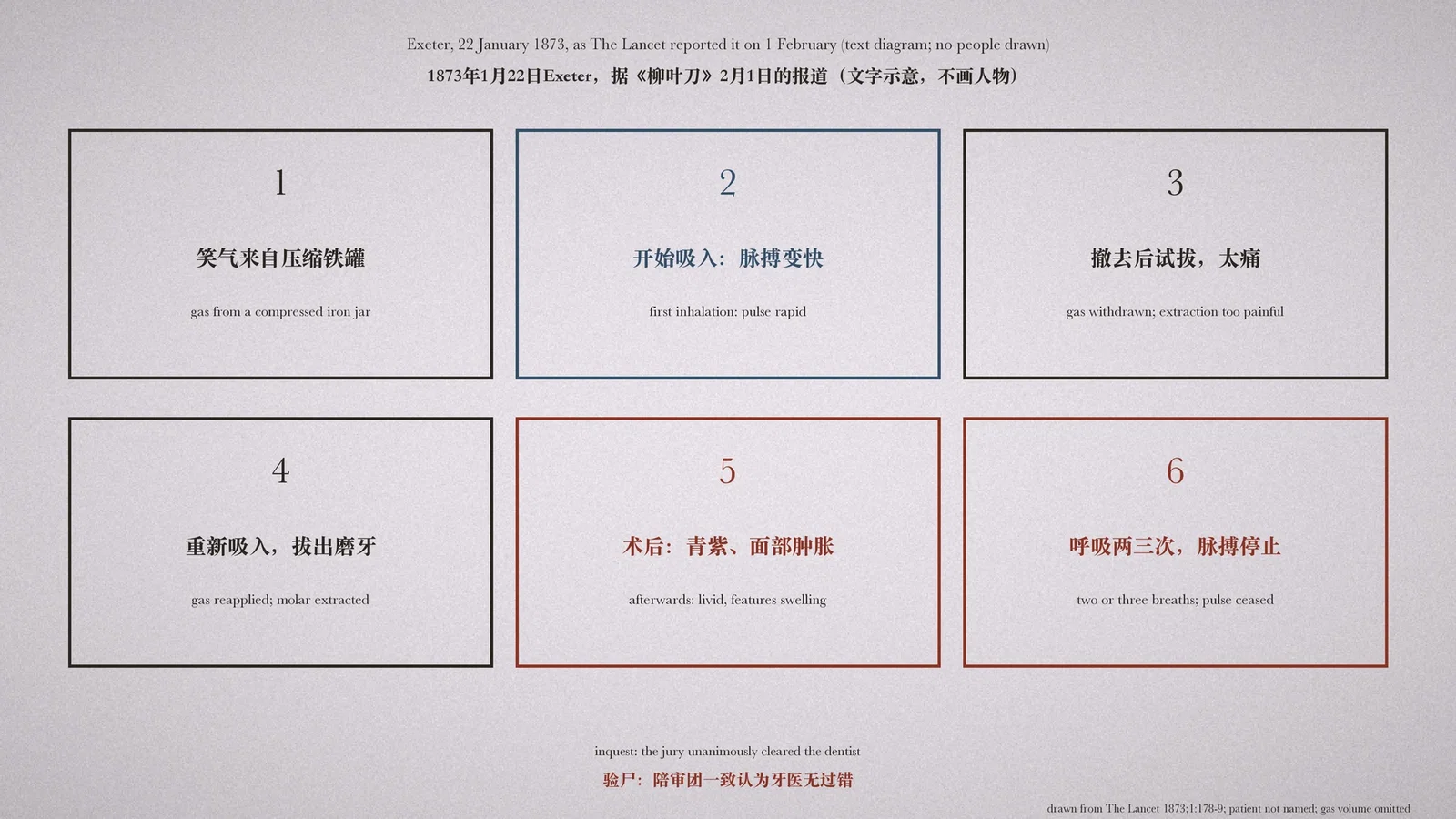
Nitrous oxide had been neglected in the first years of anaesthesia, then returned to favour in dentistry, compressed into iron jars and quick to act for a single extraction. Many believed it almost free of danger. In January 1873 a patient died under it at Exeter in the south-west of England, and The Lancet reported and discussed the case on 1 February over more than a page. This article reads that annotation; the patient is not named. [1, pp. 178-179][2]
An afternoon at Exeter
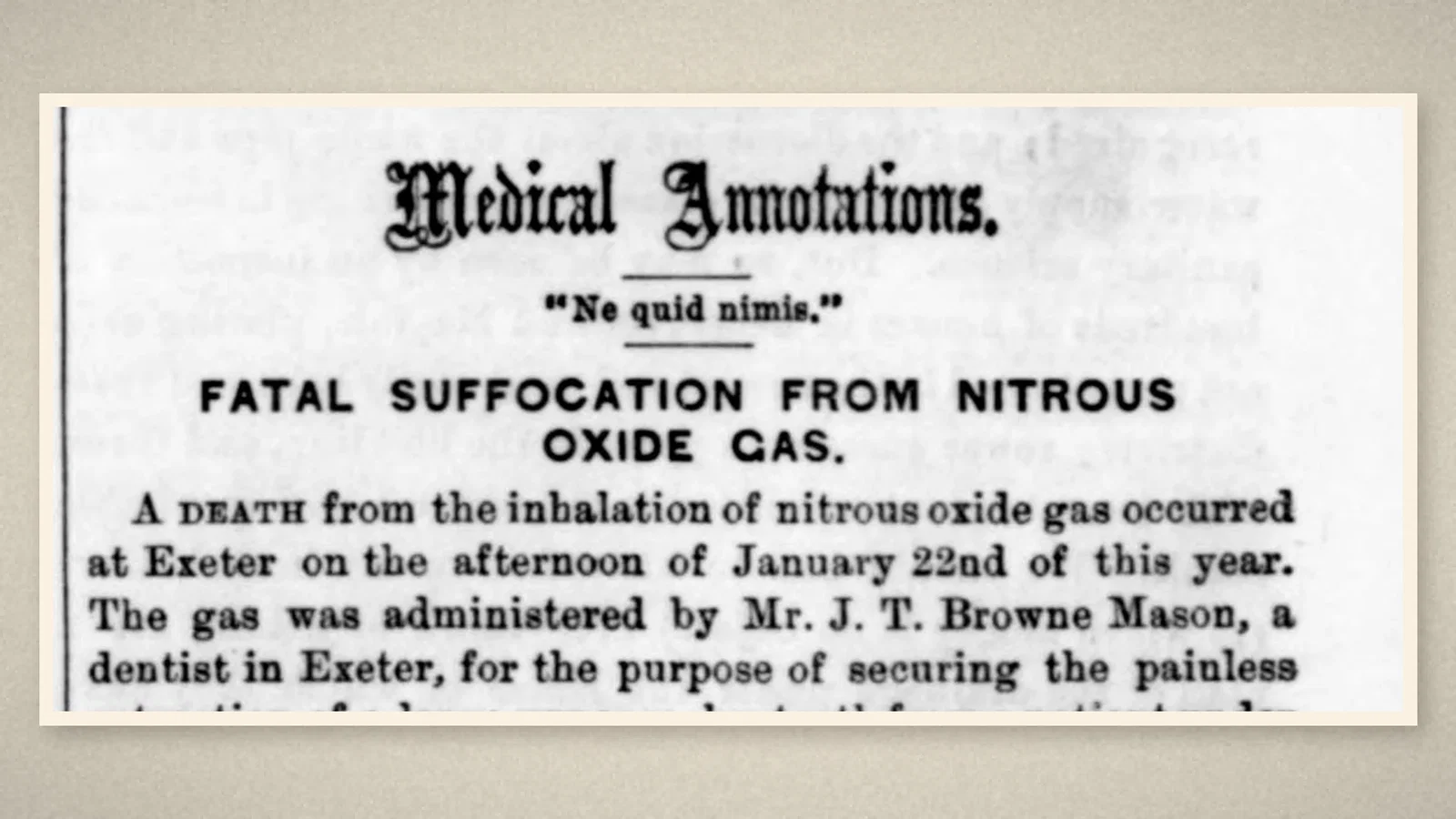
The report, "Fatal suffocation from nitrous oxide gas", ran under the heading "Medical Annotations". On the afternoon of 22 January the Exeter dentist J. T. Browne Mason gave nitrous oxide to a patient of Dr Pattinson for the painless extraction of a large upper molar. As the first death from the gas reported in Britain, the journal wrote, the facts deserved special record; that is the journal's claim. [1, p. 178]
The patient, a woman of about 38, had recently had a slight cold but had recovered. The tooth could not be removed without great pain, so at the patient's earnest request the gas was chosen, and Dr Pattinson found nothing to forbid it. The gas came from an ordinary compressed iron jar from which others had breathed without accident, so its quality was not in question, and it was given so as to supply fresh gas constantly without rebreathing. The patient had taken neither luncheon nor dinner. The dentist had used the gas for nearly two years, sometimes twice or three times a day. [1, pp. 178-179]
At the start of inhalation the pulse became rapid and, Dr Pattinson thought, less full, so the inhaler was taken away and an attempt made while the patient was conscious; it was unbearable, and the patient begged for the gas again. After a short pause to rinse the mouth the inhaler was reapplied without any sign of alarm, and at the proper degree of insensibility the gas was stopped and the tooth extracted, its roots split and taken out separately. Nothing unusual happened until the operation was over; then the face became livid and the features, it was said, "commenced to swell". The dentist fetched Dr Drake, who found the patient still alive, sitting half reclined in a chair before an open window with Dr Pattinson trying to restore animation; the features were livid and swollen and consciousness seemed gone; there were two or three breaths, and moments later the pulse ceased. All efforts at revival failed. [1, p. 179]
The editors' lessons
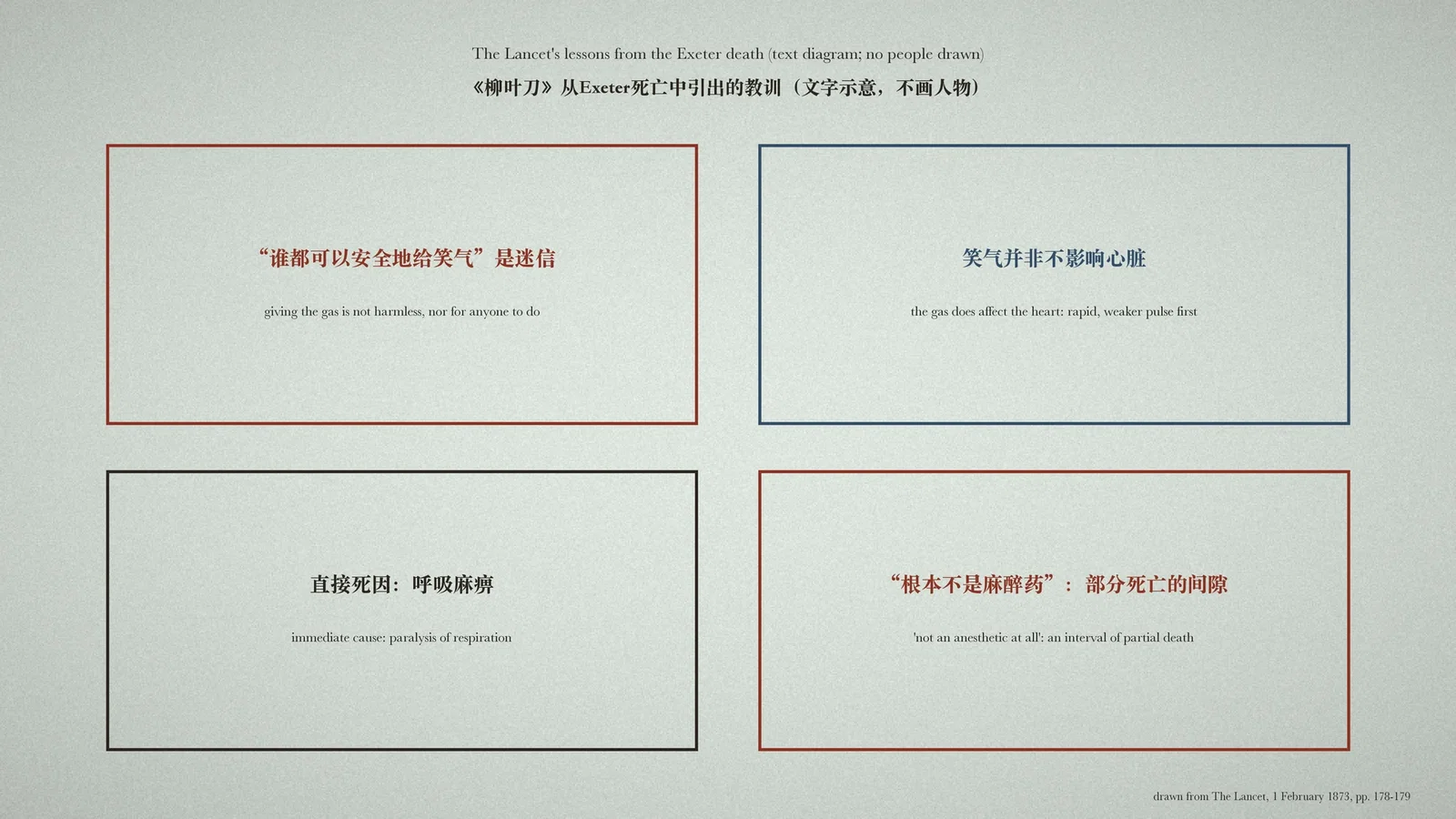
These simple facts, the journal said, taught a serious lesson. First, they destroyed "the infatuation that the administration of nitrous oxide gas is a harmless process", one that "any man, educated or uneducated, may carry out" without risk to life. No agent had produced so many hair-breadth escapes, and only weeks before a leading dentist had said that no extraction began until breathing had temporarily stopped; because no death was believed to have occurred, the practice had gone on in contempt of warning and obvious danger. [1, p. 179]
Second, the frequent assertion that nitrous oxide does not affect the heart was unfounded, since the first sign in this patient was a rapid, weaker pulse. Yet the immediate cause of death was plainly paralysis of respiration: the airway was not obstructed, the tongue protruded while breathing continued, and, as Dr Drake told the inquest, the patient was as powerless to breathe as someone immersed in water. [1, p. 179]
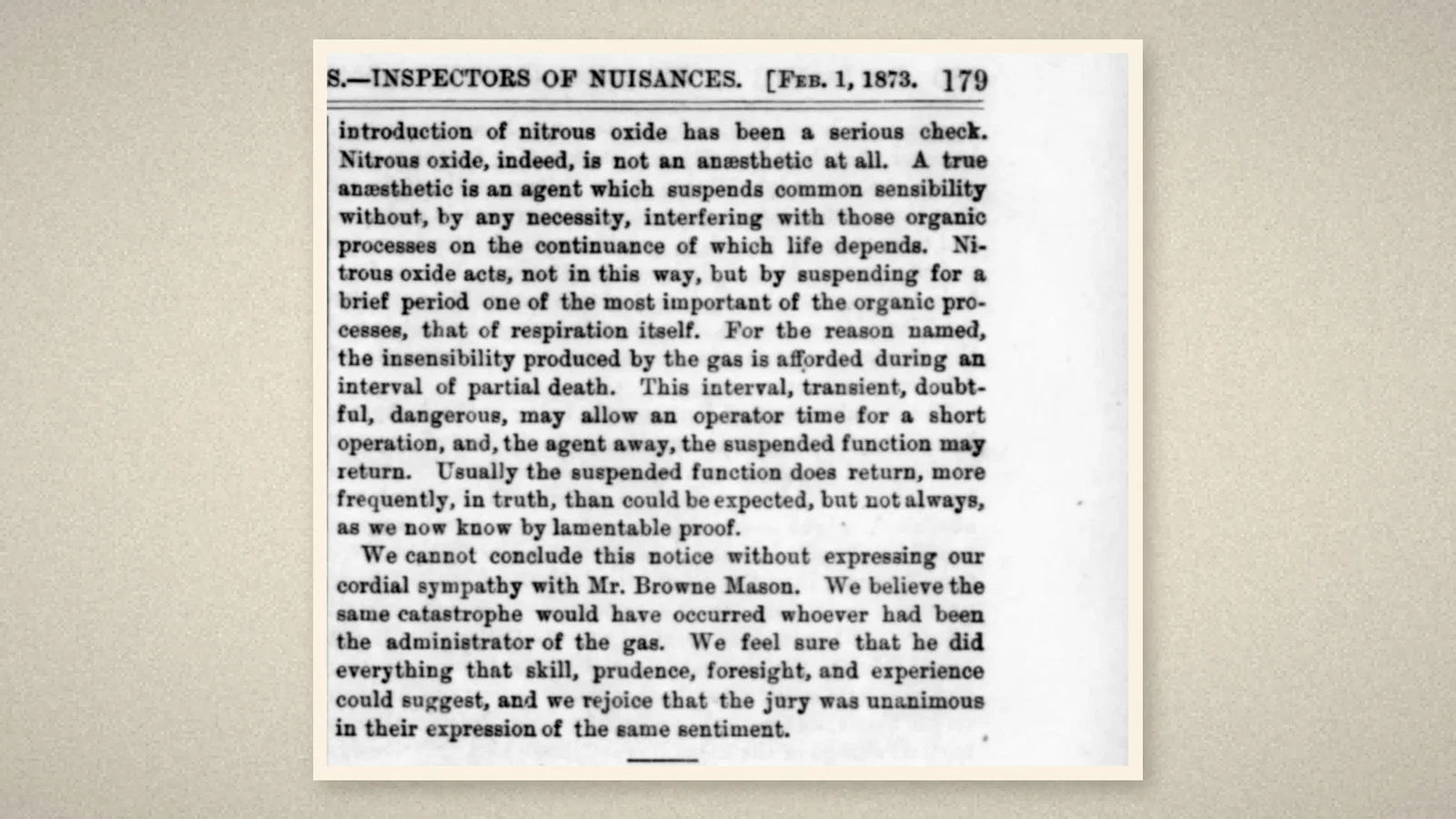
The most important lesson was that there was still much to learn before anaesthesia was perfected, and that the reintroduction of nitrous oxide had been a serious check. "Nitrous oxide, indeed, is not an anesthetic at all." A true anaesthetic, the editors wrote, suspends common sensibility without necessarily interfering with the organic processes on which life depends; nitrous oxide works instead by suspending for a brief period the most important of them, respiration, so that its insensibility is "afforded during an interval of partial death". The interval, transient, doubtful and dangerous, may give an operator time for a short operation; when the gas is removed the suspended function usually returns, more often than might be expected, "but not always, as we now know by lamentable proof". [1, p. 179]
The annotation closed with cordial sympathy for the dentist: the same catastrophe, the editors believed, would have occurred whoever gave the gas; everything that skill, prudence, foresight and experience could suggest had been done, and they welcomed the jury's unanimous view to the same effect. [1, p. 179]
What the record shows
This short annotation turned a dental death into a question about what an anaesthetic is: does a drug produce insensibility by acting on sensation, or by bringing the patient close to suffocation? It also reminds readers that "no accident so far" is not the same as safety.
Sources and reading limits
Read: the medical annotation "Fatal suffocation from nitrous oxide gas" in The Lancet of 1 February 1873 (issue 2579, pp. 178-179), in full; the History of Anaesthesia Society timeline entry for 1 February 1873.
Not covered: the inquest report and local newspaper accounts; the dentist's own account; later correspondence in The Lancet; dental journals' discussion of the case.
Limits: this is the journal's report and comment, with the facts drawn from evidence at the inquest. "The first death from the gas reported in Britain" is the journal's claim, and the timeline calls it the first documented nitrous oxide death; this article does not make that judgement in its own voice. The volume of gas estimated by the dentist is omitted. The patient's name appears in the source but not in this article, and is cropped from the illustrations.
Two illustrations are crops of The Lancet of 1873 (pp. 178 and 179). Two are text diagrams drawn from the source, with no people drawn.
- Fatal suffocation from nitrous oxide gas. The Lancet. 1873;1(2579):178-9. Internet Archive
- History of Anaesthesia Society. Timeline. Web page
Continue exploring
Related reading connects shared questions and contexts; it does not by itself establish historical influence.
- 1848: A Winlaton Girl Dies Under Chloroform, and Simpson Disputes Why
- 1864: The Royal Medical and Chirurgical Society Sets Chloroform Safety Rules
- 1868: London's Nitrous Oxide Inquiry Keeps the Case Counts Apart
Anesthesia Epochs · The Source Room · About & Editorial Method
Published November 4, 2026. Sources and reading limits are stated above. Illustrations are labelled as original source images or AI-made. Historical accounts are educational; they are not current treatment instructions.