
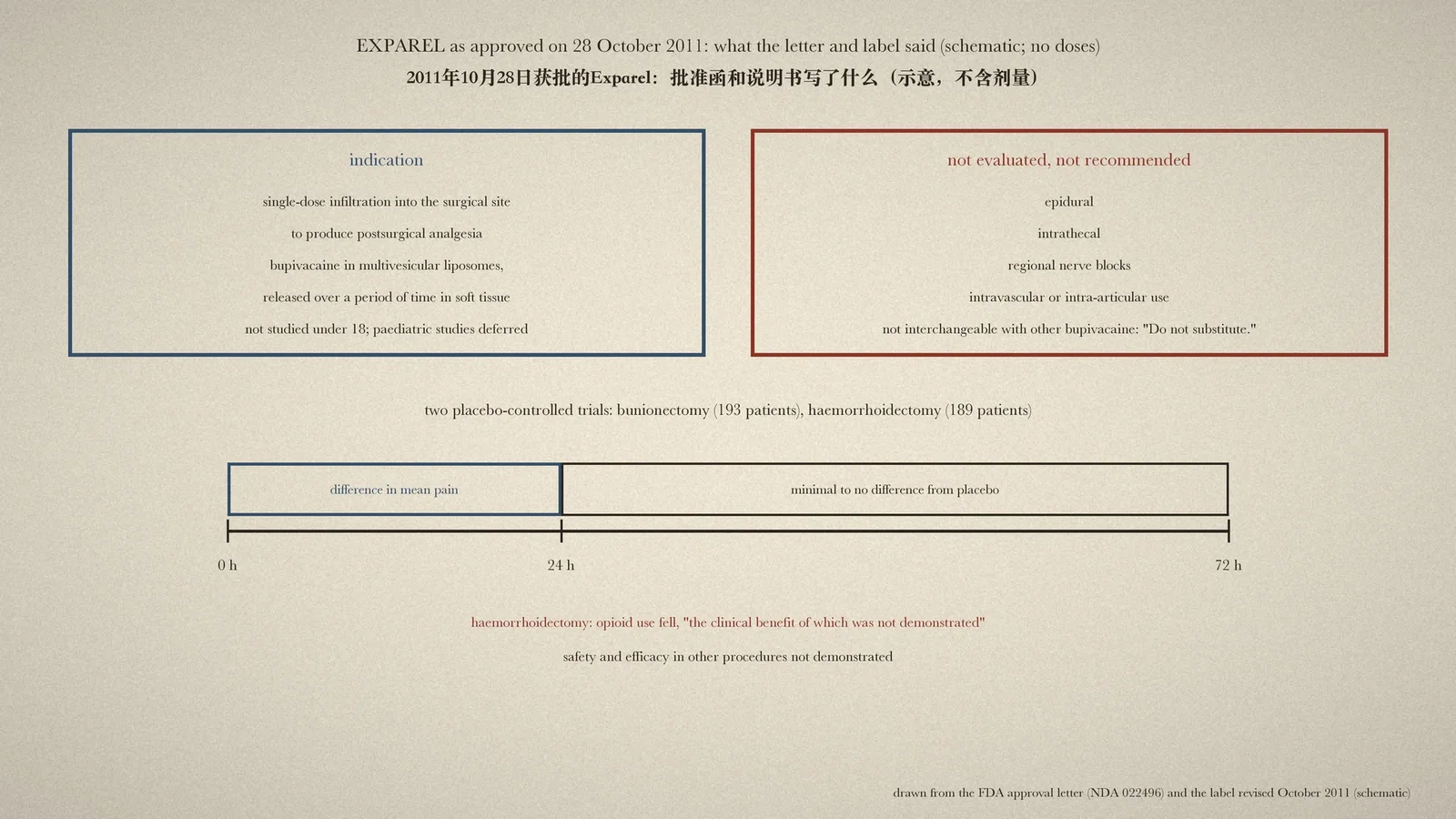
On 28 October 2011 the FDA's Division of Anesthesia, Analgesia, and Addiction Products approved Pacira's NDA 022496 for EXPAREL (bupivacaine liposome injectable suspension) 'for single-dose infiltration into the surgical site to produce postsurgical analgesia'; the label described bupivacaine in multivesicular liposomes released over time in soft tissue, warned that it was not interchangeable with other bupivacaine formulations and had not been evaluated for epidural, intrathecal or regional nerve block use, and reported two placebo-controlled trials, in bunionectomy and haemorrhoidectomy, in which differences in mean pain intensity occurred only in the first 24 hours.
Reading Library · Anesthesia Epochs · 中文版
Watch the education video (for clinicians)
2011: Liposomal Bupivacaine (Exparel) — How Long Did the Benefit Last? · Anesthesia Epochs Education Series
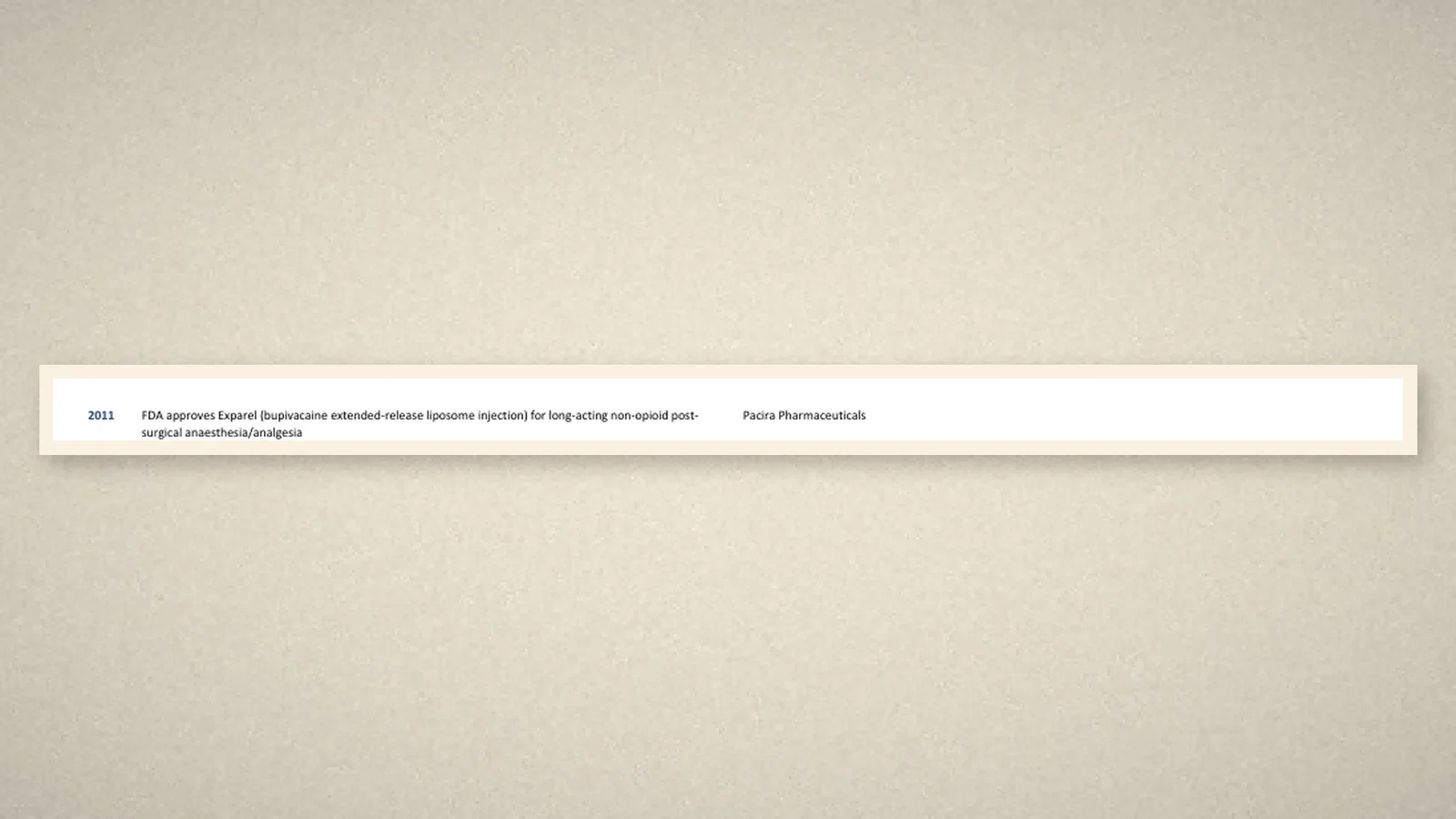
How long can a single injection of local anaesthetic into a surgical wound relieve pain? The Australian Society of Anaesthetists (ASA) timeline records one answer under 2011: "FDA approves Exparel (bupivacaine extended-release liposome injection) for long-acting non-opioid post-surgical anaesthesia/analgesia", attributed to Pacira Pharmaceuticals. [3, p. 90]
This article reads what the US Food and Drug Administration actually approved, in its own approval letter and in the prescribing information enclosed with it. Both documents are public in the FDA's Drugs@FDA database. [1][2]
The approval
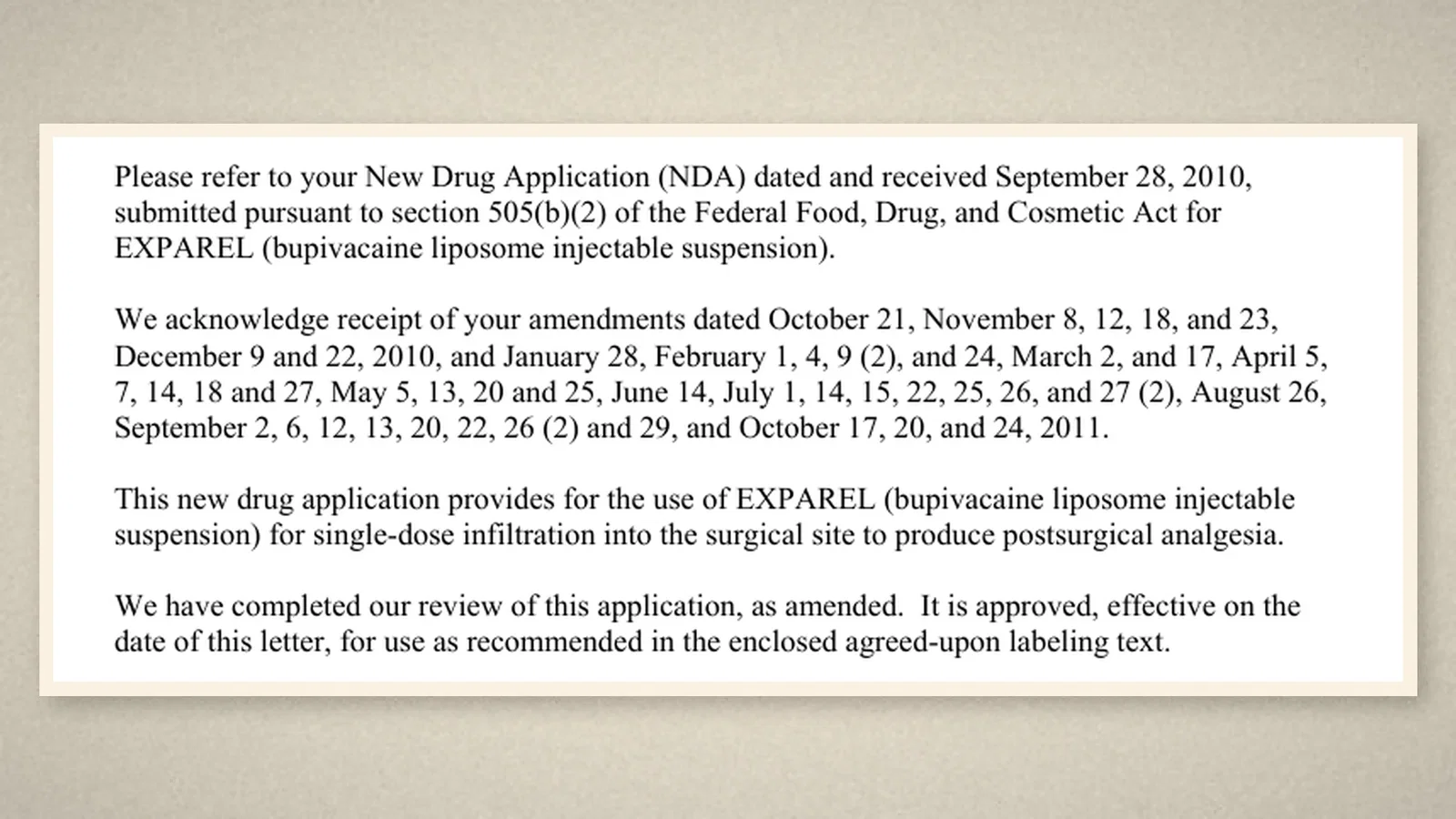
Pacira's New Drug Application 022496 was "dated and received September 28, 2010" and submitted under section 505(b)(2) of the Federal Food, Drug, and Cosmetic Act. More than a year and dozens of amendments later, the letter states that the application "provides for the use of EXPAREL (bupivacaine liposome injectable suspension) for single-dose infiltration into the surgical site to produce postsurgical analgesia", and that "it is approved". The letter was signed electronically on 28 October 2011 by Bob A. Rappaport, Director of the Division of Anesthesia, Analgesia, and Addiction Products. [1, pp. 1, 4-5]
The letter also deferred studies in patients from birth to under 17 years, "because this product is ready for approval for use in adults and pediatric studies have not been completed", and made four paediatric trials required postmarketing studies. [1, pp. 2-3]
What the product was
The label, revised October 2011, describes EXPAREL as "a liposome injection of bupivacaine, an amide-type local anesthetic", a suspension of "multivesicular liposomes (DepoFoam® drug delivery system)". After injection into soft tissue, "bupivacaine is released from the multivesicular liposomes over a period of time". The label insists that this is not simply bupivacaine in another bottle: "Different formulations of bupivacaine are not bioequivalent even if the milligram dosage is the same", liposomal encapsulation "can substantially affect a drug's functional properties", and so: "Do not substitute." [2, pp. 1-3, 11]
What it was not approved for
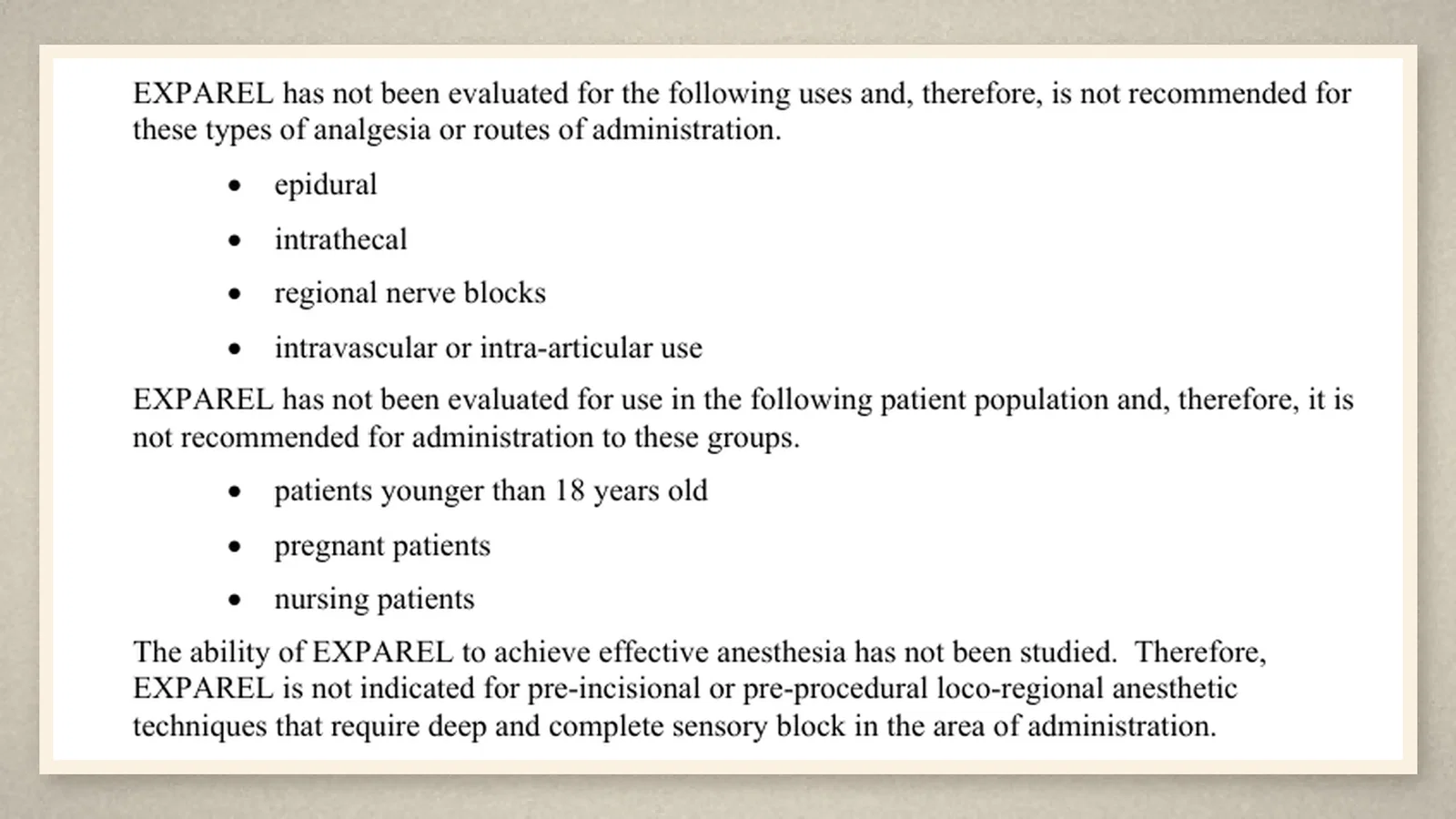
The label is just as clear about the limits. EXPAREL "has not been evaluated for the following uses and, therefore, is not recommended": epidural, intrathecal, regional nerve blocks, and intravascular or intra-articular use. It had not been studied in patients younger than 18, in pregnant patients or in nursing patients. And "the ability of EXPAREL to achieve effective anesthesia has not been studied", so it was not indicated for techniques that require a deep and complete sensory block. For anaesthetists, these sentences defined the product in 2011: a wound infiltration for analgesia, not a nerve block or an anaesthetic. [2, p. 6]
The evidence
Efficacy rested on two multicentre, randomised, double-blind, placebo-controlled trials: 193 patients undergoing bunionectomy and 189 undergoing haemorrhoidectomy, with the study drug placed directly into the wound at the end of surgery. Both showed a significant effect on the primary outcome, cumulative pain scores. But the label states plainly, for each trial, that "the difference in mean pain intensity between treatment groups occurred only during the first 24 hours following study drug administration. Between 24 and 72 hours after study drug administration, there was minimal to no difference" from placebo. In the haemorrhoidectomy trial opioid consumption fell, "the clinical benefit of which was not demonstrated", and EXPAREL "has not been demonstrated to be safe and effective in other procedures". [2, pp. 15-16]
What the record shows
The ASA calls the product long-acting. The approved label of 2011 describes something narrower: an extended-release formulation for a single infiltration of the surgical site, tested against placebo in two operations, with a measurable difference in pain for about a day. Reading the regulator's documents, rather than the description that followed them, shows exactly what was claimed at approval and what was not.
Sources and reading limits
Read: the FDA approval letter for NDA 022496 in full (5 pages) and the EXPAREL prescribing information approved with it, revised October 2011, in full (17 pages), both from Drugs@FDA; the ASA timeline entry for 2011.
Not covered: the FDA's medical and statistical reviews; the published reports of the two trials; later label revisions and supplemental approvals; the earlier history of the DepoFoam delivery system. The approval letter and label are openly available from Drugs@FDA; the reviews and trial publications were not read. The ASA's "long-acting" is quoted as the ASA's; the article reports the label's own wording on duration. Doses, volumes, concentrations, timing restrictions and rescue medication doses in the label are not repeated. The article makes no claim about later evidence or later indications. Quotations are from the English originals.
Three illustrations are crops of the approval letter (p. 1), the label (p. 6) and the ASA timeline (p. 90); one is drawn from the two FDA documents.
- U.S. Food and Drug Administration. NDA 022496 approval letter: EXPAREL (bupivacaine liposome injectable suspension). Signed 28 Oct 2011. Drugs@FDA
- EXPAREL (bupivacaine liposome injectable suspension) prescribing information. Revised Oct 2011. Drugs@FDA
- Australian Society of Anaesthetists. Anaesthesia history timeline. 2024. ASA
Continue exploring
Related reading connects shared questions and contexts; it does not by itself establish historical influence.
Anesthesia Epochs · The Source Room · About & Editorial Method
Published November 2, 2026. Sources and reading limits are stated above. Illustrations are labelled as original source images or AI-made. Historical accounts are educational; they are not current treatment instructions.