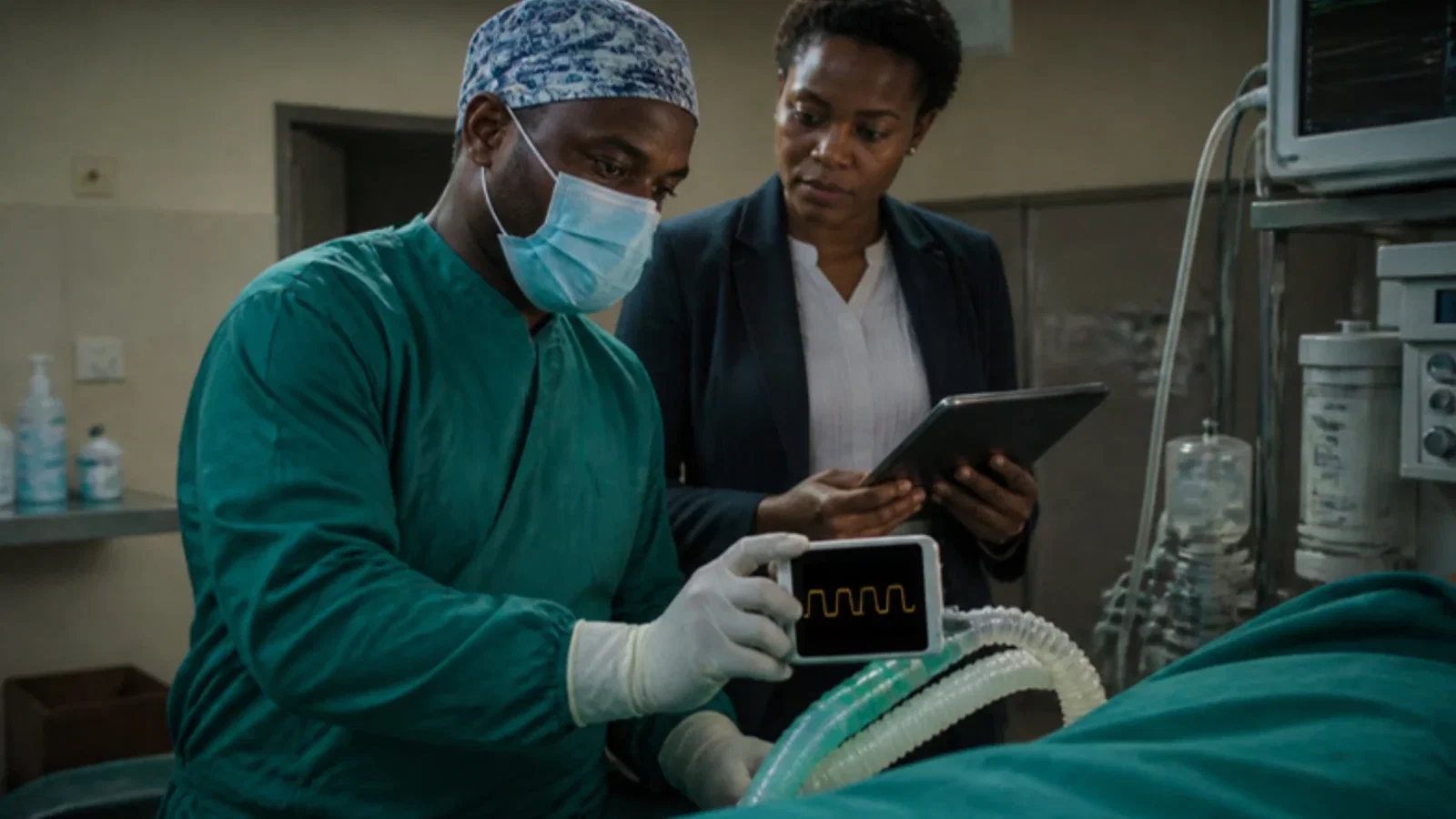
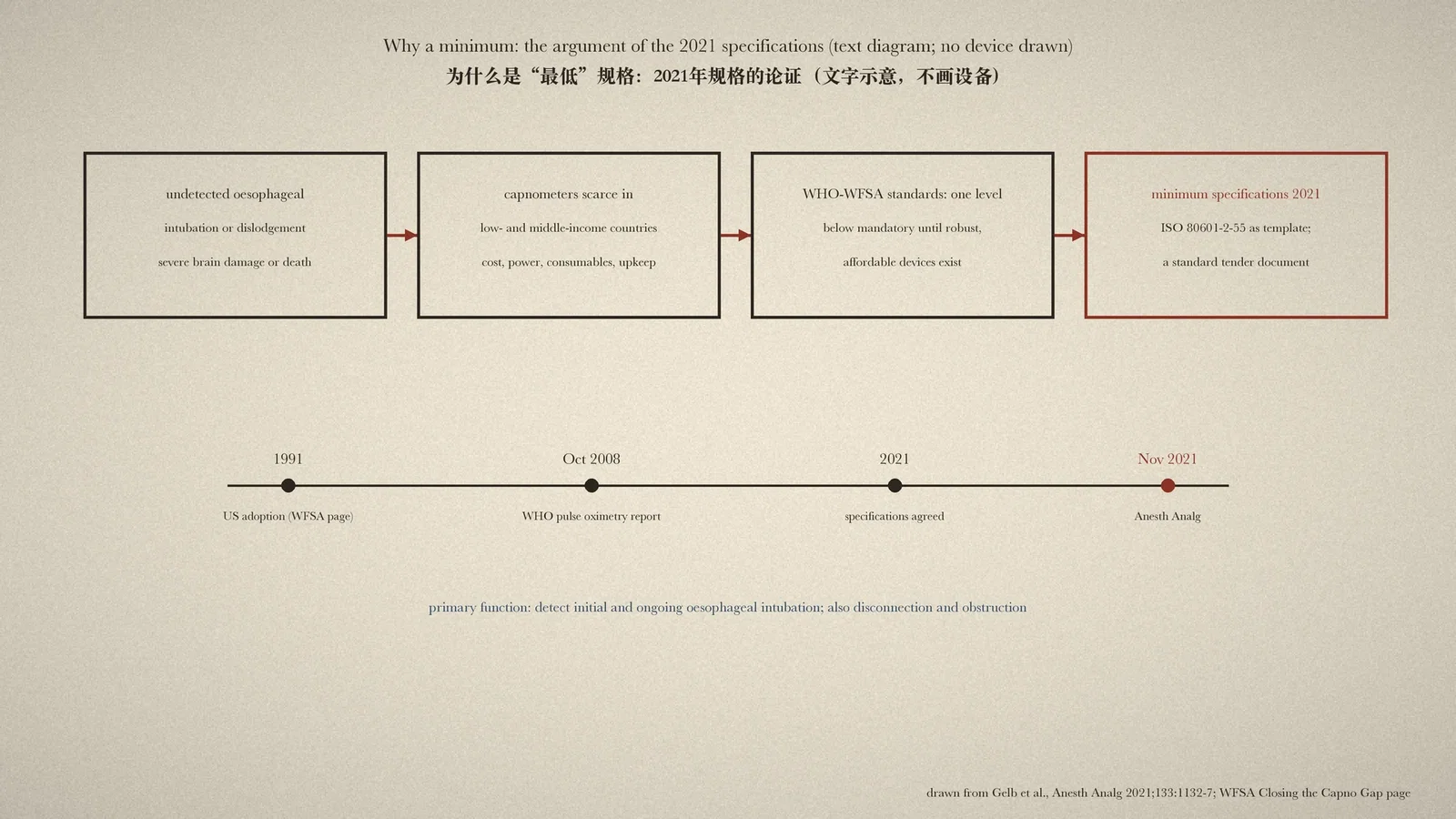
In November 2021 Anesthesia & Analgesia published 'The World Federation of Societies of Anaesthesiologists Minimum Capnometer Specifications 2021—A Guide for Health Care Decision Makers', by the WFSA Ad Hoc Capnometry Workgroup. Capnometers were hard to obtain in many low- and middle-income countries because of cost, durability, consumables, power and maintenance, which is why the WHO-WFSA International Standards placed CO2 monitoring one level below mandatory. Using ISO 80601-2-55:2018 as a template, the workgroup set the minimum requirements for a robust monitor whose primary job is to detect initial and ongoing oesophageal intubation, with 'very desirable but optional' features, as a guide for manufacturers, tenders and purchasers.
Reading Library · Anesthesia Epochs · 中文版
Watch the education video (for clinicians)
2021: Minimum Capnometer Specifications — WFSA · Anesthesia Epochs Education Series
Most of the devices in this series were invented. This one was specified. By 2021 everyone agreed that a carbon dioxide monitor saves lives in anaesthesia; the problem was that in much of the world there was no such monitor to switch on. The World Federation of Societies of Anaesthesiologists (WFSA) answered not with a new machine but with a document telling manufacturers what the cheapest acceptable machine must do. [1]
The gap
"The World Federation of Societies of Anaesthesiologists Minimum Capnometer Specifications 2021—A Guide for Health Care Decision Makers", by Adrian W. Gelb, Robert J. McDougall, Julian Gore-Booth, Phoebe-Anne Mainland and others for the WFSA Ad Hoc Capnometry Workgroup, appeared in Anesthesia & Analgesia in November 2021. Measuring exhaled carbon dioxide confirms that an airway device is in the right place and keeps confirming it. "A cardinal example is esophageal intubation. If undetected, it is likely to result in severe neurological damage or death", and a tube that slips out of the trachea later carries the same risk. [1]
"Unfortunately, capnometry devices are not readily available in many countries, especially those that are resource-limited." The obstacles were cost, durability, consumables, unreliable power, cleaning and maintenance. For exactly these reasons, the authors explained, the WHO-WFSA International Standards for a Safe Practice of Anesthesia had listed CO2 monitoring one level below mandatory, while promising that it would become "HIGHLY RECOMMENDED", the equivalent of mandatory, once robust and suitably priced devices existed. Pulse oximetry had gone first: the WHO's Global Pulse Oximetry Project reported in October 2008 and, as Lifebox, had made oximeters far more widely available. Now the WFSA wanted the same for carbon dioxide. [1]
The specification
The aim was narrow on purpose. "The primary function is to detect initial and ongoing esophageal intubation", with circuit disconnection and obstruction as further uses, and the document "will serve as a standard tender document for contracts to build, distribute, and price appropriate devices" for low- and middle-income countries. It took the international standard for respiratory gas monitors, ISO 80601-2-55:2018, as its template, but stripped out what such settings did not need: nitrous oxide, volatile agents, mains power and data connections. It also allowed use with oxygen concentrators. [1]

The mandatory list reads like a description of a hard place to work. The device had to suit adults, children and neonates; if powered, it needed an internal rechargeable battery that could be replaced by ordinary AA cells; it had to survive heat, cold, humidity, dust and water; its display could be numeric or simply a colour change; it had to be handheld or portable, labelled in the local language and carry a warranty of at least two years. Respiratory rate, a continuous waveform, adaptors for masks and nasal cannulae, connectivity, solar charging and self-calibration were "desirable but optional". [1, Tables 1-2]
Not capnography, yet
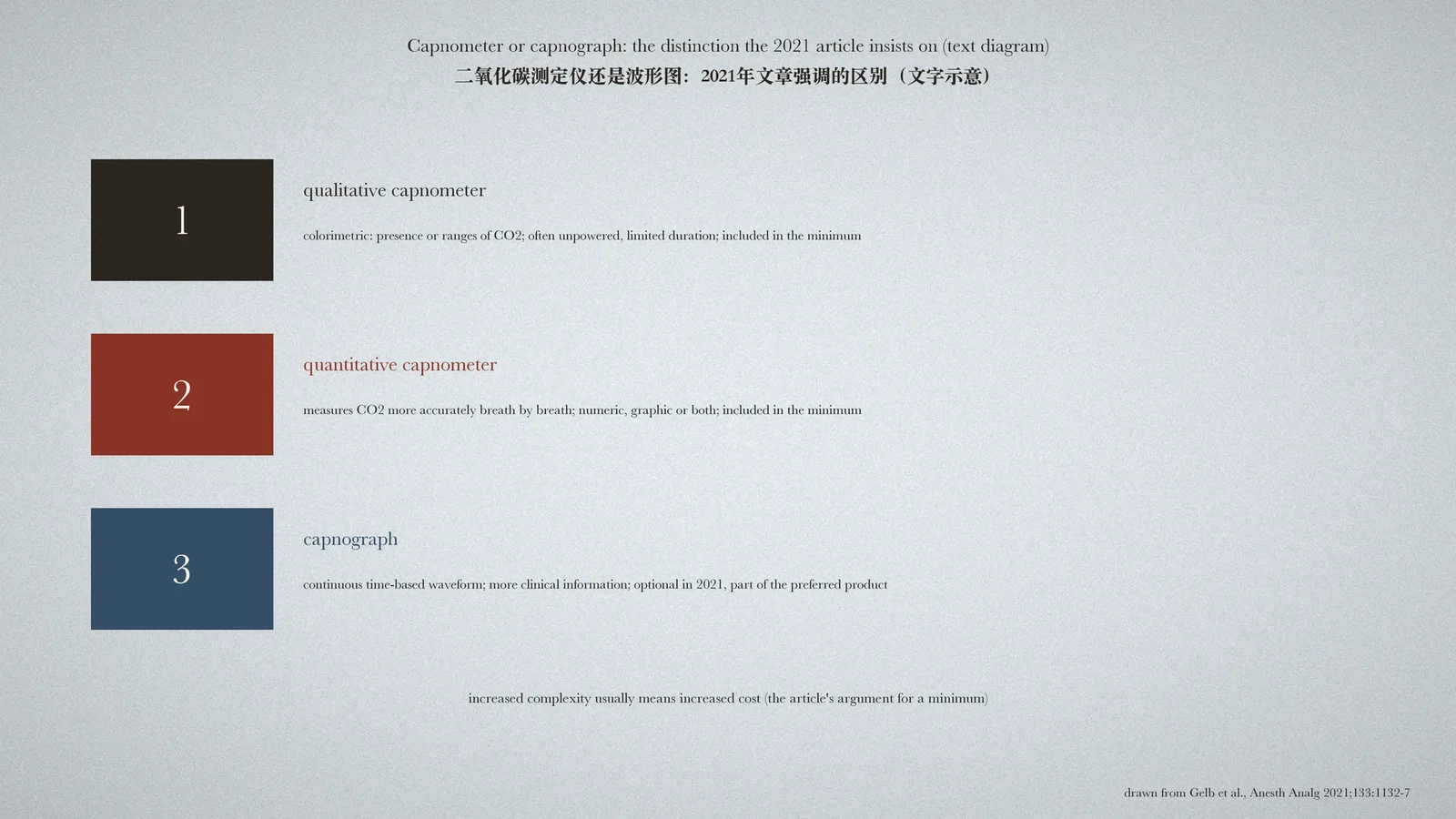
The workgroup, clinicians from Congo, Nigeria, Australia, Colombia, Honduras, Lebanon, the United Kingdom and the United States, together with an engineer, reached consensus "over a period of 18 months of regular correspondence and teleconferences". The article was careful with words: "Capnometry and capnography are frequently used interchangeably. However, they are not the same." A capnometer measures CO2 and may do so only qualitatively, by colour; capnography displays a continuous waveform. The minimum admitted the simpler devices because complexity costs money, but "only meeting the minimum should be viewed by both industry and providers as an interim step toward more optimal devices". [1]
The campaign
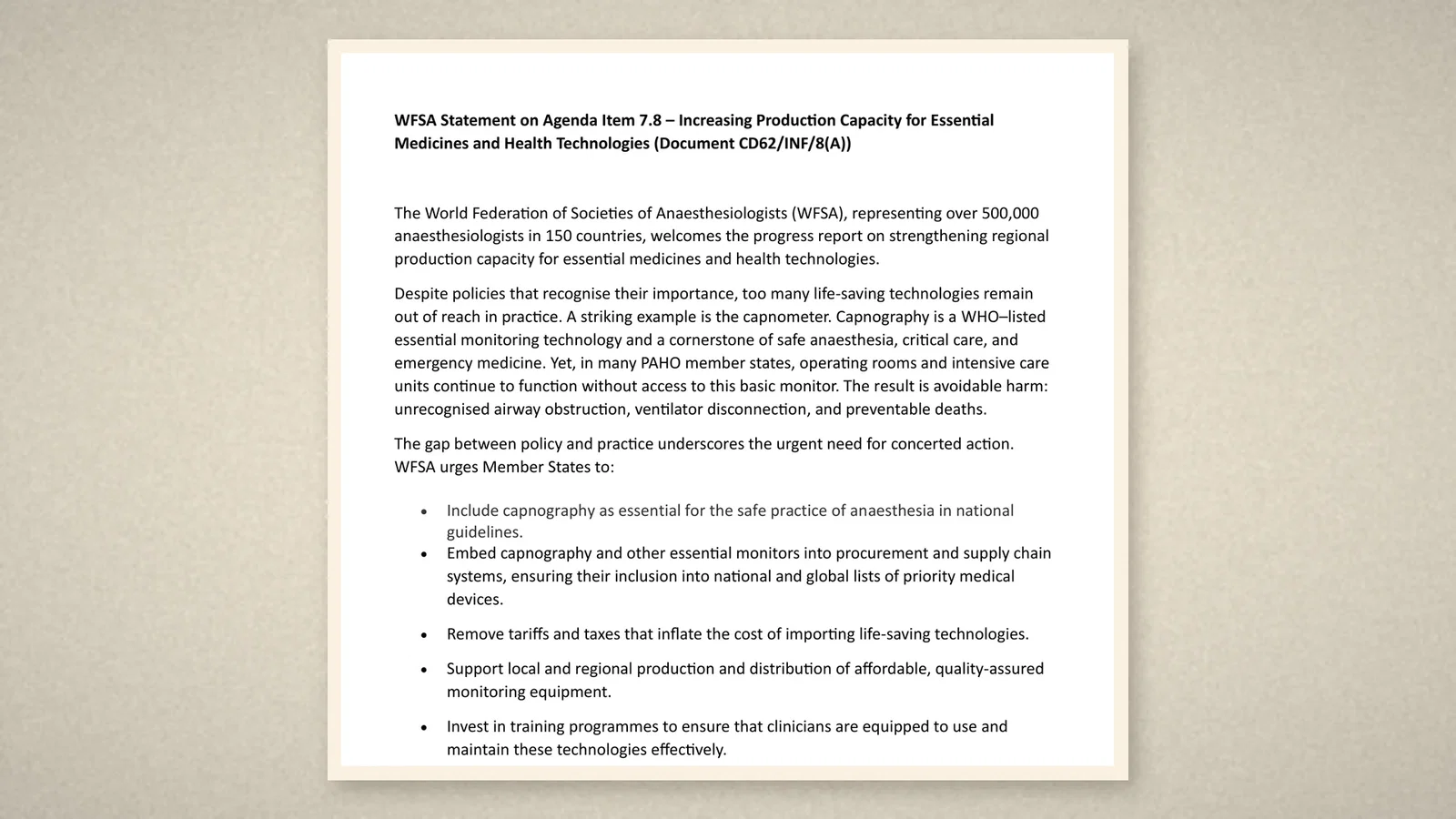
The WFSA's history timeline lists the "Publication of WFSA Minimum Capnometer Specifications" among the events of 2021. Its Closing the Capno Gap campaign page states that capnography's introduction in the United States in 1991 "led to a dramatic decline in anesthesia-related complications and deaths", that there is often "a 100% gap" between need and availability in low-income countries, and asks for capnography to be upgraded in the WHO-WFSA standards and added to the WHO Surgical Safety Checklist. A later WFSA statement to the Pan American Health Organization calls the capnometer "a striking example" of life-saving technology that remains out of reach. [2][3][4]
What the record shows
A safety standard written for the people who build and buy equipment rather than for those who use it. The 2021 document did not describe a new physiological idea; it described the least a monitor must do to catch a misplaced tube, and asked industry to meet it at a price the poorest hospitals could pay.
Sources and reading limits
Read: Gelb and colleagues, Anesthesia & Analgesia 2021;133:1132-7, in full, including Tables 1 and 2 (publisher web page, free access); the WFSA history timeline entry; the WFSA Closing the Capno Gap page; the WFSA statement on PAHO agenda item 7.8 (one-page PDF).
Not covered: the companion editorial; the WHO-WFSA International Standards themselves, quoted here only as the article quotes them; ISO 80601-2-55:2018; the papers on the global capnography gap cited by the WFSA, one of which could not be accessed; any record of devices made or bought to this specification.
Limits: the 1991 adoption and the "100% gap" are the campaign page's statements. Whether the specification changed what was manufactured or purchased is not known from these sources. Numerical environmental, power, display and alarm limits are not repeated. The PAHO statement carries no date in the PDF. Three of the four illustrations are drawn from the article's text and tables; one is a crop of the PAHO statement.
- Gelb AW, McDougall RJ, Gore-Booth J, Mainland PA, et al. The World Federation of Societies of Anaesthesiologists Minimum Capnometer Specifications 2021—A guide for health care decision makers. Anesth Analg. 2021;133(5):1132-7. DOI
- World Federation of Societies of Anaesthesiologists. WFSA history timeline. WFSA
- World Federation of Societies of Anaesthesiologists. Closing the Capno Gap. WFSA
- World Federation of Societies of Anaesthesiologists. Statement on agenda item 7.8 (CD62/INF/8(A)). WFSA
Continue exploring
Related reading connects shared questions and contexts; it does not by itself establish historical influence.
Anesthesia Epochs · The Source Room · About & Editorial Method
Published November 3, 2026. Sources and reading limits are stated above. Illustrations are labelled as original source images or AI-made. Historical accounts are educational; they are not current treatment instructions.