A recipe for a drink 'to cause a man to sleepe till hee bee ript' survives in Jane Jackson's handwritten book dated 1642, showing that a medieval recipe tradition was still being copied, though the book records no patient who took it.
Reading Library · Anesthesia Epochs · 中文版
Watch the education video (for clinicians)
1642: Jane Jackson's Recipe — A Drink to Sleep Till Ripped · Anesthesia Epochs Education Series
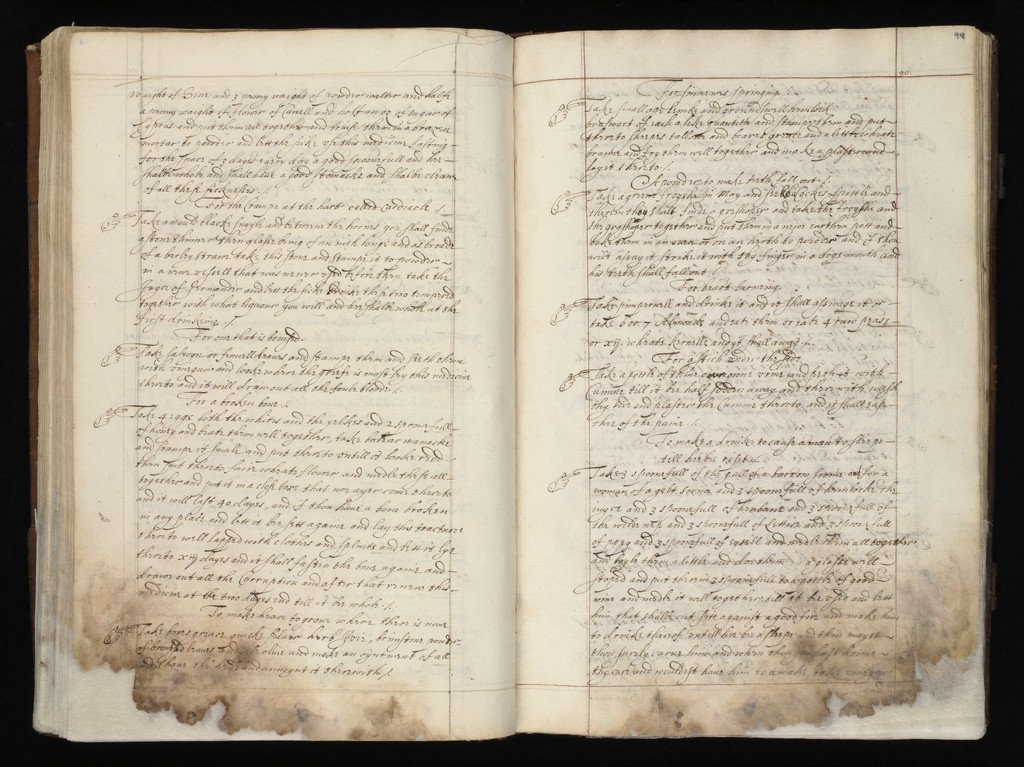
In a book bearing Jane Jackson’s name and the date 1642, a recipe promises sleep long enough for someone to be cut. Its heading reads, “To make a drinke to cause a man to sleepe till hee bee ript.” The entry sits among other remedies, within the same red rules and flowing handwriting. A promise that can sound extraordinary to a modern reader occupies an ordinary place on the page.[1]
The surviving object lets us ask a precise question: what was still being copied into a medical book in the seventeenth century? It provides much less certainty about what happened beside a patient.
A date for the book
The inscription on a flyleaf identifies Jane Jacksone and states that the book was written in 1642. That is the date used for this article. It does not date the invention of the drink, establish when every entry was copied, or identify the person who prepared or administered it.[1, image 3]
The recipe itself begins near the bottom of the right-hand leaf in image 100 and ends at the top of the next opening. Two numbers appear on its first leaf: 99 at the upper corner and 90 above the text. Hunter cites it as folio 99r; the parallel numbering explains why another reference can point to 90. A scan number, a folio number and the book’s date describe different things.[1, scans 100–101; 2, p. 486, n. 79]
An older recipe in a later witness
This particular heading does not call the drink dwale. Its identification with the English dwale tradition follows Elizabeth Hunter’s historical analysis.[2, p. 486] The distinction matters: a modern reader should know which words belong to the manuscript and which description comes from scholarship.
Earlier witnesses survive. Carter’s study reproduces the recipe in Cambridge University Library MS Dd.6.29, folios 79r–v. The library describes the medical compilation as copied by several hands in the first half of the fifteenth century, while distinguishing parts and dates within the volume.[3, fig. 1; 4] That establishes a relevant earlier manuscript setting, not a securely dated first administration. The small reproduction consulted here does not support an independent transcription of every word.
Placed beside that earlier witness, Jackson’s book changes the shape of the story. A medieval recipe tradition could remain available in a book dated 1642. Its survival on paper does not require us to imagine an unchanged medical practice continuing everywhere. Nor should an account of declining popularity be turned into a claim that such recipes had vanished before print.
What the recipe promises
The Jackson entry describes an oral preparation and connects the resulting sleep with cutting, followed by a promised return to wakefulness.[1, ff. 99r–v] These are statements within a recipe. In this entry there is no named patient, dated operation or recorded recovery against which to test them. The next lines move on to another remedy.
That absence does not prove that nobody ever used such a drink. It limits the conclusion this particular witness can carry. A collected instruction could preserve inherited knowledge, an expectation, or something considered worth retaining. Determining its use requires evidence beyond its presence in a book.
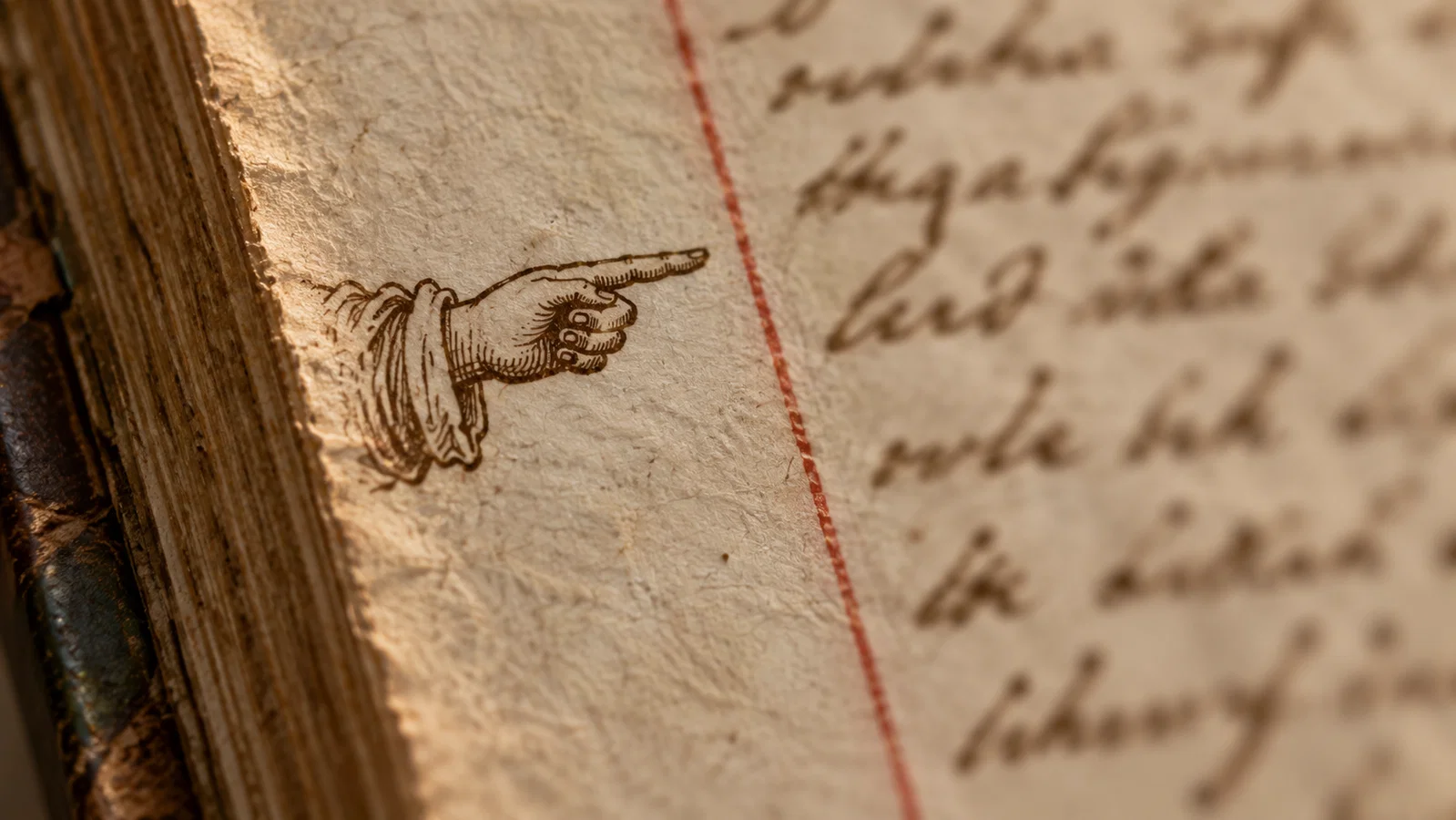
The page also contains drawn pointing hands beside entries. They make the text visually easy to notice; their presence does not turn a prescription into an observed case. Equally, the name on the flyleaf does not by itself make Jackson the inventor, sole copyist or clinical operator. Attributing a successful procedure to her would add a story the examined evidence does not tell.[1]
A connection with the sleeping sponge
The existing sleeping-sponge article concerns another group of historical texts. Hunter discusses sponge preparations and cautions about them before turning to the English oral drink.[2, pp. 485–487] That is a useful, limited comparison: different routes and textual settings carried hopes of making an intervention bearable. It is not evidence that the preparations were identical, or that one reliably developed into the other.
The dated Jackson book contributes something the general label “medieval anesthesia” can obscure. We can locate a particular instruction in a particular surviving object, see how it was arranged and recognize its continued circulation. We can also leave its patient outcomes unfilled. The recipe’s confidence and the historian’s confidence need not be the same.
Material and image limits: The dated inscription and the recipe with its continuation were actually inspected in Wellcome’s original digital images. Other portions of the manuscript were not comprehensively read. Hunter was read on selected pages, not in full; Carter’s full HTML article and its small figure were read, but the underlying Cambridge manuscript was not independently collated. The cited earlier works discussed by those historians were not independently read. These materials do not establish a safe method, successful anesthesia or reliable reversal. Quantities, preparation and administration instructions are omitted. All four images are AI editorial illustrations, not Jackson’s portrait, manuscript facsimiles, authenticated equipment or documented clinical scenes.
Sources and reading limits
[1] Jane Jackson’s medical recipe book, dated inscription 1642. Wellcome Collection, MS 373, A very shorte and compendious Methode of Phisicke and Chirurgery…. Digital manuscript manifest. Actual images: no. 3, dated flyleaf; scans 100–101, recipe on ff. 99r–v, also numbered 90r–v. Scan 2’s library label and image 5’s title page were also inspected. The collaborative transcription assisted reading. Claims were checked against the original images, including image 100 of the Wellcome manuscript.
[2] Hunter EK. ‘To Cause Sleepe Safe and Shure’: Dangerous Substances, Sleep Medicine and Poison Theories in Early Modern England. Social History of Medicine. 2022;35(2):473–493. Published online 2021. DOI:10.1093/shm/hkab064. Article. Printed pages read: 473, 476, 485–487. Page 476 supplies the methodological caution about recipes and practice; pp. 485–487 supply the sponge/drink discussion and Jackson reference.
[3] Carter AJ. Dwale: an anaesthetic from old England. BMJ. 1999;319(7225):1623–1626. DOI:10.1136/bmj.319.7225.1623. Full HTML article and figure. Full HTML read; figure 1 inspected at its available low resolution. Article-level page range is given because a paginated PDF is not covered. The article’s conjectures about operators and a lost Latin ancestor are not treated as established facts.
[4] Cambridge University Library. Catalogue of MS Dd.6.29. Introduction, origin/history and relevant bibliographic information read. Dating applies to the described manuscript units; it does not establish the recipe’s first use.
Continue exploring
Related reading connects shared questions and contexts; it does not by itself establish historical influence.
Anesthesia Epochs · The Source Room · About & Editorial Method
Updated October 30, 2026. Sources and reading limits are stated above. Illustrations are labelled as original source images or AI-made. Historical accounts are educational; they are not current treatment instructions.