In 1664 the Hamburg physician Johann Daniel Major published a short Latin book proposing to infuse medicines into a vein; he called it a conjecture awaiting experiments, and the claim of a successful operation in 1662 remains unverified.
Reading Library · Anesthesia Epochs · 中文版
Watch the education video (for clinicians)
1664: Major's Prodromus — Medicine Into a Vein · Anesthesia Epochs Education Series

The title sounds confident. The argument inside is more guarded. Johann Daniel Major presented this little book as a preliminary account of infusion surgery that he had invented. Yet on page 12 he told readers not to treat his discussion as an established axiom. It remained within the bounds of conjecture, awaiting further experiments.[1, title page, p. 12]
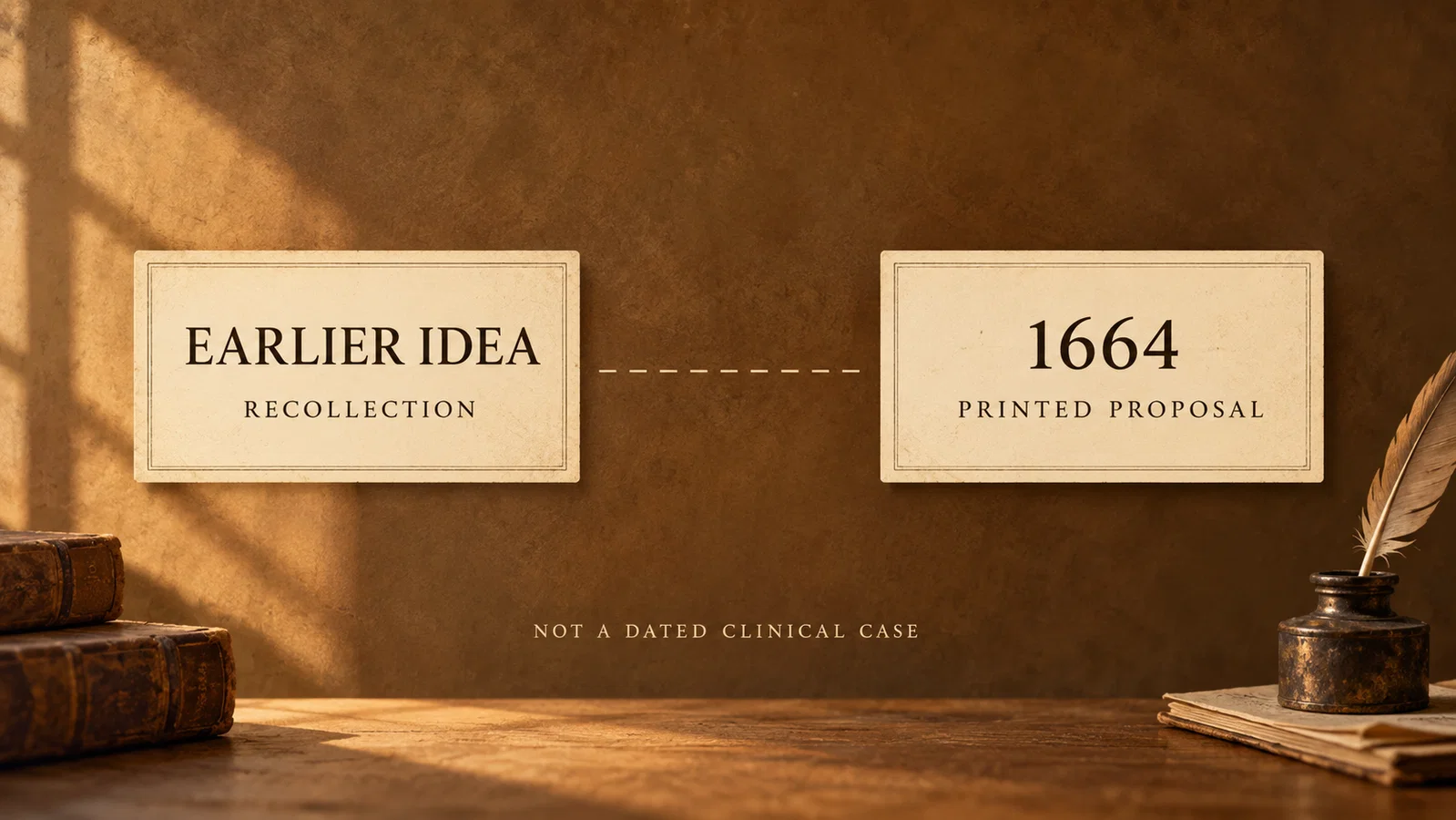
Both voices belong to the book. Its author wanted his idea to receive attention, while acknowledging that it lacked sufficient proof. The firm date for a timeline is 1664, printed on the title page. It dates the publication of a proposal; it does not automatically date a successful operation.
What happened “more than two years” earlier?
The title page identifies Major as a physician in Hamburg and gives Leipzig as the place of printing. At the beginning of the discussion, he recalls having worried for more than two years about a troubling question: why did some seriously ill people die even after apparently passing a crisis?[1, title page, p. 4]
That recollection helps explain the earlier date associated with his work. But the passage describes the beginning of his thinking. It cannot, by itself, establish a successful human intravenous anesthetic in 1662. This article therefore uses the book’s publication year and leaves the claimed successful procedure unresolved.
Major’s explanation belonged to the medicine of his period. He worried about thickened, stagnant blood and considered why medicines might fail in malignant illness. Some patients could not swallow readily; others were too weakened for ordinary routes of treatment to serve their purpose. He asked whether introducing liquid through a vein might change that predicament.[1, pp. 4–9]
These were his questions and physiological assumptions. The people he described cannot simply be assigned modern diagnoses, nor can his account of blood be translated into present-day resuscitation physiology.
A letter and the urgency to publish
Major said that he had set the idea aside without sufficiently supporting it through experiment and argument. His account then turns to a letter from Philipp Jacob Sachs in Breslau. In July 1664, Sachs brought English experiments into the discussion and asked for his views. Learning that others were considering related work sharpened Major’s concern that his own idea might remain unpublished.[1, pp. 9–12]
This is evidence of how Major explained his motives. The experiments and authors quoted in his book have not all been independently checked against their original records for this article. Those passages place the proposal within a network of correspondence and dispute; they do not settle who first accomplished every kind of injection.

Major arranged part of the book as objections followed by replies. One objection challenged the novelty of his invention. In responding, he emphasized that he had conceived the idea before hearing the English reports and allowed that similar inventions might arise in different places.[1, pp. 16–20] This is an argument made by a participant in a priority dispute, not a neutral verdict supplied to later historians.
What argument could not supply
The practical difficulties remained visible. How could one operator attend to all the tasks and observations involved? Major discussed the cooperation of a surgeon and assistants. A more fundamental objection asked where the supporting experiments were.[1, pp. 26–28]
He acknowledged the scarcity of examples, argued that a novel method could not already have a long history of experience, and discussed attempts he intended to undertake. Future plans cannot be turned into a completed human case series. Nor can the oral animal experiments mentioned in the discussion be relabelled as evidence of intravenous administration.[1, pp. 27–30]
The choice of liquid also remained unsettled. On page 31, Major was wary of opiates in the gravely ill patients envisaged by his proposal. Within his account of stagnant blood, he wanted to encourage activity rather than suppress it.[1, p. 31] This passage resists a summary of the book as a successful intravenous anesthetic. It is also a historical argument, not advice about modern opioid use.

Elsewhere he made public authority a condition for attempting the new approach.[1, p. 13] That belongs to the terms in which he defended the proposal. It should not be translated into a claim that a modern ethics committee had approved it, or that the book records informed consent.
Keeping a proposal at its proper scale
The closing pages invite readers to weigh the argument, agree or disagree, and include letters from two correspondents.[1, pp. 34–37] They show a medical idea being circulated and defended. Encouraging correspondence still cannot substitute for a patient’s outcome.
This article sits alongside the existing Wren entry so that readers can compare different kinds of evidence concerning early intravenous administration. It does not establish a direct line of influence from Wren to Major, and it does not replace that earlier entry. What the 1664 book securely offers is a proposal sent out for readers to examine. Its unanswered questions belong on the timeline too.
Material and image limits: The 1664 title page, dedication and all printed pages 1–37 were read in 39 scan images. The AI-assisted Latin interpretation has not received independent philological review. Major’s enlarged 1667 edition and the original correspondence quoted within the book were not read. The claimed successful human procedure in 1662 remains unverified. Historical doses and procedural instructions are omitted. All four images are AI editorial reconstructions or modern conceptual illustrations, not facsimiles, a portrait of Major, authenticated letters or records of a documented operation.
Sources and reading limits
[1] Major JD. Prodromus inventae a se chirurgiae infusoriae… Lipsiae: Typis Johannis Wittigau; 1664. MDZ digital copy, held by the Augsburg Staats- und Stadtbibliothek; URN urn:nbn:de:bvb:12-bsb11266643-1. Scan 001 is the title page, 002 the unnumbered dedication, and 003–039 printed pages 1–37. All were actually opened and read. References use printed pagination.
This article concerns Major’s 1664 publication proposal. Claims beyond that scope remain unresolved here.
Continue exploring
Related reading connects shared questions and contexts; it does not by itself establish historical influence.
Anesthesia Epochs · The Source Room · About & Editorial Method
Updated October 30, 2026. Sources and reading limits are stated above. Illustrations are labelled as original source images or AI-made. Historical accounts are educational; they are not current treatment instructions.