The pharmacist Mein had a small sample of crystalline atropine by August 1831, but his method appeared only in 1833, with an editor crediting him with the first pure atropine.
Reading Library · Anesthesia Epochs · 中文版
Watch the education video (for clinicians)
1831: Mein's Crystalline Atropine — A Sample Before the Paper · Anesthesia Epochs Education Series
The paper appeared in 1833, but its preface takes the reader back to August 1831. Nees von Esenbeck recalled meeting the pharmacist Mein at Norderney and learning that he had prepared crystalline atropine. Mein supplied a small sample, with which Nees’s colleague Müller performed experiments. The preface described a narcotic action that was not particularly strong.[1, pp. 67–68]
Compressing the episode into one discovery date would blur several different events. August 1831 dates the meeting recalled in the preface, not a precisely documented extraction experiment. The preface was signed at Bonn on April 7, 1833; the volume’s title page gives 1833. Neither supplies the exact day the issue appeared. This article therefore retains the range 1831–1833, with the dates distinguished in the account.[1, title page, pp. 67–68]
The sample arrived before the method
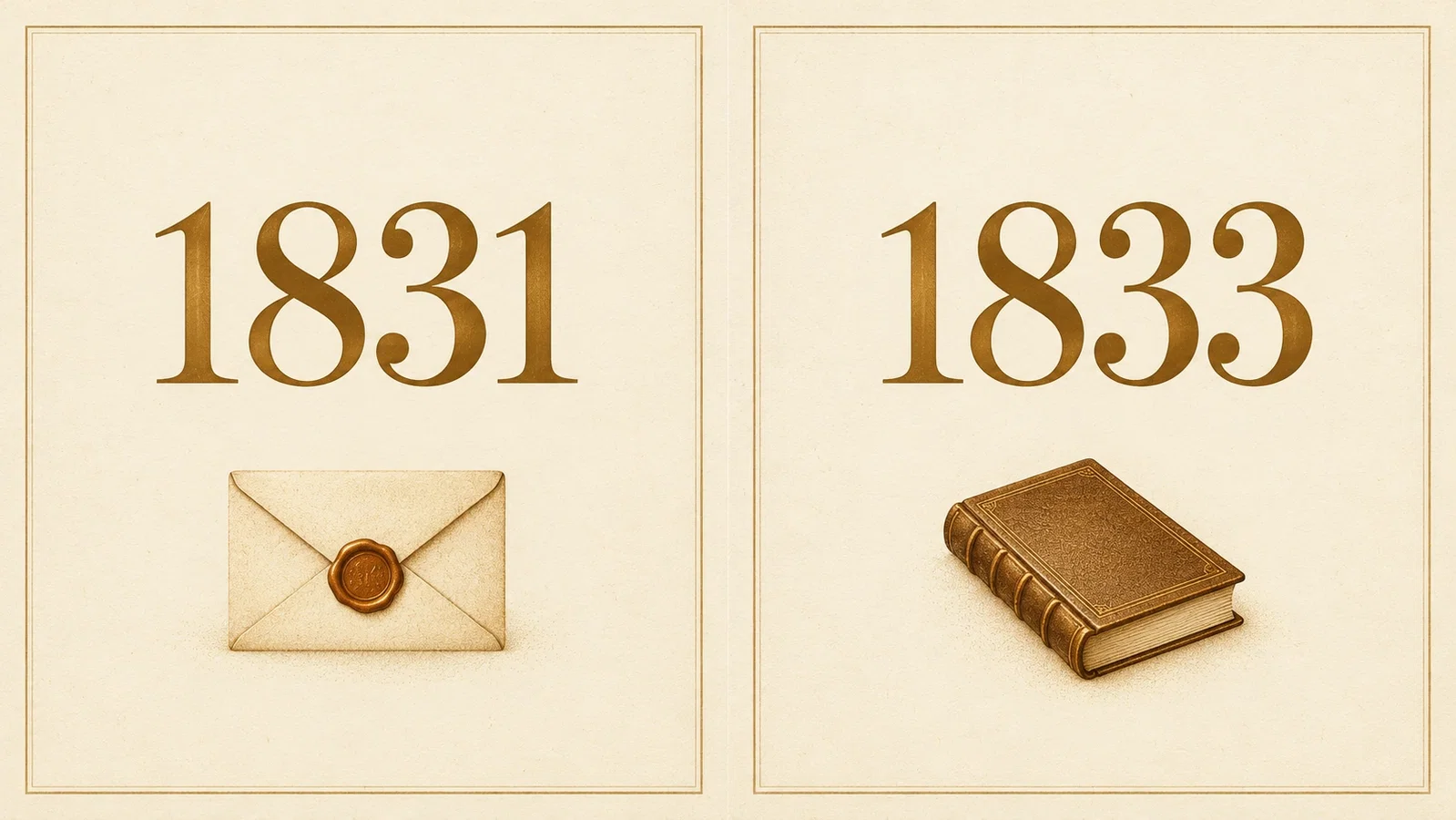
Nees explained that he had wanted Mein to make the preparation method known. Other business had delayed the manuscript, which he had only just received. He now forwarded it to his friend Geiger for publication. The preface preserves a small piece of the route from a preparation in one person’s hands to an account other readers could examine.[1, p. 68]
An editorial footnote on the same page complicates the story. Signed “Gr.,” it recalls initial doubts about Mein’s material after hearing that its action was weak. A sample subsequently received was judged fairly pure. The editor connected the weaker effect with the condition of the administered material and differences between the animals used, then credited Mein with the first preparation of pure atropine.[1, p. 68, footnote]
That is a documented contemporary acknowledgment, with an identifiable speaker. It is not an independent adjudication here of every competing priority claim. The explanation of the experiments likewise remains the editor’s historical argument, not present-day administration advice. Nor does the preface’s word “narcotic” establish surgical anesthesia or clinical safety.
Almost white crystals—and an untried proposal
Mein began with his material. Without enough fresh belladonna material, he used dried roots that he had grown and stored himself. The following pages distinguish resin that hindered crystallization, impure material and crystals obtained through further treatment. On page 71 he described a product that was almost white and regularly crystalline.[1, pp. 69–71]

The same page records a difficulty that a short success story could easily omit. Some material remained in the liquid during processing and was difficult to recover fully. Mein suggested a possible modification, explicitly adding that he had not tried it. A completed observation and an unfinished proposal sit side by side. This article retains that distinction without reproducing the preparation recipe, quantities or operating conditions.[1, p. 71]
The subsequent descriptions include solubility, an indicator reaction and dilation of the pupil. They also preserve a disagreement. Mein described the aqueous solution as almost tasteless; a footnote signed “G. u. H.” said they had always found it very bitter. Elsewhere, the editors noted that they had made the same chemical observation. The publication did not make every observation sound unanimous.[1, pp. 71–72]
These passages show how a material was described and compared at the time. They do not supply a modern purity assay, structural identification or clinical efficacy trial. Later uses of atropine still need evidence from their own historical settings.
Why retain this paper as a separate episode?
A specific comparison with Vauquelin’s 1809 belladonna analysis is useful. The crystals discussed in that earlier passage were identified as potassium nitrate and other salts. Mein’s paper explicitly discusses the crystalline material he called atropine and its properties. Reading the two together sharpens the question of what each author had separated; it does not establish a direct line of influence.[1, pp. 69–72; 2, p. 54]
The episode contains more than the line “atropine isolated in 1831.” It preserves an exchange of samples, delayed publication, editorial doubt and acknowledgment, and an improvement still waiting to be tried. Keeping those details gives the timeline something its readers can check against the original pages.
Sources and reading limits
- Mein. Ueber die Darstellung des Atropins in weissen Krystallen. Annalen der Pharmacie. 1833;6:67–72; the final editorial footnote continues onto p. 73. Read in full, with the continued footnote and the volume title page. Preface, author’s text and editorial notes are distinguished.
- Vauquelin. Analyse de la Belladone, Atropa belladona · Library copy. Annales de chimie. 1809;72:53–68. Page 54 is cited.
The 1809 and 1831–1833 reports are discussed separately. Material dated 1867, 1872 and 1901 is outside this article’s scope. All four illustrations are original historical imaginings or modern editorial images.
Continue exploring
Related reading connects shared questions and contexts; it does not by itself establish historical influence.
- 1809: Vauquelin Analyses Belladonna and Its Family Resemblance
- 1867: Atropine, the Stimulus Remained and the Slowing Faded
Anesthesia Epochs · The Source Room · About & Editorial Method
Updated October 30, 2026. Sources and reading limits are stated above. Illustrations are labelled as original source images or AI-made. Historical accounts are educational; they are not current treatment instructions.