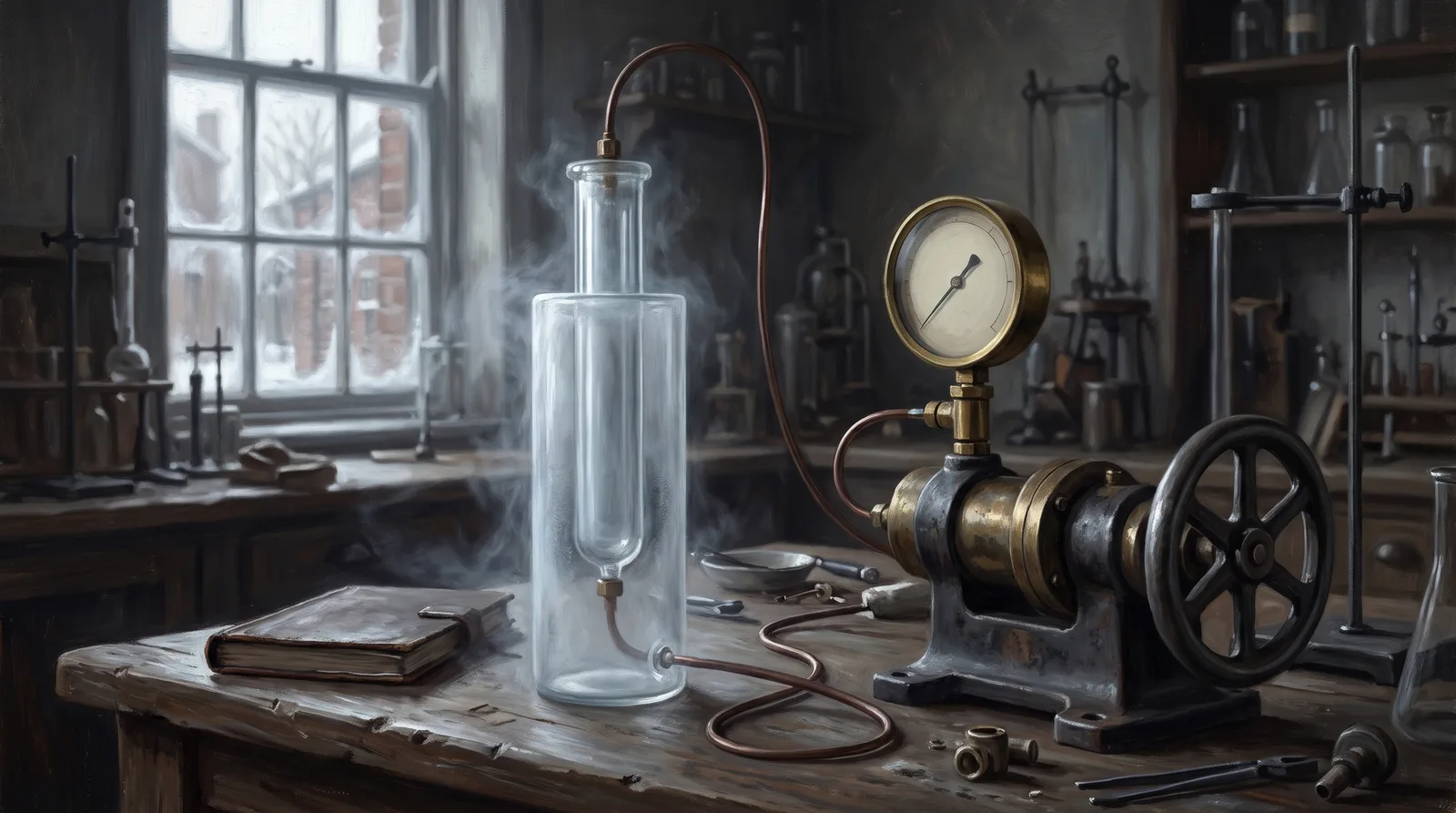
In April 1883 Wroblewski and Olszewski reported oxygen as a liquid with a clear meniscus, while nitrogen stayed liquid for only a few seconds.
Reading Library · Anesthesia Epochs · 中文版
Watch the education video (for clinicians)
1883: Liquid Oxygen and Nitrogen — A Boundary You Could See · Anesthesia Epochs Education Series
In April 1883, a telegram carried news from Cracovie to Debray: oxygen had been obtained as an observable liquid. Dated 9 April, the message appeared in the proceedings of the French Academy of Sciences for 16 April. A joint report by S. Wroblewski and K. Olszewski, presented by Debray, followed. [1, p. 1140]
The introductory discussion did not announce liquefaction without a past. The Academy’s secretary explicitly acknowledged earlier work by Cailletet and Pictet. The difficulty, as the introduction described it, was that the earlier droplets had been fleeting. How much opportunity did they leave to investigate the liquid itself? [1, pp. 1140–1141]
A boundary that could be seen
The authors likewise credited their predecessors. Their immediate problem was to reach conditions in which the boundary between liquid and gas could be distinguished, rather than observing only a brief change. [1, p. 1141]
They described efforts to lower the cooling temperature, including boiling ethylene under reduced pressure and measuring temperature with a hydrogen thermometer. A table then paired temperatures and pressures from a series of oxygen observations. The liquid was reported to have a clear meniscus and to be transparent and mobile. [1, pp. 1141–1142]
The table also carried a reservation: more exact figures would be given in a later communication. These observations should not be presented as settled physical constants when the authors themselves left refinement ahead. [1, p. 1142]
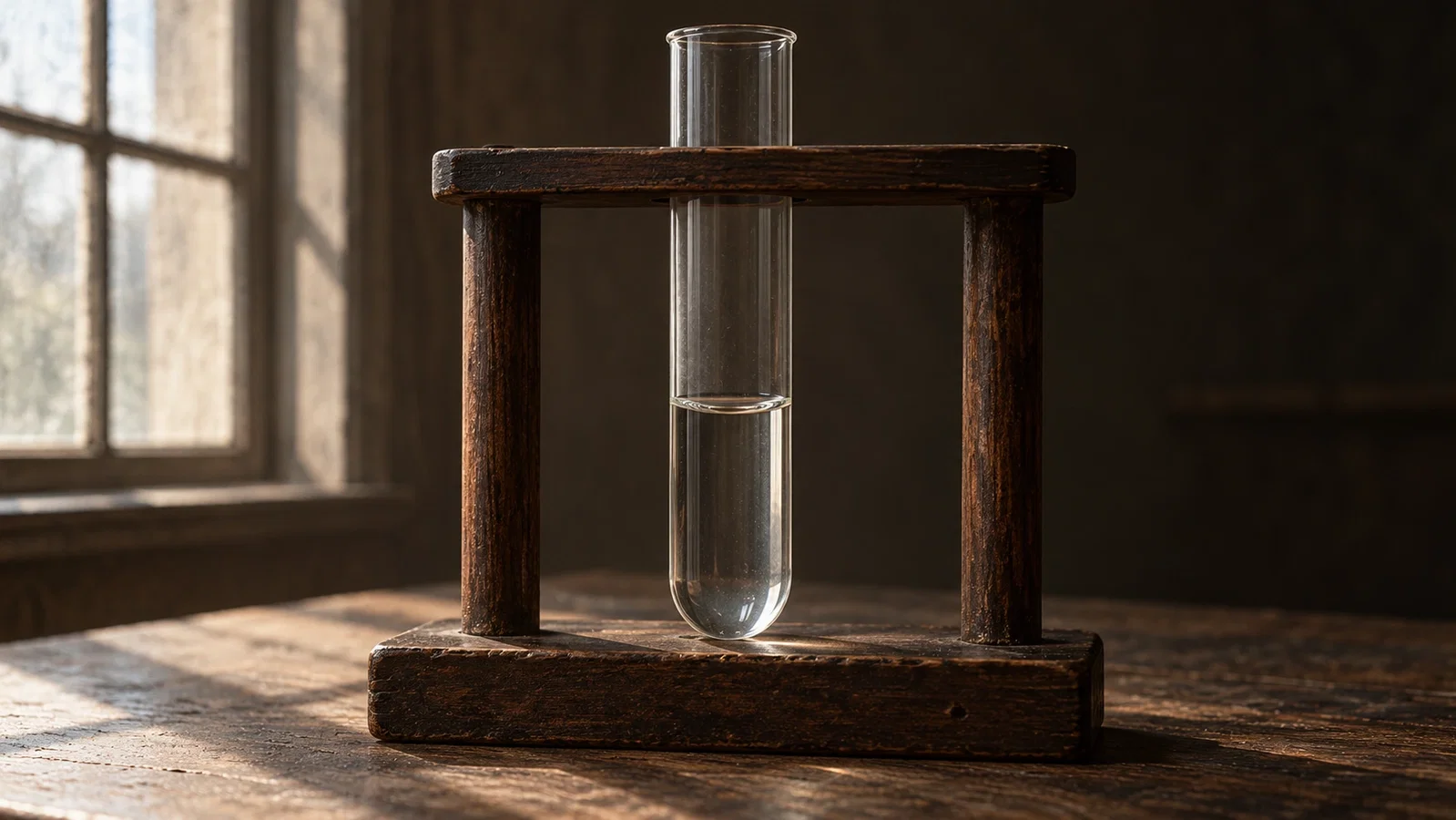
The meniscus was a particular object of observation. It offered something to describe beyond the momentary appearance of droplets. The appearance and behavior of the liquid could enter the record. Color language in that record belongs to the authors’ observations; it is not used here to define the appearance of liquid oxygen under every condition.
For nitrogen, the interval was still seconds
A telegram about nitrogen was appended to the proceedings of 16 April. At the meeting of 23 April, a separate short report explained the difficulties more fully. [1, p. 1142; 2, pp. 1225–1226]
Under the initial cooling and pressure conditions described, no liquid was visible in the glass tube. Sudden expansion produced violent boiling. With a slower release, the authors could observe a distinct meniscus, but the liquid evaporated rapidly. [2, p. 1226]
The next paragraph supplied a qualification easily lost in a timeline: nitrogen remained in the described stable liquid state for only a few seconds. Keeping it there longer would require a temperature below the lowest they had yet achieved with their method. [2, p. 1226]
The word “stable” therefore has to travel with its duration. This was an observable liquid state, not an announcement that prolonged liquid-nitrogen storage had been accomplished.
Dates of experiments, messages and meetings
The printed pages preserve several stages of research and communication: the oxygen telegram dated 9 April; the report and nitrogen message in the proceedings for 16 April; and the fuller nitrogen account presented on 23 April. The oxygen report also identifies a series of experiments on 9 April. [1–2]
A telegram date records when a message was sent. A meeting date locates its presentation in the proceedings. Neither automatically dates every experiment discussed. “April 1883” is used here to encompass these related records without making one day the beginning of the entire undertaking.
The same pages explain why an entry stating simply that oxygen was first liquefied in 1883 needs qualification. Earlier experiments were already part of the authors’ account. This article establishes the content and limits of these two reports; it does not adjudicate worldwide priority among all preceding investigations.
A neighboring problem in the history of medical gases
The April 1883 reports address a physical problem: producing and observing a liquid, and determining how long it remains available to observe.
Neither liquefaction report documents patient oxygen administration, hospital distribution, medical purity or industrial storage tanks. Their contribution to this anesthesia timeline is a background in physical investigation. They do not establish the arrival of a clinical gas-supply system.
A visible meniscus was a consequential experimental observation. Seeing it, measuring it and retaining it nevertheless remained distinct tasks.
Sources and reading limits
Read: the two reports by Wroblewski and Olszewski in the Comptes rendus of 16 and 23 April 1883 (vol. 96, pp. 1140–1142 and 1225–1226), with the secretary’s introduction, the telegrams as printed and Debray’s comment.
Not covered: the rest of the two issues; the telegrams as original manuscripts; earlier original reports by Cailletet and Pictet; later industrial or clinical adoption. Both reports come from the same investigators and do not count as independent replications.
The opening-page footer of the 16 April issue appears to print 1882, unlike its meeting header and the explicit reference to 16 April 1883 on page 1225 of the next issue. The meeting dates, volume and cross-reference support placing the reports in 1883; the scan discrepancy is retained. Priority is not judged here.
Both illustrations are AI-made interpretive images, not historical evidence; the meniscus illustration is conceptual and does not reconstruct an experimental procedure.
- Wroblewski S, Olszewski K. Sur la liquéfaction de l’oxygène et de l’azote, et sur la solidification du sulfure de carbone et de l’alcool. C R Acad Sci. 1883;96:1140–2. Internet Archive
- Wroblewski S, Olszewski K. Sur la liquéfaction de l’azote. C R Acad Sci. 1883;96:1225–6. Internet Archive
Continue exploring
Related reading connects shared questions and contexts; it does not by itself establish historical influence.
Anesthesia Epochs · The Source Room · About & Editorial Method
Updated October 30, 2026. Sources and reading limits are stated above. Illustrations are labelled as original source images or AI-made. Historical accounts are educational; they are not current treatment instructions.