Charles James Fox's On Nitrous Oxide (1869) asks in its main text whether the gas could be made portable, and records in footnotes that Coxeter was supplying iron bottles of compressed gas.
Reading Library · Anesthesia Epochs · 中文版
Watch the education video (for clinicians)
1868–1869: Portable Nitrous Oxide — Charles James Fox's Iron Bottles · Anesthesia Epochs Education Series
An original still life of a wooden box and leather case, recalling the carrying materials in Fox’s footnote. These are not surviving Coxeter products or reconstructions to verified specifications.
A small book published in 1869 preserves one problem at two different moments. Its main text asks whether nitrous oxide can be made conveniently portable. Its footnotes report that Coxeter was supplying iron bottles of compressed gas. [1, pp. 7, 30]
The change lies between layers of text. Taking the earliest meeting date and assigning every later addition to it would produce a misleadingly tidy invention date.
Charles James Fox’s On Nitrous Oxide offers a more particular story. Use of an anesthetic gas also depended on whether people could buy it, contain it and carry it away.
What was the dentist waiting for?
The title page dates the principal paper’s reading at the Odonto-Chirurgical Society in Glasgow to 13 October 1868. The volume itself was printed by J. E. Adlard in London in 1869 and included other communications. [1, title page, p. 3]
Fox discussed the possibility of reducing nitrous oxide to liquid and even solid form as a possible aid to portability. If transport became convenient, Fox reasoned, chemists could supply it as they supplied chloroform. Fox had already invested in making and storing gas and still expected home production to cost less for a time. Meanwhile, Fox encouraged other dentists to press Barth for a more portable supply. [1, p. 7]
These were questions of expectation, expense and provision. Mentioning liquefaction did not itself document a commercial supply of liquid nitrous oxide.
The discussion made the waiting concrete. Dr. Orphoot found Fox’s explanations clear enough to attempt preparing apparatus. Yet Orphoot was holding back to see whether portable gas might become available from chemists. Whatever happened with the compression experiments, Orphoot thought the paper would remain useful to people wishing to make gas themselves. [1, pp. 21–22]
This was one participant’s choice, not a survey of the profession: invest in preparation now, or await an outside supply. How to make the gas and where to obtain it were related practical questions.
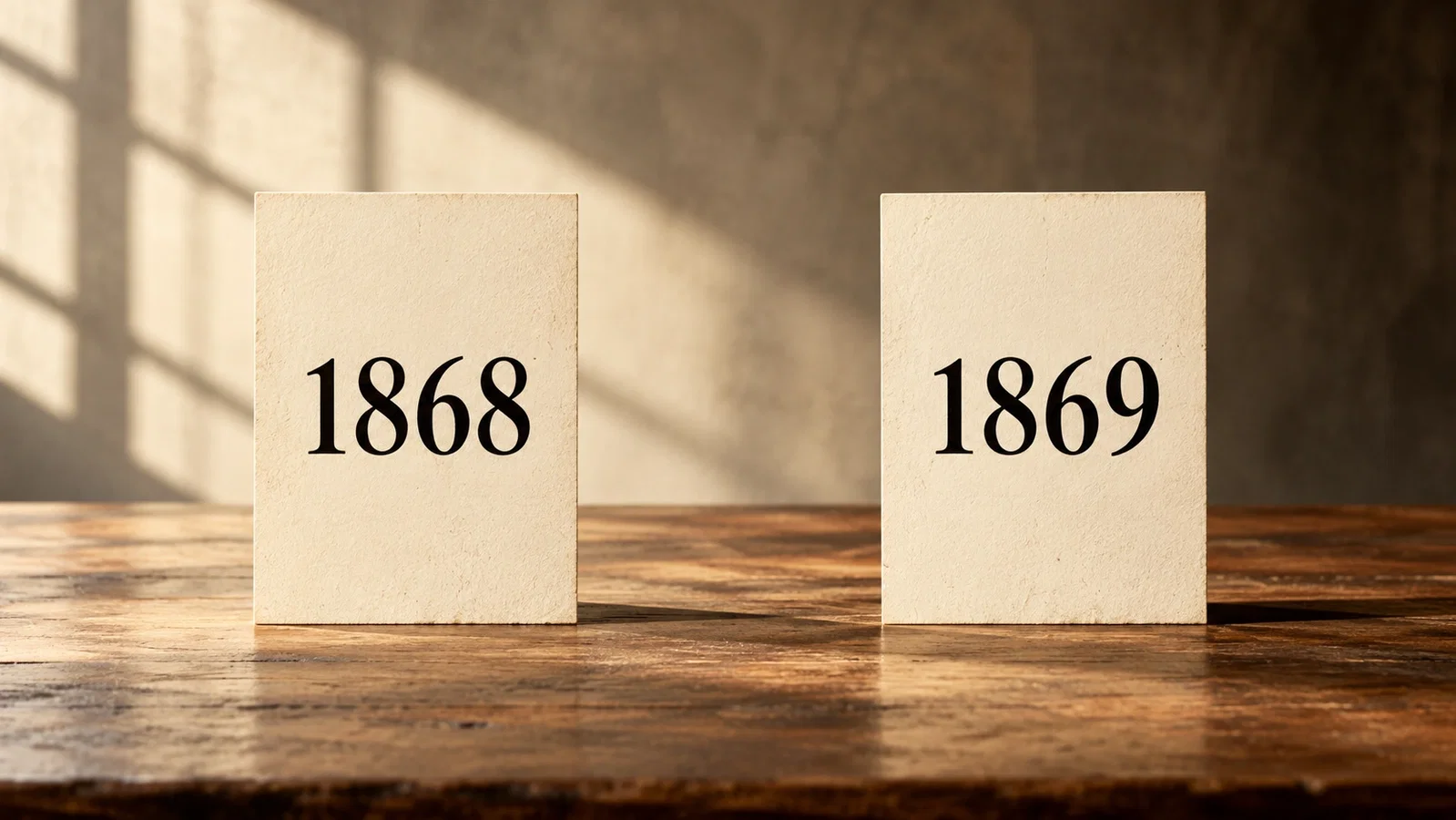
Modern editorial cards marked 1868 and 1869 distinguish the earlier lecture and letter from the later printed volume. They do not reproduce its typography or establish an exact market introduction date.
The letter still looked ahead
Near the end of the book is a letter to the editor of The Lancet, dated 28 December 1868. Discussing the prospects of nitrous oxide in longer operations, Fox identified lack of portability as an obstacle to wider use. With Coxeter’s assistance, Fox hoped to offer a more convenient form within a week or two. [1, pp. 29–30]
That was a forecast. It did not specify the first subsequent delivery, and the interval cannot be turned into a calculated launch date.
A footnote on the same page spoke instead of an outcome. The efforts had led Coxeter & Co. to supply wrought-iron bottles holding respectively 36 and 90 gallons of compressed gas, arranged in wood or leather cases. [1, p. 30, footnote]
Another footnote on page 7 reported that Coxeter and Sons had substantially carried out the earlier suggestion by supplying iron bottles containing between 36 and 90 gallons. The two notes reinforce the supply account without giving an exact completion date. [1, p. 7, footnote]
The date range used here therefore joins the expectations of 1868 to the outcome recorded in the 1869 volume. It preserves progress without inventing precision.
What the numbers describe
The figures of 36 and 90 gallons describe the quantity of gas said to be held. They are not the bottles’ internal water capacity. These pages do not provide the complete pressure, temperature and release conditions needed to reconstruct a modern cylinder specification; no conversion into liters is attempted here. [1, p. 30]
The wording matters too. Fox explicitly called the contents “compressed gas.” Fox’s earlier discussion of possible liquefaction does not turn that supply notice into verified evidence of a liquid product.
A conceptual still life of a closed dark metal bottle. Its form, dimensions, closure and contents are not verified Coxeter specifications. No delivery circuit or operating method is shown.
Those distinctions leave a substantial practical change in view. Fox was considering a step from making and storing gas oneself toward obtaining it from a supplier and carrying it to where it was needed. Packaging and provision had become problems alongside administration.
The limits of a supply story
Supply through chemists was clearly envisaged by both Fox and Orphoot. But these pages are neither order books nor sales statistics. They do not show how widely British dentists adopted bottled gas or establish who first accomplished the transition worldwide.
An imagined nineteenth-century chemist’s counter with a plain closed carrying case. This is not a documented shop or evidence that bottled gas was already commonly sold.
The book preserves a modest but tangible change: someone in the meeting was still waiting, someone in a letter was still looking ahead, and a footnote already described bottles that could be packed for carrying. A historical timeline sometimes has to accommodate both a main text and a later annotation.
Sources and reading limits
Read: in Fox’s On Nitrous Oxide (1869), the title page, preface and pages 3, 7, 21–22 and 29–30, including Orphoot’s remarks, the letter to The Lancet dated 28 December 1868, and the footnotes on pages 7 and 30.
Not covered: the rest of the book; the 1868 journal version of the paper; a separate 1869 apparatus report; the 1870 article on liquid gas; Coxeter’s factory records. Exact delivery dates, bottle weights and who first liquefied the gas are not settled here. Clinical safety claims in the preface and letter are reported, not adopted. The four illustrations are AI-made interpretive images, not historical evidence.
- Fox CJ. On nitrous oxide. London: J. E. Adlard; 1869. Wood Library-Museum
Continue exploring
Related reading connects shared questions and contexts; it does not by itself establish historical influence.
- 1868: Coleman Cleans Exhaled Nitrous Oxide over Lime to Rebreathe It
- 1868: Clover Gives Nitrous Oxide Through a Sheet-Lead Face-Piece
- 1868: London's Nitrous Oxide Inquiry Keeps the Case Counts Apart
Anesthesia Epochs · The Source Room · About & Editorial Method
Updated October 30, 2026. Sources and reading limits are stated above. Illustrations are labelled as original source images or AI-made. Historical accounts are educational; they are not current treatment instructions.