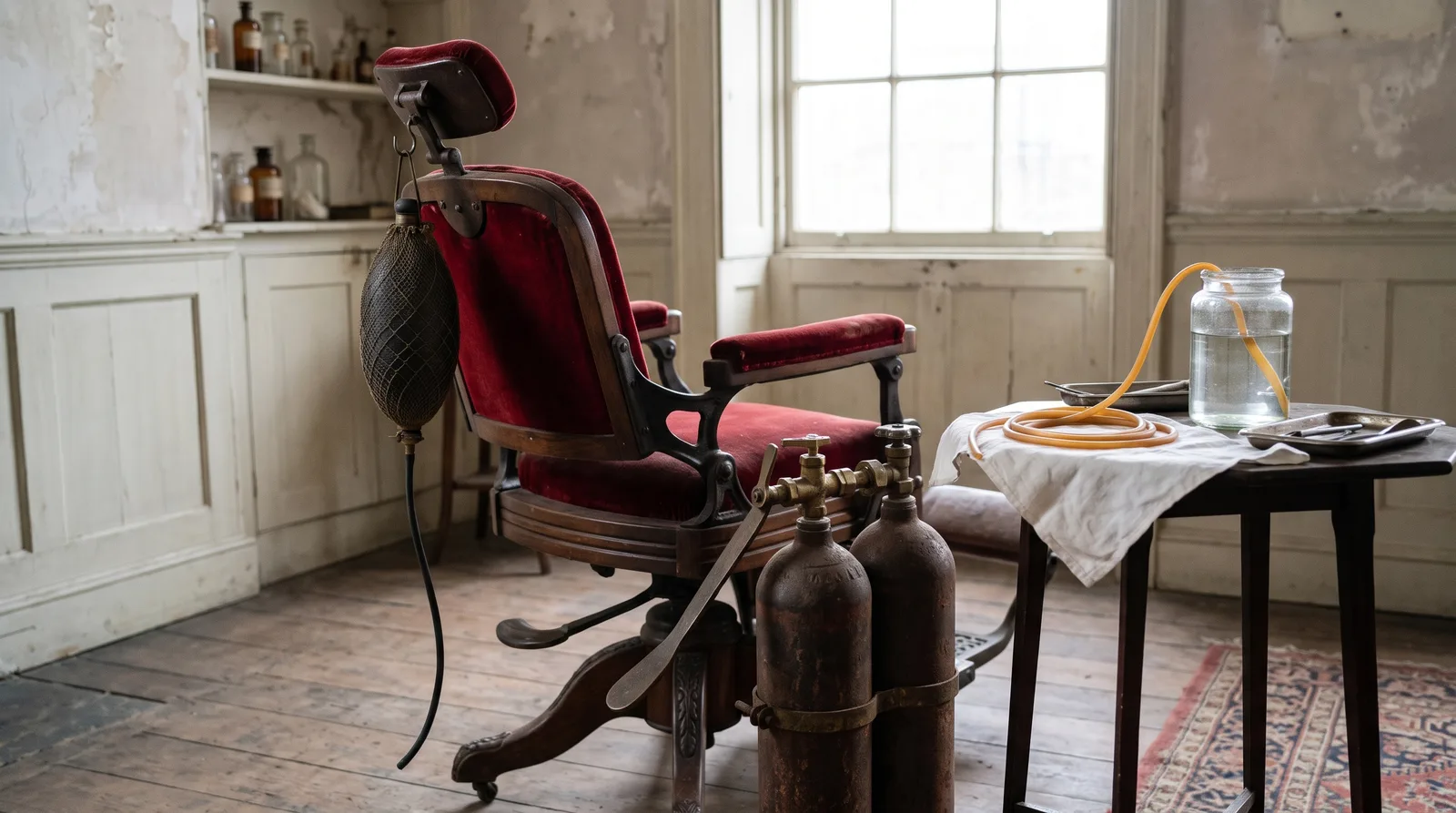
In a paper read to the Society of Anaesthetists on 17 March 1898 and printed in the Lancet on 7 May, Harvey Hilliard described passing a soft tube through the nose to keep nitrous oxide flowing after the face-piece came off, controlled by a foot-turned stopcock and a netted bag, and claimed it would make ether unnecessary in dental surgery.
Reading Library · Anesthesia Epochs · 中文版
Watch the education video (for clinicians)
1898: Hilliard's Nasal Tube — Nitrous Oxide After the Face-Piece · Anesthesia Epochs Education Series
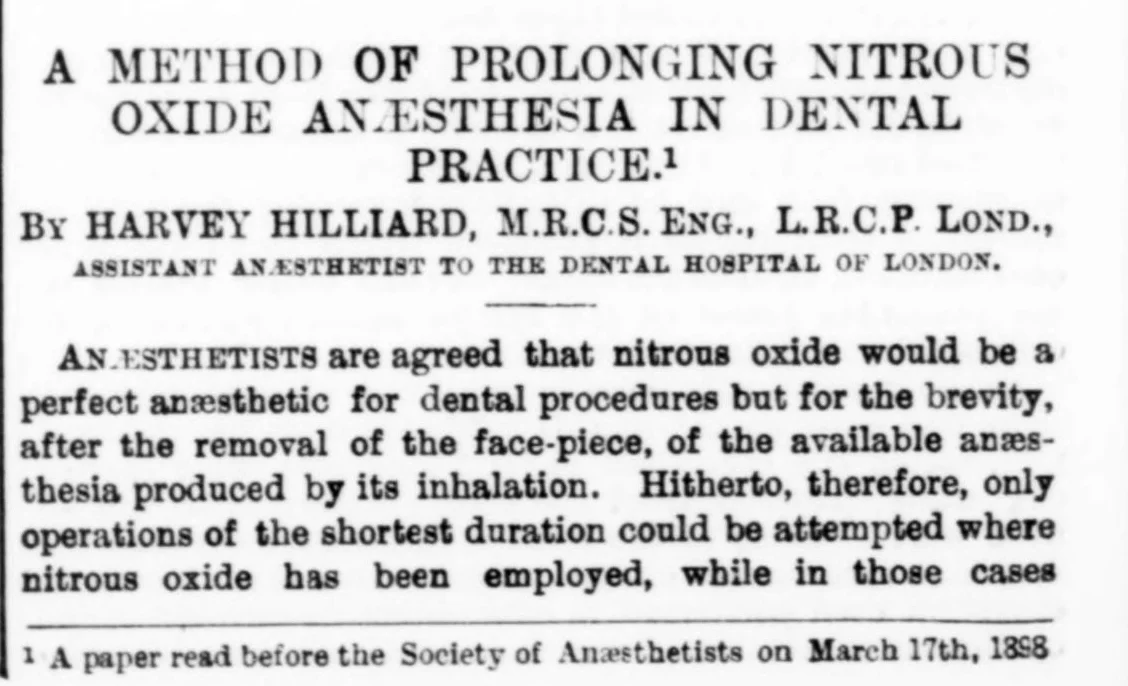
"Anaesthetists are agreed that nitrous oxide would be a perfect anaesthetic for dental procedures but for the brevity, after the removal of the face-piece, of the available anaesthesia." With that judgement Harvey Hilliard, Assistant Anaesthetist to the Dental Hospital of London, opened a paper in the Lancet of 7 May 1898. [1, p. 1244] A footnote says it had been read before the Society of Anaesthetists on 17 March 1898. [1, p. 1244] Coleman and Coxon presented their own methods the same evening.
Where the problem lay
Hilliard begins with clinical reality. Operations needing two to three minutes had in the vast majority of cases to be supplemented with ether after the nitrous oxide. [1, p. 1245] Ether brought unpleasant after-effects, a pungent smell that clung to the room all day, and preparation of the patient, so the operation was often done at the patient's house. [1, p. 1245] Nitrous oxide had none of these drawbacks, and the patient could walk home within minutes. [1, p. 1245] If gas anaesthesia could be kept up for several minutes after the face-piece came off, it would be used far more.
Hilliard then criticises the usual ways of "prolonging" it, which mostly worked by preventing elimination of the gas — pushing the lower jaw and tongue back to close the larynx, or passing a sponge into the pharynx. [1, p. 1245] These produced marked congestion, cyanosis and jactitation, the signs of impending asphyxia; in almost every reported death under nitrous oxide, Hilliard writes, the cause was obstructed respiration and asphyxia. [1, p. 1245] Congestion also increased bleeding from the gums and sockets, and blood could be drawn into the air passages. [1, p. 1245]
Hilliard recalls that the late Mr Clover had fitted a small accessory inhaler over the nose after removing the face-piece, fed from a gasometer, but the results were unsatisfactory and Clover abandoned the idea. [1, p. 1245]
From a rigid catheter to a soft tube
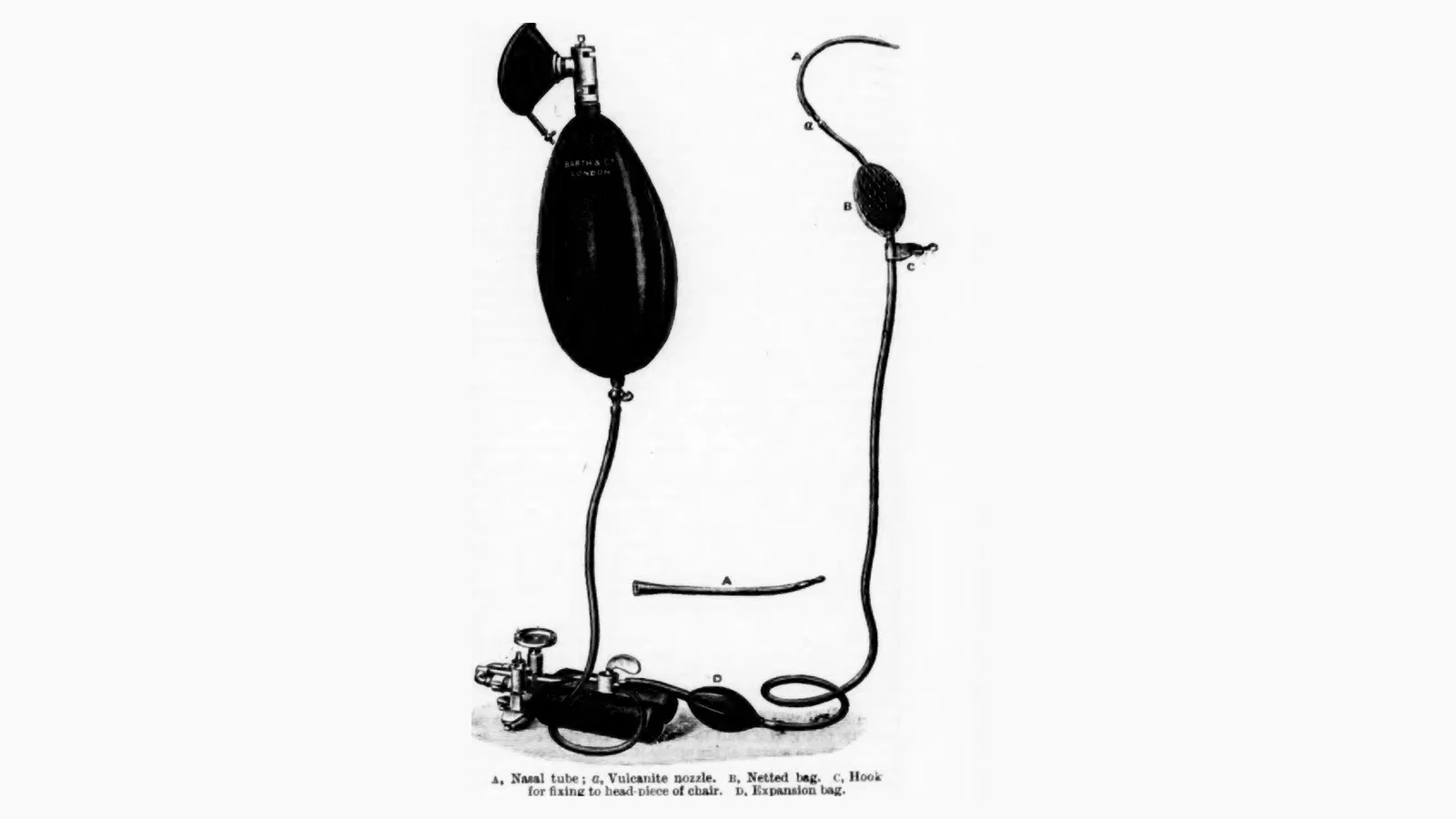
Hilliard concluded that the only convenient channel for gas after the face-piece was removed was a tube passed along the inferior meatus of the nose. [1, p. 1245] Hilliard first tried a small celluloid female catheter but discarded it as too rigid, since many patients have a deviated septum, a high-arched palate or enlarged inferior turbinates that a rigid instrument would damage; then a No. 7 (English) soft rubber male catheter, which worked well but was slower to pass, could be blown out by gas pressure and expiration, and kinked easily; and finally a soft gum-elastic silk tube. [1, p. 1245]
The tube was the diameter of a No. 7 catheter and six inches long, its distal end shaped like an à boule male catheter and solid up to an orifice half an inch from the point; the proximal end widened to take the conical fitting of tubing from the gas cylinders. [1, pp. 1245–1246]
A system controlled by the foot
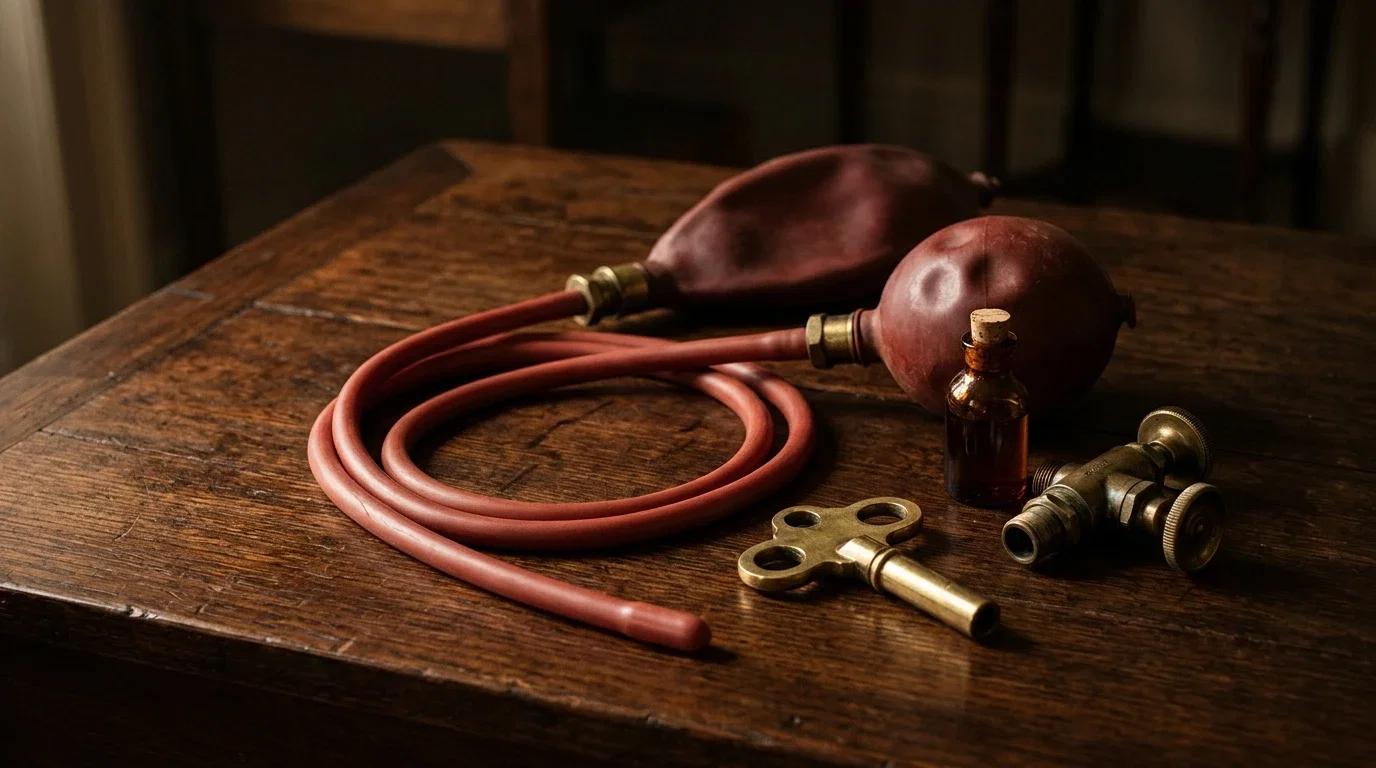
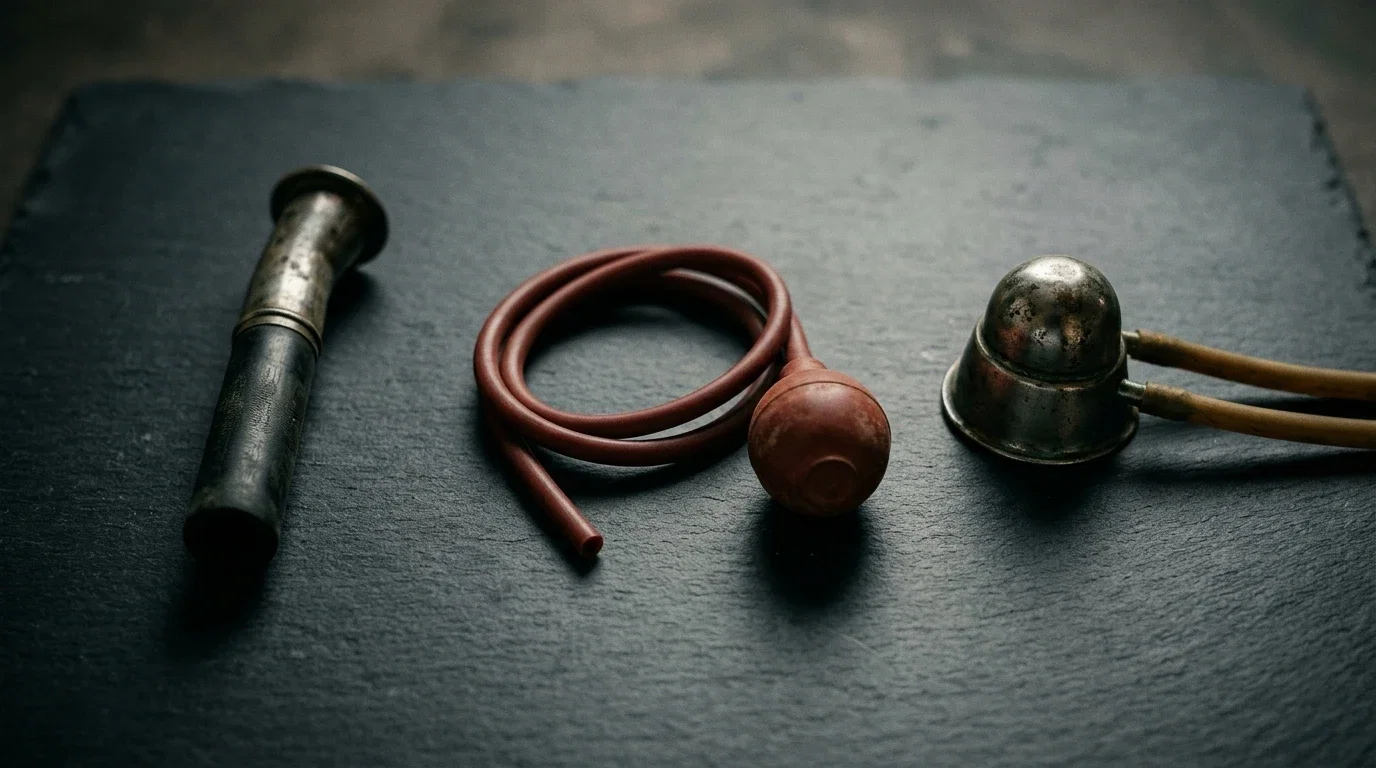
Two cylinders were coupled in the usual way and fitted with a stopcock made to Hilliard's design by Messrs Barth and Co.: a two-way stopcock whose tap was a long broad arm that could be turned by the foot, so that the whole gas supply was under the administrator's foot. [1, p. 1246] One outlet went to Hewitt's gas-inhaling apparatus, the other to the nasal-tube system: first a small stout "expansion" bag to smooth the irregular flow from the cylinders, then a thinner rubber bag covered with netting, hooked to the head-piece of the dental chair, whose degree of expansion told the anaesthetist whether the patient was receiving enough gas. [1, p. 1246]
The sequence: induce in the usual way until consciousness is lost; at the end of an inspiration remove the face-piece and pass the nasal tube quickly — it can be done during a single expiration; reapply the face-piece and turn the stopcock so gas flows only through the nasal tube; continue with tube and face-piece together to full anaesthesia; then remove the face-piece for good, begin the operation, and maintain narcosis through the nasal tube alone. [1, p. 1246] To prevent consciousness returning, the netted bag had to be kept fully distended. [1, p. 1246]
Results and risks as Hilliard reported them
Hilliard reports keeping patients fully anaesthetised for operations lasting over four minutes, stopping only because the operation was finished. [1, p. 1246] The tube had been used in over 100 cases, including 2 in which the antrum of Highmore was tapped and drained and 1 immediate torsion of a lateral incisor. [1, p. 1246] In a series of 30 consecutive extraction cases of which Hilliard kept notes, the average period of anaesthesia was roughly 1 minute 50 seconds; the cases were chosen because the extractions were numerous or difficult, and only one had to be curtailed, after 12 extractions, because bleeding from the gums was profuse and no sponges were at hand. [1, p. 1246]
The paper also set out the limits. In a typical case the patient was only slightly cyanosed, but if the mouth was obstructed by sponges or the operator's hand and the septum deviated toward the free nostril, the air intake fell and deep cyanosis, jactitation and even opisthotonos followed. [1, p. 1246] A tube passed too far could inflate the oesophagus and cause swallowing and vomiting; even with care, vomiting seemed less uncommon than under ordinary gas, so patients should fast for two or three hours beforehand. [1, p. 1246] The only absolute contraindications were marked hypertrophy of the nasal mucosa or adenoids. [1, p. 1246] For cleanliness, in hospital Hilliard used two tubes alternately, one soaking in antiseptic while the other was in use. [1, p. 1246]
In conclusion Hilliard claimed that the apparatus would render ether unnecessary in dental surgery, that it was small, portable and economical of gas, and that in skilled hands it carried no risk to the nose, naso-pharynx or mouth. [1, p. 1246]
Dissent at the meeting
At the March meeting these claims were not accepted wholesale. The President, Dudley Buxton, said that experience of nasal catheters had been poor: many nostrils were narrowed or blocked, the catheter was hard to pass, and bleeding was hard to avoid. [2, p. 855] Paterson argued that the catheter was difficult to introduce quickly and impossible to sterilise properly. [2, p. 855] Set against Hilliard's alternating tubes, the disagreement is clear. "Ether unnecessary" was the author's own claim, not a conclusion of the Society.
Sources and reading limits
Read: Hilliard’s paper in the Lancet of 7 May 1898, pp. 1244–1246, with its page images and figure; the Lancet report of 26 March 1898 on the discussion at the 17 March meeting, p. 855.
Not covered: the 1956 BMJ obituary of Hilliard and later timelines; the paper itself gives no demonstration at the Dental Hospital of London in April 1898.
- Hilliard H. A method of prolonging nitrous oxide anaesthesia in dental practice. Lancet. 1898 May 7;151(3897):1244–1246. Issue scan.
- Society of Anaesthetists [17 March 1898 meeting report]. Lancet. 1898 Mar 26;151(3891):854–855. Issue scan.
Continue exploring
Related reading connects shared questions and contexts; it does not by itself establish historical influence.
Anesthesia Epochs · The Source Room · About & Editorial Method
Published November 2, 2026. Sources and reading limits are stated above. Illustrations are labelled as original source images or AI-made. Historical accounts are educational; they are not current treatment instructions.