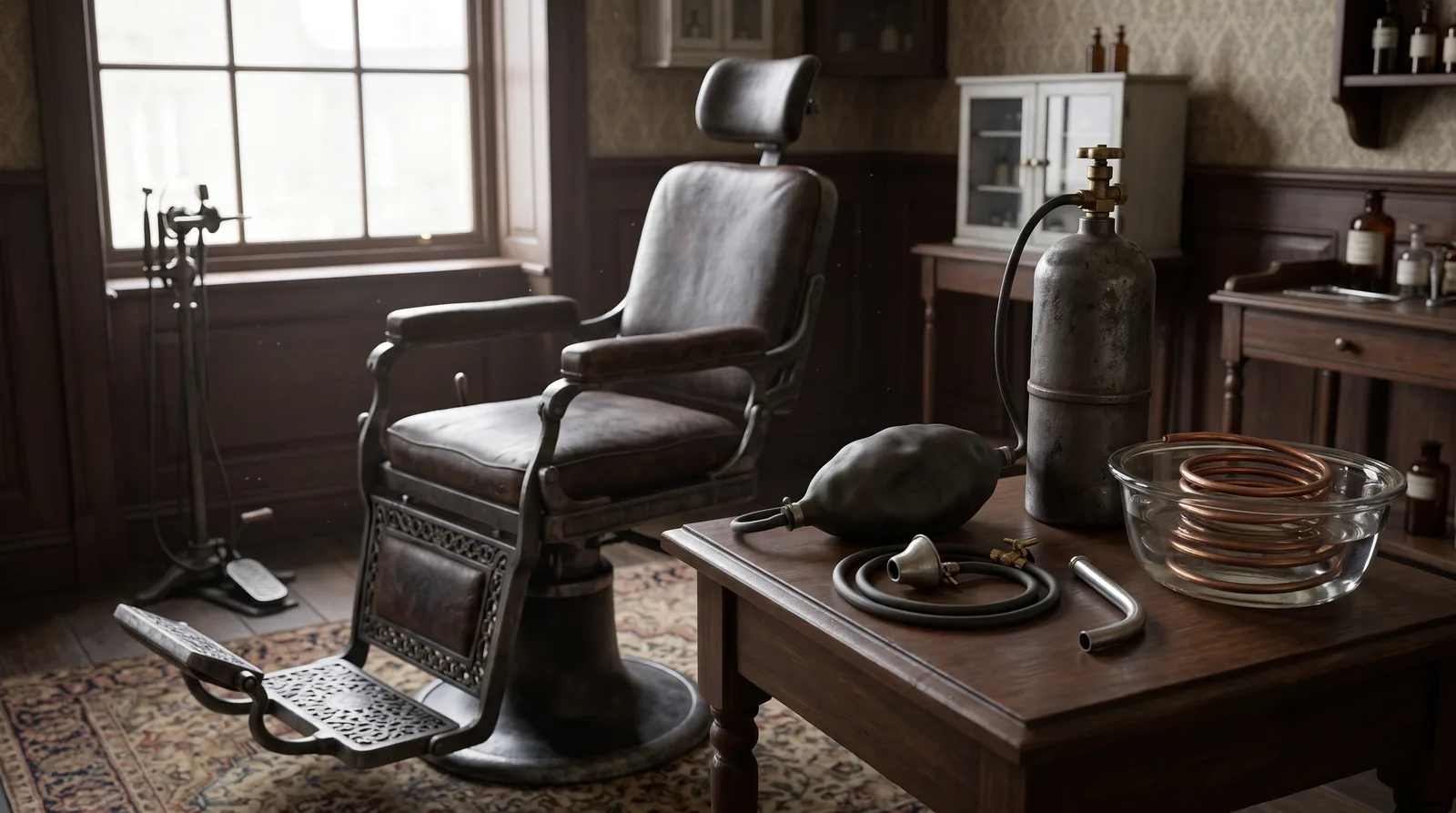
On 17 March 1898, at the Society of Anaesthetists in London, Alfred Coleman described a nasal cap and S. A. T. Coxon a warmed metal mouth tube for keeping nitrous oxide flowing after the face-piece came off, alongside Harvey Hilliard’s nasal catheter.
Reading Library · Anesthesia Epochs · 中文版
Watch the education video (for clinicians)
1898: Coleman and Coxon — Prolonging Nitrous Oxide in Dental Surgery · Anesthesia Epochs Education Series
The trouble with nitrous oxide for dental extraction was not putting patients to sleep but how quickly they woke. The dentist could start only once the face-piece came off, and once it came off the patient stopped breathing the gas, leaving very little time to work. On the evening of 17 March 1898, at an ordinary meeting of the Society of Anaesthetists in London, three members each brought a way of stretching that time. [1, p. 854]
The Lancet reported the meeting on 26 March, with the President, Dr Dudley Buxton, in the chair. [1, p. 854] The BMJ also reported the same discussion. [2] Two of the three were Alfred Coleman’s nasal cap and S. A. T. Coxon’s metal mouth tube; the third was Harvey Hilliard’s nasal catheter.
Coleman: keeping the gas flowing through the nose
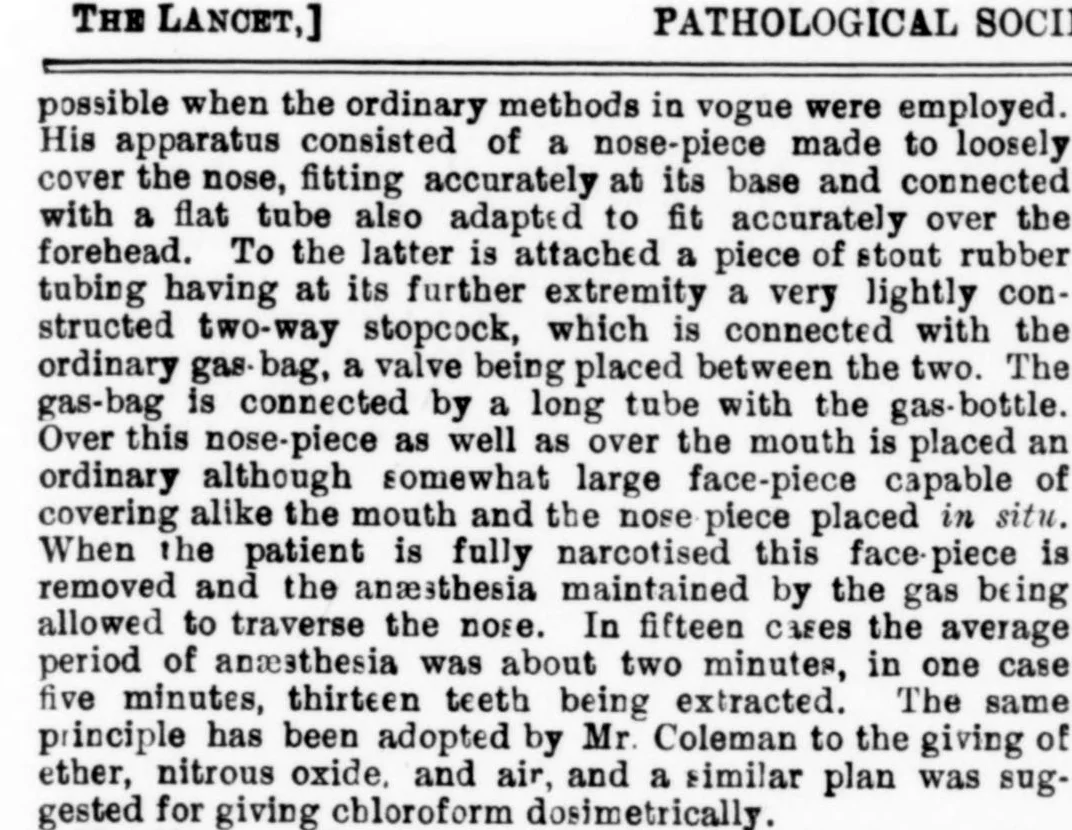
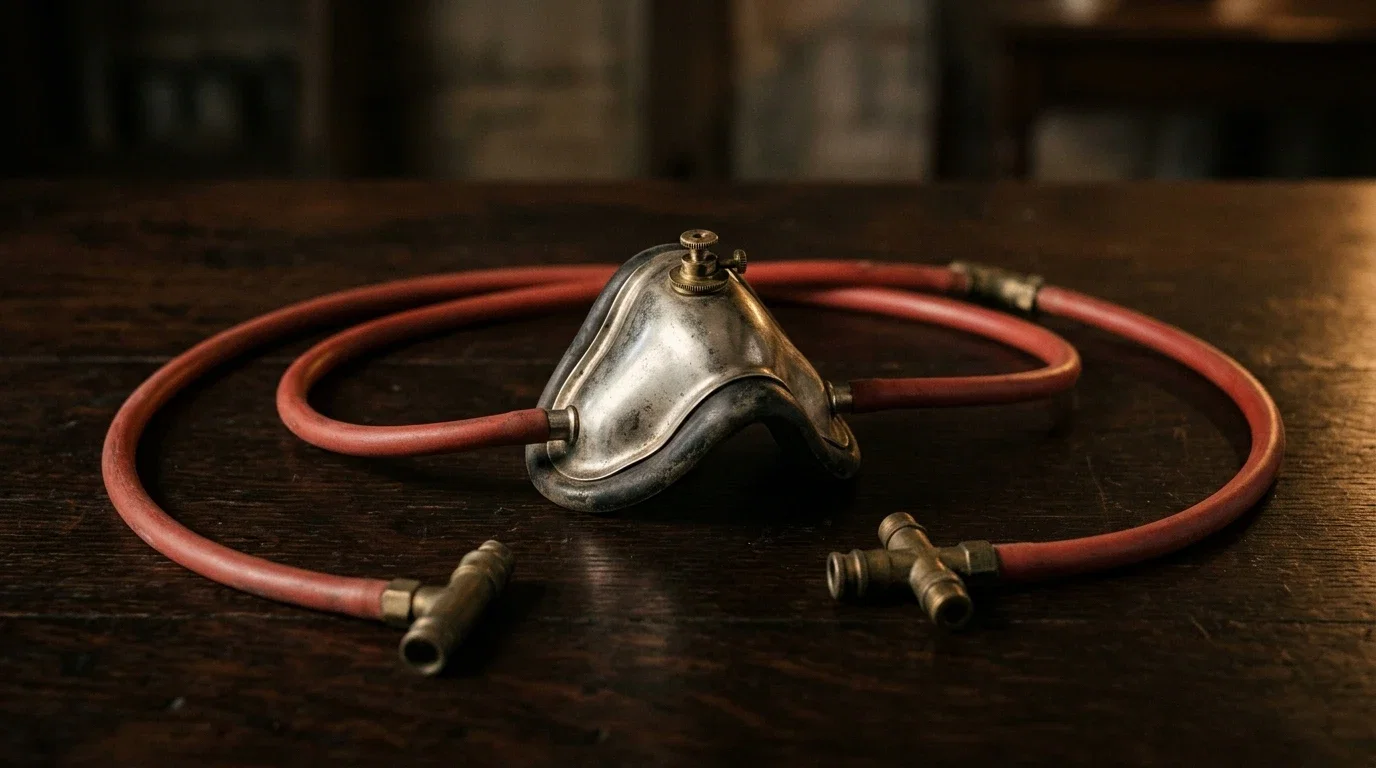
According to the Lancet, Coleman's aim was to allow longer operations on the teeth than the ordinary methods then in use permitted. [1, pp. 854–855] The apparatus was a nose-piece made to cover the nose loosely but fit accurately at its base, connected to a flat tube that lay against the forehead; this led to a length of stout rubber tubing ending in a very light two-way stopcock, joined to the ordinary gas-bag, which in turn was connected by a long tube to the gas bottle. [1, p. 855]
For induction, an ordinary but somewhat larger face-piece was placed over both the mouth and the nose-piece. [1, p. 855] Once the patient was fully under, the outer face-piece was removed and anaesthesia was maintained by gas continuing to flow through the nose-piece, leaving the mouth free. [1, p. 855]
The report gives Coleman's figures: in fifteen cases the average period of anaesthesia was about two minutes; in one case it reached five minutes, with thirteen teeth extracted. [1, p. 855] The BMJ version likewise says that an anaesthesia of five minutes had been maintained, and that longer could be obtained if necessary. [2] Coleman had also applied the same principle to giving ether, nitrous oxide and air, and suggested a similar plan for giving chloroform dosimetrically. [1, p. 855]
Coxon: a metal tube in the mouth, and a coil in warm water
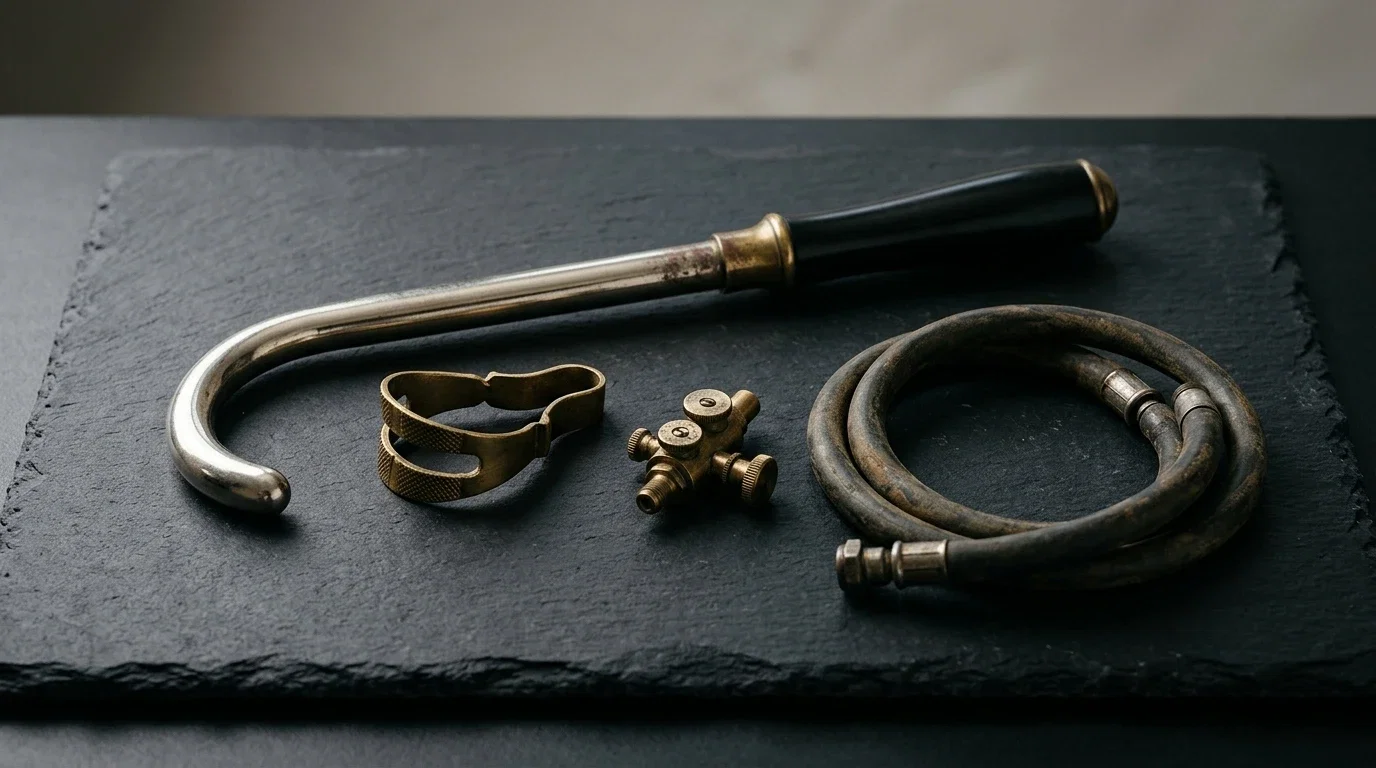
S. A. T. Coxon of Wisbech described "a further and different method" for operations on the mouth. [1, p. 855] Anaesthesia was first induced in the usual way; then a metal tube was held in the mouth to continue the gas. [1, p. 855]
Coxon had found a practical problem: gas pumped straight into the mouth cooled it. To prevent this Coxon passed the nitrous oxide through a metal coil placed in water of the required temperature before it reached the mouth. [1, p. 855] The BMJ's wording differs slightly but says the same: the gas traversed a metal coil placed in water of a requisite temperature to warm the anaesthetic. [2]
Neither report gives Coxon’s number of cases or how long anaesthesia was maintained.
Opinions in the room
The President congratulated all three authors and then gave a personal view. The President's experience of nasal catheters for prolonging anaesthesia in mouth operations was unfavourable: in very many patients one or both nostrils were narrowed or completely blocked, and it was often hard to pass the catheter at all or to avoid haemorrhage. [1, p. 855] By contrast, the President had used Coleman's method "with conspicuous success", easily obtaining four and a half minutes of anaesthesia during which fourteen teeth were removed. [1, p. 855] The BMJ report has the President using both Coleman's and Coxon's methods, with marked success in the former. [2]
The President also entered a caution: prolonged anaesthesia should not be used as a means of introducing multiple extractions, since experience had shown such operations to be open to grave objections. [1, p. 855] The technique of prolonging anaesthesia was welcomed; using it to enlarge the scope of a single sitting was not.
Another member, Paterson, had tried Coleman's apparatus and approved the principle, though Paterson thought the apparatus itself could be improved. Paterson raised two objections to the catheter: the difficulty of introducing it quickly, and the impossibility of sterilising it properly during or after use. [1, p. 855]
What the evening shows
Taken together, the three methods addressed one problem: the induction face-piece covers the mouth, so another route was needed to keep giving gas during the operation. Coleman chose an external nasal cap, Hilliard a catheter inside the nose, and Coxon a metal tube in the mouth. Each route had a cost — the nasal cap had to work with a face-piece, the catheter had to pass a nose that might be narrowed, and the mouth tube chilled the mouth — and the discussion turned on exactly these practical costs.
The meeting was not the "invention day" of any one method but a public comparison. Coleman and Coxon were not forerunners of a later Hilliard catheter: both reports show that Hilliard's paper was read the same evening, and the BMJ records that all three replied to the discussion. [1, p. 855; 2]
Sources and reading limits
Read: the Lancet’s report of 26 March 1898 on the Society of Anaesthetists meeting of 17 March, pp. 854–855, with its page images; the BMJ’s report of the same meeting, 2 April 1898, p. 889.
Not covered: the Society’s Transactions for 1898, the authors’ full papers and any drawings of the apparatus, so dimensions, materials and further case figures are not given here. Both reports print Coxon’s name only as S. A. T. Coxon.
- Society of Anaesthetists [17 March 1898 meeting report]. Lancet. 1898 Mar 26;151(3891):854–855. Issue scan.
- Reports of Societies: Society of Anaesthetists. BMJ. 1898 Apr 2;1(1944):889. DOI 10.1136/bmj.1.1944.883-a. Internet Archive volume.
Continue exploring
Related reading connects shared questions and contexts; it does not by itself establish historical influence.
- 1898: Hilliard's Nasopharyngeal Insufflation of Nitrous Oxide
- 1893: London's Society of Anaesthetists Brings Experience Before Peers
Anesthesia Epochs · The Source Room · About & Editorial Method
Published November 2, 2026. Sources and reading limits are stated above. Illustrations are labelled as original source images or AI-made. Historical accounts are educational; they are not current treatment instructions.