In 1853 Gerhardt reported that sodium salicylate and acetyl chloride formed a mixture that hardened, then supported the reading by analysing a later product, not the hardened material itself.
Reading Library · Anesthesia Epochs · 中文版
Watch the education video (for clinicians)
1853: Gerhardt's Acetic Salicylate — Count the Steps · Anesthesia Epochs Education Series

An original historical imagining with nineteenth-century glassware and blank paper. It does not reconstruct Gerhardt’s laboratory, an original sample or a manuscript.
The mixture first became liquid. A little later, it hardened throughout.
Gerhardt described this change in a short passage within a much longer paper published in 1853. Its heading was “Salicylate acétique.” Here, sodium salicylate met the substance Gerhardt called “chlorure acétique,” and a visible reaction followed. Hardening, however, did not settle the central question: what had been obtained? [1, p. 326]
A later reader may arrive at this page with aspirin already in mind. The passage itself keeps us inside a chemical investigation: observe the change, expose the resulting material to further reactions, and examine what those reactions yield. The distinction between these stages determines what the reported numbers can tell us.
Two kinds of date
The volume’s title page gives 1853. A footer on page 289 specifies March 1853. The paper’s opening separately states that the research had been presented to the French Academy of Sciences on 17 May and 14 June 1852. [1, title page and pp. 285, 289]
This article therefore uses March 1853, the publication month, as its chronological entry point. The two submission dates refer to the research named in the heading; neither can automatically be assigned to the particular reaction on page 326. Using the publication month distinguishes publication from submission and from the date of an experiment.
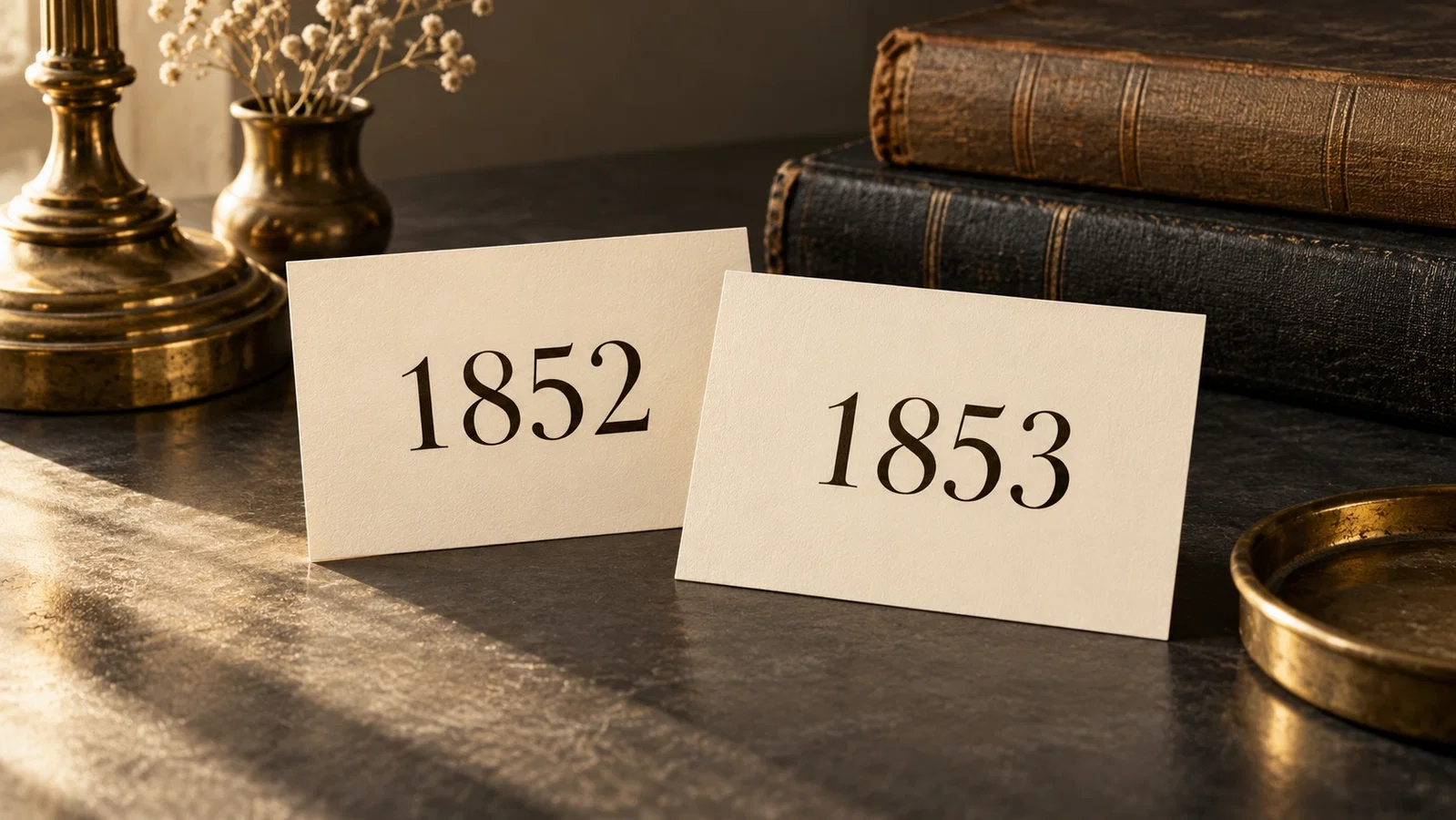
Modern editorial cards for 1852 and 1853: the submission year named at the head of the paper and the verified publication year. These are not archival documents.
A question about a class of reactions
Gerhardt opened with organic acids and their “anhydrous” forms. Why did different classes of acid behave differently under attempts at dehydration? Gerhardt placed the experiments within a discussion of chemical constitution and notation, comparing monobasic with dibasic acids and explaining how experimental results might support a general approach to preparation. [1, pp. 285–289]
By pages 322–326, salicylic materials formed one part of that larger investigation. The headings included “Acide salicylique anhydre,” “salicylide,” “Salicylate benzoïque” and “Salicylate acétique.” Each belonged to its own sequence of reactions, observations and analyses. [1, pp. 322–326]
Their proximity matters. A white powder, needle-shaped crystals or an analytical table described under one heading cannot simply be transferred to the material under the next. Even the formula and percentages at the top of page 326 continue the preceding section. The passage at issue here starts with the heading “Salicylate acétique.”
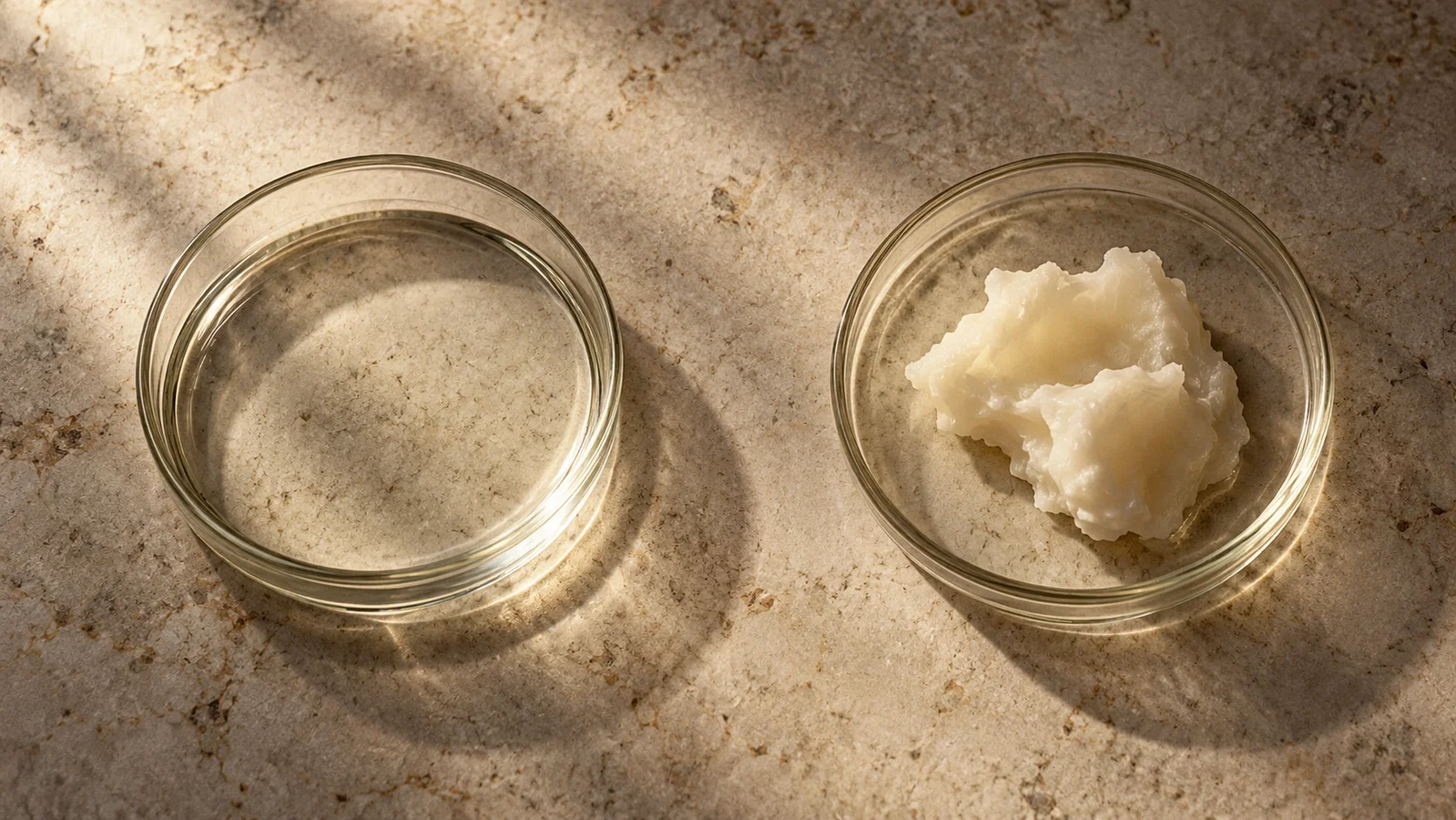
A modern conceptual comparison of two material states. It marks the distance between observing a change and establishing identity; it does not reproduce the original product’s colour, form or preparation.
What did 43.53% measure?
Gerhardt went on to describe the material changing in an alkaline liquid. Gerhardt interpreted this as decomposition into salicylic and acetic acids, then examined a salt obtained after further treatment and reported a silver content of 43.53%, comparing it with 44.1% for silver salicylate. [1, p. 326]
These percentages concern the salt obtained in the subsequent examination. They are not the purity of the initial hardened material, a synthetic yield or a measure of therapeutic success. Gerhardt used analysis of a later product to support the chemical interpretation. Reading the report requires following that path, including the change in what was being measured.
The passage does not give a separate, complete elemental analysis of the initial product or a modern structural determination. It establishes what the author reported and how the investigation proceeded; by itself, it cannot supply a modern certificate of identity and purity for that original material. [1, p. 326]

An original historical imagining of a balance with empty pans, recalling the need to identify what was measured. It is neither a reconstruction of Gerhardt’s instrument nor a representation of a real balance reading.
Reading it alongside 1838
In an 1838 paper, Piria had already given salicylic acid a separate section, describing its preparation, white crystals and properties. Piria treated the acid separately from the previously discussed “hydrure de salicyle.” [2, pp. 298–299]
Read together, the papers locate two different questions: describing and distinguishing an acid, then investigating further reactions and examining their products. That is a specific comparison the pages support. Chronological order alone does not establish a direct chain of influence between the two accounts.
The 1853 passage reports no administration to patients or pain outcomes. It preserves a chemical investigation that readers can examine. Clinical use, pharmaceutical standards and commercial manufacture each require their own later evidence; they cannot be folded into the moment when a mixture hardened.
Sources and reading limits
Read: Gerhardt's paper, title page and pp. 285–289, 322–326 and 342 (p. 289 gives the publication month; p. 285 the 1852 submission dates); Piria's 1838 paper, pp. 298–299, for the comparison.
Not covered: the rest of Gerhardt's 58-page paper; global priority, modern structure or the purity of the original sample; claims about a gastric-irritation motive, a patent or clinical efficacy.
Historical names are retained. All four illustrations are AI-made interpretive images, not historical evidence.
[1] Charles Gerhardt. Recherches sur les acides organiques anhydres. Annales de chimie et de physique. 1853;3rd series, 37:285–342. Internet Archive
[2] R. Piria. Recherches sur la Salicine et les Produits qui en dérivent. Annales de chimie et de physique. 1838;69:281–325. Internet Archive
Continue exploring
Related reading connects shared questions and contexts; it does not by itself establish historical influence.
Anesthesia Epochs · The Source Room · About & Editorial Method
Updated October 30, 2026. Sources and reading limits are stated above. Illustrations are labelled as original source images or AI-made. Historical accounts are educational; they are not current treatment instructions.